

A baby boy has been born after an egg was fertilised by a machine. The needle was used without an embryologist. The AI IVF procedure took place at a workstation in Guadalajara, Mexico, while operators watched via a monitor in New York, about 2,300 miles away. The birth made him the first ever recorded AI IVF baby.
This article describes what AI-controlled robotic IVF actually is, how the world's first case worked step by step, what the timings and fertilisation numbers really showed, and what artificial intelligence in IVF does and does not change for people in treatment right now. One detail that practically no headline carried. The first embryo generated by this method was transplanted with no pregnancy.
What Is AI IVF and How Is It Different From Traditional IVF?
AI IVF is three things: software that recommends medication protocols, artificial intelligence IVF grading embryos on time-lapse video and robots doing lab steps. This is the birth of the third, the hardest. The laboratory side of IVF is automated; only the clinical side remains human. Knowing which half makes all the headlines easier to read.
What Is AI-Controlled Robotic IVF?
The treatment is ICSI, a single sperm injected straight into a mature egg. It’s standard since the 1990s and used mostly for male-factor infertility, where sperm can’t get to the egg alone.
So why did robotic IVF begin here? Since ICSI is the most hand-dependent procedure in the lab, two expert embryologists do things a bit differently, and this difference has been measured.
That seems dramatic, but the system is not. No humanoid robot. A workstation made out of off-the-shelf parts: an inverted microscope, heated stage, non-contact laser, piezo actuator, motorised stage, micro-injectors and cameras, run from a computer screen. That gives a working definition of AI-assisted ICSI: the AI chooses, the machine moves, a human approves each move.
Manual ICSI vs AI-Controlled Robotic ICSI
| Aspect | Manual ICSI | AI-Controlled Robotic ICSI |
|---|---|---|
| Who selects the sperm | Embryologist, by eye | AI algorithm, by shape and movement |
| Sperm immobilisation | Mechanical, by hand | Non-contact laser at the midpiece |
| Injection movement | Hand-controlled micromanipulator | Motorised, single controlled movement |
| Operator location | At the microscope | At a computer interface, on site or remote |
| Main source of variation | Individual technique and fatigue | Software version and calibration |
| Steps involved | 23 | The same 23, digitally executed |
This is a real milestone, because it was tested on one patient, in one cycle, with a manual control group sitting right next to it. Definitions are good only to a point.
The World's First AI IVF Baby: How the Robotic IVF Birth Happened
The patient was 40, with one failed IVF cycle behind her. She was directed to Hope IVF Mexico for donor egg treatment. There were eight eggs. Five were carried out using the automated system. Three were fertilised by hand as controls in the same cycle.
The headline is less important than the side-by-side design, which shows the machine was compared with human work on the same day, from the same batch.
The lab was in Guadalajara. The operators were in New York, 3,700 km distant. Four of the five automated eggs were fertilised as normal. All three manual controls were fertilised. Of the automated embryos, one matured into a good-quality blastocyst. That’s what most of the coverage missed.
One good-quality blastocyst from this group was transplanted fresh with no pregnancy. A frozen blastocyst, reheated to re-expansion and transplanted after assisted hatching, did implant, and the baby was delivered at 38 weeks. The case was published in Reproductive BioMedicine Online in April 2025.
Who Built the AI-Controlled IVF System?
The technology was from Conceivable Life Sciences, a fertility biotech with offices in New York and Guadalajara. The team consisted of embryologist Dr Jacques Cohen and Dr Alejandro Chavez-Badiola, and Professor Gerardo Mendizabal-Ruiz led the engineering side.
Their declared goal was simple and practical: normalise ICSI, so the outcome depends less on which embryologist happens to be on shift that morning. The experiment was performed at Hope IVF Mexico under ethics committee supervision. That detail is worth retaining. It is the border between a controlled study and a public relations exercise.
How Does AI IVF Work? Inside the 23-Step AI-Assisted ICSI Procedure
ICSI is not one thing. It's a series of 23 tiny stages that used to be entirely in an embryologist's hands. Now the math, because it is misreported.
Five eggs times 23 steps = 115 steps in total, for the whole group, not for each egg. Of those, 49.6 per cent ran on the system itself. The others were activated by a person hitting a button while watching it on a screen.
So around half of this automated IVF still required a human to say OK. That's supervised autonomy, not a vacant lab. The three phases are these.
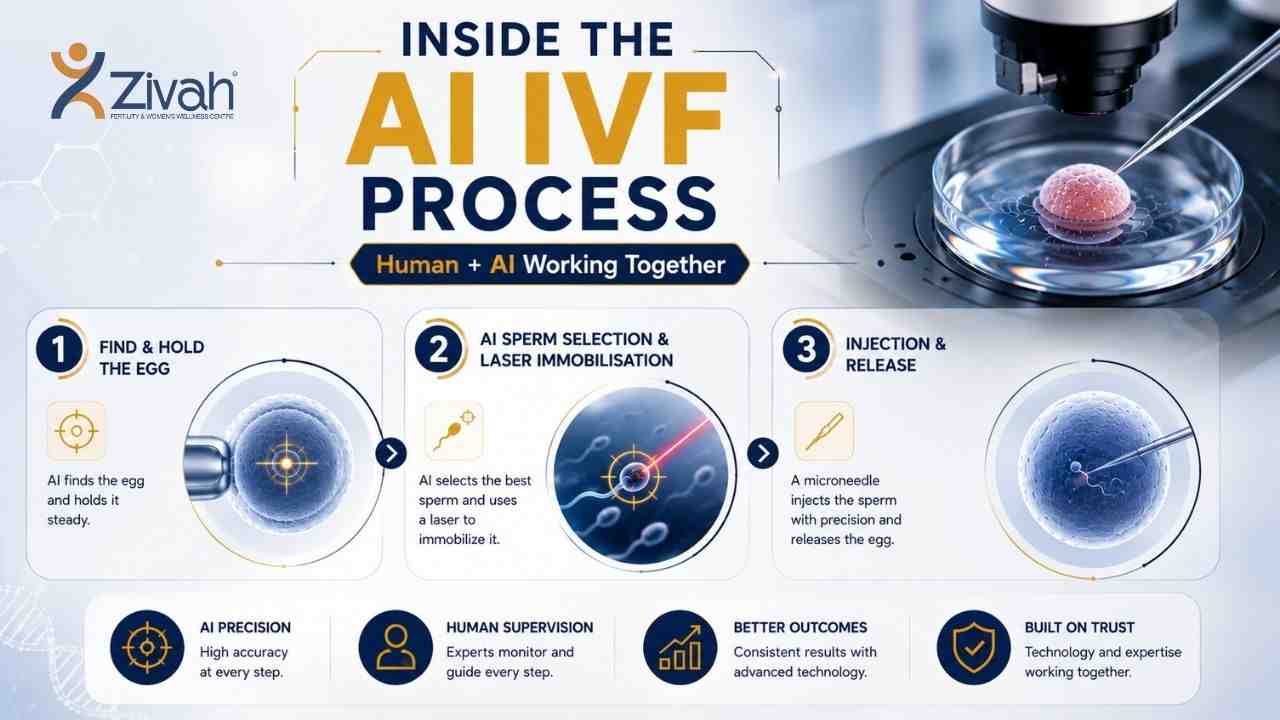
Step One: Finding and Holding the Egg
A second in-house AI, also in-house, sees the egg and figures out where the holding pipette needs to sit to keep it steady. Average: 1 minute 39 seconds Alignment is no little matter. Once you get an egg at the improper angle, then every step after that is more dangerous.
Step Two: AI Sperm Selection and Laser Immobilisation
The AI sperm selection algorithm, SiD, tracks each sperm's movement and shape, ranks them, and locks onto the best one. Then a laser fixes its tail at the centre, the same operation an embryologist does by hand, hitting it the same way each time.
Step Three: Injection and Release
A bevelled microneedle, driven by a piezo actuator, breaks the egg membrane in a single, controlled movement. Why does it even matter? Too much strain might prevent fertilisation or even damage the egg. Precision is one claim. Speed is another, and here the first case was a lot less amazing than the headlines promised.
How Long Did the AI IVF Procedure Take Compared to Manual ICSI?
This is where the numbers stop flattering the machine. The AI IVF procedure took an average of 9 minutes and 56 seconds per egg. The same work done by a human embryologist took an average of 1 minute 22 seconds. By hand, it was about seven times faster. Where did the time go? The table below reveals.
Read it, and one thing is clear: the slowest part was not the injection itself but all the steps leading up to it, locating the egg, ranking the sperm, setting the instruments. Some background is only fair. Every step of this first-generation prototype was marked and checked as it ran in a study setting.
The person in charge of engineering thinks that later versions will be a lot faster. But be honest about scale. A busy IVF lab can process dozens of eggs in a day.
This system would not be able to cope at ten minutes apiece. But that gap is an engineering problem, not a biological one. Engineering problems tend to be closing.
Step-by-Stage Timing, Automated vs Manual ICSI
| Stage of the procedure | AI-controlled system (average) | Manual ICSI (average) |
|---|---|---|
| Identifying and stabilising the egg | 1 min 39 sec | Included in total below |
| Sperm selection, immobilisation, pick-up | 3 min 50 sec | About 40 sec |
| Injection and release of the egg | 4 min 38 sec | Included in total below |
| Total per egg | 9 min 56 sec | 1 min 22 sec |
| Eggs normally fertilised | 4 of 5 | 3 of 3 |
Injection is half only. The embryo still needs to be picked, and that’s where AI has been secretly operating inside IVF labs for years now.
What Role Does AI Play in Embryo Selection?
Injecting the sperm is only part of it. But someone has to determine which embryo goes first, and that choice has traditionally been made by eye. This is what AI embryo selection changes:
- The subjectivity problem: Two embryologists can look at the same embryos and rate them differently. Neither one is wrong. Same picture, different training.
- How the software learns: It's trained on huge numbers of embryo photos matched with what actually happened next, which ones implanted and which didn't. It then grades the likelihood of appearance and implantation against those patterns.
- Which it did in this case: While the injections were automated, a second algorithm analysed the embryos for viability.
- It is here already: Today, AI-assisted time-lapse grading takes place in labs, silently determining which embryo is first. This element of ‘AI IVF’ is not in the future.
The real worth of AI embryo grading? Not more embryos, but a better order, which can reduce the journey to the cycle that works. Stronger decisions in the lab only help if they translate into the aspects of treatment patients experience.
What Are the Benefits of AI and Robotics in IVF?
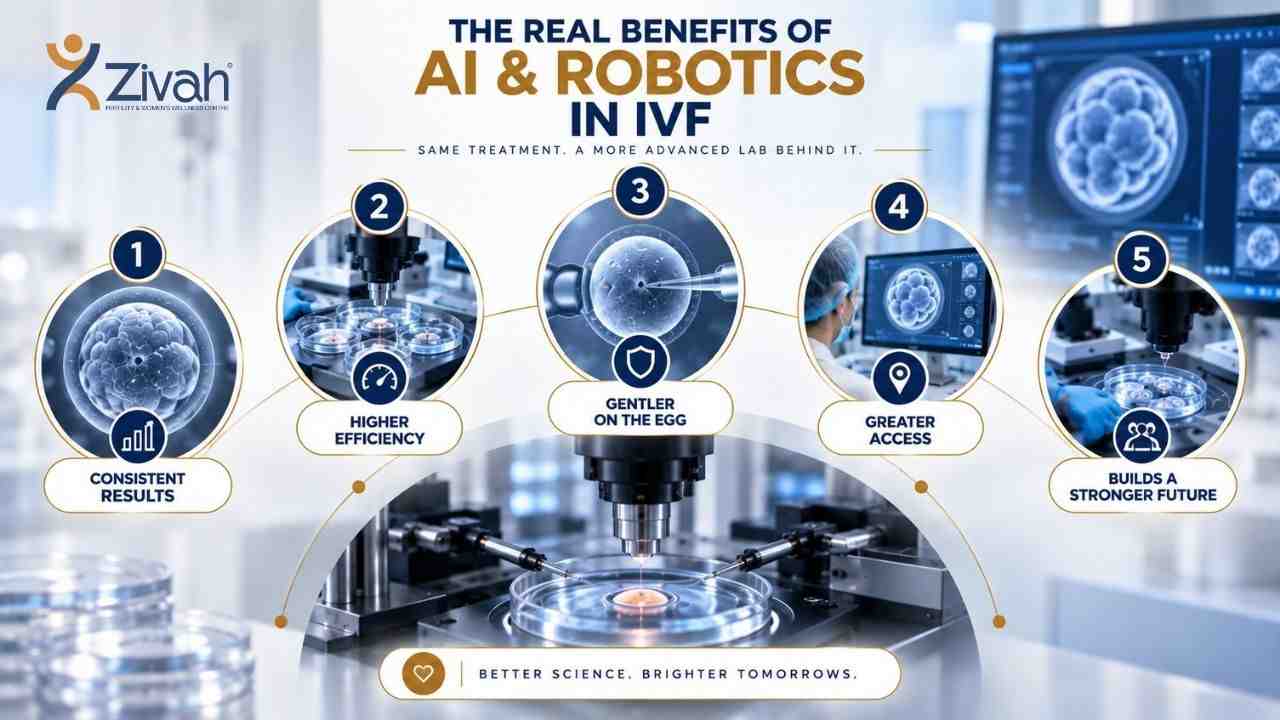
So what does this really mean for a patient? Not a different treatment: the injections, the scans, and the waiting are the same. What's changing is what happens behind the lab door. Five things:
- Continuity - Published data have demonstrated meaningful differences in ICSI performance between embryologists. Standardisation removes the "who was on shift" aspect.
- More energy - Running ICSI on hundreds of eggs a day is demanding work. This solves a serious bottleneck.
- More gentle on the egg - Better regulated membrane penetration might minimise deterioration at the injection site.
- Scale - Researchers characterise skilled manual lab work as rate-limiting in IVF throughput.
- Access - the major one. Remote operation allows an embryologist expert to assist a lab in an area that does not have an expert in residence. That's the most weight for patients living where good embryology just isn't available.
Can AI Replace Embryologists in IVF?
No. The developers mention this themselves, a human is always in the loop. What changes is the shape the job takes. Instead of doing every micro-step by hand, the embryologist supervises, troubleshoots, and makes the judgment calls.
And fertility care has a side no algorithm can touch. Consent talks. Counselling following a failed cycle. Helping someone determine when to give up. The machine can handle the injection. It can't stand the appointment when the result is explained.
Is AI IVF Safe? What One Case Does and Does Not Prove
Let's start with the scale of it: one pregnancy, one birth, eight eggs. That makes this a case report, not a trial. This case shows the workflow runs end to end and generates a healthy baby. That is the hardest first step any new technology needs to clear.
What it does not establish is what a clinic would need to offer: comparable fertilisation rates, blastocyst rates, live birth rates, or long-term outcome data for children born this way.
Two numbers deserve a second glance. Four out of five automated eggs were fertilised compared with three out of three manual, far too tiny a sample size to say anything about success rates and higher embryo ranking can't increase egg quality or counteract age-related decline because it just sorts what you already have.
There is the regulatory reality as well: this is not a routinely approved treatment anywhere, and Indian clinics operating under the ART Act 2021 would need a clear path before they could offer anything similar. Zivah believes that lab technology should be used only when it has been shown to work, not when it's marketed.
What to Ask a Clinic That Advertises "AI IVF"
| Ask this | Why it matters | A weak answer sounds like |
|---|---|---|
| Which specific step is AI-assisted? | "AI IVF" covers protocols, grading and robotics, three different things | "Our whole process is AI-powered" |
| Is the AI deciding or ranking? | Ranking supports the embryologist; deciding replaces them | "The system handles it" |
| Who reviews the AI's output? | A named embryologist should sign off | No named person |
| What evidence supports it here? | Ask for outcome data, not brochures | "It's the latest technology" |
| Does it change my cost, and why? | New equipment can appear as an unexplained add-on | A fee with no stated rationale |
The Ethical Questions AI IVF Raises
A machine performing an injection is something most people feel comfortable with. Software ranking which embryo gets transferred first, far less so. A logical line to draw.
Then come three questions. If the algorithm ranks an embryo highly and the embryologist disagrees, who wins? Does the patient ever get notified there was a score? If the system was trained largely on one group, does it perform similarly well on other groups?
And should patients know AI is part of their cycle, or discover it in retrospect? None of them has a settled solution yet. They need one before this technology scales, not later. None of this cancels the achievement. It moves the conversation from whether it happened to how long before it matters for ordinary patients.
What Is the Future of AI in Fertility Treatment?
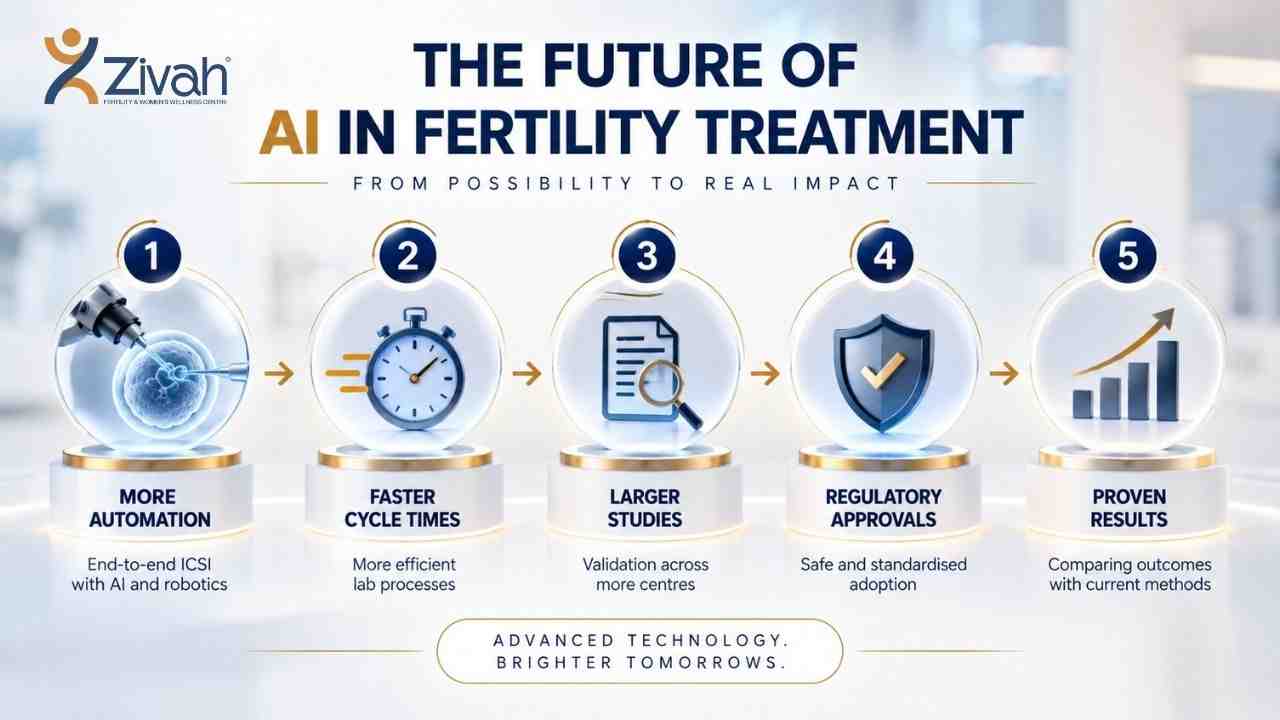
The developers are open about where this goes next: end-to-end automation of ICSI, with humans supervising rather than executing every step by hand. The realistic path runs through faster cycle times, wider validation studies, then gradual introduction as an assistive tool rather than a replacement.
Regarding cost, don't jump to the obvious conclusion. First-generation equipment is pricey to create, set up, and keep up, so any savings will be used later on. If you want to know if this is really happening, keep an eye on three things: larger multicenter studies, regulatory approvals, and published studies that compare the live birth rate to manual ICSI.
One detail from the original case is worth carrying over. The new bit was the lab automation, but the result remained the same: freezing, warming and a well-timed transfer- the parts humans have always done.
What AI IVF Could Mean for Fertility Care in India
India has one of the largest IVF volumes in the world and access to highly competent embryologists is patchy once you get beyond the big cities, which is precisely why remote-supported labs are attractive here, expertise flowing to a smaller centre without anyone moving.
The problems are real: getting permission under the ART Act, the price of the equipment, connections that work well enough to run a process, and staff who are trained to run and maintain the system.
That balance can be seen in Zivah's method, where tested lab technology and experienced embryologists work together, and where newer machinery is carefully watched rather than rushed in.
Conclusion: What the First AI IVF Baby Really Tells Us
Remove the headlines, and the story is easy enough. A machine carried out the 23 steps of ICSI under remote human supervision; four out of five eggs were fertilised normally, and a frozen blastocyst from that batch led to the birth of a healthy baby boy at 38 weeks.
What it deserves is correct framing, not excitement. This is the beginning of a validation process, not the arrival of a new treatment, so the logical approach is to ask clinics precise questions about what any AI IVF system truly performs, and judge the technology by published outcomes, not by how it is described.
And it is worth recalling what remained unchanged. The machinery is new, but the waiting isn't. Behind every automated step in the facility in Guadalajara, a person was still praying that the next scan might show something.
If you're wondering what any of this means for your individual treatment, Zivah's fertility specialists can explain what the current evidence-based technology can and cannot accomplish for you in your specific scenario.