

Constant tiredness, Hair fall, Falling ill too often, Trouble concentrating, The answer is generally easy. Your body needs a nutrient, and you don't have enough of it. The trouble is you can't tell which one. So how do you know what is really missing? You look for it. A vitamin and nutrition deficiency test looks at your whole nutritional status at once, not just one or two vitamins. It looks at where you are on the list of nutrients your body needs, from vitamins D and B12 to iron, calcium, and zinc.
At Zivah, the test is simple and painless, and it requires only one short visit. The results are given in simple language. This guide explains what is confirmed, what to look out for, how to read your results, how much it costs, and what happens next.
What Is a Vitamin Deficiency Test?
A vitamin deficiency test is a quick blood test to see if your body is missing any important nutrients. Simply put, it’s a nutritional test; it tells you how well-nourished your body actually is, rather than leaving you to guess. One small sample gives you an idea of where you are in terms of vitamins and minerals. Zivah runs this vitamin and mineral test with actual accuracy, so you get answers, not assumptions.
Why Is a Vitamin Deficiency Test Done?
Most people come in because something is wrong. Constant tiredness, hair fall, frequent colds, poor focus, these are common problems, and any of them can be traced back to a vitamin your body is running low on.
So why do you do a vitamin insufficiency test at all? These symptoms overlap so much that no one can tell what the cause is by looking. A blood test replaces the guesswork in the formula and provides your doctor something real to work with.
Which Nutritional Levels Are Checked?
A full micronutrient test compares many nutrients together because a deficiency in one is rarely found in isolation. Zivah’s nutritional test covers the basics: vitamin D, vitamin B12, the B-complex group, folate, and vitamins A, E, and K, along with critical minerals such as iron, calcium, magnesium, and zinc.
So what exactly does a nutritional deficiency test measure? Your levels, throughout the complete range. In one blood sample. Here’s what each nutrient does for you.
| Nutrient |
What It Does in Your Body |
Why It Matters |
|---|---|---|
| Vitamin D |
Helps your body absorb calcium |
Keeps bones strong and supports your immunity |
| Vitamin B12 |
Supports nerves and red blood cells |
Low levels often explain tiredness and poor focus |
| B-complex & folate |
Turns food into usable energy |
Important for energy levels and, in women, for pregnancy |
| Vitamins A, E & K |
Support vision, skin and blood clotting |
Small amounts, but each plays a role you'd miss |
| Iron |
Carries oxygen around your body |
A common cause of fatigue, weakness and hair fall |
| Calcium & magnesium |
Build bone and support muscle function |
Affect bone health, cramps and sleep |
| Zinc |
Helps healing and immunity |
Slow-healing cuts and frequent illness often link back here |
It is clear that these nutrients act together when shown side by side, so checking them together gives the most complete picture. Before we get into the signs, it’s helpful to clear up one issue people commonly mistake.
Vitamin Deficiency vs Nutritional Deficiency
The terms are used the same way, but they’re not quite the same. Vitamins are the things your body needs in small amounts, mostly from food. From the soil and water come minerals such as iron, calcium, and zinc. This is the element most people miss out on; both are nutrients, and together they make up your nutritional profile. It is not something separate. It is actually one form of nutrient deficiency.
And that is where the confusion begins. They are very similar to symptoms of vitamin deficiency or mineral deficiency. Tiredness, hair fall, weakness, poor attention. To an outside observer, a nutritional gap looks the same no matter which nutrient is lacking, and that’s why guessing gets you nowhere.
Why Zivah Tests Everything Together
The signs combine so much that by looking at one side of your nutritional overview, you could completely miss the real cause. So how can you know which nutrient you are genuinely deficient in? You test for all of them. At Zivah, a complete nutritional test covers the full range in a single blood test, so nothing slips through. One sample, one visit, a concrete answer to what your body is truly missing.
With the difference out of the way, the following question is practical: how do you know when it's time to get tested? First, your body will give you a few suggestions, so here are the signs to look for.
Signs & Symptoms of Vitamin Deficiency
When you’re low on something, your body normally offers you a few slight symptoms. They rarely show up all at once; more often, they creep in slowly, so you put them down to a busy week, bad sleep, or just getting older. These indications don’t mean anything on their own, but when a couple of them show up and stick around, they are worth paying attention to.
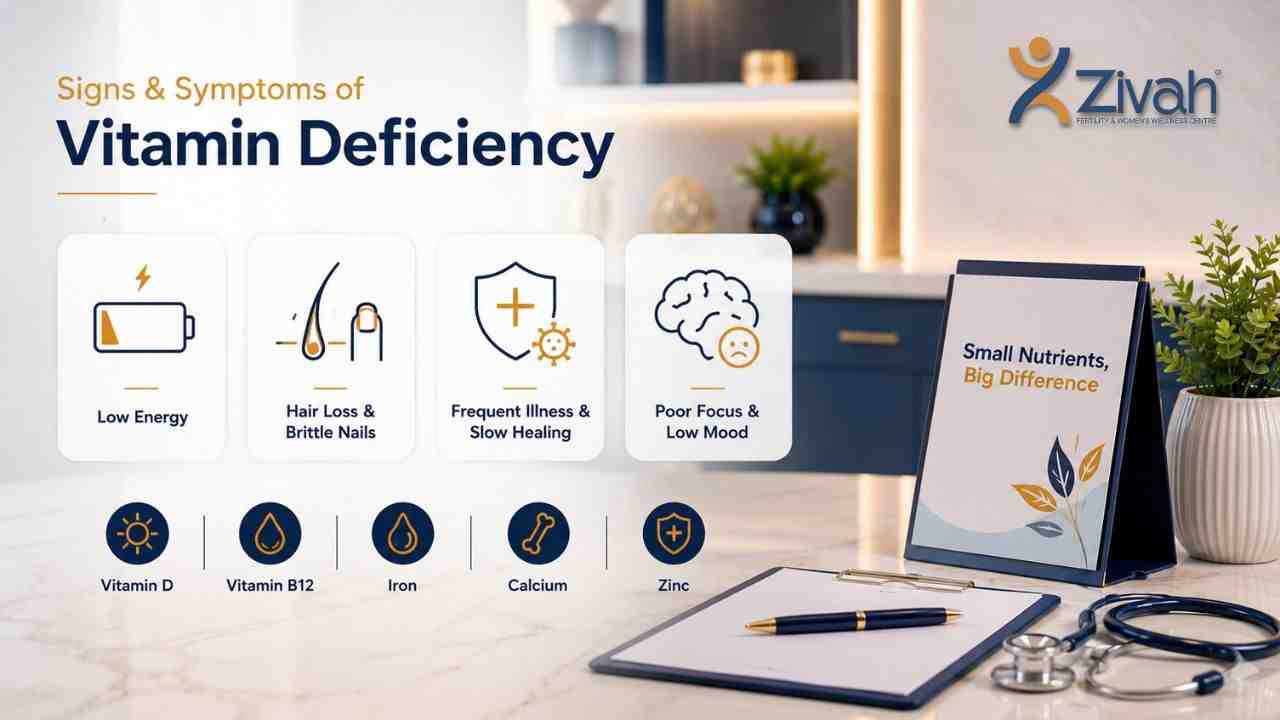
Common Symptoms to Watch For
The most common vitamin deficiency symptoms are easy to put aside, as they build up slowly:
- Continuous tiredness: poor energy that doesn’t improve with rest.
- Broken nails and hair loss: nails that break easily, or obvious shedding.
- Frequent illness or slow healing: catching every bug going around, or cuts taking longer to heal.
- Low mood or poor focus: difficulties concentrating, or feeling flat for no apparent reason.
So what do these vitamins and deficiency symptoms really mean? There’s a lot of crossover, but specific nutrients tend to present themselves in different ways. Here’s an informal guide:
| Deficiency |
Signs You Might Notice |
What It Can Affect |
|---|---|---|
| Vitamin D |
Tiredness, aching bones, low mood |
Bone strength and immunity |
| Vitamin B12 |
Fatigue, tingling hands or feet, poor memory |
Nerves and energy levels |
| Iron |
Weakness, pale skin, hair fall, breathlessness |
Oxygen supply around the body |
| Calcium |
Muscle cramps, weak nails, dental issues |
Bones, teeth and muscle function |
| Zinc |
Slow-healing cuts, frequent colds |
Healing and immunity |
Use this as a general guide, not a diagnosis. These signs vary far too much for you to narrow down by eye. The only way to know for sure what your body is missing is to have a blood test.
What Causes a Deficiency?
There are rarely single causes. Most nutritional deficiencies start with a bad diet, a limited or restrictive diet that leaves gaps your body can’t fill on its own. But diet is not the entire story. Your body may be having difficulty absorbing nutrients effectively; you may not be getting enough sunlight, or pregnancy may be asking too much of your reserves.
Some long-term health problems can also contribute. Whatever the reason, though, the first step to addressing it is to understand exactly what’s missing.If any of this sounds familiar, the next question is whether testing is good for you.
Who Should Get a Vitamin Deficiency Test?
Anyone can take a vitamin deficiency test, but for some people, it is really important. If you’ve been tired for weeks and don’t know why, that’s cause enough. The same goes for people on a vegetarian or strict diet, as some nutrients are tougher to obtain from food alone. So when should you check vitamin deficiency levels? Most likely before you start guessing your way through vitamins.
It’s also good for people who spend most of the day indoors with minimal sun, and for anyone whose body has trouble absorbing nutrients effectively. So who should be tested for a vitamin deficit above all? Anyone whose body is under extra demand, and couples considering a family are right there. A fertility health checkup generally involves a male fertility test and good vitamin levels for both partners.
Testing as Part of a Health Checkup
Not everyone who orders a vitamin test does it because something feels wrong. A lot of individuals do it to see where they are, like checking their sugar or their cholesterol.
A regular vitamin assessment offers you a clear baseline, so if something changes later, you’ll catch it early. It’s a simple, sensible step, and Zivah is a good place to start.If you choose to go forward, here’s what the test requires.
The Vitamin & Nutritional Test Process at Zivah
At Zivah, all our samples are processed by expert pathology staff so that you can be sure of the accuracy of the results. Each result is carefully reviewed before it comes to you, because a nutritional test is only valuable if you can believe what it tells you.
The good news is that the exam itself requires very little from you: no long procedure, no complicated preparation, and no need to set aside your whole day.
A Simple Blood Test, Nothing More
You don't have to prepare anything extra. You come in, they collect a little bit of blood from your arm, and you're usually on your way in a matter of minutes.
So what does a vitamin insufficiency test mean? Just that one pull. One sample provides a complete nutritional picture, including vitamins D and B12, iron, calcium, and zinc. For most people, it is no different than any routine blood test. So here goes the visit.
| Step |
What Happens |
Timeframe |
|---|---|---|
| Blood sample |
A small sample is taken from your arm |
5–10 minutes |
| Lab testing |
The team checks your vitamin and mineral levels |
Same day |
| Your report |
Prepared and explained to you in plain words |
Within a few days |
That's the entire process: one short visit and clear answers soon after.
Do You Need to Fast Before the Test?
Most nutrients don't require fasting. So you have to come on an empty stomach? This is only for specific tests, and the Zivah team will let you know ahead of time whether it applies to you.
Where fasting is indicated, this usually means no food for 8 to 10 hours; however, simple water is still allowed throughout. When your results are in, the next step is to understand what they mean.
What Your Results Mean
When your test is done, you get a bunch of numbers back, and numbers don't tell you much. A number sitting next to a range means nothing until someone explains what it actually suggests about your body. Within it lies the true worth of the test, and there lies the beginning of the explanation.
What Are Normal Vitamin Levels?
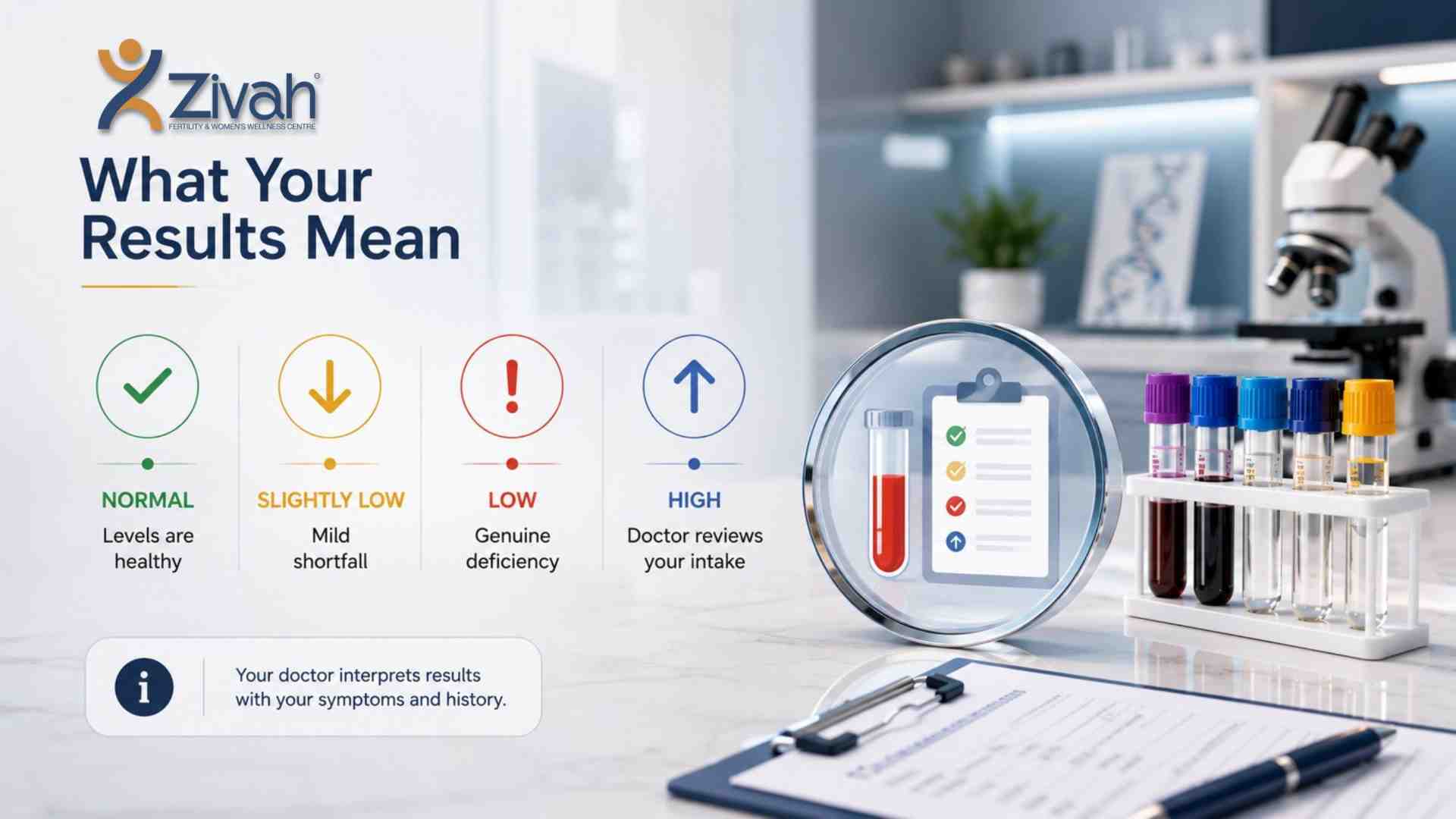
Each vitamin has a healthy band, or ideal range, for your level. Your vitamin profile compares your results to that band. So what should typical vitamin levels look like? The nutrient is where it should be when inside the range. Falling short is useful data, not a reason for concern. Here's how to read whatever comes back.
| Result |
What It Means |
What Usually Happens Next |
|---|---|---|
| Within range |
Your levels are healthy |
No action needed; retest if symptoms persist |
| Slightly low |
A mild shortfall |
Diet changes, and often a short course of supplements |
| Clearly low |
A genuine deficiency |
A treatment plan, then a repeat test to confirm improvement |
| Higher than expected |
Sometimes seen with supplements |
Your doctor will review your current intake |
One result does not tell the whole story; your doctor interprets it in light of your symptoms and history.
Reading Your Results with the Zivah Team
You don't get a page of numbers and be told to figure it out. The Zivah team will sit down with your vitamin report and translate each result into clear language: what is low, why it matters and what to do about it. And if something needs fixing, you'll know exactly how to fix it.And the good news is that most problems are quite easy to address if the result comes back low.
Treating a Vitamin or Nutritional Deficiency
Here’s the comfortable part. Some of the most common findings on any lab are nutritional deficiencies, and they are also among the easiest to treat. Unlike many health conditions, this has a clear cause and a clear solution. Your body is lacking something, and the treatment is simple to give it back. Most individuals feel better in weeks, not years.
How Deficiencies Are Corrected
Most deficiencies can be fixed with minor improvements. Your doctor may propose that you change your diet and/or take a supplement for a few months. How long does it generally take to correct a vitamin deficiency?
It is usually only a few weeks to a few months, depending on how low your levels were. One more test after that shows that things are progressing in the right way. It’s rarely difficult; it’s mostly about giving your body what it was missing.
What to Keep in Mind
That said, there are a couple of things worth being clear about:
- Deficiencies are common and fixable: if you find one, it's good news, not bad news.
- One result guides, not diagnoses: your doctor interprets it with your symptoms and history.
- Your strategy is created around YOU: the proper dose and duration are based on your levels, not a conventional formula.
None of this is speculation, and none of it is something you have to work out for yourself.
Once you know a problem can be resolved, the next practical concern is often the cost. Fair enough to ask before you book anything, so here's exactly what a vitamin test costs.
Vitamin Deficiency Test Cost at Zivah
There is no set price for a vitamin deficiency test; the cost depends on what you need. "It's much cheaper to test for one nutrient than a full panel, and Zivah is honest about their pricing.
A few things shape the total. The major one is whether you want a single targeted test or a full vitamin panel test, as more nutrients equals a more expensive test. Repeat testing adds to it as well if a follow-up is recommended. So what precisely goes into the cost of a vitamin insufficiency test? It's just the number of nutrients being measured, the same premise you'll see in our IVF pricing guide.
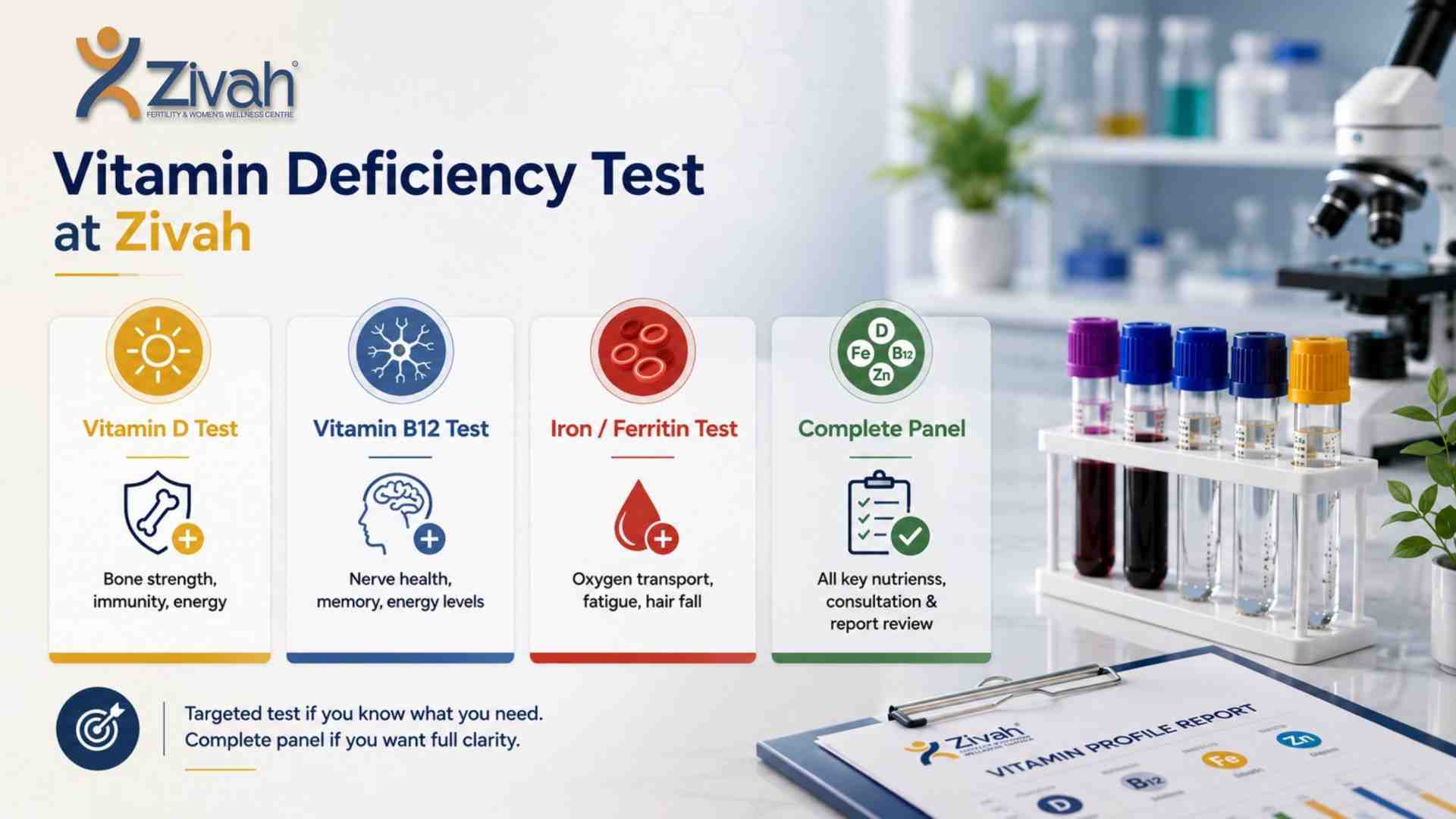
| Option |
What It Covers |
Best For |
|---|---|---|
| Vitamin D test |
Bone strength, immunity, energy |
When you already suspect low vitamin D |
| Vitamin B12 test |
Nerve health, memory, energy levels |
Ongoing fatigue or poor concentration |
| Iron / ferritin test |
Oxygen transport, fatigue, hair fall
|
Weakness, pale skin or hair fall |
| Complete vitamin & mineral panel |
All key nutrients in one draw, plus consultation and report review |
Most people - when you don't know what's missing |
If you know what you are looking for, then targeted testing is good. If not, the complete panel makes more sense; everything is covered in one visit.
Many individuals start by searching for vitamin tests near me. Zivah makes it easy: accurate results nearby, with no long wait times.
Beyond the price, where you test really matters to the answers you receive.
Why Choose Zivah for Your Vitamin Test
Testing is only one part of the puzzle. Where you are tested is just as important. A vitamin insufficiency test is only as good as the lab that does it and the person who explains it to you.
Accredited Lab & Clear Reporting
Your sample is processed in a fully authorised laboratory staffed by qualified personnel and equipped with reliable equipment. What makes a vitamin profile test worth trusting then? Accuracy, simply put, is results you can rely on and act on without second-guessing.
And when your report comes back, it doesn't come back as a page of numbers for you to try and decode. Each outcome is explained in clear, understandable words.If it seems like the kind of help you want, the first step is easy.
Book Your Vitamin & Nutritional Deficiency Test at Zivah
Guessing your way through nutritional supplements most of the time doesn't work. You end up spending money on items your body might not even need, while the real deficiency remains unrecognised. A vitamin deficiency test will take care of it with one short visit. Booking with Zivah is easy and hassle-free. No long wait. No confusing process. No pressure. Just one quick blood sample and a simple response about what your body is actually missing.
When your results come back, you're not left to interpret them yourself. The team breaks everything down into simple phrases and tells you what to do next. So if you've been exhausted for weeks, losing hair, or just want to know where you stand, this is your easy first step. It takes very little time and tells you a great deal.