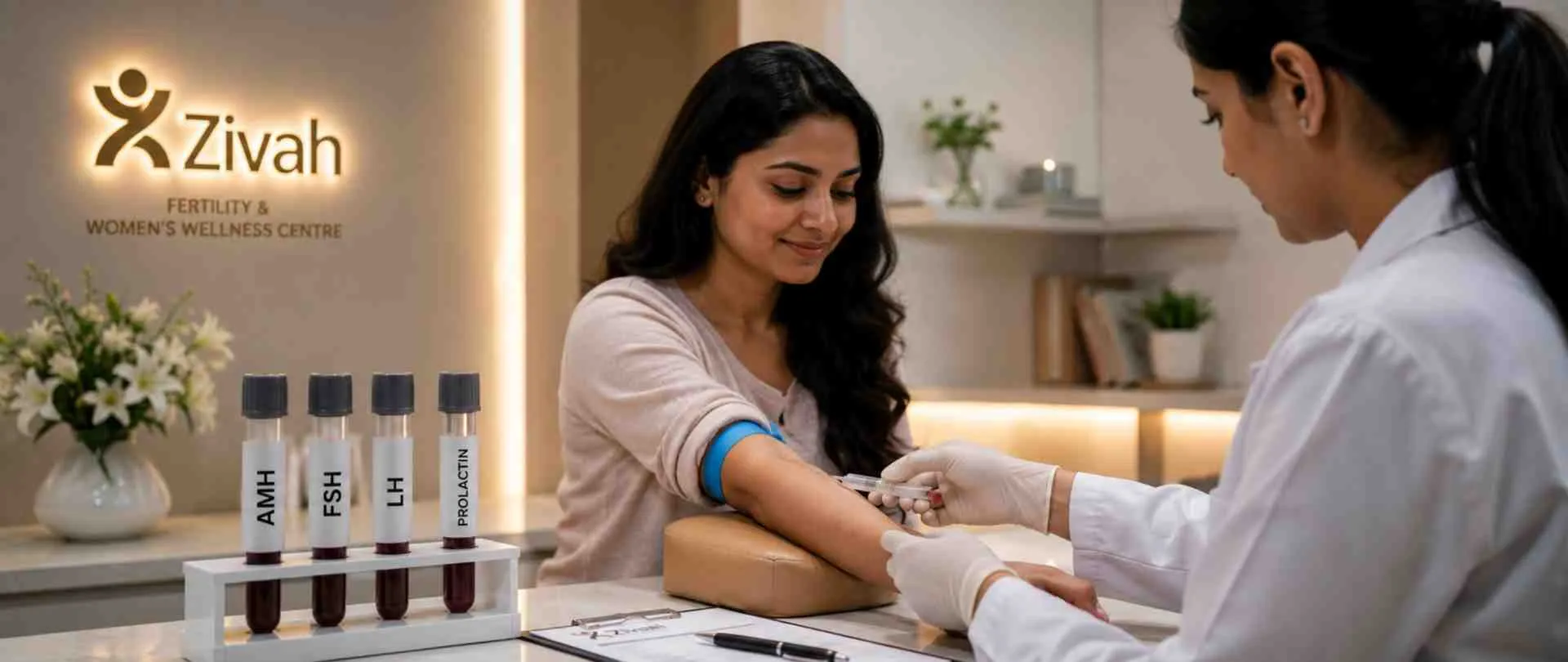
A hormonal profile test checks for four hormones (AMH, FSH, LH and prolactin) in one blood sample to check the functioning of your ovaries and menstrual cycle.
This female fertility hormone profile test is generally the first step when conceiving proves difficult, periods turn irregular, or treatment options like IVF are being discussed. The AMH, FSH, LH, and prolactin test is a brief overview of your reproductive system on a single morning.
You will learn what each hormone means, when to get this reproductive hormone test, how to prepare and how the results determine your next move. But what many people don’t realise is that each hormone answers a totally different question, and reading them all together reveals a story that no single value can.
What the Hormonal Profile Test Measures
Your menstrual cycle is managed by a communication between three players: your hypothalamus and pituitary gland in your brain, and your ovaries. This loop doctors name the HPO axis, and when it goes out of whack, so often does fertility.
A hormonal profile test listens in on that conversation by measuring the important chemical signals that go back and forth between them, all from a single blood draw.
So instead of checking one marker at a time, our female hormone panel selects 4 hormones to keep the picture whole. Each reports from a separate part of the system. The brain gives the commands, the ovary responds, and if anything is silently blocking the transmission. The sex hormones, read together, provide a significantly fuller story than any one test could.
The Four Markers in a Single Blood Panel
The FSH LH prolactin test combines signals from the pituitary gland with a measure of ovarian reserve to give a single unambiguous picture of reproductive function. Here’s what each marker in these hormonal profile tests really means.
What Each Marker in the Hormonal Profile Reveals
| Hormone |
What It Assesses |
Source | Cycle Dependence |
|---|---|---|---|
| AMH |
Ovarian reserve |
Antral follicles | Any day |
| FSH |
Follicle recruitment |
Pituitary | Day 2–3 |
| LH |
Ovulation trigger |
Pituitary | Day 2–3 |
| Prolactin |
Ovulation suppression risk |
Pituitary | Any day (AM) |
| Estradiol (companion) |
Contextualises FSH |
Ovary | Day 2–3 |
Estradiol is frequently co-tested to interpret FSH accurately, it is not part of the core four-marker panel.
When You Might Need a Fertility Hormone Test
For most women, hormones aren't on the radar until something feels off, a late period, or skips a month, or a year of trying to get pregnant with no luck. Often, the first answer is not a scan but a basic infertility blood test. Understanding the reasons for a hormonal profile test might provide you with insight into what your body may be expressing before symptoms become obvious.
Signs That Point Toward a Hormonal Evaluation
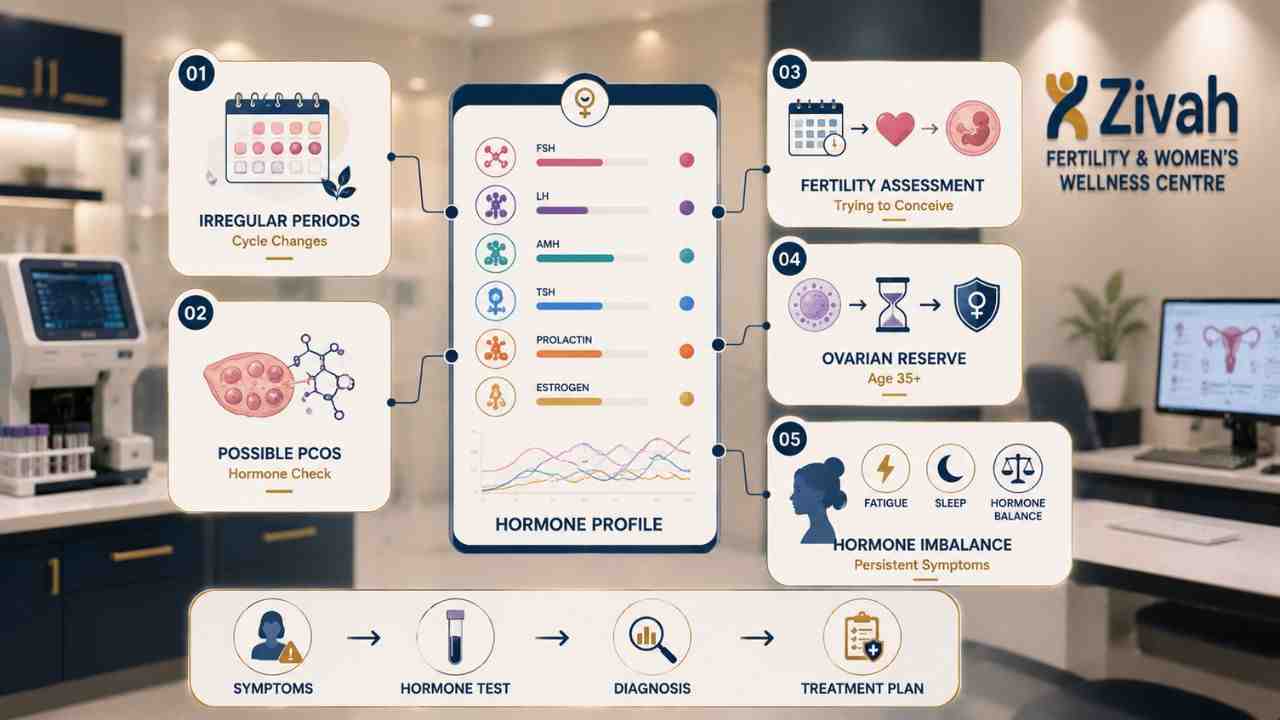
Some situations make this hormonal evaluation worth doing sooner rather than later. A doctor might suggest this hormone test in women if any of these sound familiar:
- Periods that won't settle into a pattern: late, early, missing, or all over the place. A hormone profile test for irregular periods can help determine whether your hormones are to blame.
- Possible PCOS: if you're dealing with acne, extra hair growth, or ovulation that seems to skip, a hormone profile test for PCOS helps confirm what's going on.
- Trying for a while with no luck: a few months in, this is one of the most common reasons women get tested.
- Worry about egg supply: especially after age 35 or if early menopause runs in your family.
- Tiredness or other symptoms you can't explain: these often trace back to a hormone that's out of balance.
Put simply: when your cycle or your fertility seems out of step, this test is a good place to start.
Where the Panel Fits in Your Fertility Workup
Think of this reproductive hormone panel for infertility as step one, not the complete story. A baseline fertility blood test tells your doctor where to look before anyone talks about scans or treatment. It's a lab test for hormone imbalance that guides you to the next appropriate test, rather than guessing.
And then anything like IVF? That’s a conversation for another day, one worth having with a Zivah specialist once your full results are in.
The Four Hormones Explained: AMH, FSH, LH & Prolactin
Four hormones, four separate roles. Some are from your brain, some from your ovaries, and each tells your specialist something the rest can't. This is what each marker actually means.
1. AMH: The Ovarian Reserve Marker
AMH is produced by tiny follicles in your ovaries; it is the closest thing we have to an egg counter. That's why it's the basis of any ovarian reserve assessment. High AMH levels might suggest PCOS, where many tiny follicles are crowded in the ovaries.
On the other hand, a poor ovarian reserve typically presents as a low ovarian reserve score and is often associated with age. Next to your fsh amh levels, it begins to paint a richer picture. But amh only measures eggs, it can't tell if your body is using them.
2. FSH: The Follicle Recruiter
This is where FSH comes in. FSH is made by the pituitary gland, and it is the signal that wakes up your follicles each cycle and drives one to mature. The problem is that high FSH often suggests the ovaries are working harder to get a response, a sign that reserve may be decreasing. Low FSH levels do the opposite and usually go to the brain or pituitary.
Many women want to know what the best FSH level is for conceiving. Generally speaking, the lower your Day-3 reading, the more easily your ovaries respond. But FSH starts the process; something else has to trigger the real release.
3. LH and the Ovulation Surge
That trigger is LH. This is the hormone that causes ovulation: mid-cycle, FSH and LH levels change and LH surges suddenly, releasing the mature egg. Reading these LH FSH hormones together is crucial because their balance conveys a story of its own.
The normal FSH to LH ratio is close to 1: 1. You can just divide one value by the other to find out the LH to FSH ratio. A low LH/FSH ratio can be normal, but a reversed ratio (LH greater than FSH) is a classic PCOS sign. But even perfect timing can be thrown off by one quiet hormone.
4. Prolactin: The Silent Ovulation Disruptor
That hormone is prolactin. It is known to support milk production, but can create difficulties when it runs high outside of pregnancy, a state termed hyperprolactinemia.
Too much prolactin can shut down ovulation-driving signals, which is why LH, FSH and prolactin are frequently evaluated combined. Large amounts can delay your menstruation, without any evident signs, making it harder to get pregnant. That is why it is measured, not assumed.
Hormone Source, Function & Fertility Signal
| Hormone |
Produced By |
Primary Role | What It Flags |
|---|---|---|---|
| AMH |
Ovarian follicles |
Marks ovarian reserve | Low = reduced egg supply · High = possible PCOS |
| FSH |
Pituitary gland |
Recruits and matures follicles | High = ovaries straining · Low = pituitary/brain signal issue |
| LH |
Pituitary gland |
Triggers ovulation | Surge confirms ovulation · High vs FSH = PCOS pattern |
| Prolactin |
Pituitary gland |
Supports lactation | High outside pregnancy = stalled ovulation |
Timing and Prep: Getting Your Hormone Test Right
Timing is more important with this test than with most. That same hormone can read quite differently depending on what day of your cycle you’re tested on, so getting the timing right is half the job. If you’ve been wondering when to test fertility hormones, the short answer is: it depends on the hormone.
The Best Day to Test Each Fertility Hormone
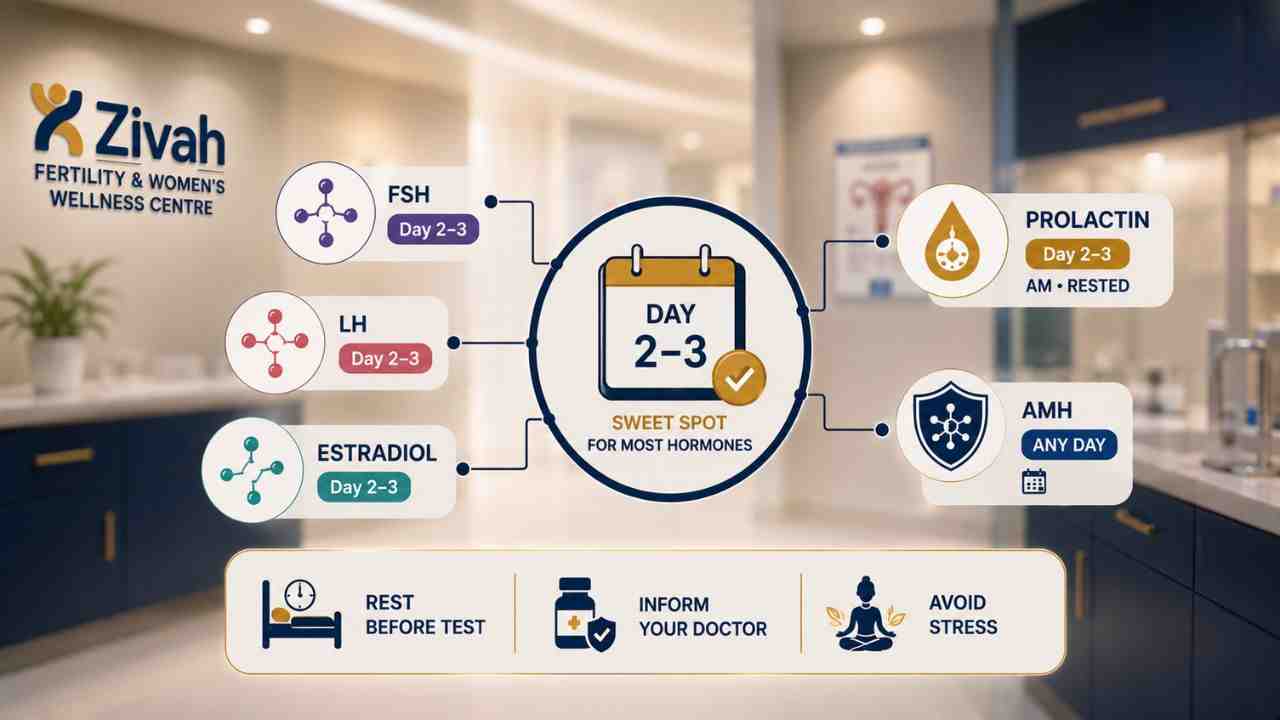
Most of the panel’s sweet spot is early in your cycle. FSH, LH, prolactin and estradiol are best drawn on Day 2 or 3, counting from the first day of true bleeding, not spotting, as that is when levels sit at their natural baseline and can be compared fairly.
AMH is the easy one: it hardly changes over the month; the test can be done any day, no scheduling needed. The results are trustworthy because you know how to verify hormone levels at the appropriate time.
Simple Prep That Keeps Your Results Honest
Just a few basic methods to keep your hormone bloodwork clean and avoid false flags:
- Beware of the prolactin window: Sleep, stress and exertion increase prolactin. The draw should be done 2–3 hours after waking, after a short rest at the clinic, not first thing in the morning, and not after running into the clinic. A sample taken at the wrong time can give a misleadingly high reading and suggest a prolactin problem that isn’t really there.
- Tell your doctor what you are taking: Oral contraceptives, thyroid medications, medications that stimulate ovulation, and even biotin supplements could affect results; biotin, in particular, interacts with the lab methods utilised.
Tell your doctor everything. Stop anything your doctor tells you to before your blood test for hormones in women. Get these properly, and you’ll have a true reading on your blood test for hormones the first time.
Recommended Testing Day by Hormone
| Hormone |
Ideal Cycle Day |
Why This Timing |
|---|---|---|
| FSH |
Day 2–3 |
Baseline reading reflects true ovarian reserve |
| LH |
Day 2–3 |
Establishes resting level before the mid-cycle surge |
| Estradiol |
Day 2–3 |
Read with FSH, confirms FSH isn't being masked |
| Prolactin |
Day 2–3 (AM, rested) |
Reduces false elevation from stress or activity |
| AMH |
Day 2–3 |
Stays stable across the cycle |
Your Hormone Test at Zivah: What to Expect
At Zivah, this female hormone panel gives you the complete picture, all in one visit. The core test includes all four markers (AMH, FSH, LH and prolactin). If it helps your specialist, they can add in Estradiol or TSH. Estradiol will help you figure out your FSH reading. TSH rules out thyroid problems similar to fertility issues.
All from a single blood draw, timing for a specific day of your cycle, so the results mean something. There is no need to fast for the core panel, and the visit only takes a few minutes. Since the timing is taken care of for you, you don’t have to figure out which hormone needs which day; that’s what makes this fertility profile test simple instead of stressful.
Easy to book and easy to use as a test for reproductive health. The hormone test costs depend on the markers your specialist recommends; you will be told the price at your appointment. Each plan is customised to what you truly need.
From Blood Draw to Your Results
This is the journey that your hormonal evaluation follows from sample to answer. Blood is drawn at the clinic, sent to the lab, and the results are usually available in a day or two.
But your hormone blood test findings do not stop at the printout. The Zivah professional will analyse them based on your age, cycle and history, and talk you through what they represent, turning raw numbers into a genuine next step.
Who Should Consider Hormonal Profile Testing
This isn’t a test every woman needs at the same time, but for some, it’s worth doing earlier. If you are over 35, have irregular periods, or think you may have PCOS, this type of female fertility test is most helpful. It’s also a good option if early menopause runs in your family, or if you’re just thinking forward, and want an ovarian reserve test so you know where you stand.
Women thinking about egg freezing or starting treatment often use it for a fertility hormone test for pregnancy planning. It discusses a slow but vital question as a sort of baseline reproductive hormone testing for women, How is my body doing right now?
One honest note. A normal screen doesn’t mean you’re pregnant, and an abnormal screen isn’t a conclusion. It’s information you and your expert can use to plan the appropriate next step.
Testing as Part of Pre-Treatment Planning
If treatment is on the cards, this fertility profile test is usually at the top of the list. Ovarian reserve testing before IVF lets your doctor set the proper dose of medication and expectations from the outset, which means fewer surprises and better-tailored care.
Your results may lead you to other relevant actions, such as Egg Freezing, NIPT / first-trimester screening, or Genetic Counselling, based on your condition and goals.
Interpreting Combined Hormone Patterns
First, an important thing: what follows is context to help you understand your results - not a diagnosis. Your professional reads them appropriately every time, balancing your numbers with your age, cycle and history.Here’s why the panel is so useful: Single values rarely tell the complete story. The key insight lies in how the hormones move together.
Here are a few reasons why. High FSH with normal LH can be a sign of decreasing ovarian reserve. High LH with normal FSH is a trend typically seen in PCOS.
Elevated FSH and LH in females at once, the kind of premature ovarian failure FSH and LH levels seen in younger women, suggests the ovaries are winding down early. Low FSH and LH levels together, sometimes with low FSH, LH, and estradiol, shift the attention to signalling from the brain.
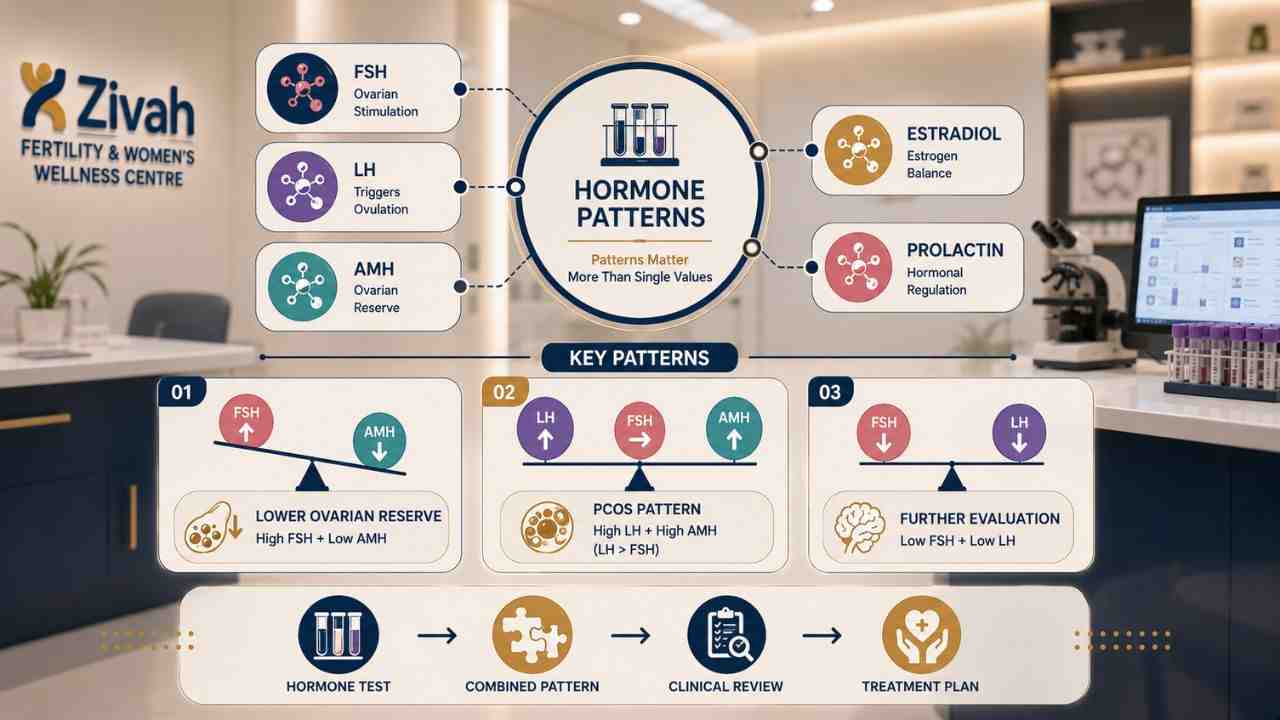
What Hormone Combinations Can Indicate
Normal FSH to LH ratio is about 1:1. High AMH and LH > FSH is a common characteristic for PCOD. Each pattern just pushes your specialisation in a different direction for the following level. If you want to understand what your results represent, Zivah is the place to start.
Hormone Levels, Patterns & What They Suggest (Lab-Dependent)
| Hormone / Pattern |
Reproductive Age |
Postmenopausal | What It May Suggest |
|---|---|---|---|
| FSH |
~3–10 mIU/mL |
Often >25 mIU/mL (normal) | High in younger women points to lower ovarian reserve |
| LH |
~2–10 mIU/mL |
Raised | Read against FSH to judge the ratio |
| AMH |
~1.0–3.5 ng/mL |
Very low / undetectable | Falls naturally with age |
| Prolactin |
~5–25 ng/mL |
Similar range | Raised levels warrant a repeat test |
| Estradiol (companion) |
~25–75 pg/mL (early cycle) |
Low | A high early reading can mask a raised FSH |
| High FSH + low AMH |
Pattern across markers |
More common with age | Diminished reserve, discuss in consultation |
| High LH vs FSH + high AMH |
Pattern across markers |
Rare after menopause | PCOS pattern, specialist review advised |
| Low FSH + low LH |
Pattern across markers |
Atypical | Possible hypothalamic cause, further evaluation |
Ranges vary by lab and assay and are for general guidance only, always clinician-interpreted.
Start Your Fertility Hormone Assessment at Zivah
One of the simplest methods to take control of your fertility is to understand your hormones. Planning for the future, or trying now? A fertility hormone test for pregnancy planning provides you and your expert with an actual basis to stand on.
At Zivah, this reproductive health test is never simply a number on the page. Your results are fully explained, then offered up in a plan customised to your goals, not a generic template.
Every plan is different; therefore, prices are not set in advance but addressed during your consultation. Don’t just draw blood. Book your hormone test with Zivah today and take it as a confident next step.