Donor egg IVF and donor sperm IVF are two trusted fertility treatments for couples and people who cannot have a baby with their own eggs or sperm. In these treatments, healthy donor eggs or donor sperm are tested first, then combined in the lab to create a small embryo. After that, the embryo is placed in the mother's womb. So, donor IVF works well for women with low egg count, premature ovarian insufficiency, or weak egg quality. It also helps men with azoospermia (absent sperm) or very low sperm count, single women, same-sex couples, and people who carry a family illness.
At Zivah Fertility, every donor cycle complies with the ART Act 2021 rules and is performed in our own lab. This guide explains how donor egg and sperm IVF works, who it suits, success rates, and more.
What Is Donor Egg IVF and Donor Sperm IVF?
Sometimes, a couple is not able to have a baby with their own eggs or sperm. Then, doctors use a method known as donor egg IVF or donor sperm IVF.
The eggs used in donor egg IVF come from a healthy, young woman who has been fully checked by doctors. The egg is then mixed in the lab with the sperm from her father. After a few days, a tiny embryo is ready. Once this is done, the embryo is placed in the mother's uterus so the baby can grow there, as in any normal pregnancy.
Donor sperm IVF is the same, but it's opposite, because the sperm comes from someone else. In the lab, his sperm is mixed with the mother's eggs. After that, the baby is put into her womb. This option helps men who have very low sperm or no sperm at all. It also helps single women who want to have a baby on their own, same-sex couples, and people who don't want to give their child a disease that runs in the family.
Here is a simple side-by-side look at both :
| Feature |
Donor Egg IVF |
Donor Sperm IVF |
|---|---|---|
| Who gives the egg or sperm |
A healthy woman donor, aged 23 to 35 |
A healthy sperm donor, aged 21 to 55 |
| Why people choose it |
Eggs are too weak or too few |
Very low or no sperm, or no male partner |
| How long it takes |
4 to 6 weeks |
3 to 4 weeks |
| How the egg meets the sperm |
ICSI or normal IVF |
Mostly ICSI |
| What the mother needs to do |
Only get her womb ready |
Take medicine so her own eggs can |
Who Needs Donor Egg or Sperm IVF?
An egg donor or a sperm donor is not needed by everyone for IVF. Although some people think it is the safest way to have a baby. Doctors usually suggest it when a couple's own eggs or sperm cannot lead to a healthy pregnancy.
When Is Donor Egg IVF Recommended?
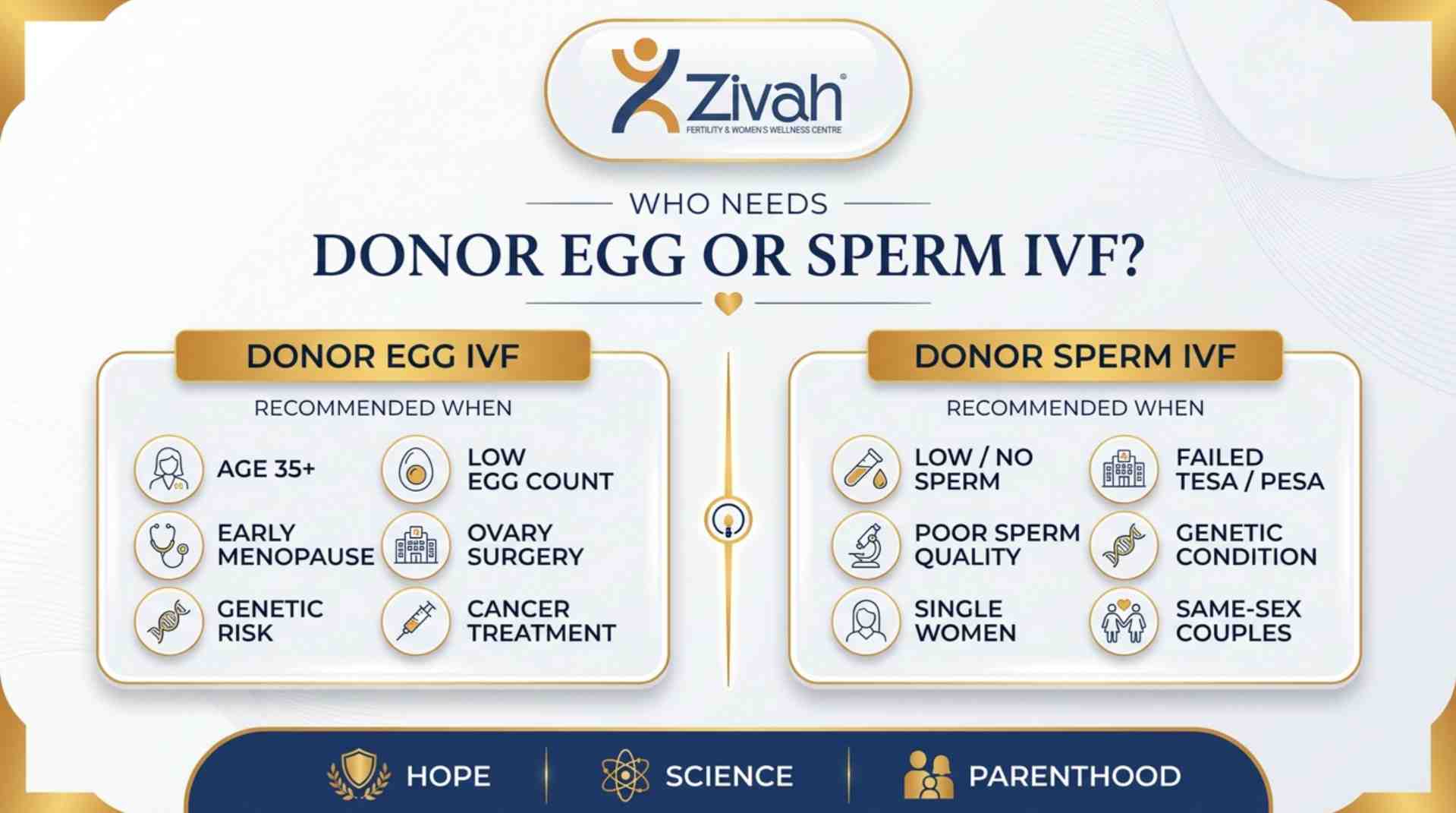
Doctors suggest IVF with egg donation when a woman's own eggs are too weak or too few. Common reasons include:
- Women above the age of 35 with falling egg quality.
- Low egg count, also called diminished ovarian reserve (DOR).
- Early menopause, also called premature ovarian insufficiency (POI).
- Women who have lost their ovaries due to surgery.
- Damage from cancer treatment, such as chemotherapy or radiation.
- Women who carry a family illness do not want to pass it on.
A simple blood test that shows high FSH and low AMH usually confirms the need. So, donor IVF for older women, especially above 42, gives the highest chance of a healthy baby.
When Is Donor Sperm IVF Recommended?
IVF using donor sperm is suggested when the father's sperm cannot lead to a healthy pregnancy. Some common reasons are:
- No or very few sperm present.
- Sperm that can't move well or don't even have a head shape, even after ICSI.
- Failed small surgeries like (TESA, PESA, or Micro-TESE).
- Men who carry an infertility illness in their family from generation to generation.
- Women who are single and want to have a child of their own.
- Same-sex female couples.
- Men who have cancer or who have tried to get their vasectomy reversed but failed.
A simple semen test and a gene test confirm whether they need them or not.
What Is the Donor Egg IVF Process Step by Step?
The donor egg process is simple once you know what each step looks like. From the day a donor is matched to the day the embryo is placed inside the womb, the donor egg procedure usually takes about 4 to 6 weeks. Each step is carefully planned so nothing is left to chance.
Step-by-Step Stages of the Donor Egg IVF Process
Here is a simple breakdown of the full egg donation process and what happens at each stage:
| Stage |
What Happens |
When |
|---|---|---|
| Donor Matching |
Donor profile shared, recipient picks |
Week 1 |
| Donor Screening |
Blood tests, gene tests, mind check-up |
Week 1–2 |
| Donor’s Egg Growth |
10–12 days of injections, scans done |
Week 2–3 |
| Egg Pickup |
20-minute small procedure under sleep |
Week 3 |
| Mother’s Womb Prep |
Hormone medicines build the womb lining |
Week 2–4 |
| Egg Meets Sperm |
Done by ICSI or normal IVF in the lab |
Day of pickup |
| Embryo Growth |
Embryo watched closely for 3 to 5 days |
Week 3–4 |
| Embryo Transfer |
Embryo gently placed inside the womb |
Week 4 |
| Pregnancy Test |
Simple blood test for results |
Week 6 |
If a couple has had pregnancy loss before or wants extra safety, Zivah Fertility also offers PGT-A (a gene test on the embryo) and frozen embryo transfer (FET) as add-on options.
If you are looking for the donor sperm IVF process instead, you can see it just below.
What Is the Donor Sperm IVF Process Step by Step?
The process of donating sperm is a little faster than donating eggs. That's because the sperm bank already freezes, tests, and stores donor sperm ready to use. So, when a couple chooses sperm donation for IVF, most of the donor work is already done. The treatment then focuses on the mother's side.
How Long Does the Donor Sperm IVF Process Take?
From start to finish, the donor sperm IVF process takes about 3 to 4 weeks. The first week goes into picking a donor from the sperm bank. The next 2 to 3 weeks focus on growing the mother's eggs, joining them with the donor sperm in the lab, and placing the embryo inside her womb. After two weeks, a simple blood test will show whether she is pregnant.
Step-by-Step Stages of the Donor Sperm IVF Process
Here is a simple step-by-step look at IVF with a sperm donor and what happens at each stage:
| Stage |
What Happens |
When |
|---|---|---|
| Donor Selection |
Recipient picks from sperm bank profiles |
Week 1 |
| Donor Checks |
Already tested and kept frozen for 6 months |
Done at bank |
| Mother’s Egg Growth |
10–12 days of injections, scans done |
Week 1–2 |
| Egg Pickup |
Small procedure done under sleep |
Week 2–3 |
| Sperm Preparation |
rozen sperm thawed and washed in the lab |
Day of pickup |
| Egg Meets Sperm |
Single sperm gently placed into each egg |
Day of pickup |
| Embryo Growth |
Embryo watched for 3 to 5 days |
Week 3 |
| Embryo Transfer |
One embryo gently placed in the womb |
Week 3 |
| Pregnancy Test |
Blood test 12 to 14 days later |
Week 4–5 |
Add-On Options for Donor Sperm IVF
If the mother's cycle needs more time or if extra eggs are saved for later use, Zivah Fertility also offers frozen embryo transfer (FET), which couples who want to have a second child in the future can use instead of going through the whole process again.
Donor IVF Success Rate by Age
Donor IVF has two types: donor egg IVF and donor sperm IVF. Both work in different ways, so their success rates differ. Donor egg IVF success mostly depends on the donor's age, while donor sperm IVF success depends on the mother's egg age. Below, you will find the success rates for both, broken down by age band.
Donor Egg IVF Success Rate by Age
Donor egg IVF has one of the highest success rates in fertility treatment. The reason is simple: success depends on the age of the donor's eggs, not the mother's age. Since donor eggs come from healthy women aged 23 to 35, they remain strong and healthy
| Recipient Age |
Donor Egg IVF Live Birth Rate Per Transfer |
Cumulative Success After 3 Transfers |
|---|---|---|
| Under 35 |
50–55% |
75–85% |
| 35 to 39 |
50–55% |
75–85% |
| 40 to 44 |
48–52% |
70–80% |
| 45 to 50 |
45–50% |
65–75% |
This is why donor egg IVF works so well for older women. A 45-year-old using donor eggs has almost the same chance of a healthy baby as a 32-year-old. By contrast, a 45-year-old using her own eggs in normal IVF usually sees a success rate below 5% per transfer.
Donor Sperm IVF Success Rate by Age
Donor sperm IVF success depends on the mother's own egg age, not the donor's. These eggs depend on how good the mother's eggs are because the donor sperm has already been checked and found to be healthy.
| Recipient Age |
Donor Sperm IVF Live Birth Rate Per Transfer |
Cumulative Success After 3 Cycles |
|---|---|---|
| Under 35 |
45–50% |
70–80% |
| 35 to 37 |
40–45% |
65–75% |
| 38 to 40 |
30–40% |
55–70% |
| 41 to 42 |
20–30% |
40–55% |
| Over 42 |
Below 15% |
Below 35% |
For a better chance of success, doctors often tell women over 42 to switch to donor egg IVF as well. Add-ons like ICSI, FET, and checking the genes of the embryo can also help at any age.
What Are the Benefits and Risks of Donor Egg and Sperm IVF?
When it comes to getting pregnant, both donor egg IVF and donor sperm IVF have benefits and risks. That's good news. The benefits are big, and the risks are few and well handled at a reputable centre. Donor IVF gives people and couples a real chance at having a healthy child, even if their own eggs or sperm aren't enough.
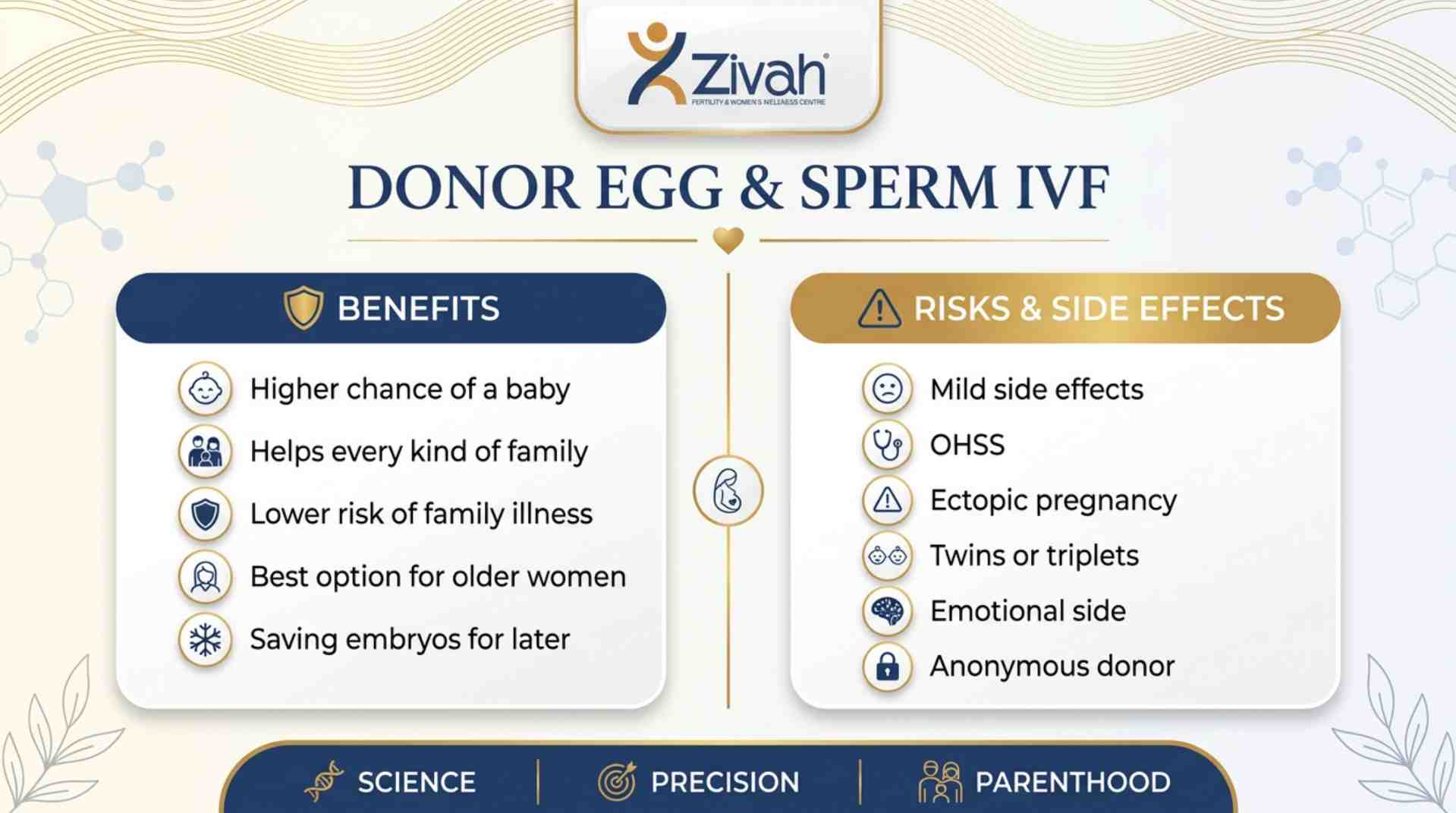
Some of the major benefits are:
- Higher chance of a baby: Some of the best success rates in IVF come from donated eggs from young donors.
- Helps every kind of family: People who are single, in a same-sex relationship, or having major problems with their eggs or sperm can all have children.
- Lower risk of family illness: Donors are screened for thalassemia, cystic fibrosis, and other illnesses.
- Best option for older women: The quality of eggs doesn't get worse with age when you use gift eggs.
- Saving embryos for later: More healthy eggs can be saved for a future child.
What Are the Risks and Side Effects of Donor Egg and Sperm IVF?
Donor IVF is safe for most people, but a few risks are good to know about.
- Mild side effects: light bloating, mood swings, or some stomach pain during injection days.
- OHSS: when the ovaries react too strongly to medicines. Rare but watched closely.
- Ectopic pregnancy (1-2%): when the embryo grows outside the womb. Doctors catch this early.
- Twins or triplets: possible if more than one embryo is placed. Most clinics now place only one.
- Emotional side: some couples feel unsure about no genetic link with the baby. Counselling helps.
- No way to meet the donor: Indian law keeps donors anonymous.
What Are the Advanced Techniques Used in Donor Egg and Sperm IVF?
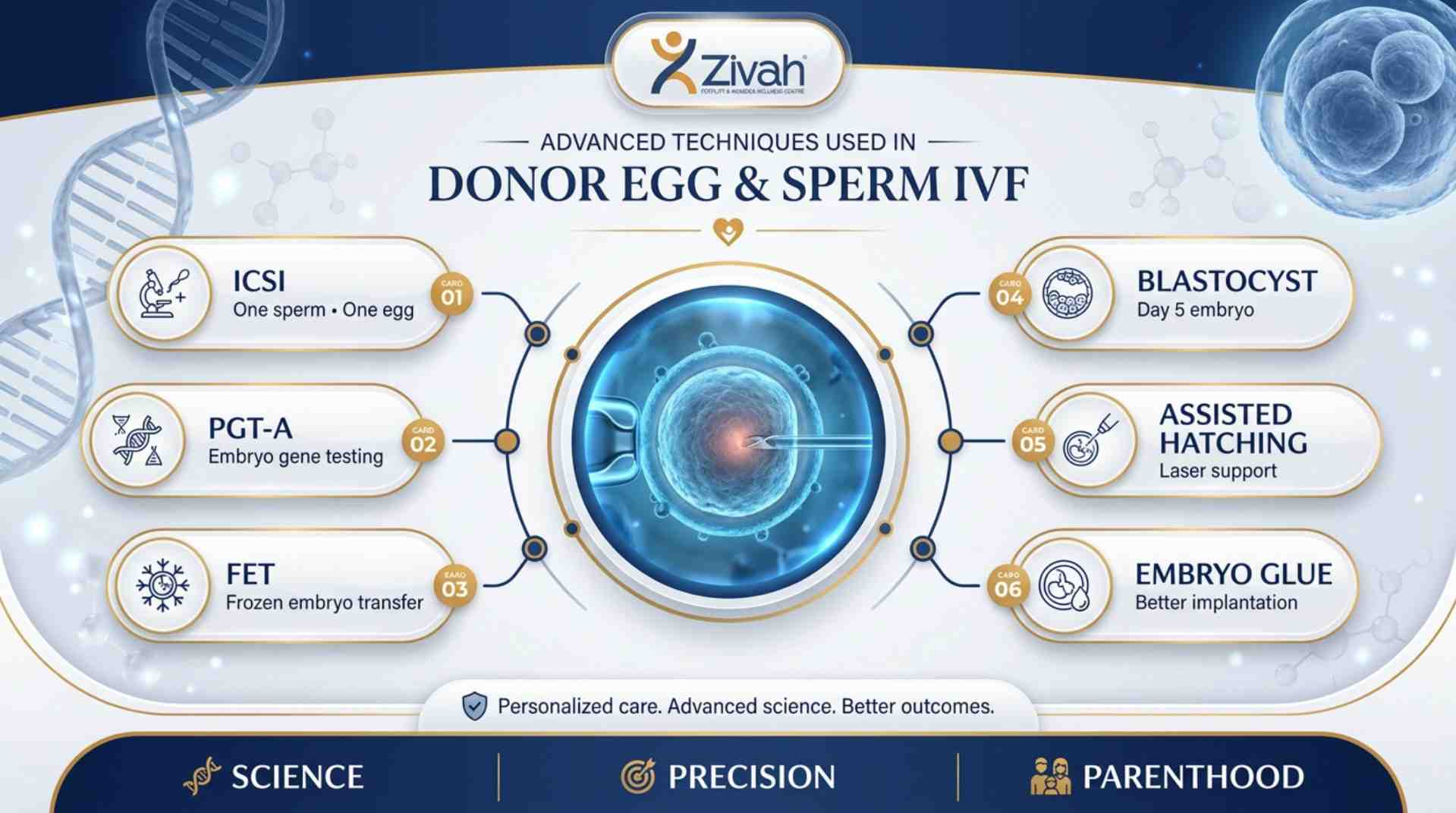
Modern donor IVF uses a few extra lab techniques to give the embryo the best chance of growing into a healthy baby. These are not always needed, but they can help older mothers, couples with past pregnancy loss, or those with frozen embryos.
List of Advanced Techniques Used in Donor IVF Cycles
Here is a quick look at the most common lab techniques used in donor egg IVF and donor sperm IVF, along with what each one does.
| Technique |
Full Form |
What It Does |
When It Is Used |
|---|---|---|---|
| ICSI |
Intracytoplasmic Sperm Injection |
One healthy sperm placed inside each egg |
Always for donor sperm IVF |
| PGT-A |
Preimplantation Genetic Testing for Aneuploidy |
Checks embryo for gene problems |
Past pregnancy loss, women above 38 |
| FET |
Frozen Embryo Transfer |
Frozen embryo thawed and placed later |
Mother needs more time, or extra embryos saved |
| Blastocyst Transfer |
Day 5 Embryo |
Embryo grown 5 days for extra strength |
Most donor IVF cycles |
| Assisted Hatching |
Laser Hatching |
Laser helps embryo stick to the womb |
Frozen embryos, older mothers |
| Embryo Glue |
Special Gel |
Helps embryo stick better in the womb |
Selected cases |
Zivah Fertility offers all six techniques based on each couple's age, history, and test results.
Why Choose Zivah Fertility for Donor Egg and Sperm IVF?
Zivah Fertility runs a fully ART-Act-compliant donor programme covering both donor egg IVF and donor sperm IVF. Every cycle is planned with care, run in our own lab, and backed by a team that stays with the couple from start to finish.
What Makes Zivah Fertility a Trusted Donor IVF Clinic?
Here is what couples and individuals get at Zivah Fertility:
- Screened donors: egg donors aged 23 to 35, fully tested.
- Trusted sperm banks: every vial frozen for 6 months and re-tested.
- In-house lab: ICSI, blastocyst culture, embryo freezing under one roof.
- Clear donor matching: blood group, traits, and education confirmed.
- Full legal paperwork: all consents handled in-house.
- Mind check-up included: pre-cycle counselling support.
- Advanced add-ons: PGT-A and FET available.
- One coordinator: single point of contact throughout.
Zivah Fertility is a trusted donor IVF clinic for couples with egg or sperm problems, single women, same-sex couples, and people with past IVF failures.
Final Thought: Your Path to Parenthood Starts Here
Donor egg IVF and donor sperm IVF open a clear and safe path to parenthood for couples and individuals when their own eggs or sperm cannot do the job. With the right team, the right tests, and the right care, the chance of holding a healthy baby in your arms is higher than ever before.
Book a free consultation with Zivah Fertility today. Our coordinators will check your eligibility, walk you through donor matching, and explain every step of the treatment. Call us, message us on WhatsApp, or book your appointment online, we are here to help.