

At Zivah, we offer the sonosalpingography (SSG) test to help you find out why pregnancy may not be happening, and to do it, with no X-ray and no radiation. An SSG test, also called a tubal patency test, uses warm saline and ultrasound to show whether your fallopian tubes are open or blocked. It is one of the first answers many couples need, because blocked tubes are a common reason conception takes longer than hoped.
If you have been trying for a while, or your doctor has advised a tube check before treatment, this test points the way forward. Here is what your SSG test at Zivah involves and how we guide you from results to a plan.
What Does an SSG Test at Zivah Include?
At Zivah, your SSG test checks whether your fallopian tubes are open and your uterus is ready for pregnancy. The sonosalpingography test, also called saline infusion sonography, injects warm saline into your uterus. At the same time, an ultrasound monitors it in real time, so we can see whether the fluid flows freely through each tube or meets a blockage.
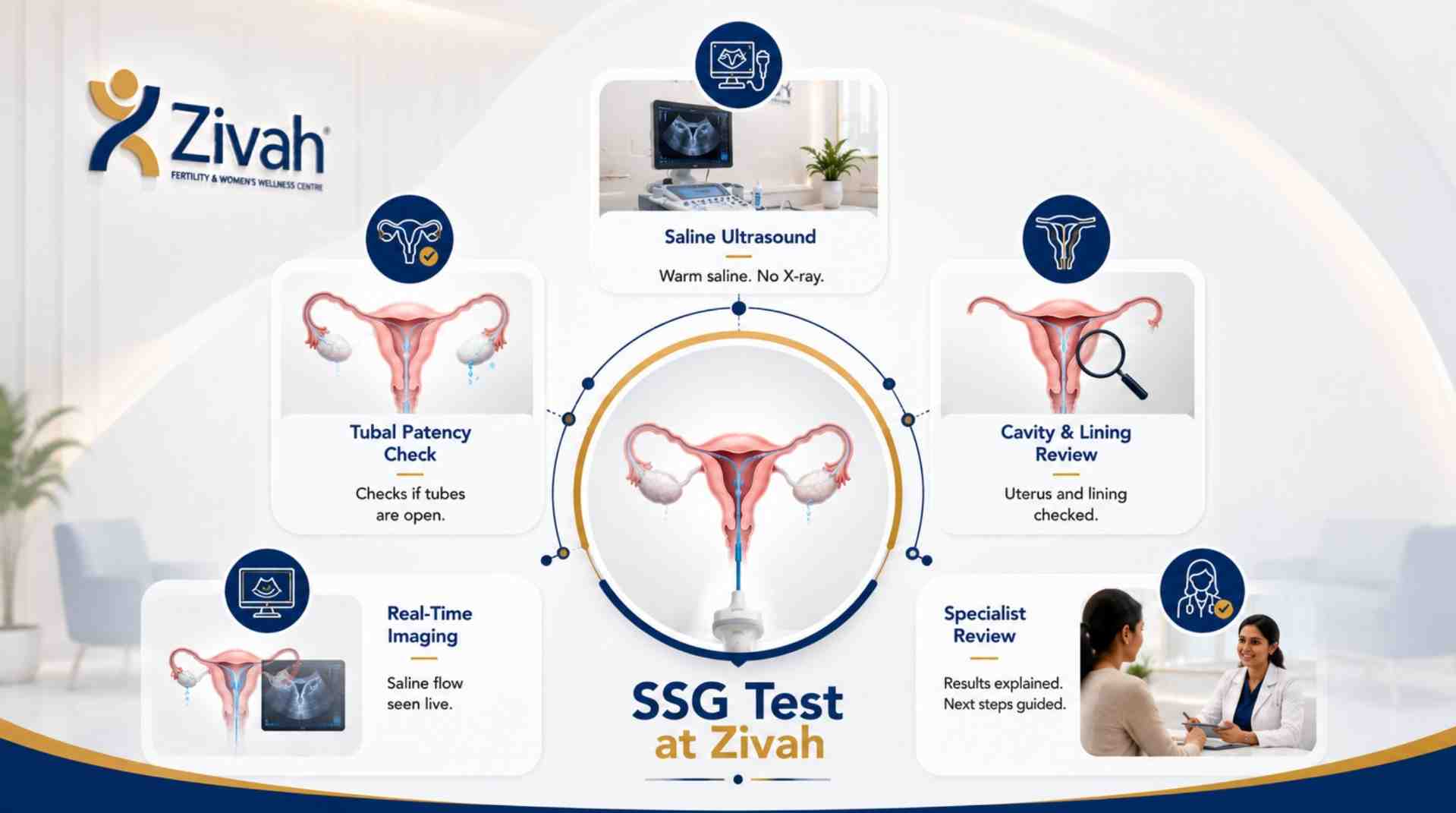
In the same sitting, we also review your uterine cavity and lining. There is no X-ray and no radiation, and it is done as a simple outpatient visit. Best of all, your scan is read by a fertility doctor, so you leave with an answer and a clear next step.
Here is what your SSG test covers at Zivah:
| What You Get |
What It Means for You |
|---|---|
| Saline Ultrasound |
A scan using warm saline with no X-ray or radiation |
| Tubal Patency Check |
Checks whether your fallopian tubes are open or blocked |
| Cavity and Lining Review |
Examines the uterus and uterine lining during the same procedure |
| Real-Time Imaging |
Views the flow of saline live throughout the scan |
| Specialist Review |
Results are reviewed by a fertility specialist, with guidance on the next steps if needed |
In one visit, you get a clear starting point for your fertility plan.
How Is an SSG Different from a Normal Pelvic Ultrasound?
A normal pelvic ultrasound can see your eggs and uterus, but not your fallopian tubes. A standard scan can't reach this part of the body, but an SSG scan can, because it uses a saline solution to track its movement through the tubes. This is why an ultrasound of the fallopian tubes is done when the tubes are closed.
What's the Difference Between SSG and HSG?
There are two different ways to check if your fallopian tubes are open. In real time, (SSG) sonosalpingography uses ultrasound and warm saline, while (HSG) hysterosalpingography uses an X-ray and an iodine dye. This is the major difference between the two options. Because the SSG doesn't use radiation, it is often the first test selected.
This is how the two compare:
| Feature |
SSG |
HSG |
|---|---|---|
| Imaging |
Ultrasound with real-time imaging |
X-ray images |
| Radiation |
None |
Low-dose radiation |
| Contrast |
Warm saline (or air-saline mixture) |
Iodine-based contrast dye |
| Comfort |
Mild cramping |
Mild to moderate cramping |
| What It Views |
Fallopian tubes and uterine cavity in real time |
Outline of the fallopian tubes and uterine cavity |
| Best For |
First-line, radiation-free evaluation |
Detailed dye-based assessment when needed |
Neither test is better than the other; they answer slightly different questions. That is why your Zivah specialist selects the test that fits your history, rather than leaving the choice to you.
Should You Choose SSG or HSG?
You are not the only one who can decide whether to get an SSG or HSG test. First, our Zivah fertility team review your medical history to see if you've had any infections, scans, or plans for IVF. Then we choose the fertility test tube that will give you the most accurate, quickest results. For many couples, that's the SSG. The HSG is saved for when they need a more thorough dye outline before IVF.
What Can an SSG Test Reveal About Your Fertility?
An SSG test checks to see if your uterus is ready to carry a baby and your fallopian tubes are open. A closed fallopian tube test tells us right away whether saline can flow through normally or if it bumps into something. This one answer can change your whole plan for getting pregnant.
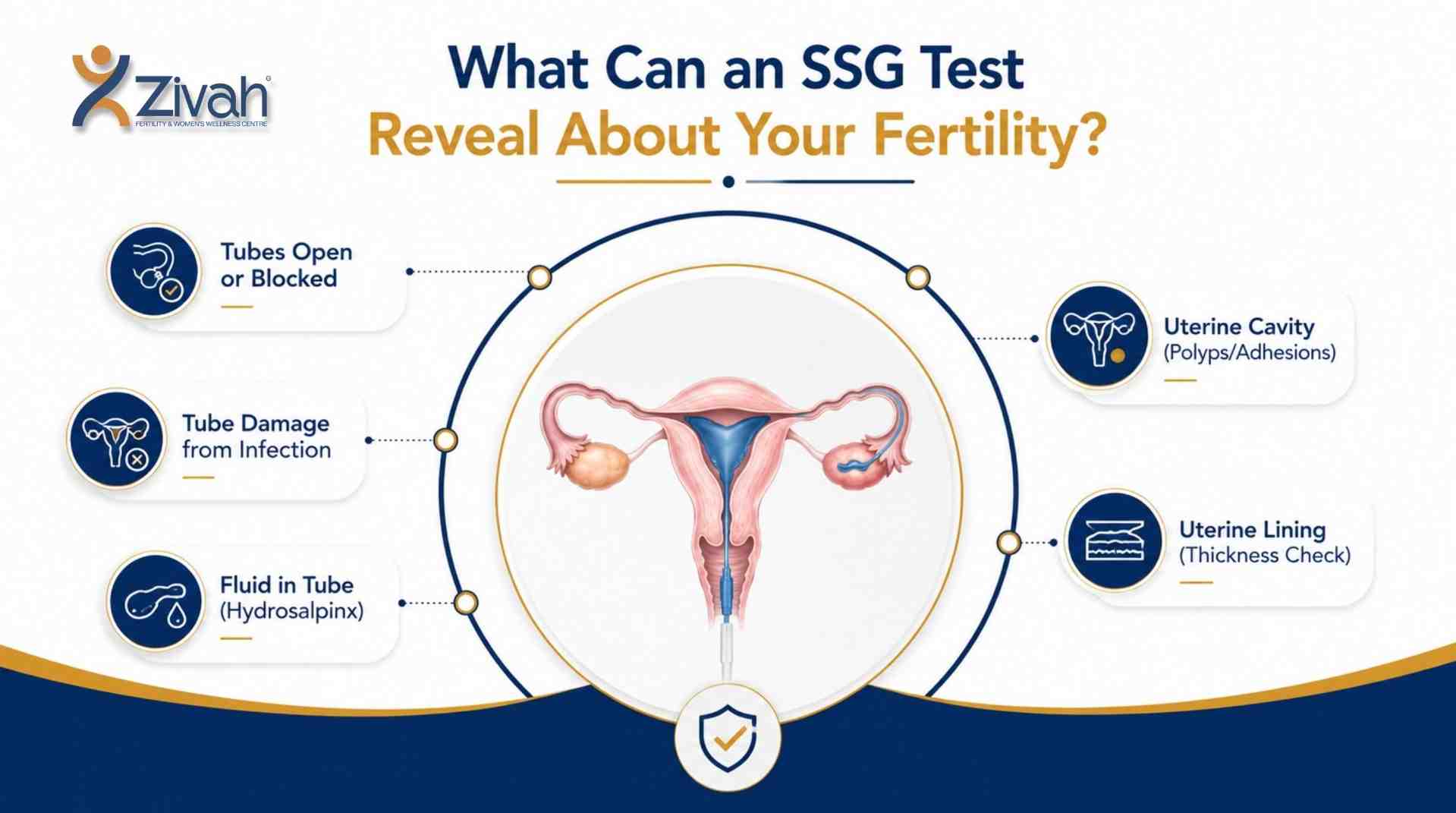
Used as an SSG for tubal blockage, the scan reveals a few key things in one sitting, and each one points to a clear next step:
- Whether your tubes are open or blocked: if we find a blockage, we map exactly where it sits and plan your next step.
- Tube damage from past infection: we trace the cause and guide the right treatment.
- A hydrosalpinx (fluid trapped in the tube): we flag it early, as it can lower IVF success
- The shape of your uterine cavity: polyps or adhesions, is checked in the same scan.
- Your uterine lining: We review the thickness and plan further care if anything needs it.
Every finding points to a clear next step, never a dead end.
What Does a Blocked Tube Mean for Getting Pregnant?
A blocked tube and pregnancy can still go together; it depends on how many tubes are affected. With one blocked tube and one open, natural conception is still possible because an egg can travel down the open tube. When both are blocked, we move you toward IVF, which bypasses the tubes altogether. Either way, your SSG tells us which path is yours, so there's no time lost in guessing.
Note: A tube can briefly tighten (spasm) during the test and read as blocked when it is in fact open. If a result is unclear, your doctor may suggest a repeat or a further test, with no rush.
When Is the Best Time for an SSG Test?
The best time for an ssg test is in the first half of your cycle, soon after your period ends. This window matters: your uterine lining is thin, ovulation has not yet happened, and the view of your tubes is at its clearest. Booked too early or too late, the same scan can be harder to read, so we plan cycle timing with you first. As a rule, the SSG test in cycle works best between days 6 and 11.
Here is when to do an SSG, and why each stage matters:
| Stage |
Cycle Days |
Why It Works |
|---|---|---|
| Too Early |
During your period |
Bleeding can affect visibility, so the test is not performed |
| Best Window |
Days 6–11 (after your period ends) |
The uterine lining is thin, ovulation has not yet occurred, and the view is clearest |
| Too Late |
After ovulation |
Usually avoided because of the possibility of an early pregnancy |
Once we know your cycle, we find the right day for you, no guesswork.
Why Does Cycle Timing Matter for an SSG?
Time improves the quality of the scan and reduces the risk of an early pregnancy. We set up your SSG after your period ends, so there is no blood in the way, and before you ovulate, so there is no risk to a pregnancy that may already be developing. This is the reason why an SSG before ovulation is safe and why we shouldn't do one after ovulation. There is no better time to read than a few days after your period.
What Happens During an SSG Test?
The SSG test is short, and you stay awake the whole time. When you get there, you lie down on the exam couch, just like you would for a normal pelvic scan. The cervix is opened, and a thin, soft tube made of soft plastic or rubber is slowly put into the uterus. Warm saline water is being added. Ultrasound tracks the fluid in real time as it flows. We watch the saline as it moves toward each fallopian tube and record whether it flows through easily or hits a blockage.
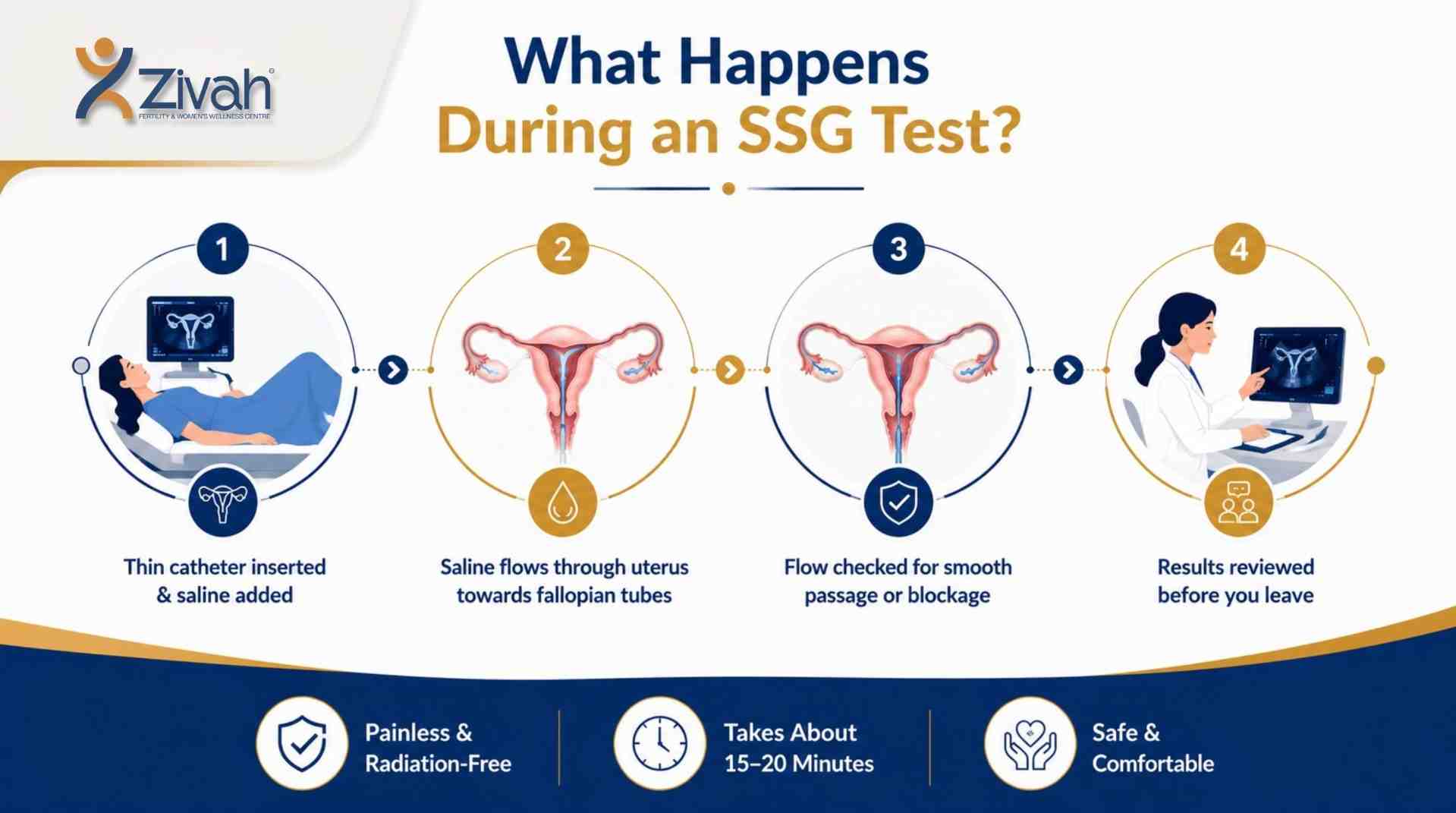
In short, here is what to expect during an SSG test:
- Not a single cut, shot, or X-ray is used in the scan; it is completely painless and doesn't use any radiation.
- After a short settling-in period, the test takes about 15 to 20 minutes.
- Before you leave, your fertility doctor goes over the results with you.
Does an SSG Test Hurt, and How Do You Prepare?
The test gives most women light cramps, which are a lot like period pain, and they go home the same day. Even though sonosalpingography doesn't eliminate sensations, it is short and easy to perform. A simple way to prepare for the SSG test is to schedule the scan for the first half of your cycle and take a small pain reliever before the test.
You don't have to fast, and you can get back to your day right away. When you book, we'll walk you through the easy steps so that nothing will be a surprise.
Who Should Book an SSG Test at Zivah?
If you have been trying to conceive for a year or more without success, an SSG test is often the sensible next step, and one we recommend early, because blocked tubes are a common, treatable cause of delay. So how do you know if you need an SSG test? It usually comes down to where you are in your journey. You may benefit from a fallopian tube test if any of these fit you:
- You've been trying for 12 months or more, or six months if you are over 35.
- You've had a past pelvic infection, ectopic pregnancy, or miscarriage, any of which can affect the tubes.
- Your doctor has advised a tube check before starting treatment, so your plan rests on a clear picture.
Sonosalpingography should not be seen as a problem at this point, but as the test that helps you make the right decisions about your fertility plan. We review the results with you at Zivah, then go right to the next step.
Do You Need an SSG Before IVF or IUI?
A lot of couples want to know if they need an SSG before they can start fertility treatment. At Zivah, this is often the first step toward finding the right one for you. Before IUI, we need to make sure that your tubes are open because sperm need a clear way to get to the egg. This is why an SSG is usually suggested before IUI. Before IVF, the look is different.
IVF skips the tubes, but a hydrosalpinx (a medical condition where a woman's fallopian tube is blocked and swells up with watery fluid) can make it less likely to work, so an SSG helps us plan around it. In any case, the test doesn't slow down your treatment; it changes it.
Why Choose Zivah for Your SSG Test?
Choosing the best SSG test centre isn't just about the scan; it's also about what happens afterwards. Experienced fertility experts do your test at Zivah, and the reports are read on the spot, so you don't just get a report to think about. You leave with answers and a plan. They should have both the scan and the next step in the process in the same building.

Here is why couples choose Zivah:
| What Matters to You |
What Zivah Offers |
|---|---|
| Skilled Team |
SSG performed by experienced fertility specialists |
| Results You Can Understand |
Findings explained by a doctor, not just a written report |
| One-Sitting Assessment |
Fallopian tubes and uterine cavity evaluated during the same procedure |
| A Plan, Not Just a Result |
Your findings are linked to a personalised fertility treatment plan |
| Care in One Place |
SSG integrated with your complete fertility care at Zivah |
If you have been searching for the best place for an SSG test near you, what matters most is exactly this: skilled hands, a clear result, and a team ready to guide your next step.
Who Carries Out Your SSG and on What Technology?
An SSG relies on high-resolution ultrasound to track saline through the tubes in real time, so the quality of the equipment affects the clarity of your results. At Zivah, the scan is done on modern ultrasound systems that capture tube and cavity detail in a single sitting, no radiation, no dye.
The SSG specialist guiding the scan adjusts the view in real time as the saline flows, catching subtle signs a still image might miss, so when couples ask which doctor performs an SSG test and how, the answer is a fertility expert reading detailed, real-time imaging, not a printout from a machine left to interpret later.
DISCLAIMER: An SSG test assesses whether your fallopian tubes are open and reviews the uterine cavity. It does not replace diagnostic laparoscopy, which remains the most accurate way to confirm tubal status, nor does it replace your specialist's advice.
Book Your SSG Test at Zivah
If blocked tubes might be standing between you and pregnancy, an SSG test is a clear, radiation-free way to find out, and the first step toward a plan that fits you. Booking your SSG at Zivah means more than a scan: it means a fertility specialist reading your result with you and guiding the next step the same day.
Reach out to book your SSG test and take that step with a team ready to help you move forward.