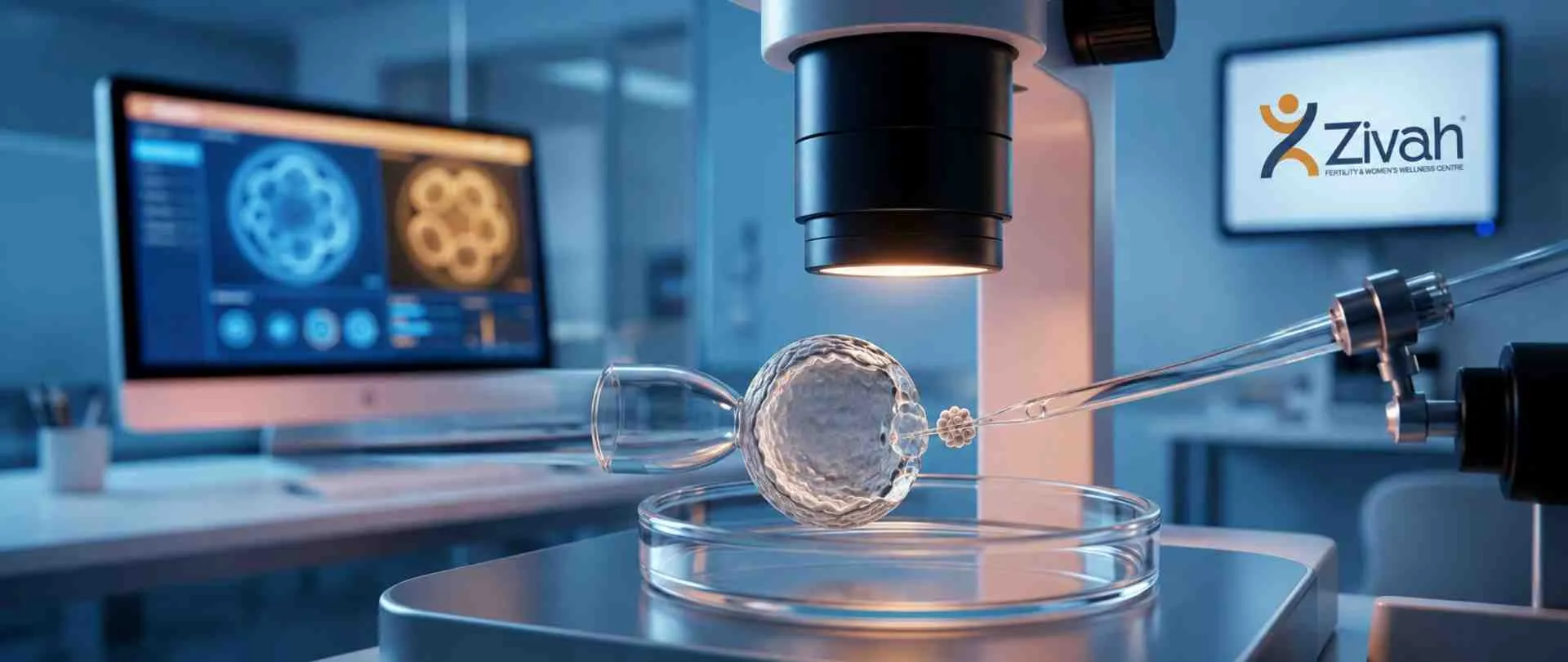

When genetic testing is part of modern IVF, the embryo biopsy is one of the most important steps. Basically, it’s the removal of a few cells from a growing embryo for testing, helping doctors select the healthiest embryo for transfer.
Here’s a common area of confusion: embryo biopsy and PGT are not the same. The biopsy is how we get the cells, and PGT is what we test the cells for. You can't do the test without the biopsy first; they are hand in hand.
At Zivah Fertility, we do the embryo biopsy in our own lab when the embryo reaches the blastocyst stage, when it is safe to do so. Here, we’ll explain everything about embryo biopsy in IVF, how it’s done, who it’s for, safety, success and cost.
What Is Embryo Biopsy in IVF?
It’s a lab process in which an embryologist carefully extracts a few cells from an embryo generated through IVF so those cells can be tested for genetic problems. The embryo is not injured; only a small number of cells are removed. This is after fertilisation, when the embryos are developing in the laboratory. Once the embryo reaches the appropriate stage, cells are removed for genetic testing.
In short, embryo biopsy in IVF is the bridge between fertilising the egg and choosing a genetically healthy embryo to transfer back. Hence, the embryo transferred back has the best chance of producing a healthy baby.
Embryo Biopsy vs PGT: What's the Difference?
People often use these names together, although they are not. Then the physical part, the embryo biopsy, actually takes cells from the embryo. That’s where PGT (preimplantation genetic testing) comes in, the lab test done on those cells thereafter. The biopsy takes the sample, and PGT reads it. Simple. You can’t do PGT without doing a biopsy beforehand.
Types of PGT: PGT-A, PGT-M and PGT-SR
Once the cells are gathered, they can be reviewed in many ways depending on what you are screening for:
| Test |
What It Screens For |
|---|---|
| PGT-A |
Chromosome count (aneuploidy), extra or missing chromosomes |
| PGT-M |
A specific inherited single-gene disease (e.g. thalassemia, cystic fibrosis) |
| PGT-SR |
Structural chromosomal rearrangements (translocations) |
When Is Embryo Biopsy Recommended? Candidates and Indications
It doesn’t need to be used in every IVF cycle, but for some couples it makes a huge difference. It is especially useful when there is a larger likelihood that the embryos may have chromosomal or genetic problems, and testing can help to select the healthiest embryo to transfer. Embryo biopsy is often recommended when there is a need to increase the odds, and ski[ when it will not give any benefits.
Who Benefits Most from Embryo Biopsy
Usually, doctors suggest embryo biopsy for:
- Older women (35+) - As women age, egg quality declines; hence, embryo biopsy for older women is useful in identifying chromosomally normal embryos
- Recurrent miscarriage - testing can lower the probability of another loss
- Repeated IVF failure - embryo biopsy for failed IVF cycles helps to rule out genetic causes
- Known inherited problems - if one or both couples possess a genetic disease, an embryo biopsy for genetic abnormalities can filter it out
- Severe male infertility - an increased incidence of chromosomal abnormalities
- Previous pregnancy with a chromosomal defect
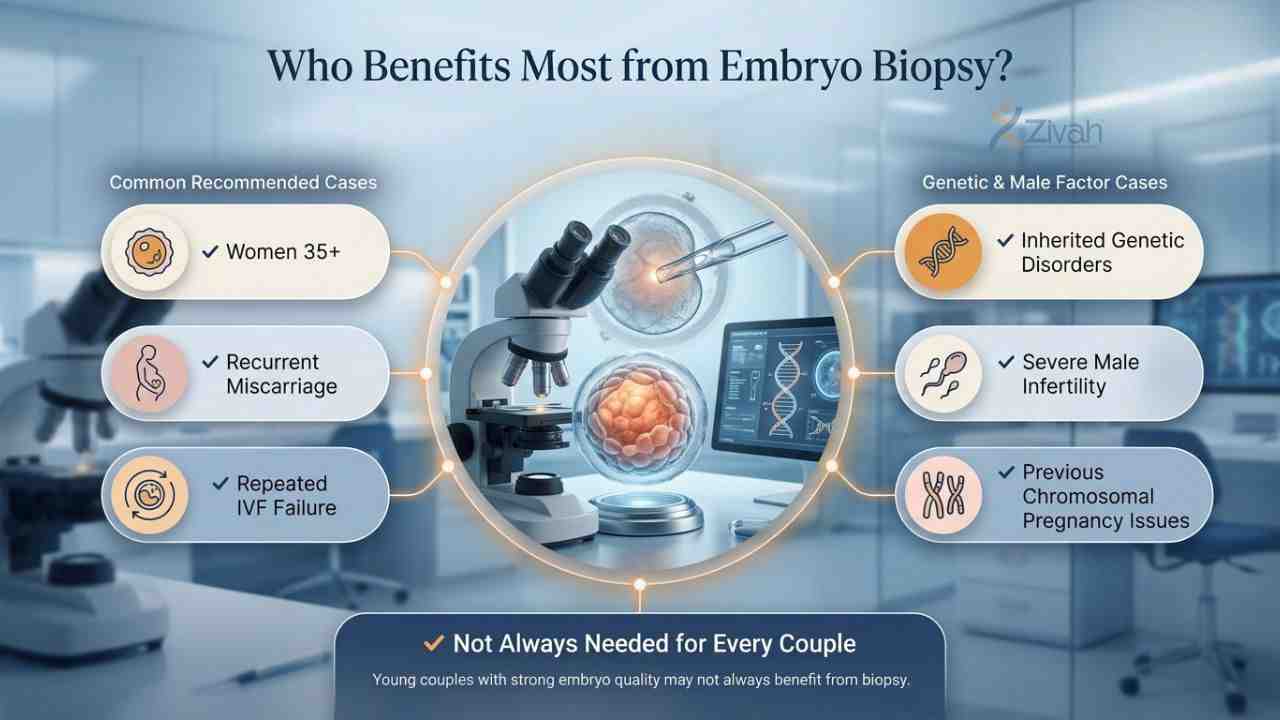
That said, it's not for everybody. For young couples with an excellent prognosis and no genetic history, or when you have only a few embryos, the additional stage may not offer much advantage. Your fertility professional will advise if it’s worth it for your case.
When Is the Biopsy Done? Why Blastocyst Stage Is the Safe Standard
Embryo biopsy can be done at three different points, and the timing is more important than most people realise; it affects both the safety of the biopsy and how reliable the genetic data will be. Here’s how the embryo biopsy stages compare, and why one has come to be the clear choice for the modern age.
- Polar body biopsy - done before the embryo is even formed. Polar body biopsy only reads the mother’s genetic contribution and misses the father’s side. This limits its usefulness, and it is rarely used today.
- Cleavage stage biopsy (Day 3) - when the embryo has just a few cells. One of the problems with cleavage stage biopsy is that you can put the embryo back just by taking one cell at this delicate period. Studies have shown that embryo biopsy on day 3 can significantly reduce the odds of embryo implantation.
- Day 5/6 blastocyst biopsy - the safe standard today. At this phase, the embryo has 100-200 cells, so that the embryologist can remove 4-6 cells from the trophectoderm. This outer layer will become the placenta, leaving the cells that will become the baby undisturbed. Blastocyst biopsy also means more cells for a more accurate genetic analysis, with no harm to the embryo.
| Parameter |
Polar Body |
Cleavage (Day 3) |
Blastocyst (Day 5/6) |
|---|---|---|---|
| Cells Removed |
Polar body only |
1 cell (blastomere) |
4–6 cells (trophectoderm) |
| Embryo Impact |
No embryo cells lost |
May reduce implantation |
No proven harm |
| Analysis Reliability |
Lower (maternal only) |
Higher mosaicism risk |
Most reliable |
| Current Use |
Rare |
Declining |
Modern standard |
How Embryo Biopsy Is Performed at Zivah: Step-by-Step
The embryo biopsy process, step by step, from fertilising the egg to selecting the healthiest embryo. A quick thing to know: This is a lab technique performed on the embryo, not on you; you won't feel anything during the biopsy itself. The embryology team at Zivah handles every step in a controlled cleanroom lab.
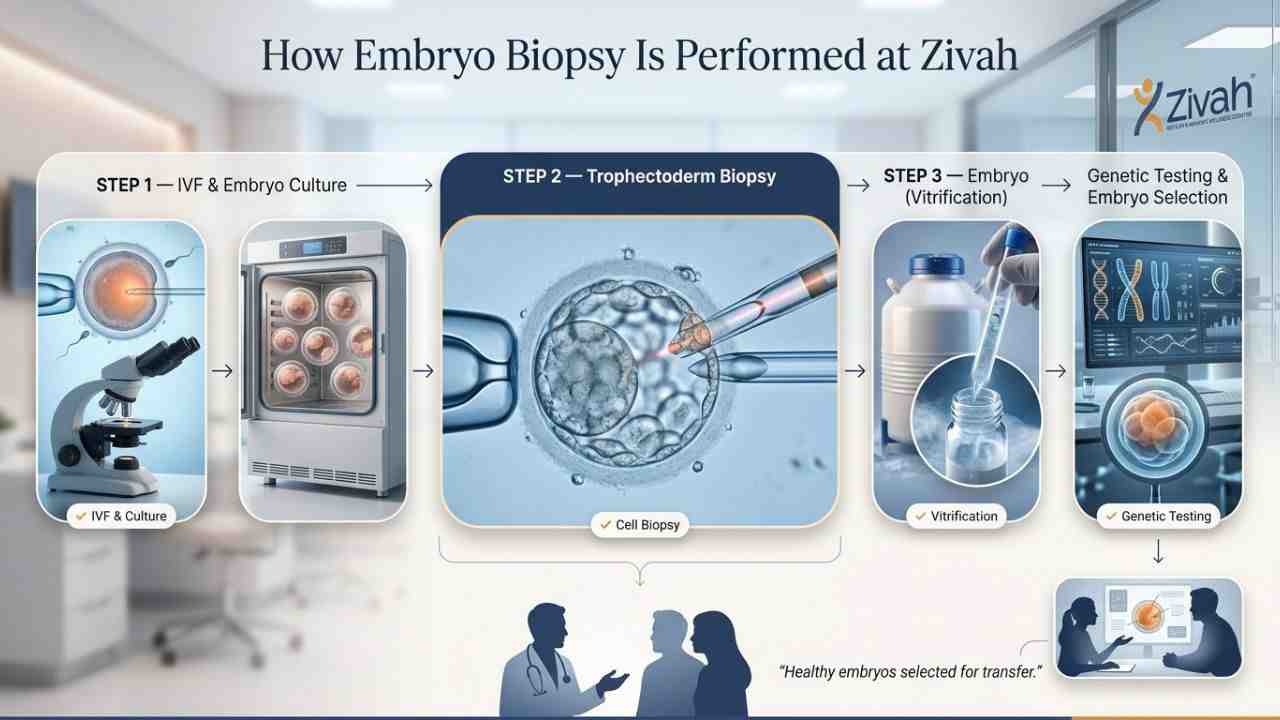
Step 1 - IVF, Fertilisation and Embryo Culture
The first step in the IVF embryo biopsy process is a regular IVF cycle. Eggs are removed and fertilised, commonly by ICSI, when one sperm is put directly into each egg.
If you’re going to do genetic testing, ICSI is better since, with conventional IVF, mistaken sperm cells might attach to the shell of the embryo and be picked up in the biopsy, giving a false genetic result. ICSI keep the sample clean. Embryos are cultured until days 5 or 6, and only those that reach the blastocyst stage are biopsied.
Step 2 - Trophectoderm Cell Removal
This is the core of the embryo biopsy process. The embryologist uses a fine laser to cut a small hole in the outer shell of the embryo under a high-powered microscope. They carefully remove 4-6 cells from the trophectoderm, the outer layer that will form the placenta. The inner cell mass (which is the baby part) is entirely undisturbed. This trophectoderm biopsy is a nice, skilled procedure that takes seconds.
Step 3 - Embryo Freezing (Vitrification)
Each embryo is vitrified (quick-frozen and properly preserved) immediately after the biopsy, while its cells are being evaluated. Freezing the embryo is a fast and reliable step, and more than 95% of embryos survive the freeze and thaw process. Freezing means no rush: the embryo waits safely until results are ready for a frozen embryo transfer.
Step 4 - Genetic Analysis, Counseling and Embryo Selection
After embryo biopsy, the biopsied cells are sent for genetic testing, where advanced DNA analysis (NGS or PCR) looks for chromosomal or single-gene abnormalities. Results often return within 5-7 days, and the genetically normal (euploid) embryos are selected for transfer. Before that, your Zivah team will walk you through your embryo genetic testing results in layman’s terms, so you know exactly what they mean and are confident about the next step.
How Embryo Biopsy Improves IVF Success Rates
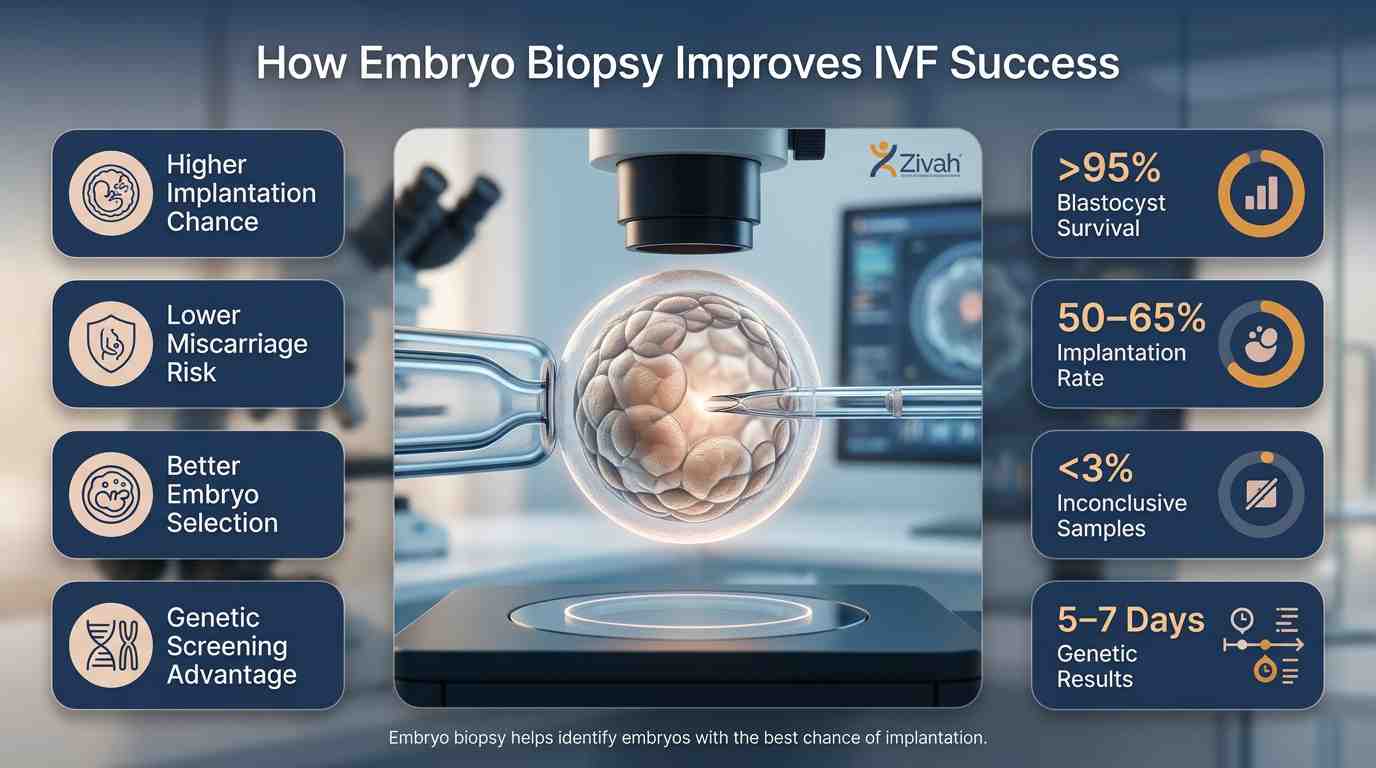
An important point regarding the embryo biopsy success rate that is easy to misread is that the biopsy itself does not produce success; it helps select for it. It allows your doctor to transfer the embryo with the best chance by detecting which embryos are genetically normal. This is what increases implantation and lowers miscarriage.
How does embryo biopsy improve IVF success? If you are transferring a genetically normal (euploid) embryo instead of an untested one, the chances of it implanting increase, and the danger of an early loss decreases. It’s done in the blastocyst stage, it doesn’t harm the embryo, it only offers you greater information to choose from. For the proper couples, embryo biopsy and genetic screening can make a big difference.
| Metric |
Reported Range |
|---|---|
| Blastocyst survival after biopsy + warming |
>95% |
| Implantation rate (genetically normal embryo transfer) |
50–65% |
| Undiagnosed/inconclusive samples |
<3% |
| Genetic result turnaround |
5–7 days |
Note: The implantation rate is based on the transfer of a genetically normal embryo, it results from better embryo selection, not from the biopsy itself.
Is Embryo Biopsy Safe for the Embryo?
Is Embryo Biopsy Safe? Yes, when performed on blastocysts by experienced embryologists. There is no evidence of impairment to the embryo's capacity to implant. The modest risks are genuine ones: very rarely, an embryo can be injured during handling, and not every embryo survives freezing and thawing. The blastocyst stage is usual now because the Day-3 biopsy was more risky.
One more thing to know, sometimes findings come back showing a mosaic embryo, a combination of normal and defective cells. If that’s the case, your Zivah team will explain what it means and help you determine the best next move.
Embryo Biopsy Cost in India
Actually, there is no fixed price for embryo biopsy in India, which is wonderful because you pay for what your situation requires. Embryo biopsy is not a stand-alone process; it is an add-on to your IVF cycle, layered on when genetic testing is part of your strategy. Instead of a single flat charge, the embryo biopsy cost is made up of several movable pieces that depend on you.
The main factor is simple: how many embryos you choose to test. Biopsy and testing are normally charged per embryo, so a couple with a lot of blastocysts will naturally spend more than a couple with one or two. It also depends on the type of genetic test you take; screening for chromosomal count (PGT-A) costs differently than tests for a specific inherited disease (PGT-M or PGT-SR).
What Affects Your Embryo Biopsy Cost
| Cost Factor |
What It Affects |
|---|---|
| Number of embryos tested |
Biopsy and testing are usually priced per embryo |
| Type of PGT |
PGT-A, PGT-M, and PGT-SR each carry different costs |
| Lab and technology |
NGS-based analysis and lab quality affect the price |
| Embryo freezing |
Vitrification and storage may be added |
| IVF cycle itself |
Biopsy sits on top of your base IVF cost |
Different couples, different amounts of embryos, various tests, different goals. The only honest way to give you a true figure is to look at your situation firsthand. Therefore, we do not provide a single price that fits all online. Book a consultation with Zivah Fertility, and our team will walk you through a clear, personalised breakdown, every component revealed, no hidden prices, no surprises later.
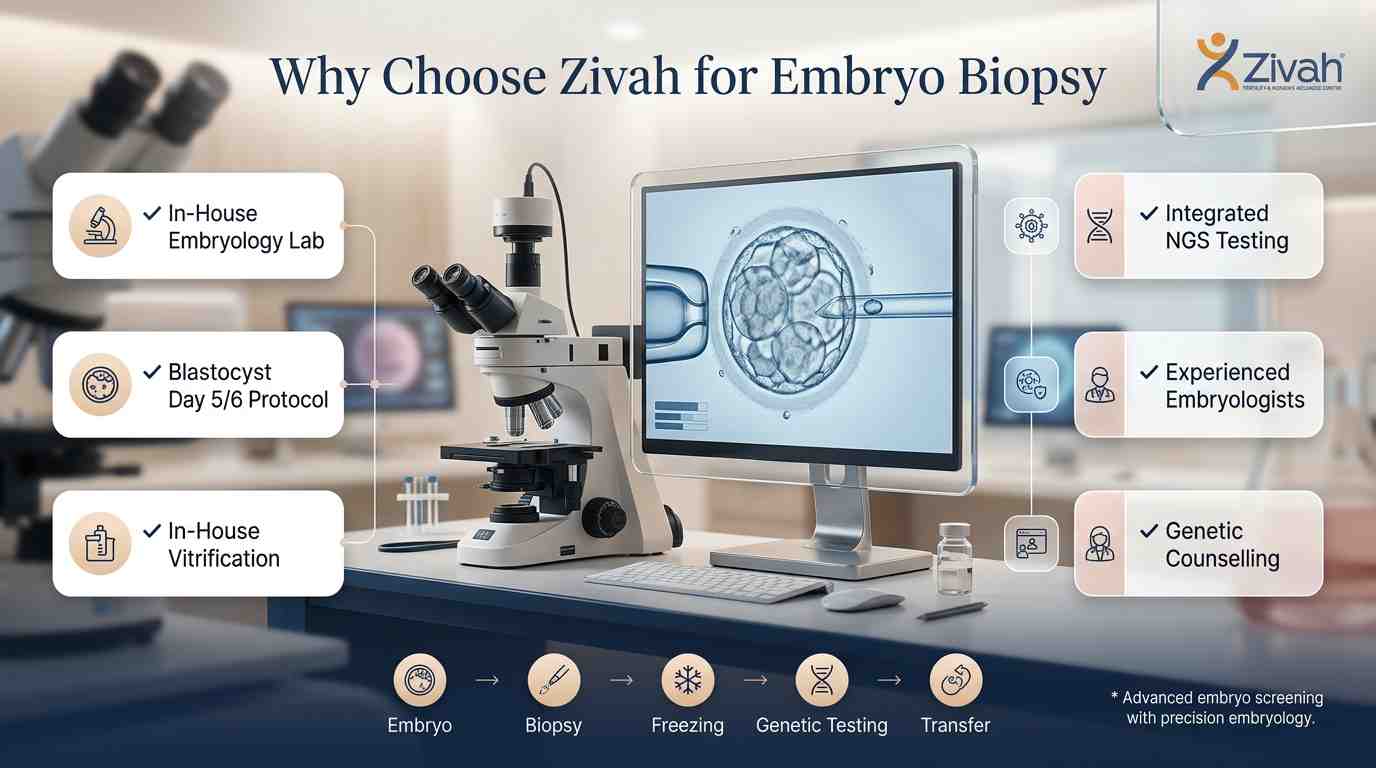
Why Choose Zivah for Embryo Biopsy
The lab is what makes all the difference with embryo biopsy. And the process is as excellent as the embryologist who does it. The technology is also important to the operation and Zivah is a top embryo biopsy clinic in India.
- In-house cleanroom embryology lab - all biopsies done in-house using high-magnification micromanipulation, never outsourced
- Blastocyst stage protoco - We use the day 5/6 technique, the safe, modern standard with no known harm to the embryo
- In-house vitrification - embryos are frozen in-house with over 95% survival rates
- Integrated NGS testing - advanced genomic analysis for accurate, dependable findings
- Experienced embryologists + genetic counselling - trained hands on the operation, and a staff that explains your results properly before transfer
Your Next Step
Embryo biopsy is a reliable and safe method of identifying the healthiest embryo, providing your IVF cycle the greatest possible opportunity and reducing the risk of miscarriage. But the outcome depends a lot on two things: the ability of the lab, and the application of the blastocyst-stage process.
You've given yourself every chance if you get both of those right. Ready to move on to the next step? Book a consultation with Zivah Fertility, and our embryology team will walk you through the options.