
NIPT test in pregnancy is a simple, safe, non-invasive prenatal test that screens for some genetic conditions early in pregnancy. It works by examining tiny pieces of cell-free DNA from the placenta that are circulating in the mother’s blood. This prenatal test evaluates the chance of your baby having a chromosomal abnormality, with no danger to your pregnancy, based on one blood draw.
This Zivah guide explains when the test is performed, how accurate it is, what your results mean, and how NIPT compares to traditional prenatal screening. It provides early, reliable insight to help guide decisions ahead in your pregnancy. NIPT is always optional - a personal choice you make with your doctor.
What Is the NIPT Test?
The NIPT full form in medical terms is non-invasive prenatal testing, sometimes called NIPS, is a prenatal screening test that checks your baby's chance of having a chromosomal condition such as Down syndrome.
So how does it do that from a simple blood sample? It looks for cell-free DNA, small bits of the baby's genetic material that normally travel from the placenta into the mother's bloodstream. Only one little draw is needed, as these pieces are already in your blood.
But why has it become so common? It's accurate, early and fully safe for the baby and can be done as early as 10 weeks into the pregnancy. But does a result mean diagnosis? No, and therein lies the point. It predicts the likelihood of a problem, not the diagnosis. But that one difference determines how every single outcome is interpreted and what happens next.
How Does the NIPT Test Work?
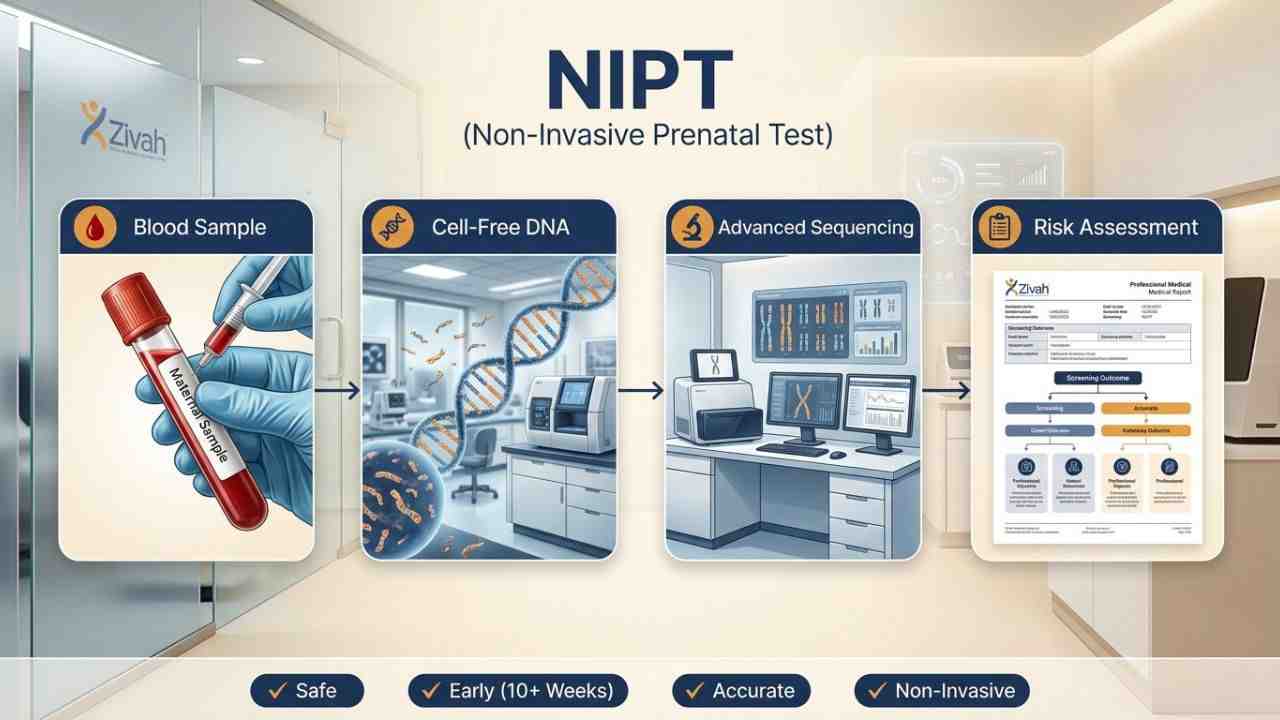
It starts with a simple blood test, a tiny sample from the mother's arm, just like any ordinary one, no fasting or special preparation required.
What happens to that sample then? It is tested in the lab for fetal DNA, the cell-free DNA in the placenta that closely matches the baby's own. The advanced sequencing then looks at the genetic material on each chromosome to work out the risk of a problem.
Could any of these be harmful to the baby? Nope. You are only testing the blood of the mother; therefore, there is no needle anywhere near the baby, and no harm to the pregnancy. Here's a quick overview before we get going.
NIPT at a Glance
| Clinical Parameter |
Zivah Protocol Detail |
Patient Significance |
|---|---|---|
| Sample type |
Maternal blood draw |
Quick, routine, no risk to baby |
| Earliest timing |
From 10 weeks |
Among the earliest screening options |
| What it assesses |
Chromosomal risk |
Flags higher/lower chance, not a diagnosis |
| Risk to baby |
None |
Non-invasive, needle only in mother's arm |
| Result type |
Screening, not diagnostic |
A high-risk result needs confirmation |
| Turnaround |
~7–14 working days |
Plan follow-up around this window |
What Does the NIPT Test Screen For?
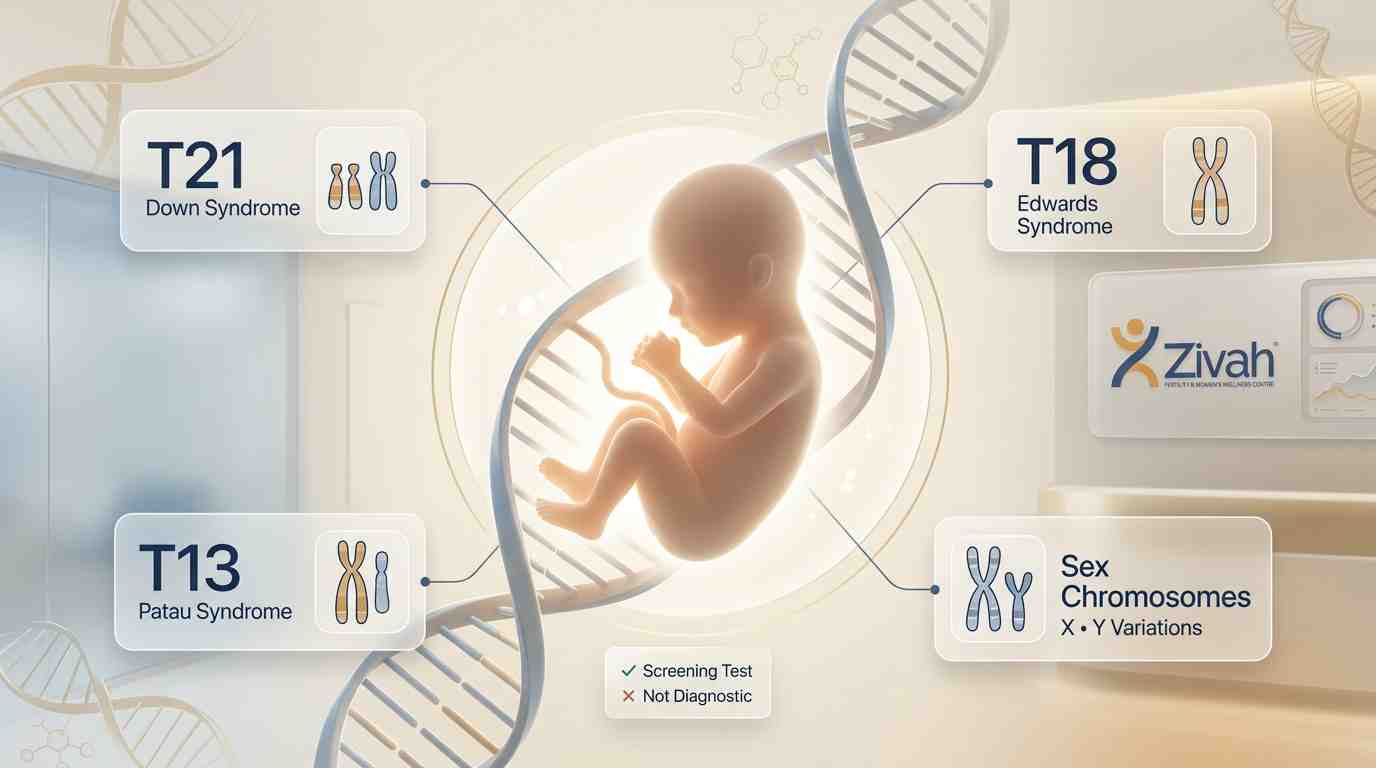
NIPT screens for the most common chromosomal conditions, which are caused by an extra or missing chromosome. So what conditions are covered? The three main ones are Down syndrome (Trisomy 21), Edwards syndrome (Trisomy 18) and Patau syndrome (Trisomy 13).
Most panels also look for changes in the sex chromosomes, such as those seen in Turner and Klinefelter syndromes. It is primarily valued as an early, reliable test, a sort of prenatal screening for chromosomal problems.
However, what doesn’t it include? This is equally important. It does not screen for neural-tube defects, physical (structural) issues, or most single-gene conditions, and it does not replace your abnormality ultrasound.
One more thing to know: panels are panels. Larger “advanced” panels that include rare illnesses or microdeletions are less reliable and are best selected with genetic counselling rather than as a default option.
Conditions NIPT Screens For
| Chromosomal Condition |
Clinical Abbreviation |
Anatomical Characterisation |
|---|---|---|
| Down syndrome |
T21 (Trisomy 21) |
Extra copy of chromosome 21 |
| Edwards syndrome |
T18 (Trisomy 18) |
Extra copy of chromosome 18 |
| Patau syndrome |
T13 (Trisomy 13) |
Extra copy of chromosome 13 |
| Sex-chromosome variations |
e.g. Turner, Klinefelter |
Missing or extra X / Y chromosome |
NIPT Is a Screening Test, Not a Diagnosis
The key to restoring: it measures a risk, it never diagnoses a condition. So what do your NIPT test results really mean? Nothing is more certain than that the chance of each condition is either increased (high-risk) or decreased (low-risk).
It is a screening test for prenatal aneuploidy and can only tell you if you are at increased risk or not; it cannot give a definitive yes or no answer. That’s why a high-risk result has always been followed by genetic counselling and a diagnostic test to confirm.
When Is the NIPT Test Done in Pregnancy?
How many weeks for the NIPT test? It can be carried out from 10 weeks of pregnancy up to delivery. But why 10 weeks? Up to that point, there is usually not enough of the baby's DNA circulating in the mother's blood to provide an accurate result. By about 10 weeks, the fetal fraction has built up to a workable level.
So when will it be done? The practical minimum is 10 weeks, which is one of the earliest options and a big reason why so many parents select genetic screening at 10 weeks during pregnancy. There is no upper cut-off either.
While most individuals test in the first trimester to allow time for follow-up, it can still be done later in pregnancy if needed. The ideal window depends on your own pregnancy; therefore, your professional will tell you when the right time is.
Fetal Fraction, BMI, and "No-Result" Reports
The fetal fraction is simply the amount of the baby's DNA that is found in the mother's blood. The more of it there is, the easier it is for the lab to read a clear result.
But what if it is too low? Sometimes it can't get a clear reading, and the report comes back as a no-result (also known as inconclusive). But don't worry, it's nothing to worry about; it just shows there wasn't quite enough fetal DNA to examine.
One reason for a low fetal fraction is a mother's greater BMI. More blood volume dilutes the placental DNA, lowering the percentage. In that case, the usual step is simply a repeat blood draw a little later, once the fetal fraction has risen.
How Accurate Is the NIPT Test?
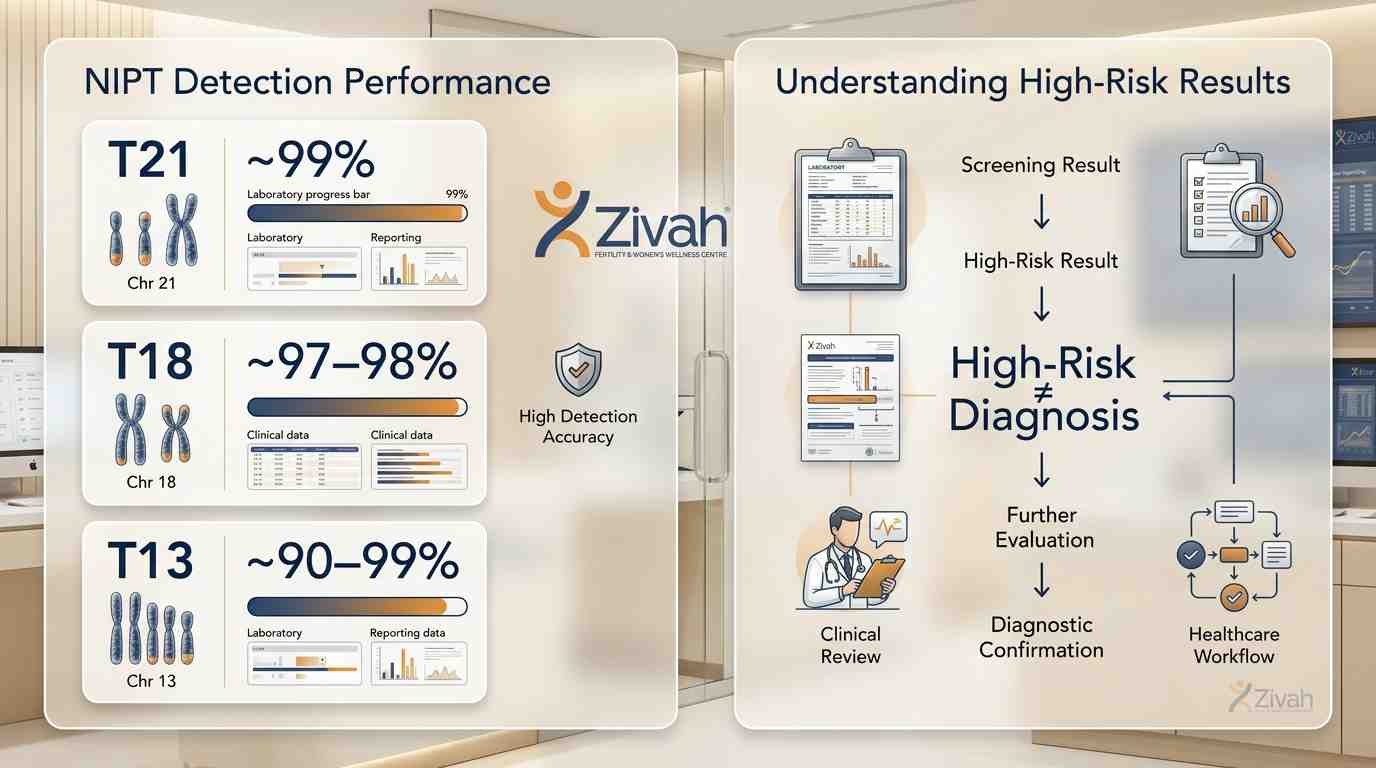
NIPT is one of the most reliable prenatal screening tests out there, but “reliable” takes some unpacking. How well does it detect Down syndrome? Very good. Down syndrome (Trisomy 21) can be detected about 99% of the time, with somewhat lower detection rates for Edwards (T18) and Patau (T13). It also generates much fewer false alarms than traditional screening approaches.
What affects NIPT accuracy? Mostly two things:
- Low fetal fraction: commonly associated with a higher BMI and can make results less reliable / no-result.
- Twin pregnancies: NIPT is still good, but detection is a little lower; hence, some laboratories utilise twin-specific panels.
So the headline figures are good, but there’s a major note on how to interpret a “high-risk” result, which we’ll discuss next.
What a High-Risk Result Really Means (Detection Rate vs PPV)
This is the most misunderstood part of NIPT; therefore, here’s the difference in plain terms:
- Detection rate (≈99%) – how often NIPT correctly detects a newborn who is positive for the disease.
- Positive predictive value (PPV) – the chance that a high-risk result means the infant is afflicted. This is normally a lot less.
What does a high-risk NIPT result truly mean? Not that your baby has the disease for sure. PPV is highest for Down syndrome, lower for T18 and T13, lowest for uncommon diseases, and varies with maternal age. Often, a high-risk result is followed by a diagnostic test that turns out to be entirely benign. That's why NIPT is a screen, not a diagnostic.
NIPT Detection Accuracy by Condition
| Target Aneuploidy |
Detection Rate (Sensitivity) |
False-Positive Baseline |
|---|---|---|
| Down syndrome (T21) |
~99% |
Very low (<0.1%) |
| Edwards syndrome (T18) |
~97–98% |
Very low |
| Patau syndrome (T13) |
~90–99% |
Low |
| Sex-chromosome conditions |
~90–95% |
Low–moderate |
Who Should Consider the NIPT Test?
The short answer here is: any pregnant woman who wants it. Now, this prenatal genetic screening test is recommended for all pregnant women and not only those who are high-risk by leading groups such as ACOG. It is no longer confined to certain situations.
That said, it is always an informed and optional choice. It's your decision whether or not to proceed, ideally after talking to your specialist or a genetic counsellor about what information the test can and can't provide. But for certain women, it's worth special consideration.
When NIPT Is Especially Recommended
It's worth thinking about, especially in a higher-risk pregnancy, if you, for example:
- Are of senior maternal age (often 35 and older
- Had an abnormal ultrasound result
- Received an abnormal result from a previous screening test
- History of chromosome abnormalities in the family
- History of prior pregnancy with abnormality of the chromosome
- Have experienced recurrent miscarriage
It's also popular with parents who just want the comfort of early-onset, low-risk. If you identify with any of these, NIPT can often be a wise choice, and a brief consultation can confirm whether it's the right choice for your pregnancy.
Understanding Your NIPT Test Results
How to read your NIPT results: It’s not a yes or no question For each condition, the report delivers one of two results: Low risk (decreased): The likelihood of such a condition is very low. That is comforting, but not an absolute promise. High risk (increasing): The risk is elevated; additional testing is necessary.
What if your result is high-risk? That doesn't indicate your baby has this issue. The next stage is genetic counselling and, if you like, a diagnostic test to confirm one way or the other. There is also a third possibility: a no-result (inconclusive) report, often from a low foetal fraction.
This isn’t a red flag, it just indicates the lab couldn’t get enough foetal DNA to interpret, and usually a new blood draw a little later will fix the problem. Whatever your result, your specialist will explain exactly what it means for you.
Fetal Sex and Indian Law (PCPNDT Act)
PCPNDT Compliance Notice: Disclosure, prediction or revelation of the sex of an unborn baby is banned in India under the Pre-Conception and Pre-Natal Diagnostic Techniques (PCPNDT) Act, 1994.
At Zivah, this is never done. NIPT includes analysis of sex chromosomes as part of its screening; however, this information is never recorded or shared. At Zivah, all NIPTs are screening tests for chromosomal health issues only. That’s not our policy; that’s the law, and we follow it without exception.
Understanding Your NIPT Result
| Report Result Category |
Clinical Interpretation |
Next Steps & Referral |
|---|---|---|
| Low-risk (decreased) |
Chance of condition is very low |
Routine antenatal care continues |
| High-risk (increased) |
Chance is raised, not a diagnosis |
Genetic counselling + diagnostic test |
| No-result (inconclusive) |
Not enough fetal DNA to read |
Usually a repeat blood draw later |
What Happens After Your NIPT Test?
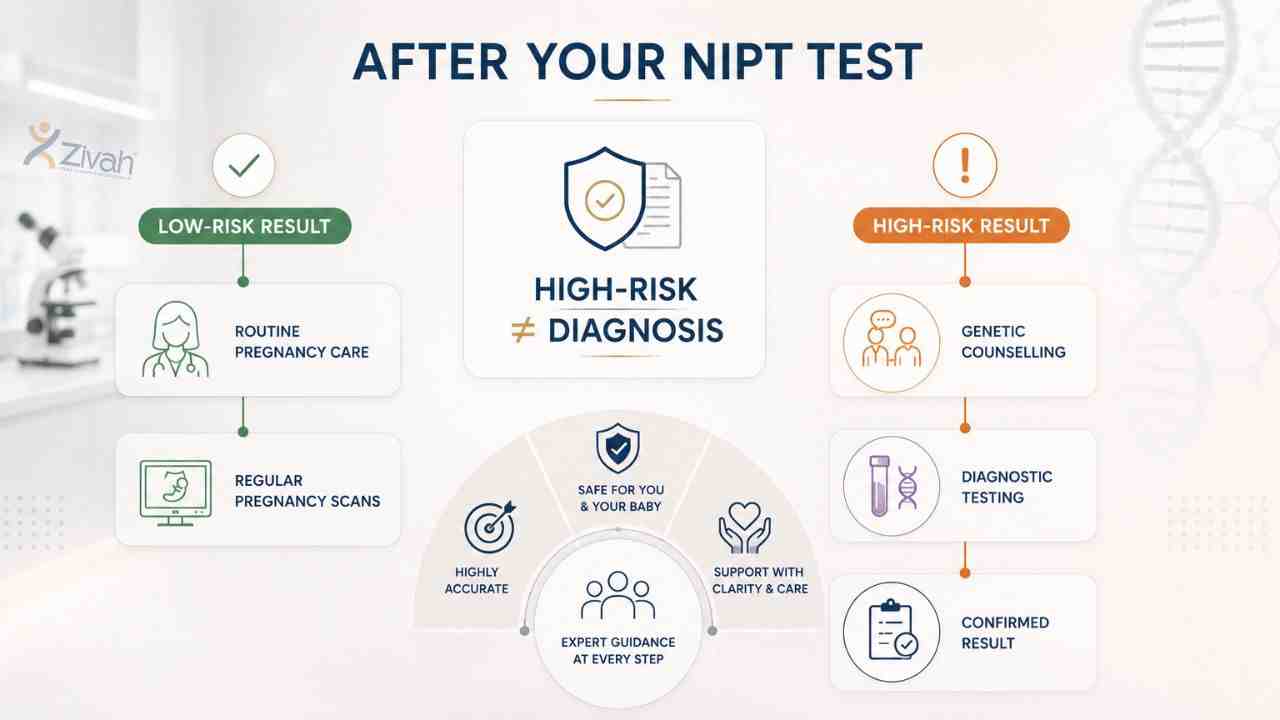
When the results are available, the next steps depend on the findings.If you’re low-risk, then usually there’s nothing else that needs to be done. You continue with your standard antenatal care and your normal pregnancy scans.
A low-risk result is reassuring, and for most women, this is the end of the NIPT journey.Your results are still worth discussing with your doctor, who can put them in perspective with your overall pregnancy. You will be offered prenatal genetic counselling if you have any queries at any moment to discuss things through.
Next Steps After a High-Risk Result
So what if your result is high risk? It’s a nudge for additional information, not a diagnosis.The first stage is prenatal genetic counselling, during which a professional will explain what the result means for you. From there, if you like, a diagnostic test can confirm things for sure:
- Chorionic villus sampling (CVS) - generally between 10 and 13 weeks
- Amniocentesis – commonly from around 15 weeks
They are the only tests that can give a definitive response. Read more on our Genetic Counselling and diagnostic-testing sites, and your specialist will point you in the proper direction.
NIPT vs Combined First-Trimester Screening
How does NIPT compare to earlier, more traditional screening methods? Both are screening tests for chromosomal disorders before birth, although they are extremely different. NIPT analyses the baby's cell-free DNA directly from a blood sample; therefore, it is more accurate, with far fewer false alarms.
The other screening is a combined screening that combines an ultrasound (the NT scan) and blood-test markers to assess risk.They are both safe. Neither is diagnostic; they just estimate the risk of a problem. The major variations are in method, time and accuracy.
Which Screening Is Right for You?
So, which one should you choose? It depends on what you value most, if early testing and more accuracy are important to you, NIPT is likely the best option, although some parents begin with combination screening as a first step. Your specialist can assist you in deciding based on your stage of pregnancy and your priorities.
NIPT vs Combined First-Trimester Screening
| Screening Feature |
Cell-Free DNA Testing (NIPT) |
Combined Screening (NT + Serum) |
|---|---|---|
| Method |
Maternal blood (fetal DNA) |
NT ultrasound + blood markers |
| What it analyses |
Baby's cell-free DNA |
Scan measurements + serum markers |
| Timing |
From 10 weeks |
11–14 weeks |
| Detection accuracy |
Higher (~99% for T21) |
Lower |
| False-positive rate |
Very low |
Higher |
Why Choose Zivah for NIPT Testing
What makes Zivah the perfect choice for your NIPT? It’s about doing the complete adventure well, in one place. Are you searching for a dependable prenatal testing clinic? At Zivah, your sample is handled by an approved laboratory, and your obstetric care and genetic counselling sit side by side, so a result is never given over without context.
There is always someone to explain what it means and what will happen next.We are also a trusted pregnancy genetic testing provider, holding firmly to PCPNDT compliance. This means you may be confident your care is both accurate and fully within Indian law.
As a dedicated prenatal genetic screening centre, Zivah combines accredited-lab processing, integrated genetic counselling, and strict PCPNDT-compliant practice, the three elements that matter most when you're deciding where to test.