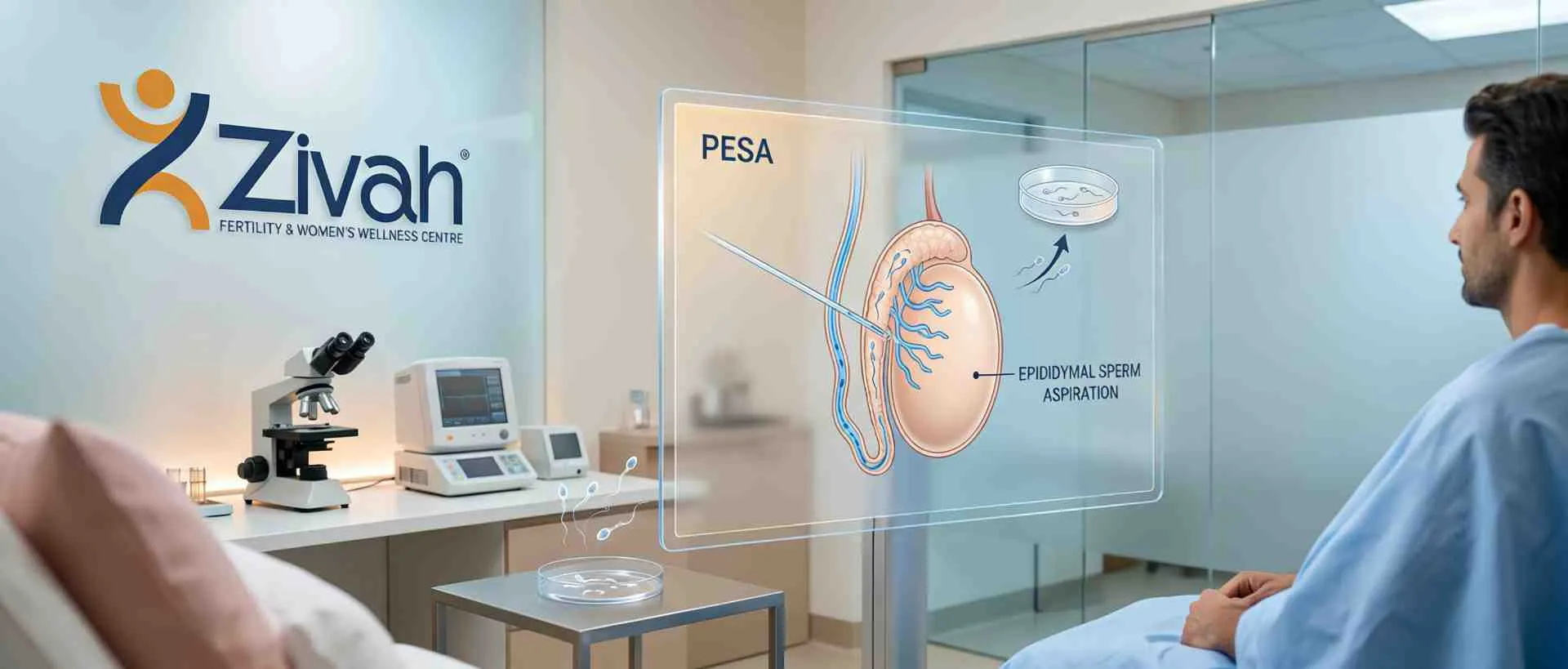
PESA treatment can still help you become a father if you have been told you have azoospermia, no sperm in your semen. Percutaneous epididymal sperm aspiration (PESA) is a simple, minimally invasive sperm retrieval procedure. It uses a fine needle to collect sperm directly from the epididymis, the coiled tube behind each testicle, where sperm mature.
PESA is most commonly used for obstructive azoospermia, in which sperm production is normal but the sperm are blocked from getting to the semen. They are often due to a previous vasectomy, infection or congenital blockage. In many cases, the sperm is already there; it only has to be retrieved.
PESA fertility treatment is combined with ICSI because only a few sperm are obtained. Here’s everything you need to know about PESA at Zivah Fertility, how it works, who it’s for, success rates, recuperation, cost, and what to expect.
What Is PESA (Percutaneous Epididymal Sperm Aspiration)?
Percutaneous epididymal sperm aspiration is a minimally invasive method to collect sperm when there is no sperm in the semen. A doctor uses a small needle to directly extract sperm from the epididymis, which passes through the block pathway altogether.
So here’s the anatomy quick. Just behind each testicle sits the epididymis, a tightly coiled tube. Sperm is made in the testes and then travels here to mature and learn how to swim. PESA reaches this point of storage directly through the skin of the scrotum.
That place is a major advantage for PESA. Because epididymal sperm have already matured, it's often better developed than sperm taken straight from the testes, a key reason doctors favour it for blockage-related cases.
PESA Full Form and Medical Definition
The full form of PESA is Percutaneous Epididymal Sperm Aspiration. In layman’s terms, “percutaneous” means through the skin, “epididymal” refers to the epididymis, and “aspiration” involves gently sucking fluid out with a needle. It is a basic phrase for surgical sperm retrieval performed in fertility centres around the world.
PESA vs TESA vs TESE vs Micro-TESE: Choosing the Right Method
PESA is not the only way to retrieve sperm, but you don’t normally get to your usual choice. The proper procedure depends on your diagnosis. Here’s how they match up. The main division is testicular vs epididymal sperm retrieval. PESA involves extracting mature sperm from the epididymis using a needle, while TESA extracts it from the testes. Because epididymal sperm are more mature, the difference between PESA and TESA often makes PESA the preferred option for blockages.
When a needle isn’t enough, the procedures step up: TESE is a small biopsy from the testes, and Micro-TESE uses a microscope to find if there is any sperm in non-obstructive situations. MESA is a microsurgical variant of PESA for larger yields or CBAVD.
How PESA Compares to Other Sperm Retrieval Methods
| Parameter |
PESA |
TESA |
Micro-TESE |
|---|---|---|---|
| Site of Retrieval |
Epididymis (needle) |
Testis (needle) |
Testis (microscope |
| Best ForMicro-TESE |
Obstructive azoospermia |
Obstructive azoospermia |
Non-obstructive azoospermia |
| Anesthesia |
Local / Short General |
Local |
General |
| Duration |
15–30 min |
15–30 min |
2–4 hours |
| Sperm Maturity |
Mature |
Immature |
Immature |
| Invasiveness |
Minimal |
Minimal |
Highest |
When Is PESA Recommended? Indications and Candidates
So, who needs PESA? The short answer: men with obstructive azoospermia have normal sperm production, but a barrier that prevents it from reaching the semen. If sperm are being created but can’t get out, PESA can be used to collect them directly. The most common signs for PESA are:
- After a vasectomy: Most common reason
- Blocked or missing sperm ducts, including CBAVD (born without the vas deferens)
- Scarring from infections blocking the epididymis
- Ejaculatory duct blockage
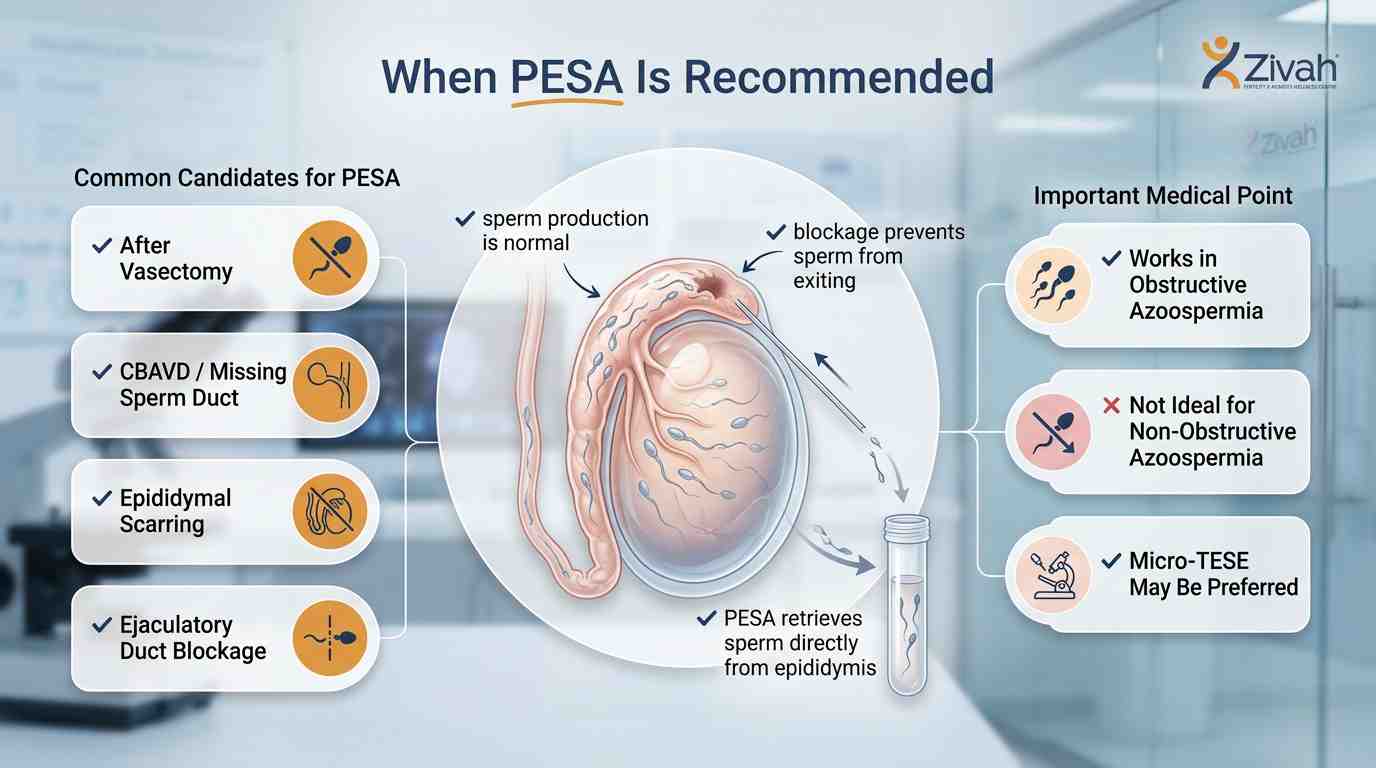
One important point is that PESA only works if sperm production is normal. It is not suitable for non-obstructive azoospermia, where the testes are not producing enough sperm. Instead, Micro-TESE is the ideal approach in these situations.
Obstructive Azoospermia and Blocked Sperm Ducts
PESA is a good choice for obstructive azoospermia if sperm are trapped behind a barrier. Common causes are blockage of the epididymis, obstruction of the ejaculatory duct and scarring due to past infections. So the sperm is there, and it is healthy, and the retrieval rates with PESA are really high.
Sperm Retrieval After Vasectomy or CBAVD
The reason sperm retrieval after vasectomy is most common is straightforward: a vasectomy stops delivery but not production. PESA after-vasectomy is a fast, less invasive procedure, frequently easier than a second vasectomy reversal surgery. It is also beneficial for males with CBAVD, born without the tube that delivers sperm.
How PESA Is Performed at Zivah: Step-by-Step Procedure
Curious about what happens during PESA? So here's the PESA procedure, one step at a time, from the exams beforehand to walking out the same day. It's quicker and easier than most guys think, and at Zivah, the andrology and embryology specialists work side by side, so everything is done in one visit.
Step 1: Pre-Procedure Tests and Evaluation
Before PESA, a few tests confirm the diagnosis and plan the retrieval. A semen analysis confirms the azoospermia, and a hormonal profile is run to make sure the sperm production is still working regularly. A scan of the testes and a check on your partner's fertility will complete the picture.
| Test |
Purpose |
|---|---|
| Semen analysis |
Confirms azoospermia (no sperm in semen) |
| Hormonal profile (FSH, LH, testosterone) |
Confirms sperm production is intact |
| Scrotal ultrasound |
Checks testicular and epididymal anatomy |
| Partner fertility evaluation |
Plans the IVF-ICSI cycle together |
Step 2: Anesthesia and Preparation
Is PESA done under anaesthesia? Yes, but only local anaesthesia, generally a spermatic cord block that numbs the area totally. If you like, sedation can be offered. It takes about 5-10 minutes to get numbed, and it's an outpatient setup, so no hospital stay. You stay awake yet experience no pain.
Step 3: Epididymal Sperm Aspiration
This is the crucial stage: how sperm is collected in PESA. A thin needle (21-26 gauge) is inserted through the scrotal skin into the epididymis, generally the caput, the area where sperm is normally most active. The fluid containing sperm is drawn out by gentle suction. Most men feel little more than mild pressure, and the whole step takes approximately 15-30 minutes.
Step 4: Real-Time Microscopic Confirmation
The aspirated fluid is immediately handed over to the embryologist for microscopic examination. If they find live sperm, they do the surgery. If not, the surgeon may try the other side or switch to a rescue TESA, so you leave knowing the result, not waiting for it.
Step 5: Sperm Processing and Same-Day Discharge
Once sperm is found, it’s washed and analysed, and either used fresh for ICSI the same day, or frozen for a later round. You rest a little bit, and you go home that day. No overnight stay needed. So what comes next after the sperm is collected? That’s where ICSI comes in.
PESA and ICSI: Why Retrieved Sperm Needs Injection
Getting the sperm out is a huge step. But it’s not the final stage. PESA and ICSI nearly always go together. Sperm acquired via PESA can’t fertilise an egg in the normal manner on their own.
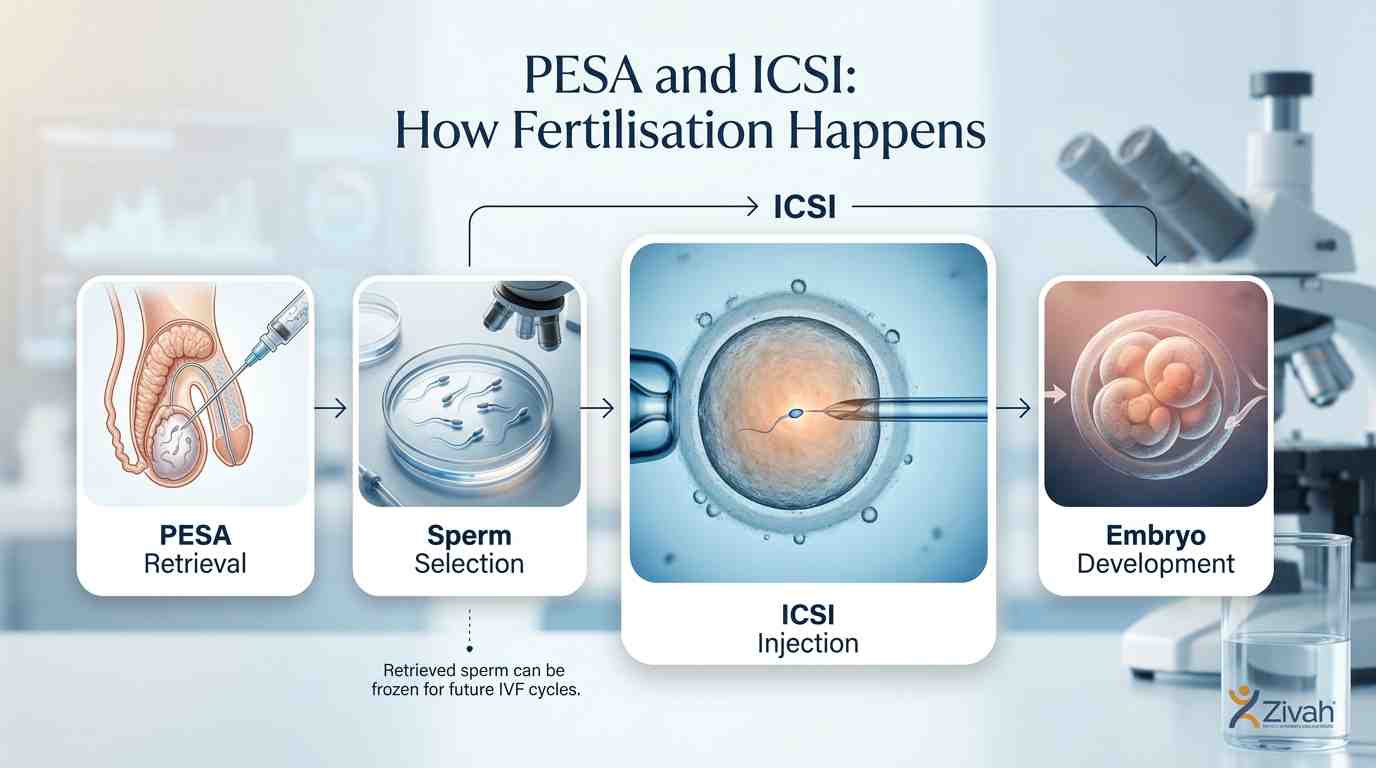
Here's the simple reason: PESA recovers a little volume of sperm. And sperm taken from the epididymis does not fertilise well in normal IVF, where it has to find and enter the egg itself. “So instead of leaving that up to chance, what the doctors do is ICSI treatment. They take one good sperm, and they inject it right into the egg. It’s a much surer path to fertilisation. This is the complete pathway:
- PESA - sperm is taken from the epididymis.
- Preparation - the lab cleans the material and picks the best sperm.
- ICSI - one sperm is injected straight into each egg.
- Embryo transfer - embryo matures and is transferred to the womb.
PESA can be timed on the day of your partner’s egg retrieval or performed ahead of time with the sperm frozen. Excess sperm can be frozen and kept; thus, one PESA can be used for more than one IVF attempt, and you may never need the procedure again.
How Successful Is PESA? Sperm Retrieval Rates Explained
When males ask about the PESA success rate, they’re generally looking at three separate numbers without realising it. It is useful to separate them because each measures a different stage of the journey.The first is the sperm retrieval rate: did we actually retrieve sperm? This is high for obstructive situations.
The second is the ICSI fertilisation rate: did the sperm retrieved fertilise the egg? And third is the pregnancy rate per cycle, which also depends on your partner’s fertility, her age and egg quality. A strong retrieval is a good sign, but that’s only the first of three steps to a pregnancy.
The good news: For azoospermia due to blockage, the success rate for epididymal sperm aspiration is among the greatest of any retrieval procedure.
| Metric |
Reported Range |
|---|---|
| Sperm retrieval rate (obstructive) |
51–100% |
| Motile sperm found |
62–94% |
| First-attempt success |
~75% |
| ICSI fertilization rate (PESA sperm) |
70–85% |
| Clinical pregnancy rate per cycle |
30–45% |
What If No Sperm Is Found During PESA?
It’s the question every guy worries about, so let’s be honest. Can PESA fail? Yes, about 25% might not get sperm on the first try. But that is provided for. If no sperm is identified, the following steps are usually to attempt the opposite side, perform a rescue TESA or donor sperm IVF. A failed PESA is not the end of the journey, just a change of direction.
PESA Recovery and Safety: What to Expect Afterward
One of the great things about PESA is that it requires very little downtime. No cuts or stitches. Just a small needle point that heals itself. Most men recover within a few days, and serious complications are uncommon. Here’s the entire report on PESA recovery time and safety.
First 48 Hours and Return to Normal Activity
A little discomfort, light bruising, or a bit of PESA swelling in the first day or two is quite normal. During the first 24 hours, ice the area in 15-minute intervals. Wear snug cotton underwear or a scrotal support for 48–72 hours to be comfortable. The rest is usually treated with over-the-counter pain relief.
| Timeline |
Do |
Avoid |
|---|---|---|
| First 24 hrs |
Ice in 15-min spells, take it easy |
Hot baths, saunas, pools (48 hrs) |
| 24–48 hrs |
Return to desk work |
Heavy lifting |
| 5–7 days |
Get back to the gym |
Pushing too hard too soon |
| 7–10 days |
Resume sexual activity |
Rushing the timeline |
Side Effects and Repeat-Procedure Safety
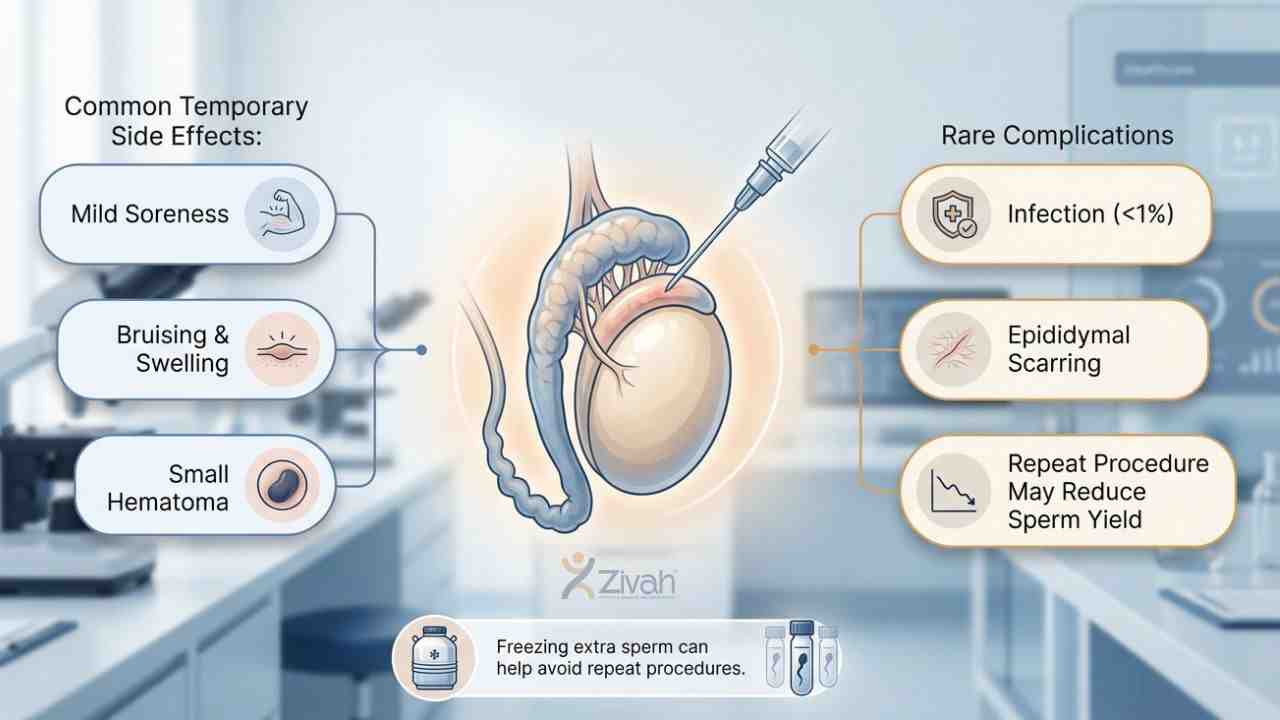
Is PESA safe? Yes, for practically all guys, the overall complication rate is just ~3.4%. Most of the negative effects of PESA are minor and temporary:
- Mild soreness – frequent, becomes better in days
- Bruising and swelling - common, will go away on its own
- Hematoma (small collection of blood) - uncommon
- Infection – very rare, less than 1%
- Epididymal scarring – rare, but can block any future reconstruction
If you ever require PESA again, the procedure may usually be repeated safely; however, a second attempt on the same side often produces fewer sperm (about 26 per cent). This is why preserving surplus sperm during your first cycle is the smartest approach to prevent a repeat treatment altogether.
PESA Treatment Cost in India
PESA treatment in India doesn’t have a fixed price; it depends on the treatment you need. A full PESA with ICSI package costs more than a separate PESA, and there are a few things that can affect the ultimate value.
| Cost Component |
What It Covers |
|---|---|
| PESA procedure |
Sperm retrieval and local anesthesia |
| ICSI cycle |
Egg retrieval, fertilisation, embryo transfer |
| Sperm freezing |
Cryopreservation and yearly storage |
| Pre-procedure tests |
Semen analysis, hormonal profile, ultrasound |
| Clinic and location |
Lab quality and city pricing |
As PESA is frequently performed as part of a complete IVF-ICSI package at Zivah Fertility, the best way to find out your specific cost is just to inquire. Book a free session, and you will be given a clear, tailored price depending on your situation, with no hidden charges or surprises down the line.
Why Choose Zivah for PESA Treatment
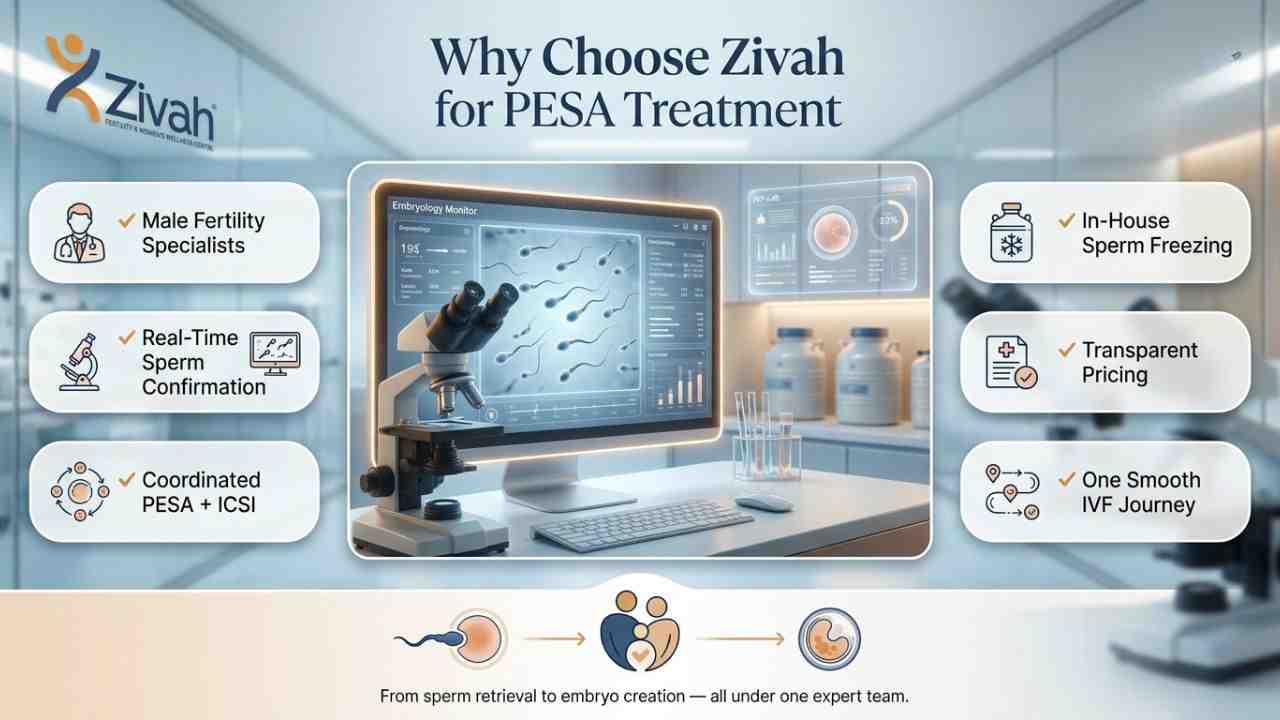
With PESA, where you get it done is just as important as the procedure itself. That’s because retrieval is only as good as the lab confirming the sperm and the team turning it into an embryo. Here’s what makes Zivah special:
- Dedicated andrology and fertility specialists - Your retrieval is performed by male fertility professionals, not handed around
- On-site embryology lab - your sperm is checked under the microscope, in real time, so you get your answer the same day
- Coordinated PESA + ICSI scheduling - one smooth, synced cycle instead of separate visits
- In-house sperm freezing - more sperm frozen on the same day, thus one process can be used for future attempts
- Transparent Pricing - Full quote before we start, no hidden fees
Your Next Step Toward Fatherhood
An azoospermia diagnosis is not the closed door it at first seems. For most men with a blockage, the sperm is already there; PESA just gets it out, and then it’s ICSI. With the right team and strong lab behind you, one minimally invasive procedure can often be all that stands between you and starting your family. Start today. Schedule your PESA consultation at Zivah Fertility, and discover your options.