

Mindfulness therapy at Zivah Fertility is a guided, one-to-one service for women carrying anxiety and stress through fertility treatment. Your specialist works with your attention and your breathing until the racing thoughts slow and the body finally loosens its grip.
Women often ask whether this is actually part of their fertility care or something separate. It sits inside your care here, not outside it. The person you sit with already knows where you are in your cycle and which week will be the hardest, so you never have to start from the beginning.
On this page, we will walk you through what mindfulness therapy is, who it is for, what happens in the room, and how your Zivah specialist helps you protect your mental health through the harder days. If the stress of treatment is starting to weigh on you, book a session with a Zivah specialist.
What Is Mindfulness Therapy at Zivah?
Mindfulness therapy at Zivah is a structured course of one-to-one sessions in which a specialist trains you to hold your attention in the present moment rather than losing it to worry about the future.
Is mindfulness therapy just meditation with a different name? It is not. Meditation is one technique within a larger set, and you can look at Mindfulness therapy, which is guided, structured, and led by a specialist, working towards something tailored only for you, whether that is sleeping through the night or walking into a scan without fear.
You and your therapist work on paying attention so you can catch a hard thought as it comes up and breathing so your body doesn't go into worry mode first. This is what it means to be aware for mental health. And not just a blank mind. You need to be able to stay calm in your mind while treatment goes on around you.
Is Mindfulness Therapy Safe During Fertility Treatment?
Yes. Mindfulness therapy is safe at every stage of treatment, including through an active IVF cycle. Could it interfere with my medication or my cycle? It cannot. There is no drug, no supplement, no procedure. The work is done through breathing and attention alone, so it sits alongside your treatment without even touching your medication or your cycle.
The Zivah specialist assigned to you will not work in isolation. They know your stage and what is coming next because they already speak with the team treating you.
Who Should Book Mindfulness Therapy at Zivah?
Mindfulness therapy at Zivah is for any woman whose mind has started to carry more than she can comfortably hold. You do not need a diagnosis, and you do not need a reason anyone else would recognise.
Do I have to already be in treatment to book this? No. Many women come to us before starting anything, simply to build steadier ground before the first cycle begins.
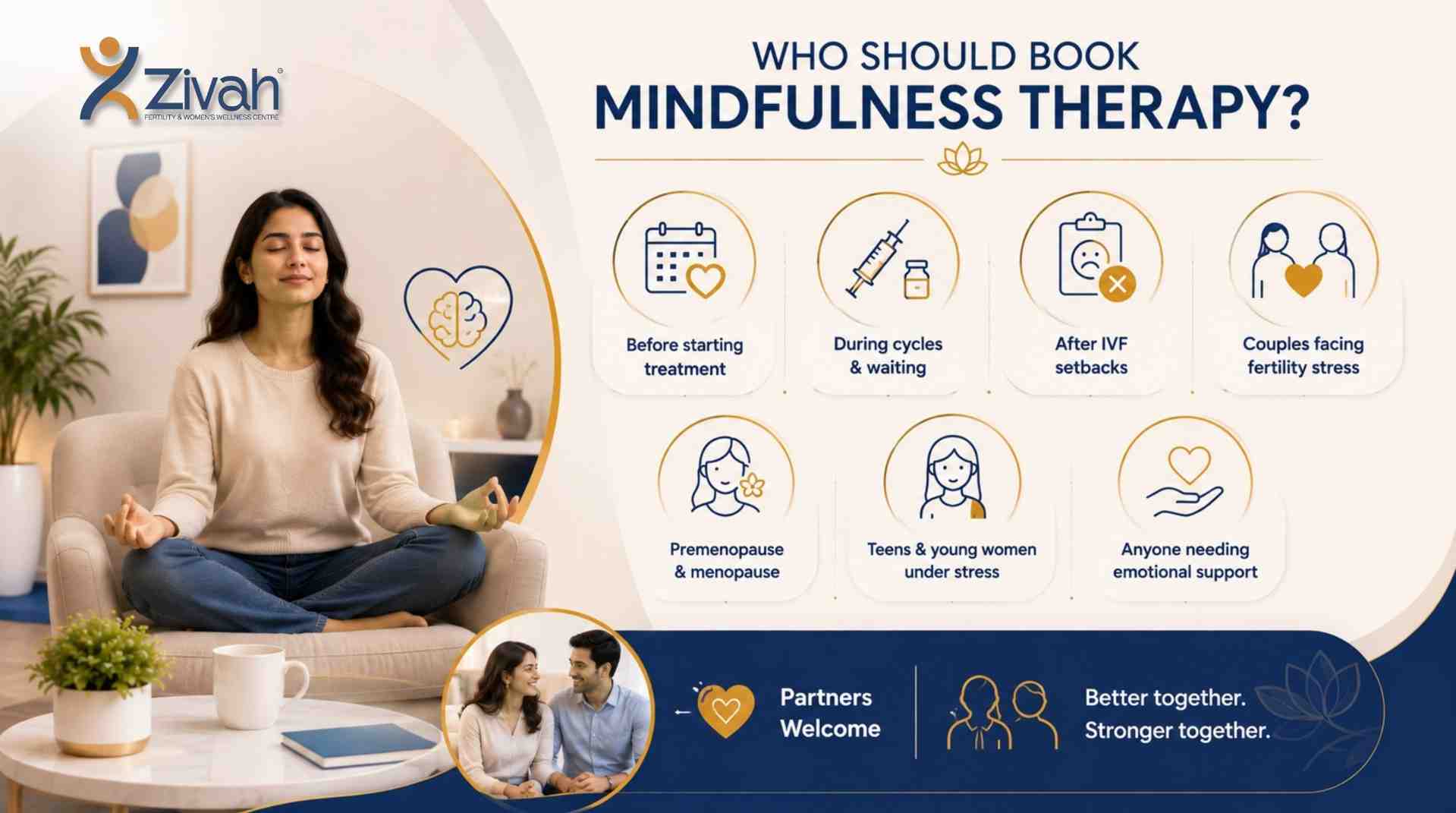
You may recognise yourself here:
- Women who are getting ready to start treatment and want to get their lives in order before the first cycle.
- Women in the middle of their cycles, having scans and shots, waiting in between.
- Women who have tried IVF but failed are thinking about whether to try again.
- There are some couples in which the stress affects each partner differently.
- Women going through premenopause and menopause.
- Adolescents, teens, and young women who are stressed about exams, their bodies, or their periods.
- Anyone who has never had a place to put this weight down.
Can my partner come with me? Yes, and it often works better when he does. Fertility pressure rarely lands evenly on two people, and a session with you both in the room lets your specialist work with it as it actually sits between you. Wherever you are in this, mindfulness for mental health at Zivah begins with one conversation
When Is the Right Time to Book Your First Session?
There is no wrong or correct week to start. As it is said, women tend to get the most from mindfulness therapy when they begin before the pressure peaks rather than at its height, because a skill is easier to learn when the mind has a little room. Is it too late if I am already struggling? It is not. Your Zivah specialist will simply start somewhere different, working first on settling the body before building the longer practice. Mindfulness in mental health care is not a course you can fall behind on. It meets you where you are.
What Signs Suggest You Need Mindfulness Support?
Stress rarely announces itself. It arrives as a shorter temper, a shallower breath, a night that will not close. Most women only recognise how much they were carrying once someone finally asks. What if it is not bad enough to need help? You do not have to reach a crisis to qualify. Simple, grinding stress is reason enough to walk in, and it is what most of our sessions are built around.
The signs below are the ones women most often bring to us. Each one has something happening underneath it, and each one has a way through.
| What You May Be Feeling |
What Is Happening Underneath |
How Zivah Helps You |
|---|---|---|
| Waking at 3 AM with a Racing Mind |
Your stress response remains active |
We build a calming night-time practice |
| Tight Chest, Shallow Breath, Racing Heart |
Your body is stuck in a stress response |
We teach breathing techniques that promote calm |
| Snapping at People You Love |
Emotional capacity is overwhelmed |
We help you notice and manage reactions earlier |
| The Same Worry Circling All Day |
Your mind is caught in repetitive thinking |
We teach techniques to interrupt the worry cycle |
| Feeling Flat, Numb, or Disconnected |
You may be emotionally overwhelmed |
We gently help you reconnect with the present |
| Dread Before Scans or Blood Tests |
Anticipatory anxiety is building |
We prepare coping strategies before difficult appointments |
None of these means something is wrong with you. They mean your body has been running its alarm system for too long without a break, and that is exactly what mindfulness and anxiety work are designed to interrupt. If two or three of those lines relate to you, a Zivah specialist can show you where to start.
What Happens During Your Mindfulness Therapy Session?
A session doesn't start with a workout, but with a talk. Your doctor will ask you what is causing you the most stress right now and then listen for what's underneath it. Once that is clear, you practice with your specialist in the room, who will correct you and keep you steady until the technique holds. You are given a short daily practice to do after the session. The next session will pick up where the last one left you.
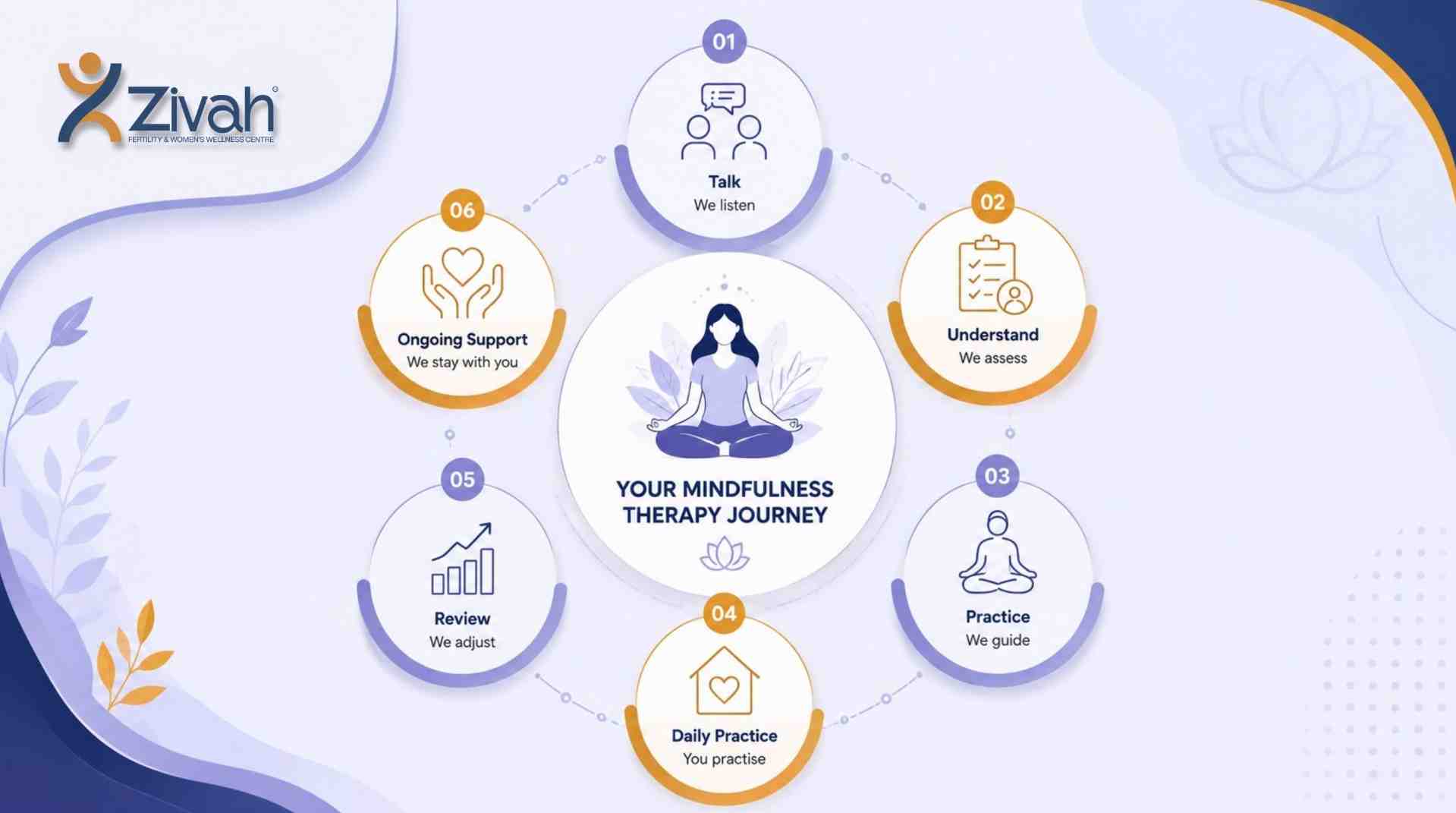
Will I have to talk about everything that has happened to me? Only as much as you want to. This is a room built around practice, not interrogation. Some women say very little in the first session and still walk out with something that works.
How many sessions you need depends entirely on what you are carrying. Your specialist will advise how many suit your situation, and nothing is fixed in advance.
| Stage |
What Happens |
How Zivah Helps You |
|---|---|---|
| First Conversation |
We discuss your main concerns and challenges |
We listen and identify where support is needed |
| Assessment |
We explore stress, sleep, and your current treatment journey |
We personalise the approach to your needs |
| Guided Practice |
You practise mindfulness techniques during the session |
We guide you until the technique feels comfortable |
| Home Plan |
You receive a short daily practice |
We keep it realistic and easy to follow |
| Review |
We discuss progress and challenges |
We adjust your plan based on what works |
| Ongoing Support |
Sessions continue as clinically appropriate |
We provide support through difficult periods |
Not a single thing in that order is rushed. It takes practice to learn how to be aware in the right way, and the whole point of the review stage is that the plan changes as your life does.
How Do You Prepare for Your First Mindfulness Session?
There's nothing you need to do. Don't bring anything with you; just show up as you are and wear something that won't bother you. Do I need to have practised before? Not at all. Most of the women who come in have never done this before, and some are sure they will fail at it. Your specialist starts from scratch, assuming you have no experience. Before you start, it's helpful to think about what you want to change the most: the way you sleep, the way you worry, or the way you have been reacting to people. That one answer gives the expert a place to start.
Which Mindfulness Techniques Will Your Specialist Use?
There isn't a single method that works for everyone. What you are taught changes based on where the stress is. A woman who can't sleep is given a different medicine than a woman in the waiting room whose chest gets tight. Do I need to sit cross-legged on the floor to do this? No. A chair, a bed, a walk, a waiting room. Wherever you are is where the practice works.
Every technique below works on the same system: the body's stress response. When the mind reads threat, the breath shortens and the nervous system tips into alarm. These are the tools that interrupt it. Structured mindfulness exercises of this kind have been found to lower reported anxiety and improve sleep, which is why mindfulness stress reduction sits at the centre of what we do.
| Technique |
What Your Specialist Teaches You |
What It Is For |
|---|---|---|
| Paced Breathing |
Slow breathing with a longer exhale |
Stress, panic feelings, and physical tension |
| Body Scan |
Notice sensations throughout the body without judgement |
Tension, stress, and sleep difficulties |
| Thought Labelling |
Recognise thoughts without automatically reacting to them |
Overthinking and repetitive worries |
| Sensory Grounding |
Focus on what you can see, hear, and feel |
Sudden overwhelm and appointment-related anxiety |
| Mindful Walking |
Focus attention on your steps and breathing |
Restlessness and difficulty sitting still |
| Self-Compassion Practice |
Respond to yourself with greater kindness |
Self-blame and emotional setbacks |
| Three-Minute Breathing |
Space A short mindfulness reset |
Work breaks, waiting rooms, and stressful moments |
Most women learn two or three of these, not all seven. Your specialist builds you a small set you can actually reach for under pressure. If you would rather work with movement as well as attention, our fertility yoga sessions run alongside this one.
How Does Your Specialist Decide Which Technique Is Right for You?
The symptom that costs you the most is the first thing your doctor looks at. If you can't sleep, do the body scan and paced breathing first. This is because the body needs to settle down before anything else can work. Thought labelling comes first if a thought keeps going around all day.
The choice is also based on how you will be treated. Your doctor may have you focus on sense grounding before the scan because it is the best mindfulness exercise for anxiety that can be done in the waiting room. Later on, emotional control is built.
There is no fix. After two weeks, if a method isn't working, it's changed.
Can Mindful Eating Support Your Practice at Home?
Yes, and it is one of the easiest mindfulness activities to fit into a day with no spare time. Mindful eating has nothing to do with what is on the plate. It is attention training, applied to a meal. You put the phone down, slow the pace, and notice whether you are actually hungry or simply topping up after a stressful afternoon. Will this tell me what I should be eating? It will not. If you want to know which foods genuinely support fertility, read our guide on the top fertility-boosting foods recommended by fertility experts, and speak to our Nutrition Counselling team.
What Results Can You Expect From Mindfulness Therapy?
Most women first notice a change in their bodies, not their minds. It's inside the body. The shoulders drop, the chest opens up, and the night stops being something to survive.
Is being aware going to help my chances of getting pregnant? We won't tell you otherwise, so don't ask. Mindfulness isn't a way to get pregnant, and it doesn't take the place of one. The benefits are that it makes treatment easier, helps you sleep better, and keeps you going through the process without stopping.
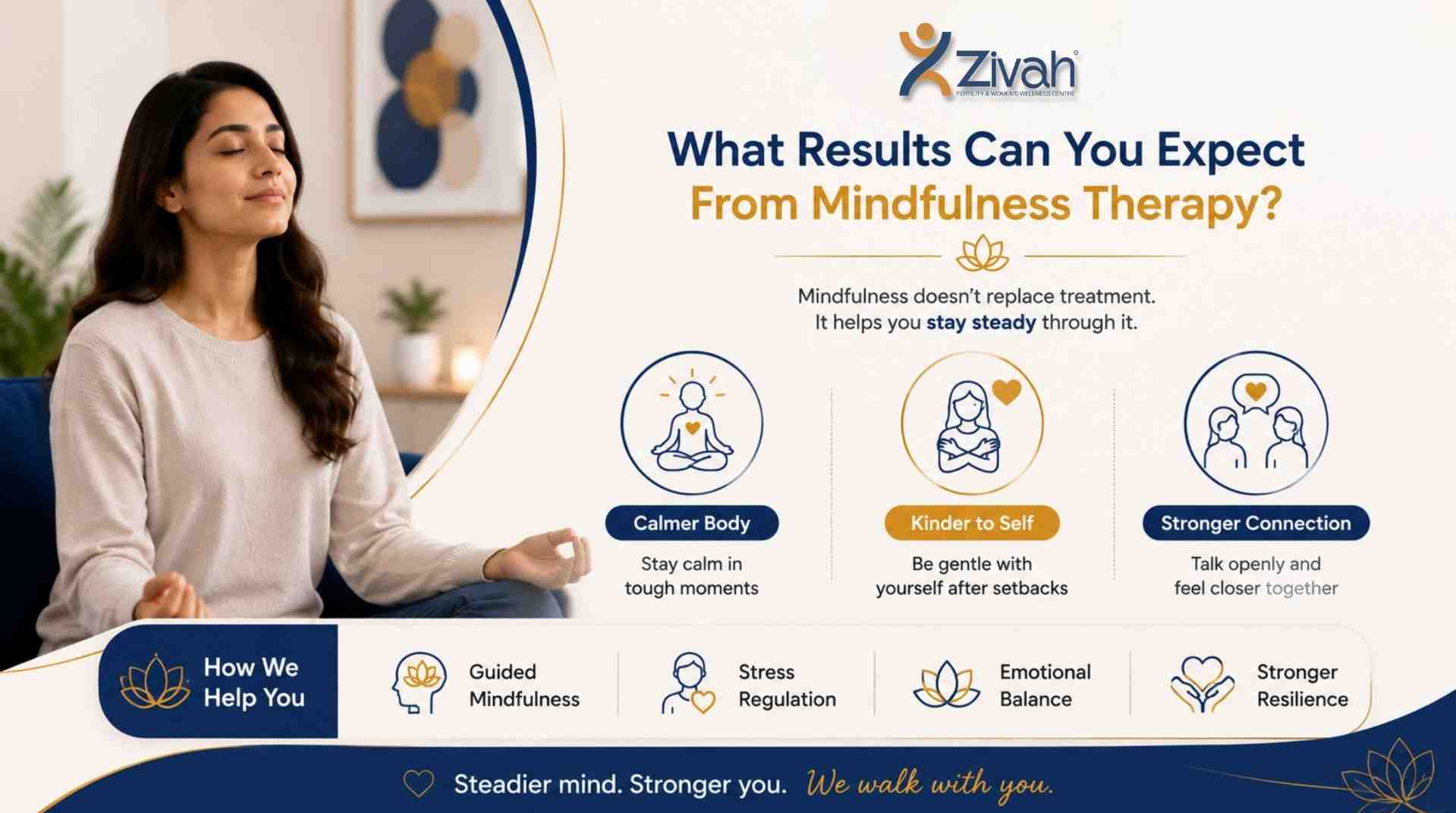
Women who finish a course with us tend to describe the same three things:
- Being able to wait in a room without having their heart race.
- Being nicer to themselves after something bad happened.
- Being able to talk about it again with their partner.
Those are the mindfulness benefits we work towards with you, session by session, and the table below sets out how we do so.
| What We Work Towards |
What May Change for You |
How Zivah Helps You |
|---|---|---|
| Lower Anxiety |
You may manage anxious thoughts more effectively |
We help you practise coping skills regularly |
| Better Sleep |
Improved ability to relax and settle before sleep |
We build a practical wind-down routine |
| Steadier Emotions |
Greater awareness before reacting |
We develop skills for responding more calmly |
| Less Overthinking |
Better ability to disengage from repetitive thoughts |
We teach techniques for recognising and redirecting attention |
| Healthier Relationships |
Better communication and stress management |
Couples support may be included when appropriate |
| Greater Coping Capacity |
Treatment-related stress may feel more manageable |
We provide continued support through your care journey |
This isn't what most people think of when they hear the word "happiness." Being aware will help you deal with stress, but it won't be easy this year. It lets you breathe, which is what most women say they had lost.
How Long Before You Feel the Benefits of Mindfulness?
There is no fixed timeline, and anyone who promises one is guessing. Your Zivah specialist will advise what to expect based on what you are carrying and how much of it there is.
What if I do not feel anything after the first session? That is normal and not a failure. The body often settles well before the mind does, so you may sleep a little better long before the thoughts slow down. Your specialist will tell you exactly what to watch for so you are not left wondering whether it is working.
The wider mindfulness meditation benefits, the steadier mood and the quieter head, build with repetition. This is a skill, and skills take practice, not belief.
How Much Does Mindfulness Therapy Cost at Zivah?
The cost of mindfulness therapy depends on how many sessions you need, and that is not something anyone can decide from a price list. A woman who wants help sleeping through a two-week wait needs less than a woman who is rebuilding after a failed cycle.
Do I have to commit to a long course upfront? No. Nothing is decided before you have spoken to your specialist. You are not asked to buy a package on the strength of a webpage.
Before your session, your Zivah care team will clearly explain all of your package choices, so there is no pressure to choose. Before you make a choice, you will know how much each option costs, what it includes, and how many sessions your expert actually thinks will help you.
Note: To know the cost of mindfulness therapy at Zivah, call us and ask. It is a reasonable question, and we would rather answer it plainly than have you go without the support you need.
Why Choose Zivah for Mindfulness Therapy?
Most mindfulness therapy is delivered by people who have never sat with a woman the day after a failed transfer. That is the difference here, and it is not a small one.
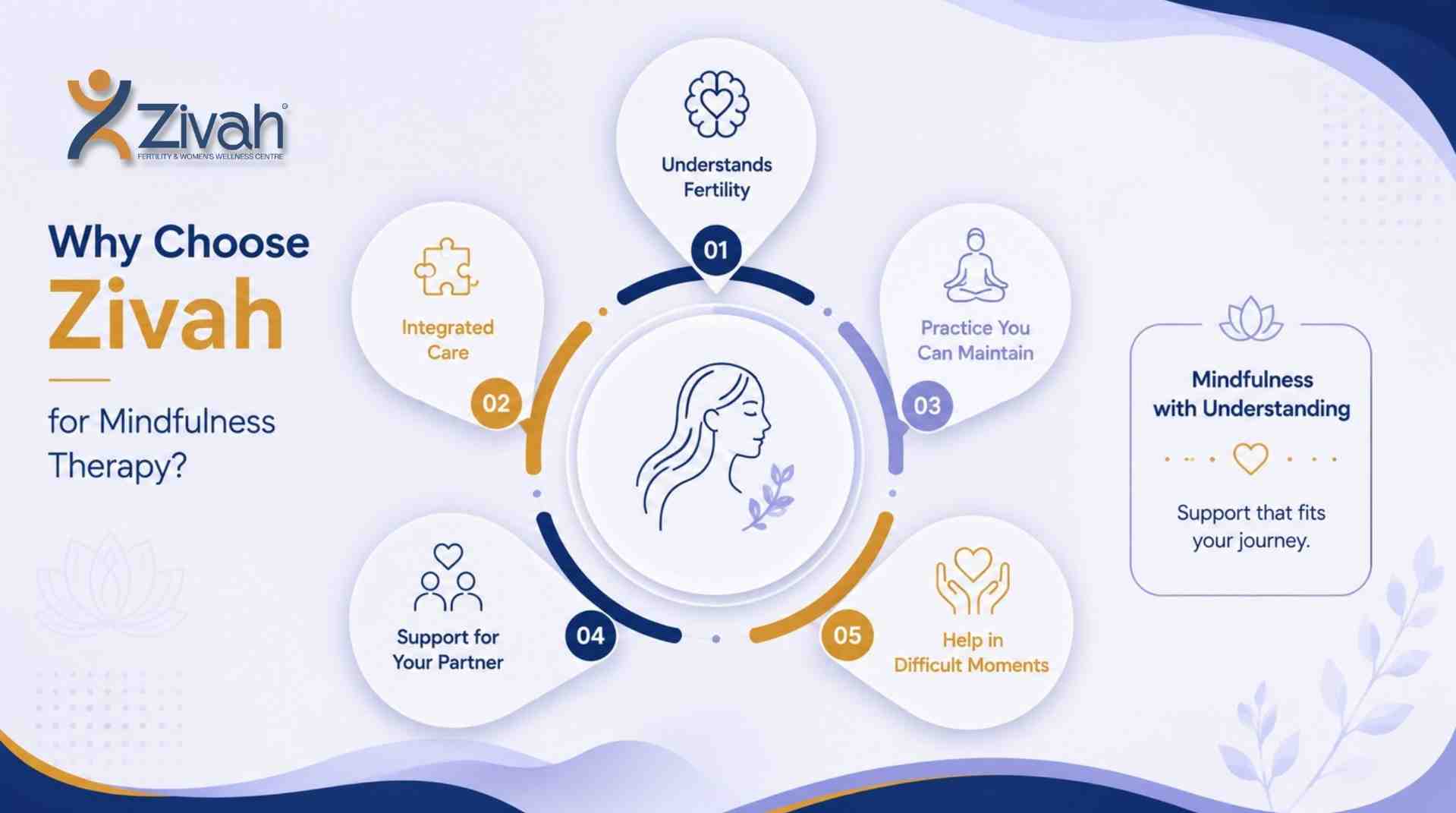
Do your therapists understand fertility, or only mindfulness? Both. Because they do this work every day, our certified mental health workers and fertility-informed counsellors know what it's like to have a cycle fail. You won't have to explain what a two-week wait is in your first meeting.
That understanding is what makes mindfulness for mental health work in a fertility setting rather than around it.
| What Matters to You |
What You Get at Zivah |
How Zivah Helps You |
|---|---|---|
| Care That Understands Your Journey |
Support informed by women's health and fertility care |
We tailor mindfulness support to your circumstances |
| Integrated Care |
Mindfulness support alongside your wider care plan |
We coordinate support when clinically appropriate |
| A Practice You Can Maintain |
Short, realistic mindfulness exercises |
We create routines that fit your daily life |
| Support for Your Partner |
Couples may receive support together |
We address shared stress when appropriate |
| Help During Difficult Moments |
Support around appointments, treatment waits, and results |
We prepare coping strategies for challenging periods |
None of that works if the mindfulness sits in a separate room from the medicine. It does not here.
How Is Mindfulness Therapy Joined Up With Your Fertility Care at Zivah?
No, your specialist is not a separate service you go to on the side. They are part of the team that is helping you. They know when your next scan is, what you're taking, and what test result you are waiting for. Things in the room change because of that. Your doctor already knows which session you are in, so they don't need to be told.
A session before an embryo transfer looks different from a session a week after a negative result. It also means that mindfulness techniques for mental health will happen at the right time, not whenever there is a free moment.
Book Your Mindfulness Therapy Session at Zivah Fertility
Most women who come to us have been managing this alone for months, and almost all of them wish they had spoken sooner. Mindfulness therapy will not make treatment easy. It will make it possible to keep going without losing yourself somewhere in the middle of it. Booking is simple. You speak to a Zivah specialist, you tell them what is weighing on you most, and they take it from there. No preparation, no experience needed.
Book your mindfulness therapy session at Zivah Fertility, and let us help you put some of the weight down.