If your family carries a known genetic condition, PGT-M can offer something many couples thought was out of reach: the chance to welcome a healthy baby with real peace of mind. We understand how heavy that worry can feel, but when you know a condition runs in your family, every dream of parenthood comes with a quiet question: "What if?"
But the truth is reassuring: today, science offers a clear, gentle path forward. PGT-M lets us check your embryos for that single inherited condition before pregnancy begins so that you can move ahead with confidence instead of fear. At Zivah Fertility, we're there with you every step of the way on this journey. If you have questions, a free consultation is just a conversation away.
What is PGT-M (Preimplantation Genetic Testing for Monogenic Disorders)?
PGT-M (Preimplantation Genetic Testing for Monogenic Disorders) is a sensitive genetic test we perform on embryos created through IVF (In Vitro Fertilisation) before any pregnancy begins. In simple words, it lets us look closely at each embryo for one specific inherited condition that runs in your family, so we can choose an embryo free of that disorder to transfer.
Here's why this matters so much. Some conditions are caused by a change in a single gene, which doctors call a monogenic, or single-gene, disorder. If you or your partner carries that gene, there's a real chance of passing it on. PGT-M gently steps in at the very start of the journey. Rather than waiting and worrying through a pregnancy, we test the embryos first and select the healthiest one.
So instead of hoping for the best, you move forward knowing you've already given your future baby the strongest, safest start. That quiet confidence is exactly what PGT-M is designed to give you.
When PGT-M is the right choice for your family
You may be wondering whether PGT-M is truly meant for you, and that's a fair question. In our experience, this gentle test brings the most peace of mind to couples who share a few common stories:
- Carrier couples: where both partners carry the same single-gene condition, raising the chance of passing it on.
- A clear family history: when a genetic disorder has appeared in close relatives across generations.
- A previously affected child: couples who have already faced a genetic condition once and long to protect their next baby.
- A known single-gene mutation: when testing has already confirmed the exact gene change in one or both partners.
If any of these feel like your story, you're in exactly the right place, and a conversation with our team can bring real clarity.
How does PGT-M work? The step-by-step process
Many couples think that PGT-M is hard, but the trip is gentle and well-planned, and we'll be there with you every step of the way. Let's take it one step at a time and talk about how PGT-M works in IVF.
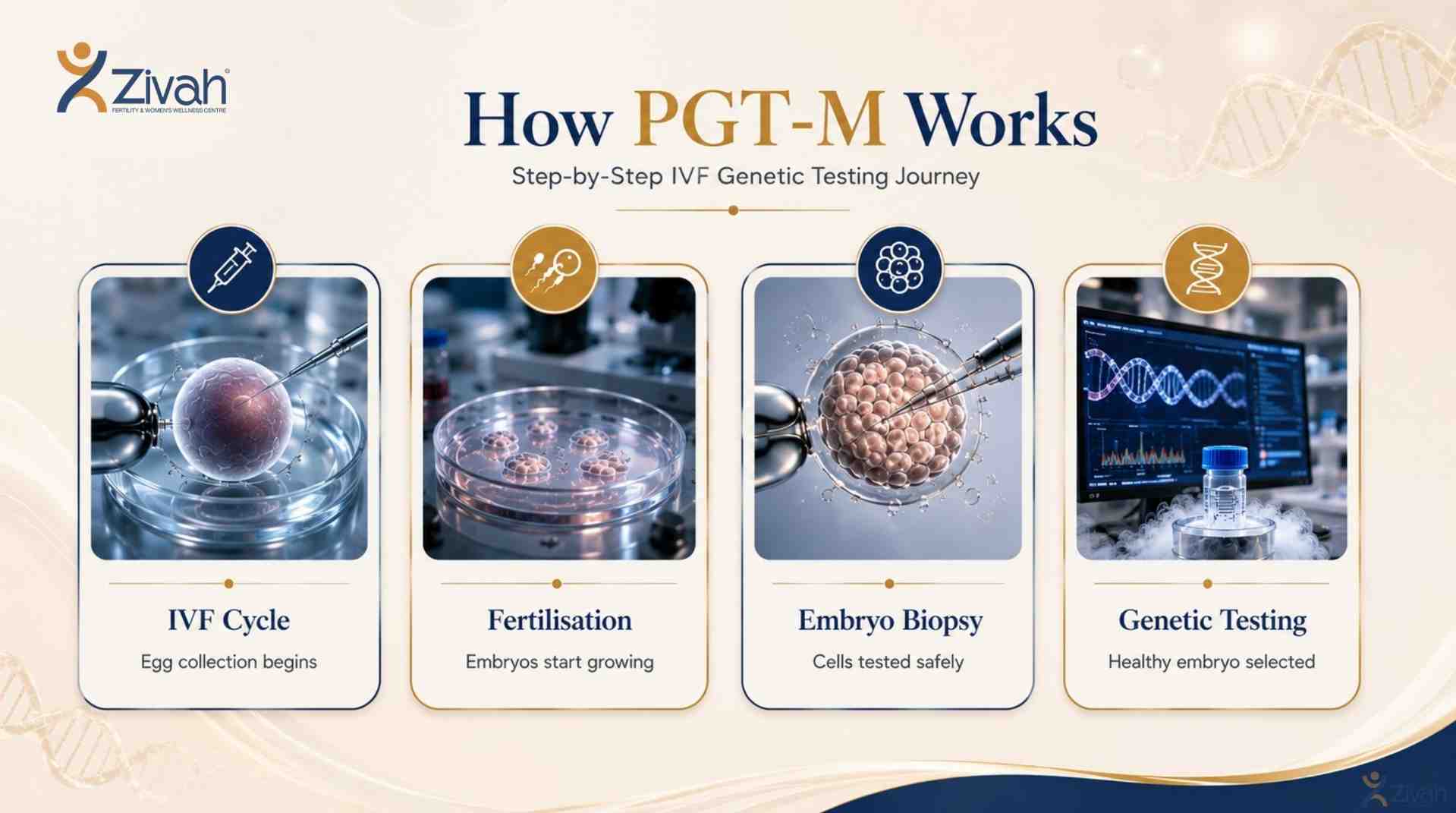
The PGT-M process, step by step
Step 1: Your IVF cycle begins
It starts with a normal round of IVF. First, we give you a low-dose hormone medicine to help your ovaries produce a few eggs slowly. When they're ready, our experts take those eggs through a quick and painless process.
Step 2: Fertilisation in the lab
In the meantime, a sperm sample is being prepared. The eggs and sperm are then brought together in the lab so that they can fertilise each other. These eggs will grow into embryos over the next few days.
Step 3: The embryo biopsy
The heart of PGT-M now comes. Around day five, when each egg has grown into a blastocyst, a tiny ball of cells, our embryologist carefully takes out a few cells from the top layer. This is the part that will become the placenta, not the baby. This is an embryo biopsy, and it is done very carefully to protect the baby.
Step 4: Genetic analysis and transfer
Next, those few cells are sent to a lab for genetic analysis. There, the lab looks very carefully for the one inherited condition we're checking for. Besides that, the eggs are kept safe by being frozen while we wait. Once the test results come back, we will choose a healthy embryo that hasn't been harmed and transfer it so you can start your pregnancy with full trust.
How long does PGT-M take?
This is one of the first things couples ask us, and understandably so. In most cases, a full PGT-M journey takes around four to eight weeks from the start of your IVF cycle to the moment we have your genetic results ready. The egg collection and embryo growth fill the first couple of weeks, while the genetic analysis usually takes one to two weeks more. We'll always share a clear, personal timeline with you on your call - so you're never left guessing.
PGT-M process timeline
| Stage |
What Happens |
Approx. Timeframe |
|---|---|---|
| Ovarian Stimulation |
Gentle hormone medication helps your ovaries produce several eggs |
10–12 days |
| Egg Collection & Fertilisation |
Eggs are retrieved and combined with sperm in the lab |
1–2 days |
| Embryo Growth |
Fertilised eggs develop into day-5 blastocysts |
5 days |
| Embryo Biopsy |
A few outer cells are gently removed for testing |
Same day as freezing |
| Genetic Analysis |
The lab checks the cells for the inherited condition |
1–2 weeks |
| Embryo Transfer |
A healthy, unaffected embryo is transferred. |
In a later cycle |
PGT-M vs PGT-A vs PGT-SR - what's the difference?
If you've started reading about genetic testing in IVF, you've probably come across three similar-looking names: PGT-M, PGT-A, and PGT-SR and wondered how they differ.
It's a common point of confusion, so let's clear it up gently. Think of them as three different checks, each looking for something different. PGT-M, the test we've been talking about, looks for a single-gene disorder that runs in your family.
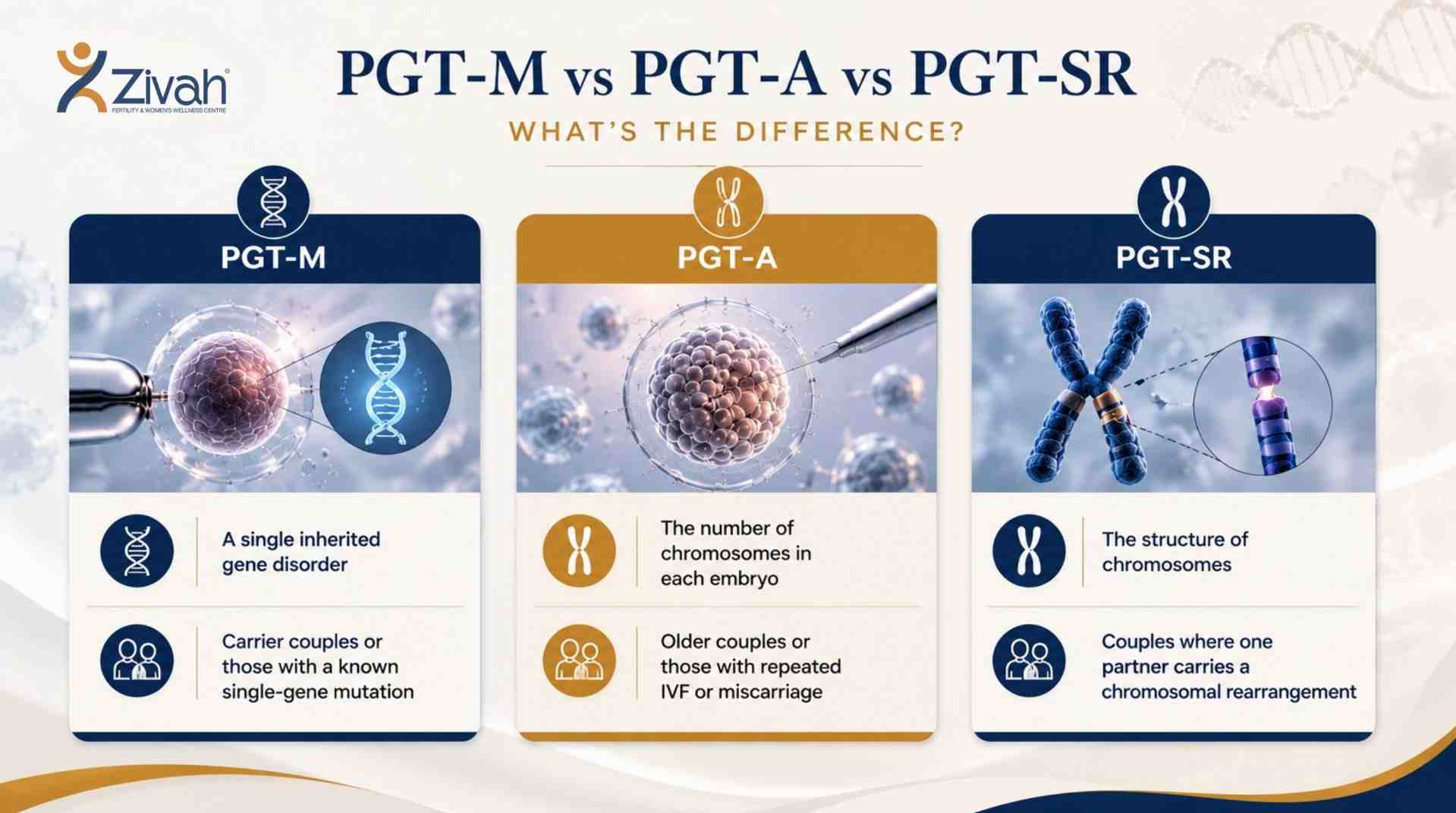
PGT-A, on the other hand, counts chromosomes in each embryo to ensure the number is correct, which is especially helpful in cases of advanced age or repeated IVF setbacks. PGT-SR assesses chromosome structure and is the right fit when one partner carries a known chromosomal rearrangement. So while they sound alike, each answers a very different question about your embryos.
| Test |
What It Screens For |
Best For |
|---|---|---|
| PGT-M |
A single inherited gene disorder running in the family |
Carrier couples or those with a known single-gene mutation |
| PGT-A |
The number of chromosomes in each embryo |
Older couples or those with repeated IVF or miscarriage |
| PGT-SR |
The structure of chromosomes |
Couples where one partner carries a chromosomal rearrangement |
Which PGT test is right for you?
Here's the good news: You don't have to figure this out alone, so choosing the right test depends on your family history, your past pregnancies, and what testing has already revealed. Sometimes a couple even benefits from more than one.
That's exactly what our specialists are here for: in a simple, no-pressure conversation, we'll listen to your story and guide you toward the test that truly fits your needs.
Which genetic conditions can PGT-M test for?
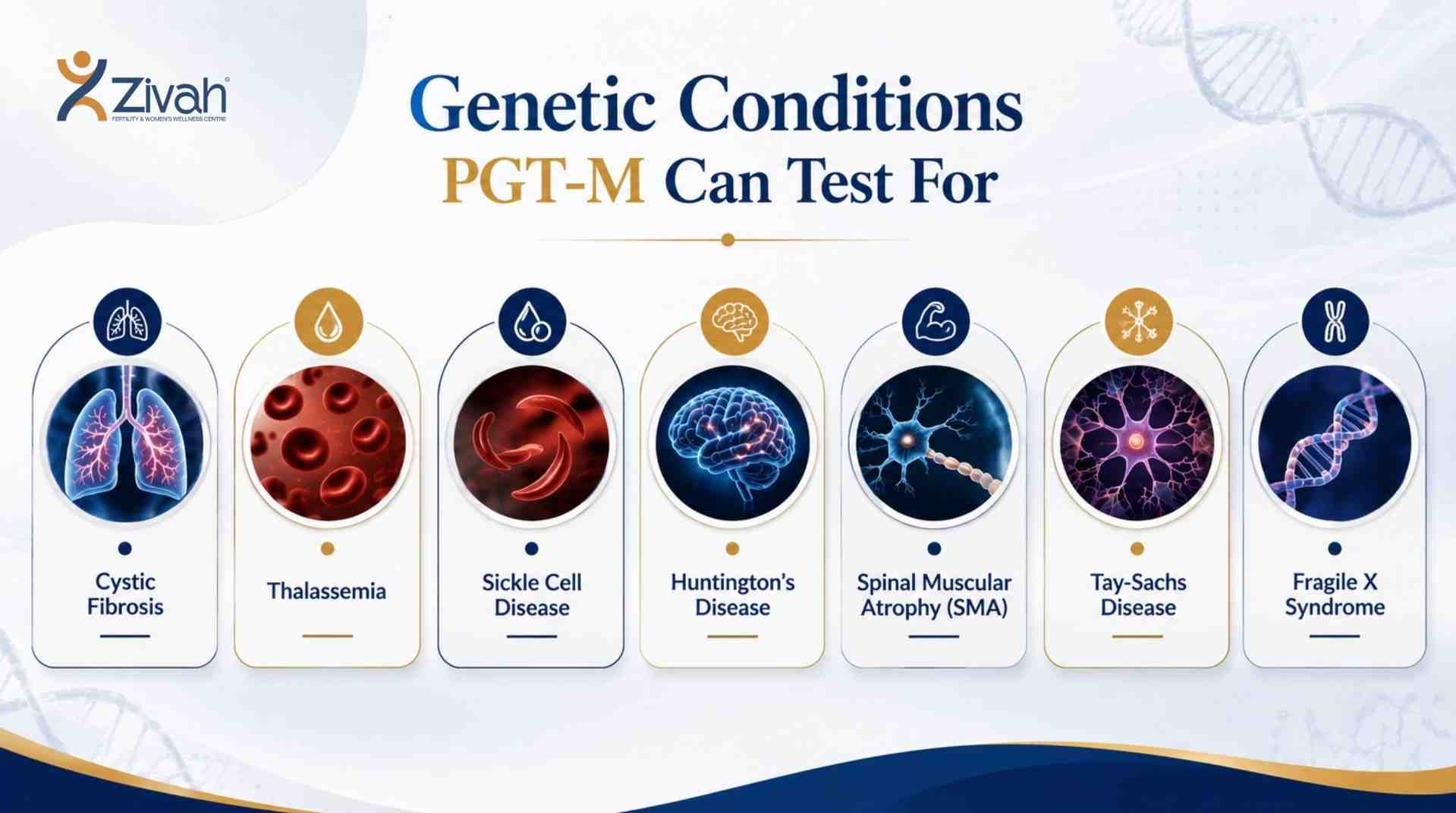
One of the most comforting aspects of PGT-M is the number of inherited conditions it can detect. If a disorder is caused by a change in a single gene, and that gene change is known, there's a very good chance PGT-M can test for it. So whatever condition runs in your family, it's worth asking, because the answer is often "yes, we can."
While every family's situation is unique, PGT-M is commonly used to test for single-gene disorders such as:
- Cystic fibrosis: a condition affecting the lungs and digestion.
- Thalassemia: an inherited blood disorder common across parts of India.
- Sickle cell disease: another inherited blood condition.
- Huntington's disease: a disorder affecting the brain in later life.
- Spinal muscular atrophy (SMA): a condition affecting muscle strength.
- Tay-Sachs disease: a rare disorder affecting the nervous system.
- Fragile X syndrome: the most common genetic cause of learning difficulties.
This is only a glimpse of what's possible
Testing for rare and uncommon conditions
Even if your family problem isn't on this list, PGT-M can still help. PGT-M can be used to screen for a wide range of genetic conditions, including rare ones that affect only a few families, because each test is built around the exact gene we're looking for.
The best way to be sure is to talk to us about your family background during a free consultation. Then we'll let you know if your condition can be tested.
PGT-M success rate and what affects your results
Every couple wants to know what the PGT-M success rate looks like, and it's a hopeful picture. Because PGT-M allows us to select a healthy, unaffected embryo before transfer, it gives your IVF cycle a strong, confident start.
Still, a few gentle factors work together to shape your result. Age matters, embryo quality counts, and the skill of the embryology lab makes a real difference. The table below shows how each one influences your chances, and when they come together well, your odds rise meaningfully.
| Factor |
Why It Matters |
Effect on Success |
|---|---|---|
| Your Age |
Younger eggs tend to produce more healthy embryos to choose from |
Higher chance with more embryos available |
| Embryo Quality |
Stronger embryos handle the biopsy better and implant more readily |
Better-quality embryos lift success |
| Lab Expertise |
A careful, experienced lab protects each embryo and reads results precisely |
Skilled handling safeguards your odds |
So when good eggs, healthy embryos, and expert hands come together, your chances rise, and that's exactly the care we focus on.
Is PGT-M accurate?
Every parent cares about this question, and the answer is comforting. PGT-M is highly accurate; in the vast majority of cases, it correctly indicates whether an embryo has the condition being tested. As with any test, it's not always accurate, so we often use it with a confirmation test during pregnancy. However, it's one of the most reliable ways to learn about your baby's genetic health before transfer.
Want to know the cost of PGT-M? Let's talk personally
If you're searching for the cost of PGT-M, you're not alone, but here's the honest truth: there's no single fixed price, and that's actually good news for you. Every couple's PGT-M plan is a little different, so the clearest way to understand your cost is a short, personal conversation rather than a one-size-fits-all price list.
A few things gently shape your plan, as the table below shows. We should also mention that, under the ART (Assisted Reproductive Technology) Regulation Act 2021, PGT-M is offered only for genuine medical and inherited conditions, and choosing an embryo's sex is not permitted under the PCPNDT (Pre-Conception and Pre-Natal Diagnostic Techniques) Act.
| What It Depends On |
Why It Varies |
Next Step |
|---|---|---|
| The Genetic Condition Being Tested |
Each gene needs its own test design |
Schedule a free consultation |
| Number of Embryos to Test |
Testing is done per embryo |
We’ll guide you on a call |
| Your IVF Cycle Plan |
Every couple’s protocol differs |
Talk to our team |
So if you're searching for the cost of PGT-M or simply want clarity, schedule a consultation or call us, and we'll be happy to walk you through everything personally.
Why choose Zivah Fertility for PGT-M?
Deciding where to start your PGT-M journey is a personal choice, and we don't take your trust lightly. At Zivah Fertility, we built our care around one simple belief: every couple deserves the highest standard of science offered with the warmth of family. From your very first question to the moment you hold your baby, we walk beside you.
It starts with a complimentary consultation. No pressure, no rush, just plain, honest advice tailored to your story. Behind that conversation sits an experienced embryology lab, where each embryo is handled with precision and protected through every step of testing. And because genetic news can feel overwhelming, we offer caring genetic counselling support, so you always understand your options and never feel alone with a difficult decision.
What truly sets us apart is our end-to-end care, one trusted team guiding you from testing to pregnancy. If you've been carrying this worry for a while, there's no better time to take the first gentle step. Reach out today, and let's begin together.
A gentle final word
If your family carries a genetic condition, please know this, your dream of a healthy baby is still very much within reach. PGT-M offers a clear, caring path to get there, and you don't have to walk it alone.
At Zivah Fertility, we are here to listen, guide and walk with you every step of the way. When you’re ready, a free consultation is just a conversation away