
Carrying twins or multiples is a remarkable experience, and while a twin pregnancy or multiple pregnancy is, of course, considered high risk, it simply means it needs extra attention, not that something will go wrong. With proper twin pregnancy care, most multiple pregnancies will safely progress to healthy babies.
This page covers the care and treatment of multiple pregnancies at each step, from early scans and monitoring to nutrition, daily management and planning for delivery.
At Zivah, we are directed by Maternal fetal medicine specialist and backed by advanced, in-house imaging for twin and multiple pregnancies. We notice any change early and handle it with confidence, keeping mother and baby safe throughout.
Understanding Twin & Multiple Pregnancy
If you are pregnant with two babies, it is called a twin pregnancy. Multiple pregnancy means two or more pregnancies with multiples, such as triplets, and is referred to as a higher-order multiple pregnancy.
Most parents hear about it initially at an ultrasound scan, where a second or third heartbeat might be shockingly early. Then your doctor's biggest concern is what type of twins you have, because that one little fact decides how your whole pregnancy is managed.
Identical vs Fraternal Twin Pregnancy
A fraternal twin pregnancy begins with two eggs and two sperm. These babies don't have the same genes; they are actually siblings born together, and might be either the same or opposite sex.
An identical twin's pregnancy is different. One egg is fertilised, then splits in two, so babies have the same genes and are always the same sex. Very rarely, if ever, are twins born linked when an egg doesn't divide all the way.
Chorionicity: Dichorionic vs Monochorionic Twins
Your doctor also tests your chorionicity, whether your twins share a placenta. It seems complex, but it's how much monitoring you will require. A dichorionic (DCDA) twin is the lowest risk type, having their own placenta and sac.
Monochorionic twins share a single placenta, either with separate sacs (MCDA) or with a single shared sac (MCMA) and are at increased risk of twin-twin transfusion syndrome. This is best confirmed on the ultrasound at 11-14 weeks.
Twin Types & Chorionicity
| Type |
Placenta / Sac |
Identical or Fraternal |
Relative Risk |
|---|---|---|---|
| DCDA |
Separate placenta + separate sac |
All fraternal; some identical |
Lowest |
| MCDA |
Shared placenta, separate sacs |
Most identical |
Higher (TTTS) |
| MCMA |
Shared placenta + shared sac |
Rarely, identical |
Highest |
What Are The Signs and Symptoms of Twin Pregnancy
Sometimes the earliest signs of twins can be before any ultrasound. It’s useful to tell the difference between the twin pregnancy signs your doctor could observe and the twin pregnancy symptoms you experience.
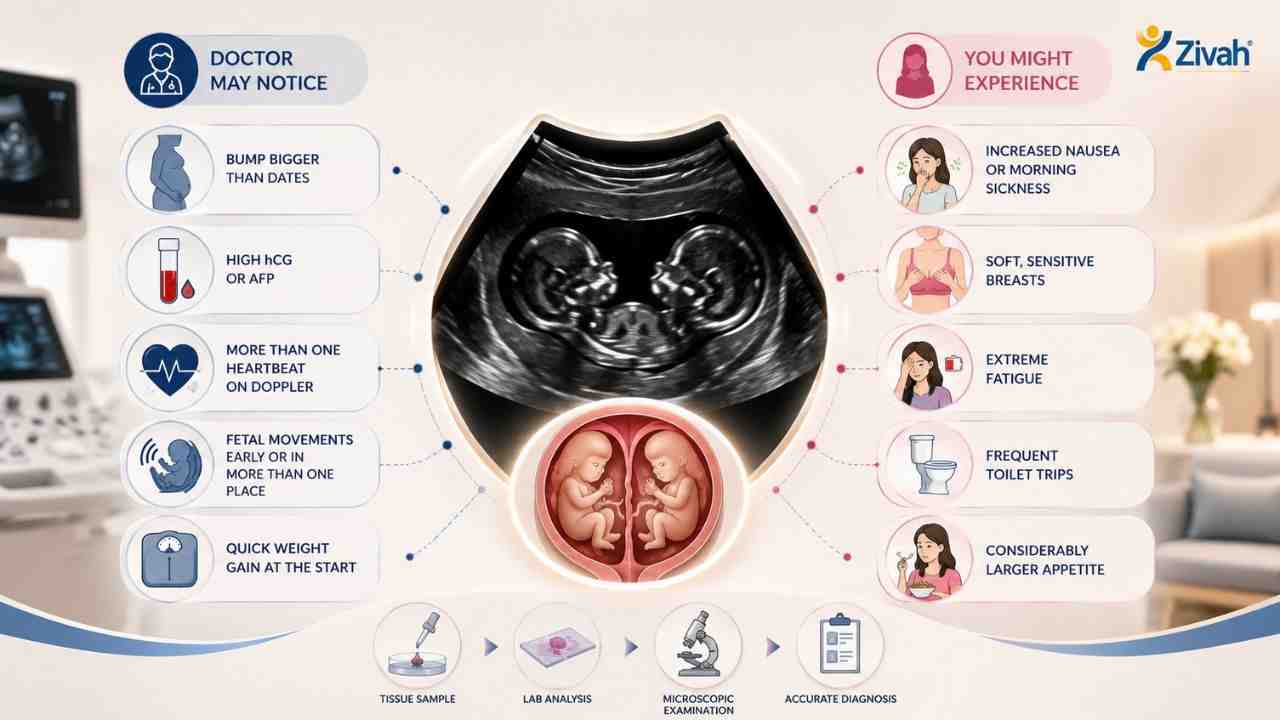
Signs of a twin pregnancy that a doctor may notice include:
- A bump bigger than your dates
- Blood tests showing unusually high hCG or AFP
- More than one heartbeat on a Doppler
- Quick weight gain at the start
- Fetal movements felt early, or in more than one place
Twin pregnancy symptoms you might have, the standard ones, just more intense:
- Increased nausea or morning sickness
- Soft, sensitive breasts
- Extreme fatigue
- Frequent toilet trips
- A considerably larger appetite
Keep in mind that these signs are just hints of twins and are never 100% certain. The only way to be sure you are pregnant with twins, or more, is to have an ultrasound scan, which displays each baby.
Why Twin & Multiple Pregnancy Is Considered High Risk
Being told you have a high-risk twin pregnancy can sound scary, but the label is not a warning. It just means your care team is watching more closely and stepping in early. Most twin pregnancy risks or multiple pregnancy risks are widely known and often controllable if detected early.
Common Twin & Multiple Pregnancy Complications
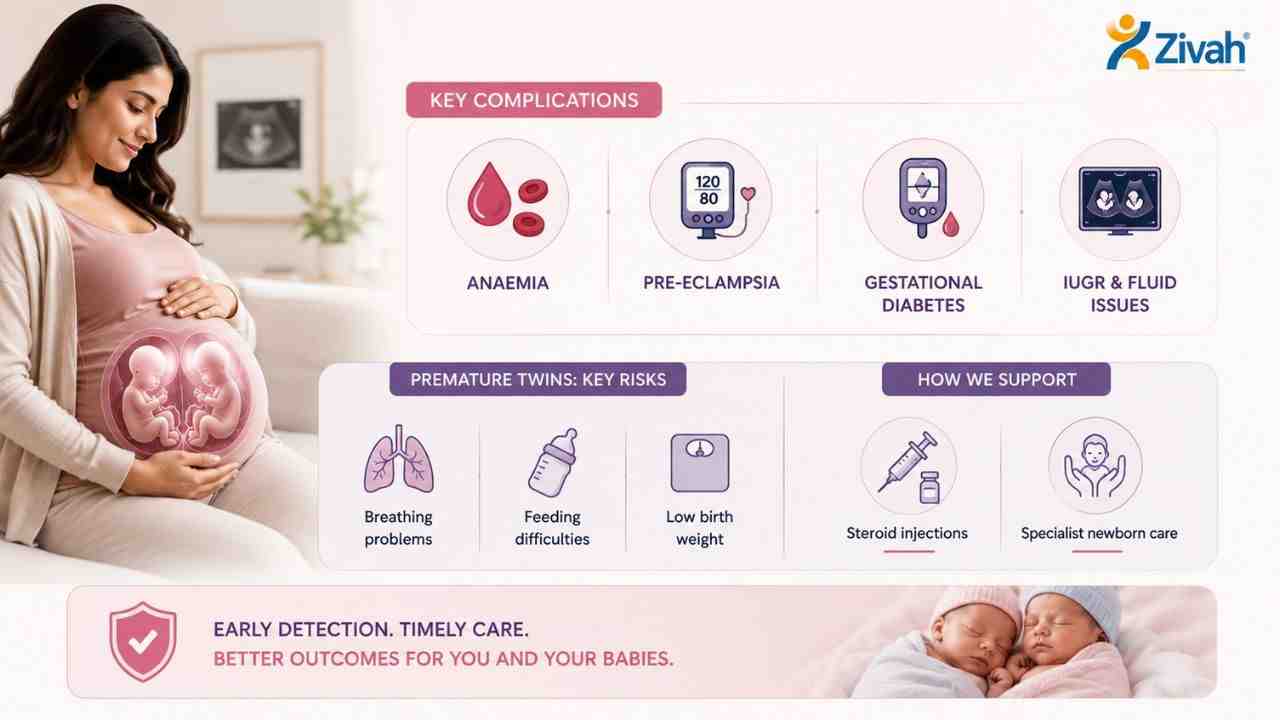
Certain pregnancy problems are more common with twins or multiples. The reassuring thing is that all have a clear approach to handle it:
- Anaemia - improved on iron support
- Pre-eclampsia (high blood pressure) - picked up early with regular blood pressure checks
- Gestational diabetes - screening and individualised strategy
- IUGR (uneven growth) - monitored at routine growth scans
- Too little or too much fluid - seen on the same images
- Twin-twin transfusion syndrome (TTTS) - it affects 10-15% of monochorionic twins; regular scans enable early detection and treatment
Complications in Premature Twins
The most common risk in a multiple pregnancy is premature birth, because most twins are born before 37 weeks. Early born babies might have:
- Immature lungs and breathing problems
- Trouble feeding or staying warm
- Increased risk of low birth weight
Steroid injections help to mature the babies’ lungs, and specialist newborn care supports them immediately when early delivery is planned.
Complications & How Zivah Monitors Them
| Complication |
Higher Risk In |
Detection / Monitoring at Zivah |
|---|---|---|
| TTTS |
Monochorionic (MCDA/MCMA) |
Frequent growth + Doppler scans |
| Pre-eclampsia |
All multiples |
BP checks, fetal-maternal assessment |
| Gestational diabetes |
All multiples |
Screening + specialist referral |
| IUGR / discordant growth |
Shared-placenta twins |
Serial growth ultrasound |
Twin Pregnancy Monitoring, Scans & Antenatal Care at Zivah
Antenatal care with twins is a little different from a pregnancy with a single baby. You'll have more things to keep an eye on, so you'll have more prenatal appointments and more scans. This isn't about worry; it's about catching anything early, while it's still easy to manage.
At Zivah, twin pregnancy monitoring is based on advanced in-house imaging; therefore, every twin pregnancy scan and check is done under one roof, with faster results and clearer images at every stage. That is what right antenatal care for twins should feel like.
Twin Pregnancy Scan & Ultrasound Schedule
Every twin ultrasound is customised for the sort of twins you are expecting. Here's a normal twin pregnancy ultrasound schedule:
- 11-14 weeks - dating scan to confirm your twins and type of twins (chorionicity), and your due date. Early risk is also checked.
- 16-20 weeks - cervical length scan to check your risk of going into labour early.
- 20 weeks - anomaly scan to look closely at how your babies are developing.
From then on, normally DCDA twins are scanned every 4 weeks; monochorionic twins need more regular growth and Doppler checks. These regular antenatal scans with twins are the easiest way to stay ahead.
Antenatal Scan & Monitoring Schedule
| Gestational Week |
Scan / Test |
Purpose |
Applies To |
|---|---|---|---|
| 11–14 wks |
Dating + chorionicity |
Confirm twins, type, dates |
All twins |
| 16–20 wks |
Cervical length scan |
Preterm-birth risk |
All twins |
| 20 wks |
Anomaly scan |
Fetal development check |
All twins |
| Every 2–4 wks |
Growth + Doppler |
Track growth, detect TTTS |
DCDA monthly / MC more often |
Maternal-Fetal Medicine Specialist (Perinatologist) for Twins
Some twin pregnancies require special expertise. If difficulties arise or if your twins share a placenta, you may be referred to a maternal-fetal medicine specialist (sometimes called a perinatologist) for your twin pregnancy.
At Zivah, care is managed by specialists and backed by scans from the very beginning. A twin pregnancy specialist and imaging team collaborate, identifying changes early on and modifying your plan as necessary.
Care & Management of Multiple Pregnancy: Nutrition, Rest & Medication
The answer to the treatment and management of multiple pregnancies is a plan that is created around you. Not all twin pregnancies are the same, so proper multiple pregnancy management combines nutrition, rest, and the right medicines with your twin pregnancy care plan, adjusted as your pregnancy progresses.
Twin Pregnancy Nutrition & Weight Gain
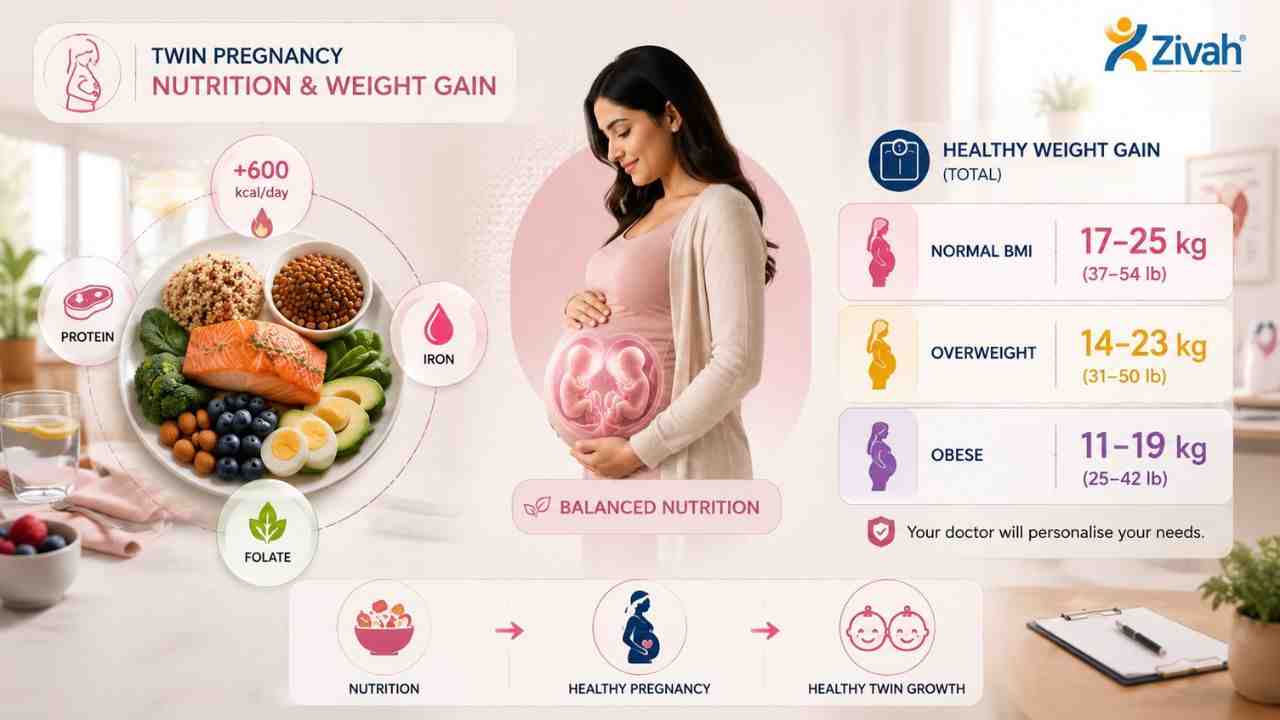
When you're carrying two babies, your body requires more, therefore twin pregnancy nutrition is about more calories, protein and iron. That's another 600 kcal/day for most women, but your doctor will individualise it for you. Weight increases with twins; healthy twin pregnancy weight growth counts too. The amount of weight gain with twins depends on your beginning weight:
- Normal BMI: 17–25 kg (37–54 lb)
- Overweight: 14–23 kg (31–50 lb)
- Obese: 11–19kg (25–42lb)
As stated, a balanced twin pregnancy diet containing iron and folate helps you and your twins.
Rest, Activity & Bed Rest in Twin Pregnancy
Rest is part of the strategy, but it's personal. During a twin pregnancy, your team will advise you on your rest depending on how your pregnancy is going.
It's worth remembering that routine bed rest in a twin pregnancy has not been shown to prevent early delivery and is indicated only when there is a clear medical reason. Sensible precautions in a twin pregnancy, gentle activity, hydration, and not overdoing it, usually benefit the most.
Medications & Cervical Cerclage in Twin Pregnancy
If your babies seem to be coming early, a few medications can make a huge difference:
- Corticosteroid medicines to assist in growing the babies' lungs before a potential early birth
- Tocolytic medications may temporarily stop contractions if premature labour begins
- Progesterone may be provided if a scan shows a short cervix
If your cervix is fragile, you may be offered cervical cerclage in a twin pregnancy, a stitch to keep it closed, early on. Each step is only taken when it's right for you.
Recommended Weight Gain in Twin Pregnancy (by BMI)
| Pre-Pregnancy BMI |
Recommended Gain (Twins) |
Note |
|---|---|---|
| Normal |
37–54 lb (17–25 kg) |
IOM guidance |
| Overweight |
31–50 lb (14–23 kg) |
Specialist-monitored |
| Obese | 25–42 lb (11–19 kg) |
Specialist-monitored |
Twin & Multiple Pregnancy Delivery Planning
Planning for the delivery of twins begins far before your due date. The date and mode of delivery for your twin pregnancy will depend on the type of twins, the location of the twins, and how you and your babies are doing. Multiple pregnancy is riskier towards the end; therefore, a planned birth is usually safer than waiting for labour to start naturally.
When Are Twins Usually Delivered? (Planned Birth Timing)
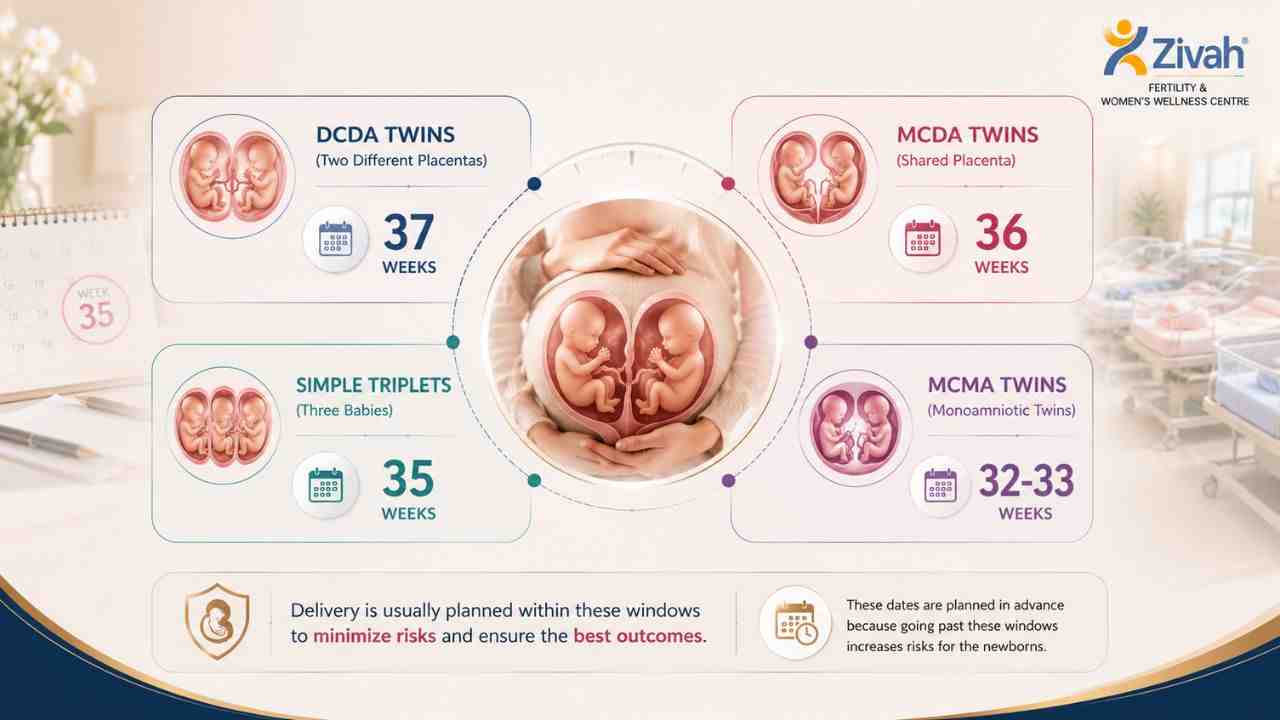
Twins are generally born between 32 and 37 weeks, depending on whether they share a placenta or sac. Most multiples are born before they are full term; thus, your twin pregnancy time of birth is designed to get you to the safest point without going too far. As a guide, the scheduled birth for twins is generally:
- DCDA (two different placentas) ~37 weeks
- MCDA (shared placenta) - ~36 weeks
- Trichorionic Triamniotic Triplets - around 35 weeks
- MCMA twins - about 32-33 weeks
The dates are chosen in advance because going past these windows increases the risk for the newborns.
Vaginal Delivery vs C-Section for Twins
Many parents ask: Can twins be born naturally? If the first (lower) twin is head-down (vertex), then vaginal birth of twins is typically possible. A cesarean delivery, a C-section for twins, is usually recommended if the first twin isn't head-down, if you're carrying triplets or more, or if there are signs of fetal distress.
Sometimes the first twin is delivered vaginally and the second still requires a C-section, so your team prepares for both and keeps you safe no matter what the day brings.
Planned Delivery Timing by Twin Type
| Pregnancy Type |
Planned Birth Week |
Reason |
|---|---|---|
| DCDA (placenta each) |
~37 weeks |
Lower shared-placenta risk |
| MCDA (shared placenta) |
~36 weeks |
Higher TTTS risk |
| Uncomplicated triplets |
~35 weeks |
Earlier prematurity risk |
| MCMA twins |
~32–33 weeks |
Cord-entanglement risk |
Twin & Multiple Pregnancy Care at Zivah
Having twins on the way is a big adjustment. But with the right group behind you, twins' pregnancy care can be calm and simple. At Zivah, we do all the work in one place.
- Specialist-led High-Risk Care: Your pregnancy is cared for by an experienced twin pregnancy doctor and fetal medicine working as a team to handle any issues so nothing is ignored.
- Imaging-Backed Monitoring: Modern, in-house ultrasound means your scans are planned and read under one roof. A clear picture of your babies at every stage.
- Personalised Twin Pregnancy Care Plan: Nutrition, monitoring and delivery planning, all in one customised plan. Pregnancy care with twins will seem straightforward and supported.
You don’t have to do it by yourself. Schedule a twin pregnancy consultation with a Zivah twin pregnancy specialist and start your journey off with a clear strategy and a team that’s with you every step of the way.