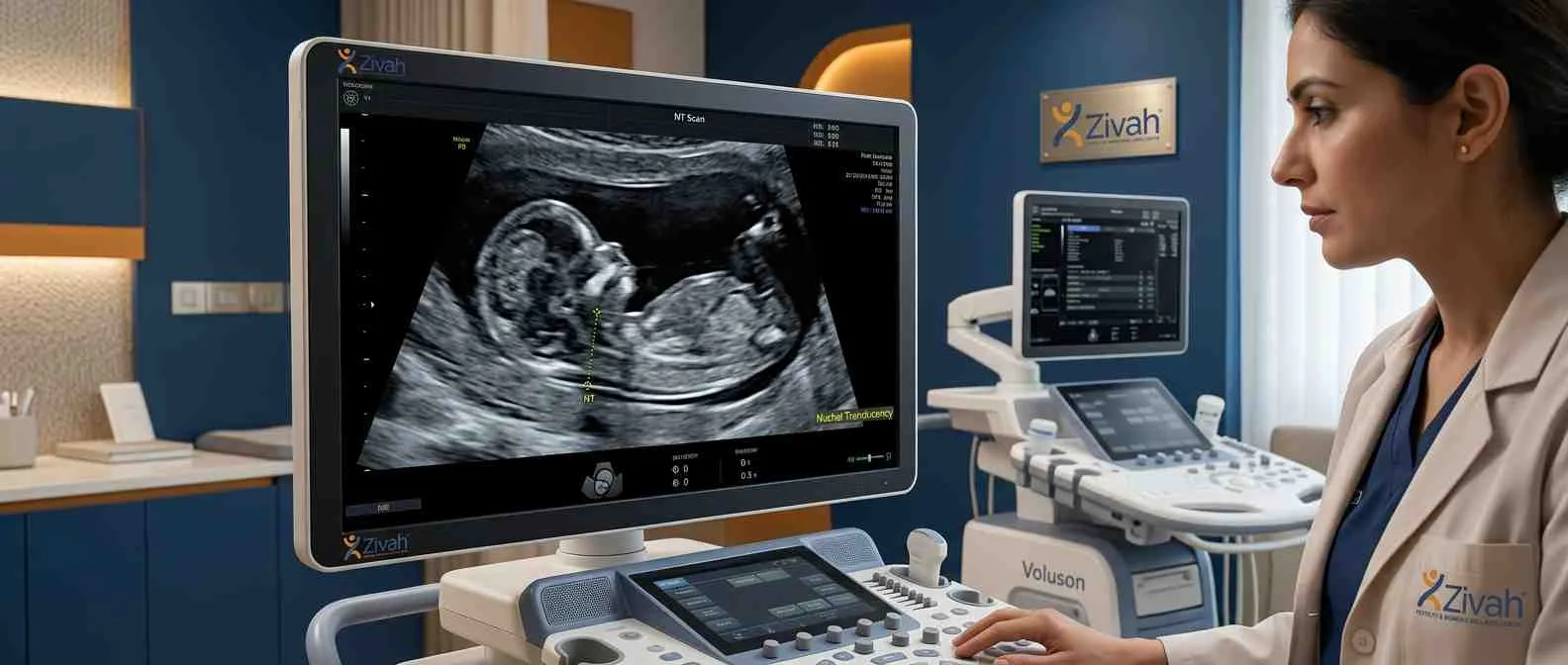
An NT scan in pregnancy, short for nuchal translucency scan, is a simple, painless ultrasound done in the first trimester to assess the fluid behind your baby’s neck. NT means nuchal translucency, a medical term meaning the scan gives an idea of your baby’s risk of diseases such as Down’s syndrome. It’s a screening test, not a diagnostic.
This guide explains what an NT scan looks for, the best week to have it, how it is done and how to read your results. At Zivah, your nuchal translucency scan is performed by fetal medicine expert using advanced, modern ultrasonography, so you get clear answers and calm support at every step.
What Is an NT Scan?
What is an NT scan in pregnancy? It is a first-trimester ultrasound that measures a thin layer of fluid at the back of your baby’s neck. The letters can be confusing at first; in medical terms, NT stands for nuchal translucency, and that’s all “NT” implies on your report or scan request.
The point to remember is this: an NT scan, also called Nuchal translucency scanning, is a screening test, not a diagnostic examination. In simple terms, it estimates the risk of a condition, it doesn’t tell you if your baby truly has one.
At this period, every baby has a little bit of fluid. When that fluid is thicker than normal, it could suggest an increased risk of chromosomal problems, which is why your doctor or radiology team makes a careful nuchal translucency assessment.
What Is the Nuchal Fold and Nuchal Translucency?
The nuchal translucency is the fluid-filled transparent space beneath the skin at the back of the neck. On the ultrasound screen, it looks like a dark ring, and ‘translucency’ means light passes through it. The nuchal fold is a related but somewhat different measurement obtained later in pregnancy, so the two aren’t quite the same thing.
How Ultrasound and Sonography Work in Obstetrics
An ultrasound (also termed sonography or USG (ultrasonography) uses safe sound waves (not radiation) to create live images of your baby. In obstetrics, these fetal scans allow your sonologist to observe and measure your baby, without any risk. If you are wondering what this scan is, the NT scan is one of the first detailed scans you will undergo.
NT Scan at a Glance
| Parameter |
Detail |
|---|---|
| What it measures |
Fluid behind fetal neck |
| Best time |
11–13 weeks 6 days |
| Type |
Ultrasound (abdominal/transvaginal) |
| Duration |
20–30 min |
| Report |
Same-day scan; combined report after blood test |
| Detects |
Risk of T21, T18, T13, cardiac defects |
What Does an NT Scan Look For?
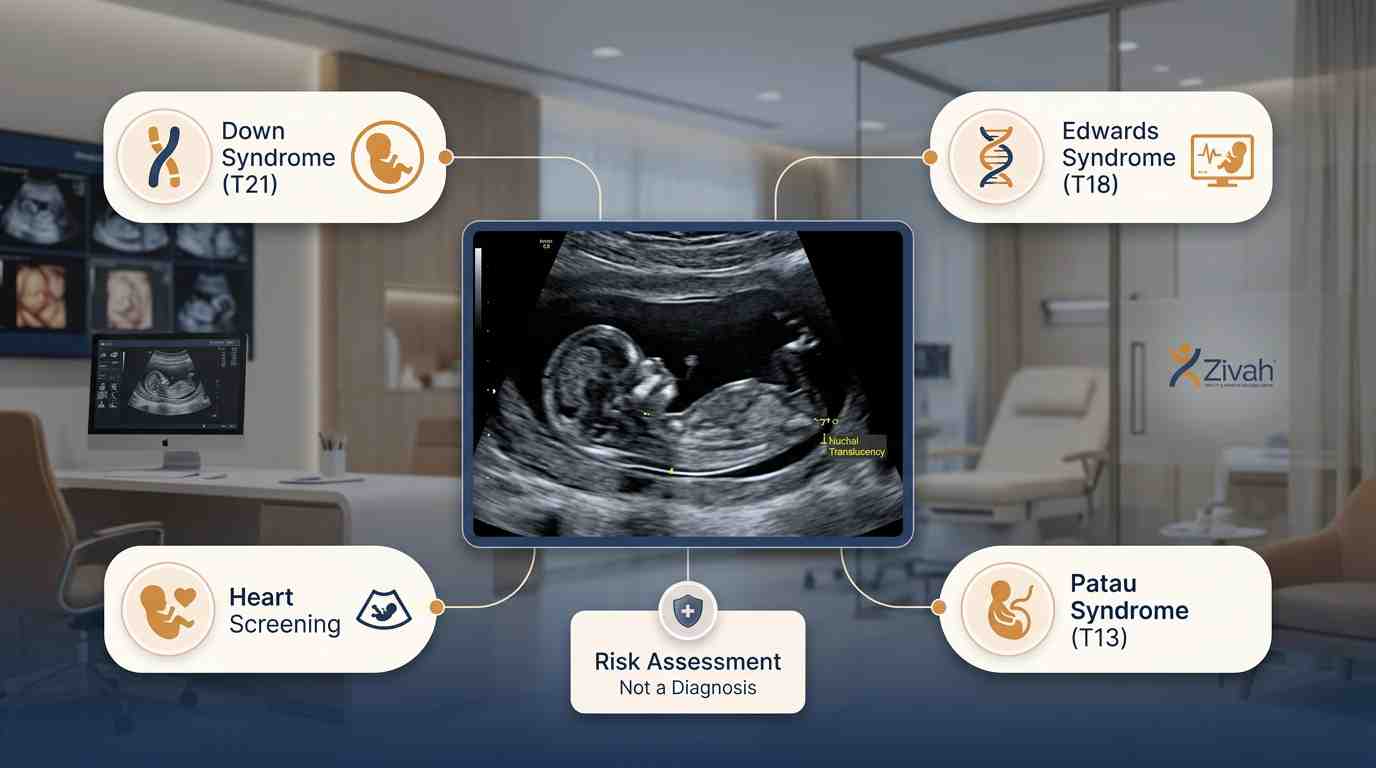
Most of the time, it checks for risk of specific birth defects and chromosomal problems. A birth defect is just a health condition a baby is born with. The scan alone does not diagnose anything. It looks for early warning signs, the most important being an increase in fluid behind the neck. An NT scan particularly looks at the risk of:
- Down syndrome (Trisomy 21)
- Edwards syndrome (Trisomy 18)
- Patau syndrome (Trisomy 13)
- Congenital heart defects
If the fluid layer is thicker than usual, an thickened nuchal fold (nuchal oedema) may be a marker of a higher risk of these conditions. But keep in mind: increased risk is not a diagnosis.
Down Syndrome and Other Chromosomal Conditions
This scan looks for the most common chromosomal abnormality, Down syndrome. Basically, it’s when a newborn has an extra copy of chromosome 21 (hence it’s also called Trisomy 21) and affects how the baby learns and grows. Nuchal fluid (nuchal oedema) is raised and a common early ultrasonographic finding.
The scan also takes up Edwards syndrome (Trisomy 18), Patau syndrome (Trisomy 13) and several congenital heart abnormalities. Again: an extended nuchal fold is a sign, not a proof. Many babies measuring thicker are born perfectly healthy.
When Is the NT Scan Done?
When can the nuchal translucency test be done? The NT scan is done between 11 and 13 weeks and 6 days. Week 12 of pregnancy falls right in the centre of that range, and it’s when many women have theirs.
Timing is more important than people realise. This can only be checked during these weeks, as after roughly 14 weeks the body reabsorbs the fluid behind your baby’s neck; thus, the reading is no longer accurate. An ultrasound earlier in pregnancy (week 8) is just too early to get a reliable NT measurement.
Also, your sonologist checks the nasal bone, this may be written on your report as the NT and NB scans. NB is only the nasal bone, and its presence is another useful sign in risk evaluation.
NT Scan in the Pregnancy Scan Timeline
So how many scans throughout pregnancy, and where does the NT scan fit in? Here's the easy take:
- 6–9 weeks - dating/viability scan
- 11-13+6 weeks - NT scan
- 18–20 weeks - anomaly scan (the thorough “20-week scan”)
- ~24 weeks onwards - growth scans
Commonly confused, the NT scan is not the 20-week or 24-week scan. Sometimes people search for 'nuchal translucency 20 weeks' or find the anomaly scan believing them to be the same, but they're two separate exams done at different stages of pregnancy.
NT Scan Procedure: How Nuchal Translucency Is Measured
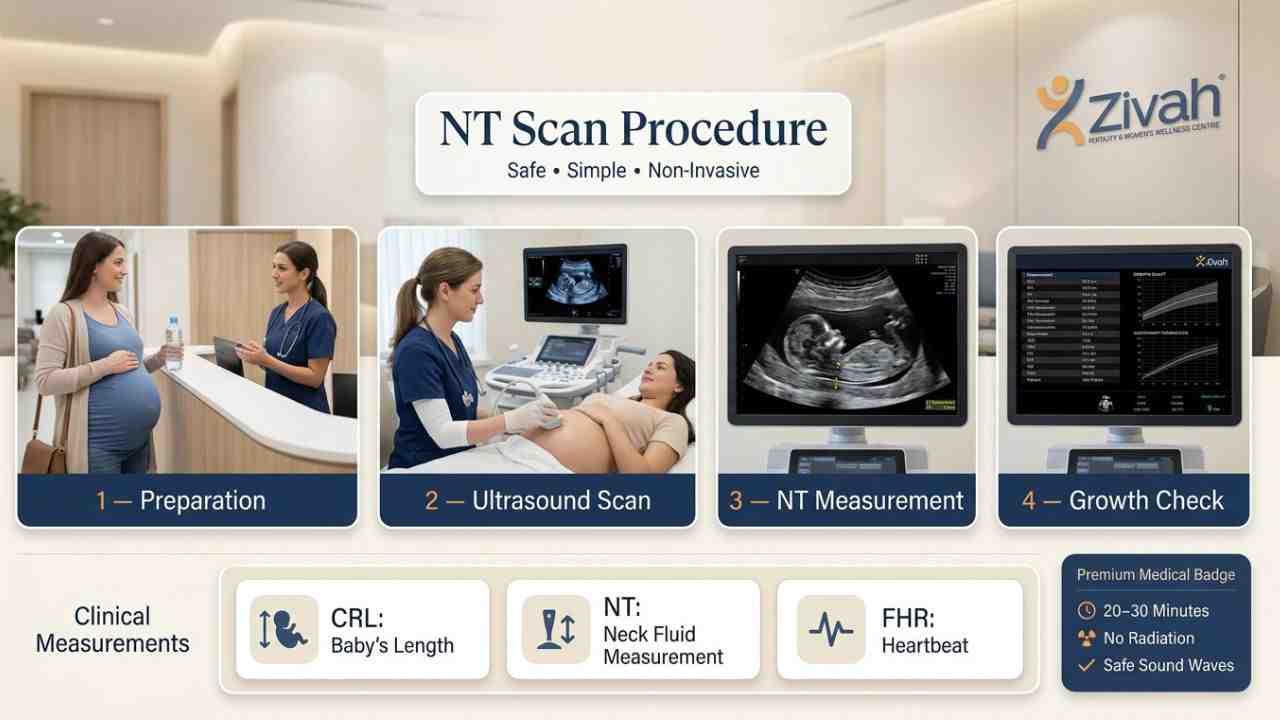
An NT scan is a routine, painless ultrasound to measure nuchal translucency, and the steps are simple:
- Preparation: You may be advised to attend with a full bladder, since this can help to make the images clearer.
- Gel applied: You lie back comfortably, and your sonologist applies a transparent gel to your lower abdomen.
- Scanning: A transducer, a hand-held device, is softly moved across your tummy. This is the per-abdomen view of the scan.
- Measurement: Live photos of your baby are displayed on a screen, and the nuchal translucency measurement is taken in millimetres from the fluid space behind the neck.
- Recording: Your sonologist will also record fetal biometry, the basic measurements of your baby's growth.
The complete process takes about 20 to 30 minutes and uses safe, sound waves, not radiation. It won't hurt you or your kid.
Is the NT Scan Internal or External?
In most circumstances, the NT scan is external, done over your tummy (transabdominal). Sometimes your baby or your body position means that the picture is not clear, and your doctor will do an internal transvaginal ultrasound for a clearer picture. Both are safe and routine.
What Is Recorded (CRL, NT, FHR, Biometry)
Your sonologist will take a few critical measurements in addition to the fetal biometry during the scan:
- CRL (crown–rump length) – your baby's length, head to bottom
- NT – the nuchal translucency thickness, measured in mm
- FHR (fetal heart rate) – your baby's heartbeat
Nuchal Translucency Normal Range and Measurement Chart
NT is measured in millimetres, and there is no single NT scan normal value that applies to everyone. The normal range for an NT scan varies a little with the growth of your baby and is always read with your baby's CRL (crown-rump length) and your age.
The usual range for nuchal fold thickness changes a little as your baby grows; therefore, it's always read along with your baby's CRL (crown–rump length) and your age. A thinner measurement is comforting; a thickened one might require a deeper inspection.
For example, NT > 3 mm at 12 weeks is often a limit for additional testing. The table below is illustrative of ranges only. Figures on any nuchal translucency chart or NT scan calculator represent a ballpark, not a diagnosis. Your nuchal fold measurement can only be properly interpreted by your doctor.
What Is a Normal NT Measurement at 12 Weeks?
Generally, up to about 2.5 mm is within the usual range at 12 weeks, and values above about 3 mm are considered increased. This number is not standalone; it is paired with your blood test and age to establish your risk score, which is why an NT scan calculator alone cannot provide a meaningful result.
Nuchal Translucency Indicative Range
| Gestational age (CRL) |
Indicative NT (mm) |
Interpretation |
|---|---|---|
| 11 wk (CRL ~45–55 mm) |
up to ~2.0 mm |
Within normal range |
| 12 wk (CRL ~55–68 mm) |
up to ~2.5 mm |
Within normal range |
| 13 wk (CRL ~68–84 mm) |
up to ~2.8 mm |
Within normal range |
| Any week |
above ~3.0 mm |
Increased, further testing usually advised |
For guidance only. Your NT is presented relative to CRL (typically a percentile or MoM) and is to be interpreted by your clinician – this chart is not a self-diagnosis tool.
Combined First-Trimester Screening and Accuracy
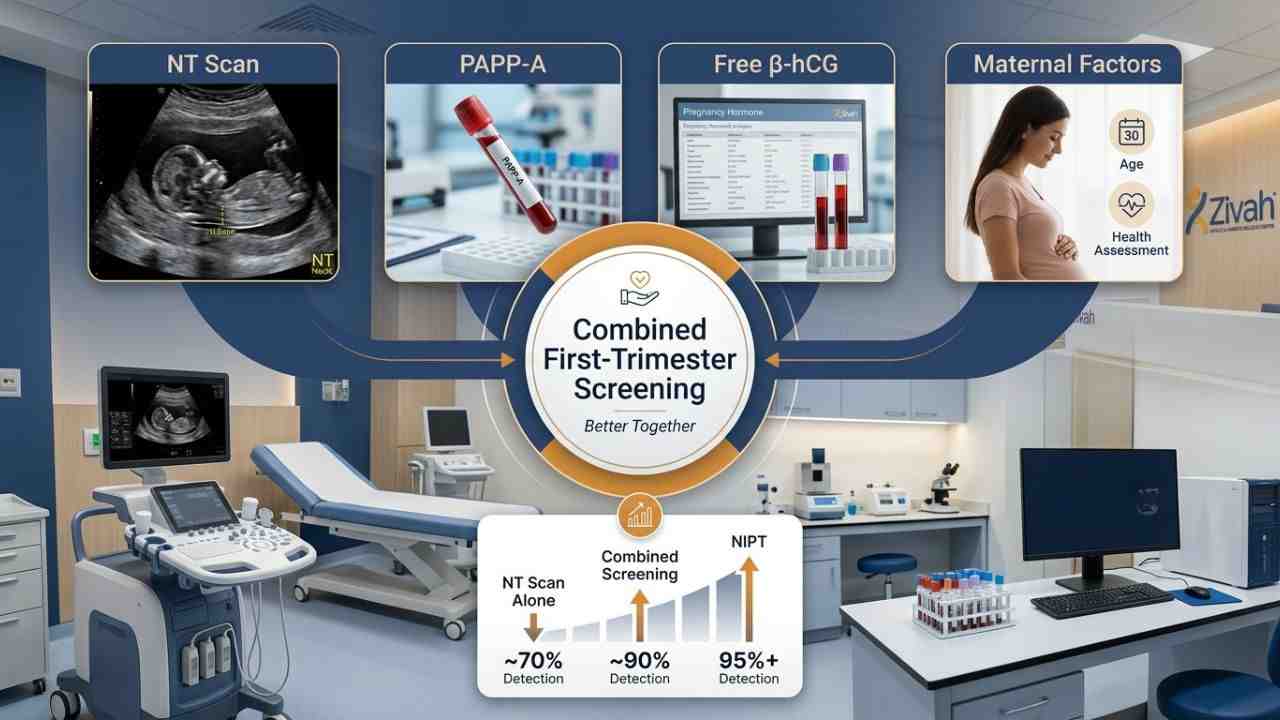
The Nuchal screening alone is helpful but not the whole story. By itself, it detects about 70% of Down syndrome cases, which is useful but not the most reliable test on the market. That’s why most doctors perform it with a blood test. Your blood test results from your pregnancy, plus the ultrasound, are what’s called combined first-trimester screening, and this combo is way more trustworthy. The combination screening examines four parameters at the same time:
- Your NT measurement – from the scan
- PAPP-A – a protein produced by the placenta
- Free beta-hCG - a hormone of pregnancy
- Your age and other details
When your radiologists and lab team read these together, they have roughly a 90% accuracy rate in finding Down syndrome. If your doctor is looking for more accuracy, 95% or higher, they may recommend NIPT, or non-invasive prenatal testing, a blood test that looks at DNA. The simple takeaway? The scan is far more accurate when it’s not on its own.
NT Scan vs NIPT vs Double Marker
These names are confusing; therefore, here is the difference. The nuchal translucency blood test, sometimes termed the double marker test, checks for PAPP-A and free β-hCG. If you are seeking the nuchal blood test, I suspect you are looking for this combination- the scan and the blood work read together. NIPT is a more advanced DNA-based blood test and is the most accurate. No one replaces the others; they build on each other to refine your risk score.
Combined First-Trimester Screening Components
| Component |
What it measures |
Type |
|---|---|---|
| NT scan |
Neck fluid thickness |
Ultrasound |
| PAPP-A |
Placental protein |
Blood |
| Free β-hCG |
Pregnancy hormone |
Blood |
| Maternal age |
Background risk |
Input |
Understanding Your NT Scan Results and Report Terms
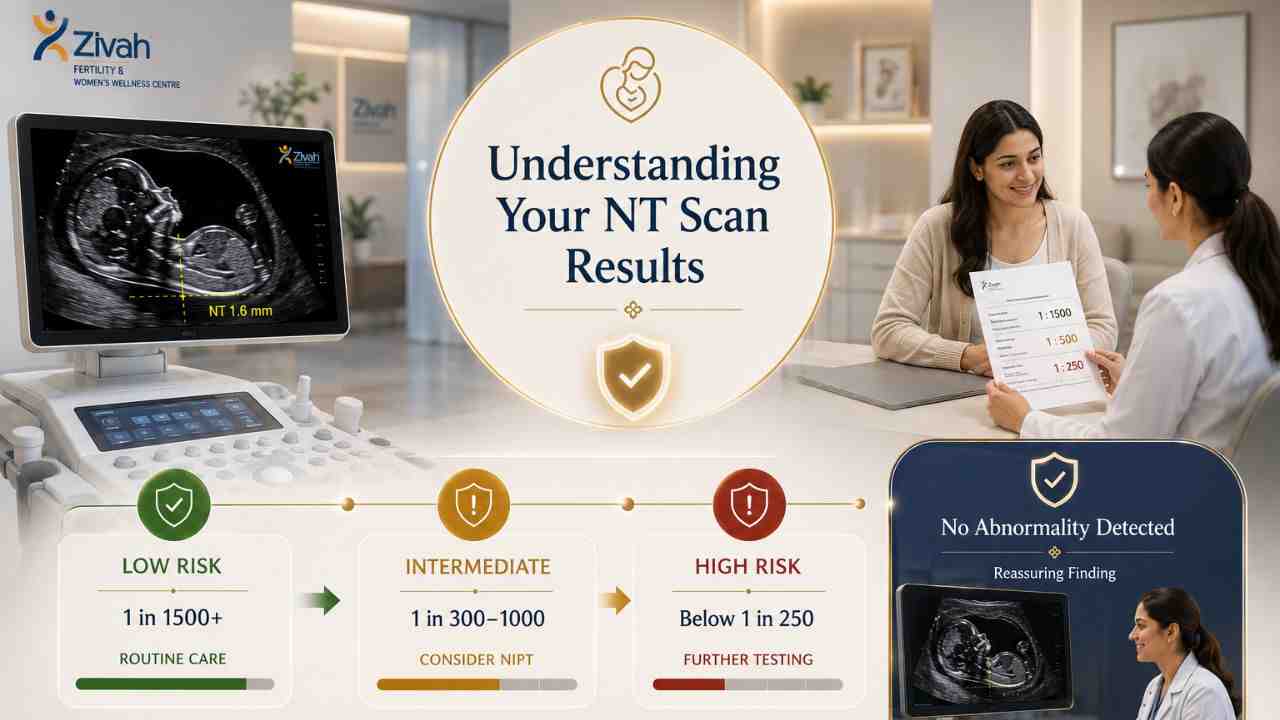
Your NT test results aren't just a "yes" or "no." They are expressed as risk ratios, such as 1 in 300 or 1 in 1,500. It is 1 in 300; therefore, in 300 pregnancies with this same reading, only 1 baby would have the condition. In other words, the report is an opportunity, not a diagnosis. Your doctor examines the ratio to determine whether you are at low, intermediate or high risk and if additional testing is necessary.
NT Scan Risk Result Interpretation
| Result |
Example ratio |
Meaning |
Next step |
|---|---|---|---|
| Low risk |
1 in 1,500+ |
Lower than average |
Routine care |
| Intermediate |
1 in 250 |
Borderline |
Discuss NIPT |
| High risk |
1 in <250 |
Higher likelihood |
CVS / amniocentesis |
What "No Abnormality Detected" Means on Your Report
If your abdominal USG result states "no abnormalities detected" or "no sonographic abnormality detected," it is good news, it just means the scan did not identify anything uncommon at that point. That's good to hear, but don't let your regular checkups stop.
Report Terminology Decoder
| Abbreviation / Phrase |
What It Stands For |
Plain-English Meaning |
|---|---|---|
| NT |
Nuchal Translucency |
Fluid thickness behind the neck |
| CRL |
Crown–Rump Length |
Baby's length, head to bottom |
| FHR |
Fetal Heart Rate |
Baby's heartbeat per minute |
| NB |
Nasal Bone |
Presence checked as a marker |
| No Sonographic Abnormality Detected |
— |
Scan found nothing unusual |
Does an NT Scan Show the Baby's Gender?
No, an NT scan doesn't show your baby's sex, and it is not designed to. While some seek ways to check the gender in an ultrasound report, it is an unlawful act in India to reveal the sex of a baby before birth under the PCPNDT Act. The NT scan is to check on your baby's health and development.
High-Risk Result: Next Steps (CVS and Amniocentesis)
High risk doesn't indicate your baby has a problem; it suggests the probability is higher; therefore, a confirmatory test may be helpful. Congenital abnormality (a condition present from birth) can be diagnosed by doctors using CVS (typically at 10–13 weeks) or amniocentesis (after 15 weeks). Both carry a minor risk of miscarriage, about 0.5-1%. Your doctor or a genetic counsellor should be able to advise you.
NT Scan Cost and Booking at Zivah
The nuchal translucency scan price varies from city to city and centre to centre. So it is better to directly check out the current rate instead of depending on a fixed number. In most situations, this cost will include the ultrasound itself, and the combined report (a combination of your scan and blood test) is usually available within a few days to roughly a week.
Zivah makes it easy if you’ve been looking for a nuchal translucency scan near you. You can book your NT scan online or by calling your nearest location. Our specialists will guide you to the best planning, preparation and what to expect on the day.
Why Choose Zivah for Your NT Scan
- Modern certified ultrasound equipment for clear, accurate imaging
- Experienced fetal-medicine and sonology staff doing NT scans every day
- Trusted integrated reporting that integrates your scan and blood findings
- Calm, supportive follow-up if more testing is necessary
Book your NT scan with Zivah today for early professional first-trimester treatment.