

If you and your partner have just been told that one of you carries a balanced translocation, PGT-SR (preimplantation genetic testing for structural rearrangements) may be the quiet turning point you have been searching for. After one miscarriage, then another, it is easy to feel that your body has failed you. But the truth is gentler than that. Your body is not broken; your chromosomes are simply packaged a little differently, and that small difference is what has made each pregnancy so hard to hold onto.
At Zivah Fertility, PGT-SR helps us find the healthy embryos before transfer, so recurrent miscarriage no longer has to be your story. And it begins with a free conversation.
What is PGT-SR?
If you are wondering what PGT-SR in IVF actually mean? Here it is in the simplest words. PGT-SR, or "preimplantation genetic testing for structural rearrangements", is a safe test that we do on your embryos before they are transferred during IVF. It helps us find embryos with balanced, healthy genes, so we can pick the best one. For couples going through balanced translocation IVF, this is the step that changes everything in a quiet way. We don't just hope that a pregnancy will last; we give it a much better chance right away.
In India, PGT-SR is offered only for genuine medical reasons, under the Assisted Reproductive Technology (ART) Regulation Act 2021. The PCPNDT (Pre-Conception and Pre-Natal Diagnostic Techniques) Act says that you can't choose the baby's sex. So it's not about picking the child you want, it's just about giving every embryo a fair, honest chance
Why PGT-SR matters if you carry a translocation
To understand how PGT-SR helps translocation carriers, it helps to remember one truth: when you carry a translocation, your own chromosomes are complete; they are simply arranged in a different order. You are healthy, and you feel well. But when those chromosomes pass into an embryo, some can end up with too much or too little genetic material, and these are the ones that often lead to miscarriage.
PGT-SR test results give us a clear way forward: we can tell which embryos are balanced and which are not, so you are no longer left waiting and wondering.
Which type of rearrangement do you carry?
Chromosomal rearrangement testing usually shows one of three types, and knowing yours helps us understand what your embryos may face. The table below explains each one in plain language.
| Type |
What’s Happening |
What It Means for Your Embryos |
|---|---|---|
| Reciprocal Translocation |
Pieces swapped between two chromosomes |
Higher chance of unbalanced embryos |
| Robertsonian Translocation |
Two chromosomes joined together |
Linked to miscarriage and some conditions |
| Inversion |
A chromosome segment flipped |
Can unbalance an embryo’s genetic material |
Whichever type you carry, the next question is usually the most personal one: is PGT-SR right for you?
Is PGT-SR right for you?
If you have been asking yourself who needs PGT-SR testing, it is made for couples who have been through more than their share of heartbreak. It helps most when miscarriage has happened more than once, or when a test has shown that one of you carries a structural rearrangement. You may have done everything right and still found yourself back at the start, and that is the exact situation PGT-SR is here to change.
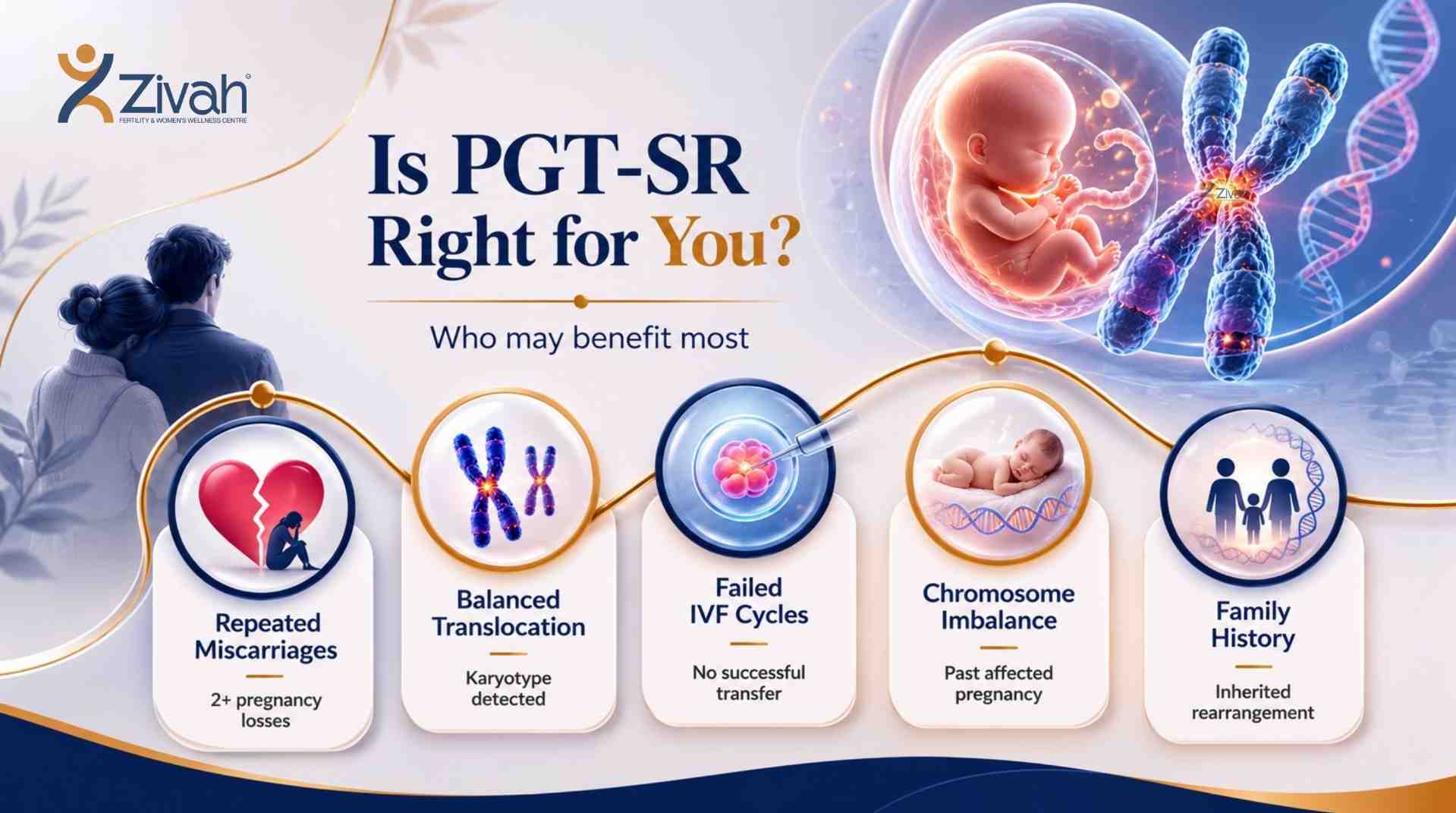
PGT-SR may be right for you if any of these feel familiar:
- You have had two or more miscarriages, and no one has been able to explain why fully.
- A karyotype test has shown that you or your partner carries a balanced translocation or inversion.
- You have been through balanced translocation IVF or other cycles that did not lead to a baby.
- A past pregnancy or child was affected by a chromosome imbalance.
- A translocation or rearrangement runs in your family.
Signs PGT-SR could be the answer you've been looking for
If you have been searching for a PGT-SR test for recurrent miscarriage, part of you probably already knows something deeper is going on, and that feeling is usually right. When you lose pregnancy after pregnancy, and every report still says everything looks fine, it leaves you stuck in the worst kind of silence. No reason. No name for it. Just the quiet ache of starting over again. So often, a structural rearrangement is the very thing that silence was hiding.
What PGT-SR gives you is something to finally hold onto. You no longer have to try again and simply hope, with your heart in your throat, that this time it stays. You and your partner can step forward knowing the embryo we choose has the best chance of growing into the baby you have been waiting for. Many of the couples we meet say the same thing through tears, that they only wish someone had told them about this sooner.
And once PGT-SR feels right for you, the next thing you will want to know is simple: what does the journey actually look like?
Your PGT-SR treatment journey at Zivah Fertility
People often ask us how PGT-SR testing works. But underneath that question is usually a quieter one: Will this be hard on me? Here is the part that matters most: at every stage, you are looked after. Nothing is rushed, nothing happens without your understanding, and you are never left to face any of it alone. For couples going through IVF with PGT-SR for translocation carriers, the science is careful, but the care around you is what you will feel each day.
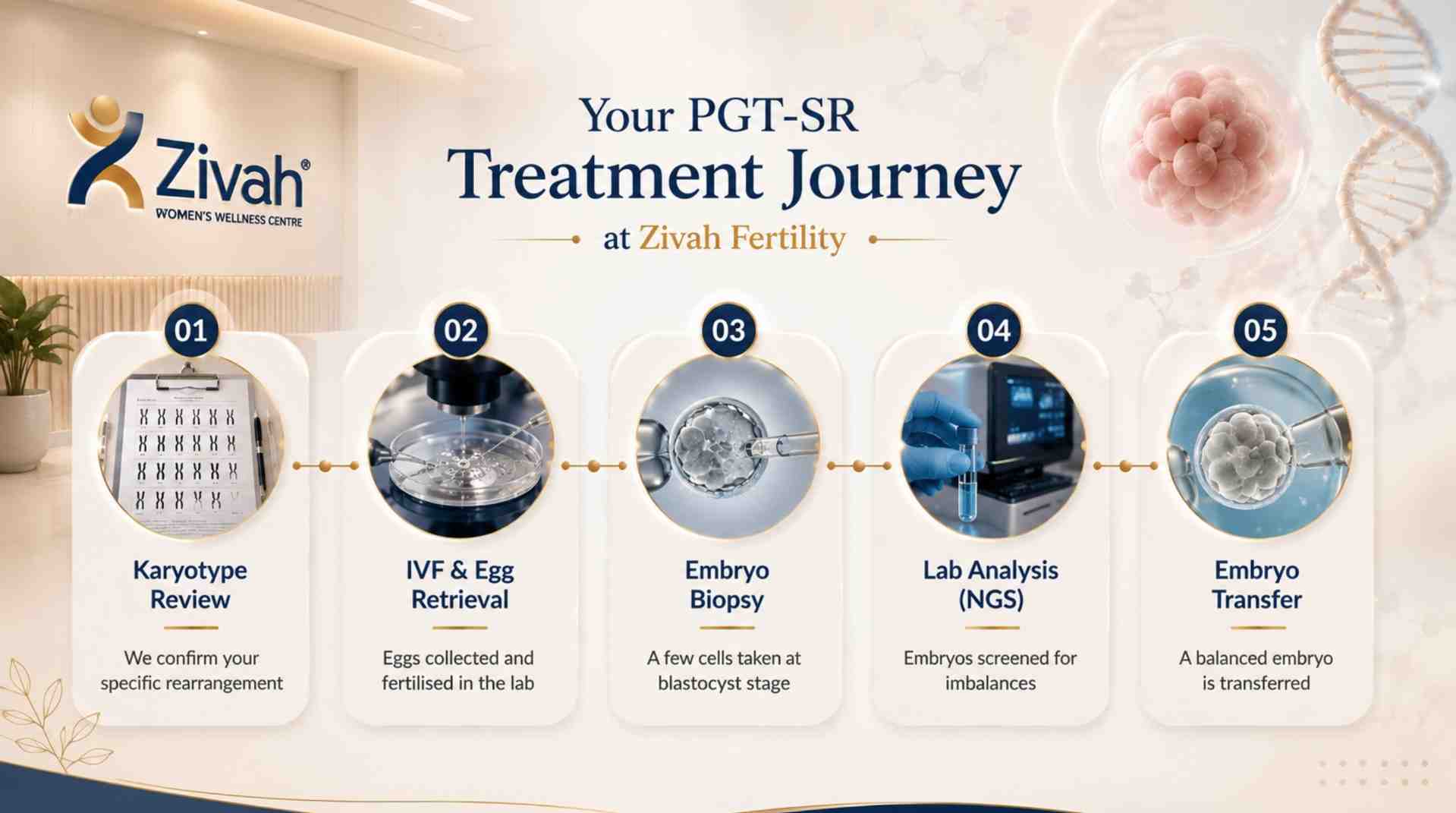
The journey moves through a few clear stages, shown below. Read it whenever you like, and we will walk you through every line of it in person.
| Step |
What Happens |
Why It Matters for You |
|---|---|---|
| Karyotype Review |
We confirm your specific rearrangement |
Makes sure PGT-SR will work for you |
| IVF & Egg Retrieval |
Eggs collected and fertilised in the lab |
Creates the embryos to be tested |
| Embryo Biopsy |
A few cells taken at blastocyst stage |
Safe sampling for testing |
| Lab Analysis (NGS) |
Embryos screened for imbalances |
Finds the healthy ones |
| Embryo Transfer |
A balanced embryo is transferred |
Lowers your miscarriage risk |
What the table cannot show is how it feels, the team that remembers your name, the call that comes the moment your results are ready. That is the part we hold most carefully.
How long does the PGT-SR process take?
Most couples complete the entire PGT-SR process in 2 months, from the initial tests to the transfer. As you wait for your results, those days feel very long because so much hope is riding on them. You don't have to keep checking your phone because we'll call you as soon as we hear something.
Do both partners need testing before PGT-SR?
Usually, only one of you carries the rearrangement, and knowing which partner is where everything begins. That is why we start with a karyotype review. It also means the partner who carries nothing can stop quietly blaming themselves, and the one who does can see this is something we can work with, not a fault to carry. You go in as a team.
So once you understand the path, the next question is the most hopeful one: how well does it actually work?
Does PGT-SR improve my chances of a healthy baby?
Here is the hope, told straight. The PGT-SR success rate for balanced translocation carriers is encouraging. Once we transfer a healthy, balanced embryo, your chance of the pregnancy holding goes up, and your risk of another miscarriage drops. Left to chance, a carrier can produce many embryos that appear normal but carry the wrong amount of genetic material. PGT-SR lets us tell a balanced embryo from an unbalanced one before transfer, so we are not hoping anymore; we are choosing.
We will always be honest about numbers. PGT-SR does not promise a baby, and not every cycle gives a healthy embryo. But for couples who have faced loss after loss, knowing each transfer carries its best odds changes everything. There is also a real case for not waiting too long; egg quality declines with time, so the sooner we begin, the more embryos we usually have.
Will my child be a carrier like me?
This is the question so many carriers lie awake with, and you deserve a real answer. When we look at your embryos, PGT-SR helps us see which is which:
- Fully unaffected embryos: none of your rearrangement at all.
- Balanced-carrier embryos: they carry the same rearrangement you do, and like you, they can grow into a completely healthy child.
- Unbalanced embryos: these carry the wrong amount of genetic material, and they are the ones behind miscarriage.
PGT-SR's first job is to rule out the unbalanced embryos. Depending on the testing method, it can also sometimes distinguish a fully normal embryo from a balanced-carrier one. And if your child does inherit your rearrangement, remember what your own life already shows them: a carrier can be completely healthy, and one day, should they wish, they will have this very option open to them too.
So once you can see the odds in your favour, it helps to know how PGT-SR sits alongside the other genetic tests you may have heard about.
PGT-SR vs PGT-A vs PGT-M - which test do you need?
If the letters are starting to blur together, you are not alone; most couples arrive unsure which test is theirs. The PGT-SR vs PGT-A difference is simplest to picture this way: PGT-A counts an embryo's chromosomes, PGT-M looks for a single inherited disease, and PGT-SR is the one for you, because it catches the imbalances that come from a translocation or inversion. All three are forms of genetic testing on embryos, but only PGT-SR is built around chromosomal rearrangement testing. The table makes it clear at a glance.
| Test |
What It Checks |
Best Suited For |
|---|---|---|
| PGT-A |
Counts the number of chromosomes in an embryo |
Older age, repeated IVF failure, recurrent miscarriage |
| PGT-M |
Looks for a single inherited genetic disease |
Families with a known inherited condition |
| PGT-SR |
Detects chromosome imbalances caused by translocations or inversions |
Couples carrying chromosomal rearrangements |
Can PGT-SR and PGT-A be done together?
Yes, and for translocation carriers, this is often the wisest path. PGT-SR finds the unbalanced embryos that come from your rearrangement, while PGT-A checks that the rest of the chromosomes are present in the right number, too. Run together on the same embryo sample, they give you the fullest picture, so the embryo we choose is sound on both counts. There is no extra biopsy for this; the same few cells can be tested for both. We will discuss whether this combined approach suits you during our review of your karyotype.
So once you know which test fits, the next honest question is what it all costs.
PGT-SR test cost in India
When you are carrying both worry and hope, the last thing you need is a price that hides surprises. So let us be open about PGT-SR cost. The cost of the PGT-SR test in India is not one fixed figure; it depends mainly on how many embryos need testing, since the lab analysis is done per embryo. Your type of rearrangement and overall IVF plan matter too. That is why we never quote a one-size-fits-all number.
The clearest way to know your cost is a short, personal conversation, and a free consultation is always your first step — no pressure, no obligation.
What's included in your PGT-SR cost at Zivah?
We believe you should see exactly what you are paying for, with nothing buried in the fine print. The table below shows what usually makes up your PGT-SR cost.
| Cost Component |
What It Covers |
|---|---|
| Karyotype Review |
Confirming your specific rearrangement |
| Embryo Biopsy |
Taking a few cells from each embryo |
| Lab Analysis (Per Embryo) |
NGS testing for imbalances |
| Genetic Counselling |
Helping you understand your results |
If you want a clear picture of the cost of PGT-SR before you decide, we are happy to walk you through every part of it in person. So once the numbers feel clear, the only thing left is knowing you are in the right hands.
Why couples choose Zivah Fertility for PGT-SR
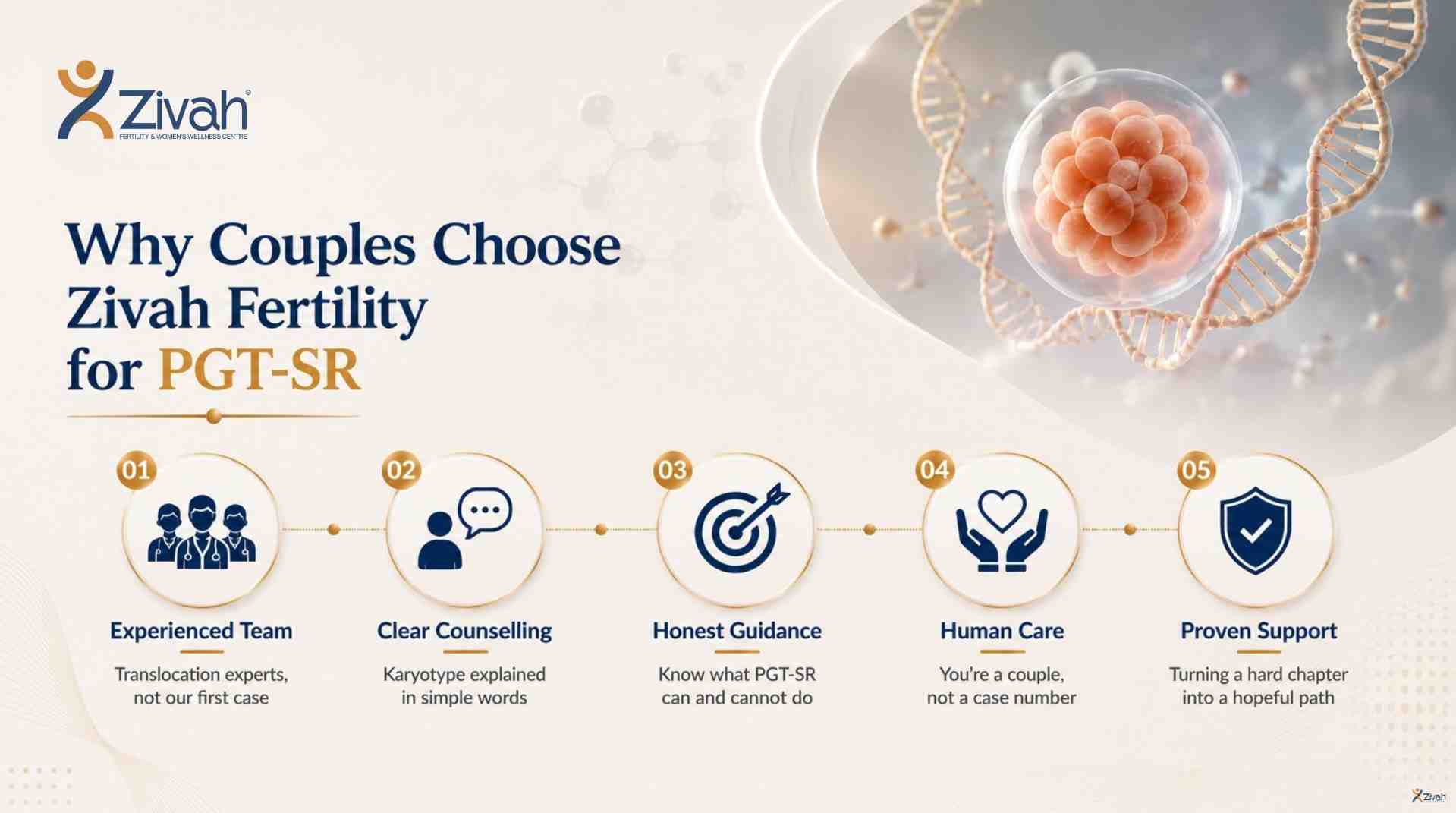
By the time most couples reach us, they have already been through a great deal, and what they want is not just a clinic, but somewhere they finally feel understood. If you have been searching for the best PGT-SR clinic in India, here is what sets Zivah apart:
- A team that has done this before. Our specialists handle translocation cases with real experience, so you are never anyone's first.
- Counselling that actually explains. We make your karyotype make sense, in plain words, for as long as you need.
- Honesty about your odds. We tell you what PGT-SR can and cannot do, so your hope rests on something solid.
- Care that stays human. From your first call to your results, you are a couple to us, never a case number.
For couples choosing PGT-SR in India, that mix of skill and warmth is what turns a frightening chapter into a path you can walk.
Genetic counselling that explains your results, gently
Someone probably handed you a karyotype report and a word you had never heard, then left you to carry it alone. We do this differently. Our genetic counselling is where your results stop being frightening and start making sense, what your rearrangement means, what your embryos may face, and what your real options are. You can ask anything, as many times as you need. Understanding your own situation is where hope takes root, and you will never leave a conversation more confused than when you walked in.
So when you are ready, the next step is the simplest one of all.
Book your free PGT-SR consultation
You have carried this for long enough on your own. If you and your partner are ready to understand whether a PGT-SR test is right for you, the first step asks nothing of you but a conversation. Sit with us, bring your reports and your questions, and let us explain what IVF with PGT-SR for translocation carriers could mean for your family, clearly and without pressure. There is no commitment here, only answers you have been waiting a long time to hear.
"Your body isn't failing you. Your chromosomes are simply packaged a little differently, and that is something we can work with."
The road behind you has been hard, but it does not have to be the whole story. Many couples tell us they only wish they had reached out sooner, so when you feel ready, we are here. Book your free consultation with Zivah Fertility, and let us take the next step together.