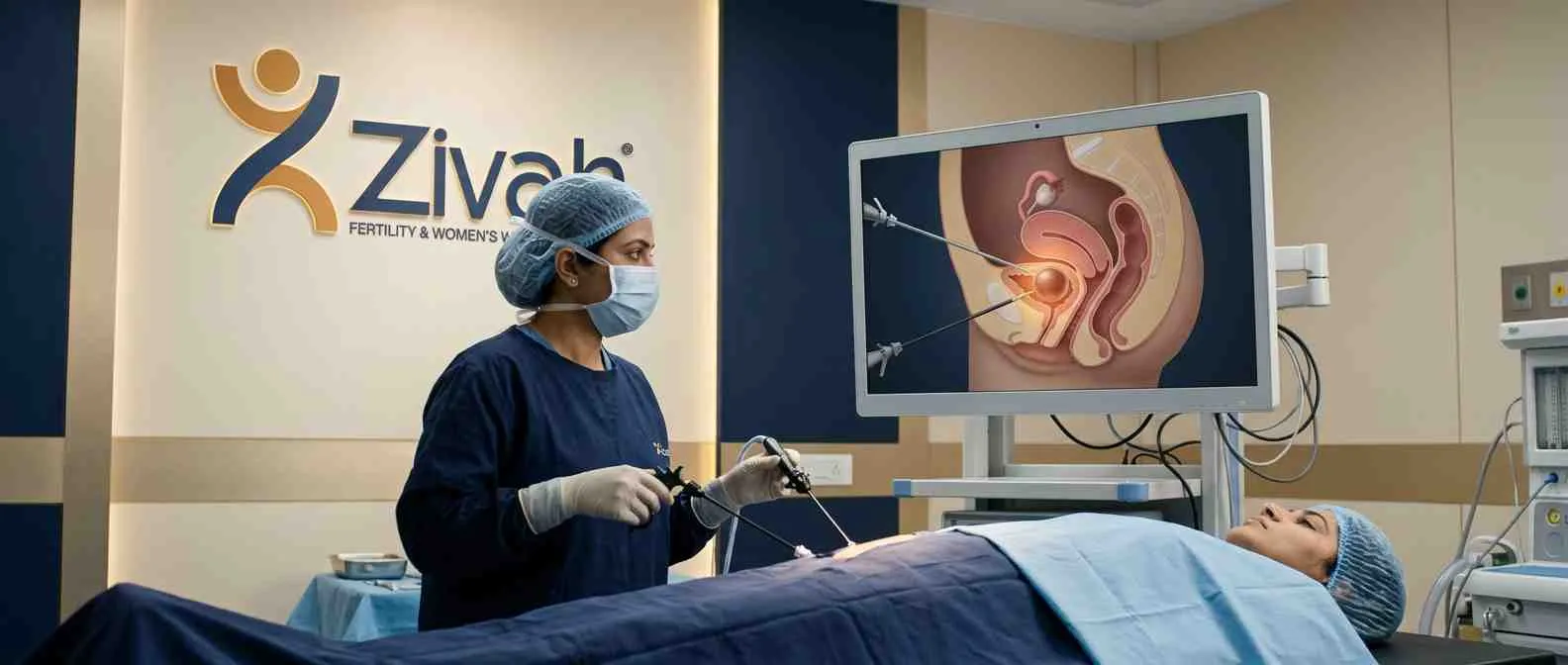

A laparoscopic cystectomy for an ovarian cyst: a laparoscopic ovarian cystectomy removes the cyst with a few small keyhole incisions, leaving the healthy ovary in place. It’s a minimally invasive ovarian cyst surgery, which means less discomfort, fewer scars and a quicker return home than open surgery.
This page takes you through everything that matters before you decide: when the surgery is really needed, the scans and tests done beforehand, the specifics of how the process works, what recovery really looks like, what determines the cost, and how it affects your fertility.
What patients don't expect, mostly? You can take out the cyst without taking off the ovary with it. This one difference is what keeps your fertility safe, and it’s where surgical skill makes the difference.
At Zivah, our fertility and maternal-fetal specialists take an ovary-sparing approach to each cyst removal, so you can feel confident that the issue is being treated without compromising your reproductive future.
What Is a Laparoscopic Cystectomy for an Ovarian Cyst?
It’s a simple word: “cyst” + “ectomy”, which means removal. An ovarian cystectomy means just that: the removal of a cyst that has grown on or within the ovary. The 'laparoscopic' portion is the technique: instead of a big cut, the surgeon uses a few small holes, a camera and skinny tools.
Most ovarian cysts are benign, and if one has to come out, the keyhole technique is the route of choice. It provides the surgeon with a clear, magnified view of the ovary, allowing precise laparoscopic removal of the ovarian cyst while protecting the surrounding healthy tissue.
The surgery is done under a general anaesthetic, so you are asleep the whole time. Most women describe ovarian cyst laparoscopy as a simple and well-tolerated treatment, with many patients going home the same day.
Cystectomy vs Oophorectomy: What's Removed
That’s the big difference, and it all boils down to one question: is the ovary remaining or going?
- Cystectomy is the removal of the cyst solely. The ovary is left in place, complete with its hormone production and its eggs.
- Oophorectomy removes the entire ovary, cyst included.
Surgeons prefer cystectomy when it is safe. The full removal is generally in the case of a highly damaged ovary or a real fear about cancer. However, the aim is cystectomy and ovary preservation in most benign cysts, and the ovary continues to function normally thereafter.
When Is Laparoscopic Ovarian Cystectomy Needed?
Not all ovarian cysts require surgery. Many are minor and harmless and disappear on their own after a cycle or two. So when do you need to get ovarian cyst surgery? The answer is usually down to three factors: your symptoms, what the scan shows and whether the cyst is acting irregularly.
Symptoms are frequently the first clue. If the cyst is no longer worth waiting and monitoring for, you may have ongoing pelvic pain, bloating, discomfort when doing sexual activity, or a feeling of pressure on the bladder or bowel. The scan tells the rest. You would have an ovarian cyst operation if it is big, has not resolved with observation, or appears complex on imaging.
These are the main indications for ovarian cystectomy. And sometimes there is no waiting at all. A cyst can also distort the ovary (torsion) or rupture, causing sudden, acute pain, a medical emergency that may require same-day surgery.
Symptoms That May Require Ovarian Cyst Surgery
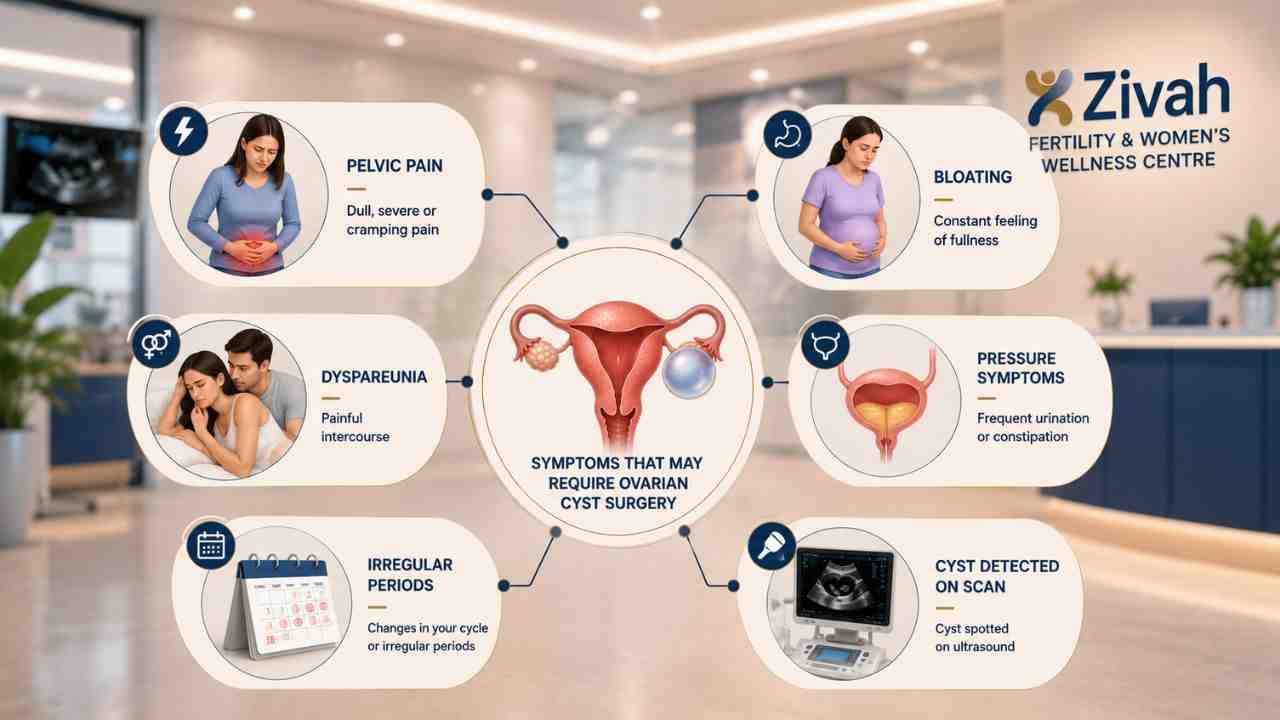
The most important of them when symptoms dictate the decision for surgery for removal of ovarian cysts are:
- Dull, severe or cramping ongoing discomfort in the pelvic area
- Bloating or a constant feeling of fullness in the abdomen
- Dyspareunia (painful intercourse)
- Symptoms of pressure: frequent urination or constipation
- Changes in your cycle or irregular periods
These generally warrant an operation to remove an ovarian cyst, as well as a cyst spotted on a scan.
Imaging Findings That Indicate Surgery
The scan can make its own case, separate from symptoms. When to operate on an ovarian cyst based on imaging depends on size, appearance and persistence: a huge cyst, solid or irregular characteristics or one that doesn’t resolve. Here, laparoscopic removal of the ovarian cyst is performed, and the cyst is sent for testing.
| Clinical Situation |
What It Means |
Why Surgery Is Considered |
|---|---|---|
| Large or persistent cyst |
Cyst is sizeable or hasn't resolved after watchful waiting |
Unlikely to disappear on its own; removal prevents ongoing symptoms |
| Complex or solid-component cyst |
Scan shows solid areas, thick walls, or irregular borders |
Needs removal and testing to rule out anything serious |
| Endometrioma with pain |
Cyst formed from endometriosis, causing significant pain |
Removal relieves pain and confirms the diagnosis |
| Recurrent cysts |
Cysts keep coming back with repeated symptoms |
Surgery addresses the source and reduces further episodes |
| Torsion or rupture (emergency) |
Cyst has twisted the ovary or burst |
Sudden severe pain, same-day surgery may be needed to save the ovary |
| Suspicious features on scan |
Imaging raises concern about malignancy |
Removal allows tissue testing and early treatment if required |
Tests and Imaging Before Ovarian Cyst Surgery
It is easy to identify cysts before they appear. What happens next depends on the diagnosis of an ovarian cyst; hence, a few important tests are always done first.Usually it begins with a scan. Before ovarian cyst surgery, the ultrasound is transvaginal and displays the size, shape, and character of the cyst, and detects anything that appears abnormal.
At Zivah, this sits within our wider fetal and pelvic ultrasound imaging and Doppler studies, so your surgeon has a full, detailed image before walking into theatre. Then there are the blood tests.
In women under 40, the usual tests are HE4 and LDH, together with AFP and HCG. Still, CA-125 is commonly tested to assess the possibility that an ovarian cyst is more than benign. Other typical testing before excision of ovarian cysts includes a simple blood count and check of your coagulation, merely to make sure your body is ready for surgery.
These tests together remove the uncertainty so when surgery happens, the cyst isn’t a surprise.At Zivah, every diagnostic imaging of the pelvis is done strictly as per the PC&PNDT Act.
Who Is a Candidate for Laparoscopic Ovarian Cystectomy at Zivah?
If you're asking, "Am I a candidate for laparoscopic cystectomy?" the good news is that most women are. For most normal ovarian cysts, the keyhole method is the natural first choice, and the preoperative diagnostics make sure you are a suitable fit.That said, part of appropriate treatment is identifying who shouldn't have laparoscopic cystectomy or rather, when an alternative method serves the patient better. The keyhole method may be more difficult or less safe in some cases, including:
Dense scar tissue from previous surgery
- A very large or suspicious cyst
- Extreme obesity
- Bleeding disorders
- An active pelvic infection
- Some pregnancies
In these circumstances, the surgical strategy is simply altered to keep you safe. That's why screening up front is so important in the pre-op examination; it gets the appropriate patient with the proper strategy.
When Open Surgery Is Recommended Instead
Sometimes the best solution is open surgery, called a laparotomy, and that's not a disadvantage. If cancer or extensive adhesions are suspected, open surgery to remove ovarian cysts gives the surgeon more access and allows the cyst to be removed entirely and securely if malignancy is suspected.
It is a conscious, sometimes life-saving choice, not a fall-back. In the contrast below, you will see how the two approaches differ in the ordinary items patients ask about.
Laparoscopic vs Open Ovarian Cystectomy: A Side-by-Side Comparison
| Feature |
Laparoscopic |
Open Surgery |
|---|---|---|
| Incision size |
A few small cuts (0.5–1.5 cm) |
One larger cut (10–15 cm) |
| Hospital stay |
Same day or one night |
Two to three days |
| Recovery time |
One to two weeks |
Four to six weeks |
| Scarring |
Minimal, fades over time |
More noticeable |
| Pain level |
Generally mild |
More significant |
| Ovary/fertility preservation |
High priority, ovary-sparing |
Preserved where possible |
| Typical suitability |
Most benign cysts |
Large, complex, or suspicious cysts |
Types of Ovarian Cysts Treated Laparoscopically
Cysts aren't all the same, and the type of cyst frequently dictates how the procedure is performed. Laparoscopic treatment for ovarian cysts is flexible enough to treat most of them, yet each type needs a little different touch.
The functional cyst is the most frequent and generally the least worrisome type. These are often self-limiting and are just watched, not operated on. For the other forms, surgery is usually needed.
If the pain persists due to a blood-filled ovarian cyst, hemorrhagic ovarian cyst surgery can be an option. Cystadenomas are fluid-filled cysts that can be enormous and are usually also removed this way. And we remove endometriomas, which are cysts associated with endometriosis, very carefully to protect the ovary beneath.
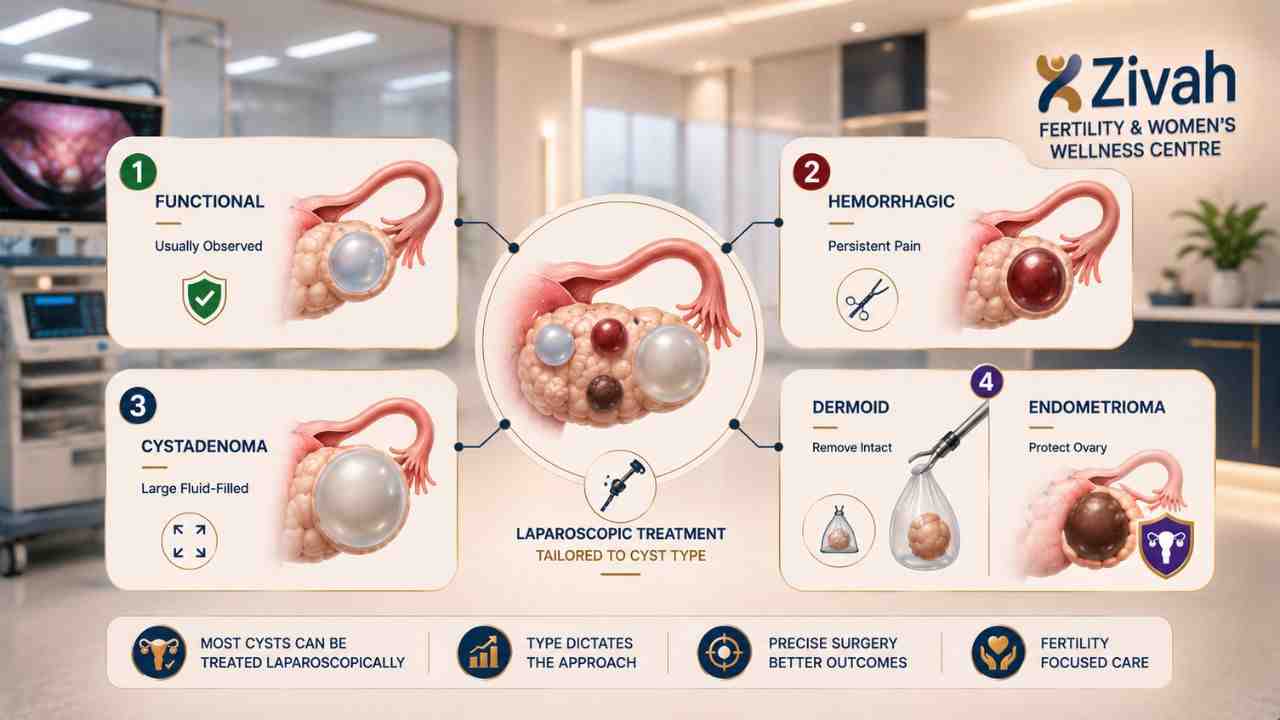
Dermoid & Endometrioma Cyst Removal
Each of these demands closer study, as each requires unique handling.
- Dermoid cysts: In laparoscopic surgery for a dermoid cyst, the aim is to remove the cyst in its entirety. Dermoid cysts contain thick, oily material, and if it bursts during surgery, it can irritate the lining of the abdomen; therefore, it is important to preserve it intact. This is when precise dermoid cyst removal surgery really demonstrates the surgeon's ability.
- Endometriosis: There is another issue with endometrioma laparoscopic surgery. These cysts are attached to the good ovarian tissue; therefore, forceful removal can reduce ovarian reserve. It is the most careful removal that maintains fertility.
How to Prepare for Laparoscopic Ovarian Cystectomy at Zivah
Proper surgery begins long before the day of operation. If you know how to prepare for ovarian cyst surgery, most of the nerves are gone. The processes are simpler than you would expect.Your pre-op consultation is where it all begins; you’ll discuss the treatment, ask your questions and sign your agreement.
Then a few checks to make sure you are ready: blood tests, a look at your scans, and any medicines you use regularly. Tests before ovarian cyst removal usually include a blood count and a check to see if the blood clots are to make sure surgery can safely go ahead.
It’s got two practical things to complete. Follow the fasting instructions carefully and make arrangements for a lift home as you won’t be able to drive yourself after anaesthesia.
Fasting and Medication Instructions
Fasting is more important than many realise. You are usually told to stop eating and drinking for about 6 to 8 hours before surgery; this helps to keep the anaesthetic safe. One instruction is not to bend properly before ovarian cystectomy.
You might also need to change your medicines. Blood thinners and several other drugs are commonly stopped a few days earlier, but only on the advice of your doctor; never stop anything on your own. And because you will be drowsy afterwards, be sure someone can give you a ride home.
Pre-Operative Preparation Checklist
| Step |
What to Do |
Why It Matters |
|---|---|---|
| Consultation & consent |
Discuss the procedure and sign consent |
Ensures you understand the surgery and agree to it |
| Blood tests |
Complete blood count and clotting profile |
Confirms your body can handle surgery and clot normally |
| Imaging review |
Surgeon reviews your ultrasound and scans |
Plans the operation around your specific cyst |
| Medication review |
Flag all medicines; pause blood thinners if advised |
Reduces bleeding risk during surgery |
| Fasting |
No food or drink for 6–8 hours before |
Keeps anaesthesia safe and lowers complication risk |
| Transport arrangement |
Arrange a lift home |
You can't drive after anaesthesia |
How Is Laparoscopic Ovarian Cystectomy Done?
Wondering what actually happens during the surgery? Knowing the steps ahead of time makes the whole thing feel far less daunting. The laparoscopic cystectomy procedure follows a clear, careful order: nothing rushed, every step there for a reason. Here's how ovarian cysts are removed, from the moment you're asleep to the last stitch:
- Anaesthesia - You are put under general anaesthesia, and you sleep, but your vital signs are monitored throughout.
- Small cuts - The surgeon makes a few cuts (keyholes), only 0.5-1.5 cm per cut.
- Making room - Carbon dioxide gas easily raises the abdomen wall to provide space and good vision.
- Placing the camera - On a screen from a laparoscope, we see greater detail of the ovary.
- Removal of cyst - The surgeon carefully dissects, peeling the cyst wall off, leaving the healthy ovarian tissue underneath, hopefully lifting the cyst out intact.
- Repair of ovary - The bleeding is stopped, and the ovary is rebuilt with care.
- Going dark - The cyst is extracted in a specimen bag, the gas is let out, and the tiny cuts are closed.
All cysts are referred for histopathology. It matters that it is taken out whole. If it is malignant, taking it out whole helps prevent it from spreading.
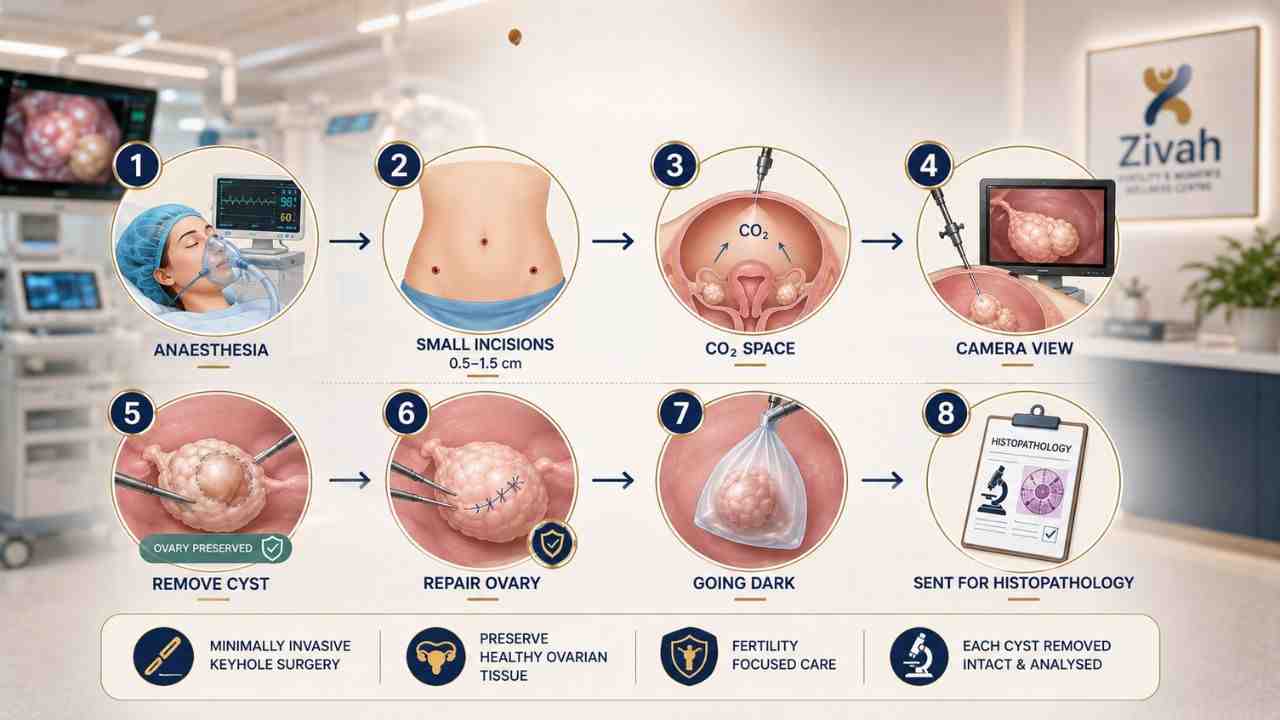
Anaesthesia and Incisions
The ovarian cystectomy operation begins with general anaesthesia so you won't feel anything. The keyhole ports and carbon dioxide gas make the recuperation gentler than open surgery.
Cyst Removal and Ovary Repair
This is the basis of the ovarian cystectomy procedure. Working in the capsule plane to separate the cyst from the ovary. Controlling bleeding. Repairing the ovary. This is where surgical competence is most important in ovary-sparing therapy.
What Happens If the Cyst Can't Be Removed Laparoscopically
The keyhole technique is sometimes not the safest alternative; once surgery starts, it is frequently due to scar tissue or a complex cyst. The surgeon may then convert to open surgery, a planned conversion to open surgery about safety, not failure.
Recovery After Laparoscopic Ovarian Cystectomy
The best thing about keyhole surgery is how soon you get back on your feet. Most women find their ovarian cystectomy recovery much easier than they imagined because tiny wounds just heal faster than a big incision.You should expect some stiffness around the wounds the first day or two, and perhaps a strange ache in your shoulders.
That's residual gas from the surgery, and it resolves on its own. The average recovery period for a laparoscopic cystectomy is one to two weeks for daily activities, and three to four weeks for a complete recovery.
You can generally shower the day after but avoid showers and swimming until the wounds have healed. The laparoscopic cystectomy scars are small, and they go away with time.
One quick note: if you observe any of these, notify your clinic:
- Fever or feeling ill
- Bloody bleeding, Increasing or severe pain
- Drainage or redness at a wound
First 48 Hrs After Recovery
Don't lie flat in bed but do rest. Gentle movements help you heal and reduce the chance of blood clots. Rest and drink fluids. Take pain medication as indicated. Getting back to work and exercise.
Returning to Work and Exercise
Most women cope with light work in a week. Avoid heavy lifting for a few weeks after your ovarian cyst removal. Wait until you are off pain medication before you drive. Resume intercourse when you feel comfortable.
Recovery Timeline After Ovarian Cyst Removal
| Time After Surgery |
What to Expect |
Activity Guidance |
|---|---|---|
| First 24 hours |
Soreness, drowsiness, possible shoulder ache |
Rest, sip fluids, gentle movement |
| Days 2–3 |
Discomfort easing, more energy |
Short walks; avoid strain |
| Week 1 |
Feeling noticeably better |
Light work and daily activities |
| Weeks 2–4 |
Near-full recovery |
Gradually resume exercise and normal routine |
Risks and Benefits of Laparoscopic Ovarian Cystectomy
Like any surgery, this one comes with clear advantages and a few risks worth understanding. The best way to feel confident in your selection is to consider both.
Benefits of Minimally Invasive Cyst Removal
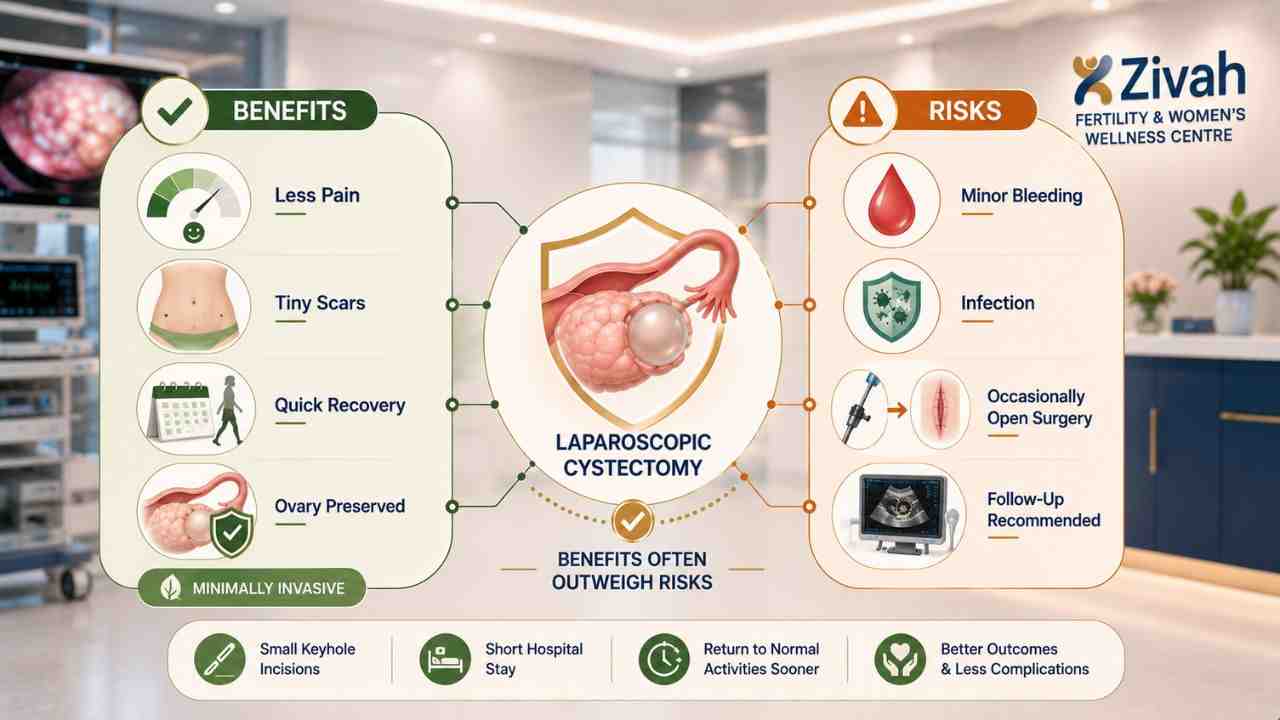
Laparoscopic cystectomy is the preferred option due to its benefits. It is a minimally invasive ovarian cyst surgery, which promises less pain, minor scars, a short hospital stay and a speedy return to regular life. Importantly, it maintains the ovary and helps to retain fertility, and it has a lower overall complication rate than open surgery.
Possible Risks and Complications
The risks of laparoscopic cystectomy are rare, but honesty is key. More common are minor bleeding, infection or nausea after anaesthesia.
More rarely, there is a danger of injury to nearby organs such as the bladder or colon, a move to open surgery mid-procedure, or, very occasionally, removal of the ovary if it's significantly damaged. “Cysts can also return over time, which is why follow-up care is important.”
Why Choose Zivah for Laparoscopic Ovarian Cystectomy
Where you get your operation matters just as much as the surgery itself. What makes Zivah different is a serious emphasis on saving your ovary and your fertility, not just taking out the cyst. We are a specialist clinic for ovarian cystectomy. We combine the experience of a minimally invasive team, extensive pre-op imaging and, if you need it, reproductive assistance post-surgery, all under one roof.
Expert Ovarian Cyst Surgeons in Zivah
Our ovarian cyst surgeons offer the accuracy needed for ovary-sparing surgery and the skill that safeguards your reproductive future. Best Doctor for Ovarian Cyst Surgery: An Experienced Gynaecologist for Laparoscopic Cystectomy at Zivah Will Take You Through the First Scan to Recovery.
Ready to move to the next step? Book a consultation to discuss your options and check out our related High-Risk Pregnancy Care, Genetic Counselling, and Fertility Services for complete, connected care.