

Doppler studies are a specialised type of ultrasonography that measures blood flow. Not simply how the body is built, but how blood is actually moving through it, in which direction and how fast.
A fetal Doppler study is the capacity to take that skill and use it on the circulation that matters most in pregnancy, the flow of blood between you, the placenta and your baby. Colour Doppler ultrasonography can be performed by a specialist to check whether your baby is receiving enough oxygen and nutrients through the cord and placenta.
This guide describes what a Doppler study is, the types used in pregnancy, when it is needed and how to read your findings. It gives you a clear view of your baby's blood supply.
What Are Doppler Studies & How Do They Work?
What is a Doppler test? A normal ultrasound gives us still images of the way things are put together, organs, bones, and the baby's anatomy. A Doppler study takes it one step further by revealing blood flow. It's the same machine, same probe, only in a different mode.
Sounds difficult, yet the science is simple. The probe sends sound waves into the body, and when those waves bounce off moving blood cells, they emerge with a slightly different pitch due to the Doppler effect. The machine reads that change and displays it as either a colour or a waveform on the screen.
Just a short clarification: This page is about the general blood flow scan. Doppler is part of fetal echocardiography, which studies the heart itself.
Doppler vs Standard Ultrasound, and Reading the Colours
The difference is flow vs. structure. A standard scan tells you 'what is it made of?' A Doppler tells you How is the blood moving?' The colours here on a colour Doppler just show a direction; by convention, red is flow flowing towards the probe, and blue is flow going away. For finer detail, a spectral waveform represents that flow as speed over time, which is what the professional actually measures.
Types of Doppler Ultrasound
| Doppler Type |
What It Shows |
Typical Use |
|---|---|---|
| Colour Doppler |
Flow direction and speed, as colour |
Quick map of blood flow |
| Power Doppler |
Presence of very slow flow (no direction) |
Detecting faint flow in tissues |
| Spectral (PW/CW) |
Velocity plotted over time as a graph |
Precise flow measurement |
| Duplex |
A 2D image combined with Doppler |
Structure and flow together |
Why Are Doppler Studies Done in Pregnancy?
Your baby relies completely on a steady stream of oxygen and food, passed from you through the placenta and the umbilical cord. A Doppler study is the way doctors check that this supply line is working.

Instead of just looking at the baby, it measures the blood flow itself, showing whether the placenta is doing its job and the baby is being fed well. This makes it quite handy if a pregnancy needs closer attention. Doppler studies are often applied to:
- Check if the placenta is pumping enough blood to the baby.
- Keep track of a baby who is small or growing slowly.
- Monitor pregnancies complicated by high blood pressure or diabetes.
- If the movements have slowed down, check on the baby.
In these situations, regular monitoring of blood flow will become an important part of knowing how your baby is getting on.
What a Pregnancy Doppler Study Shows
A pregnancy Doppler looks at blood flow in three key areas: the umbilical cord (your baby's lifeline), the uterine arteries (your supply to the placenta) and the baby's brain. Together, they tell the team how effectively the placental blood flow is operating and how well your baby is coping.
Types of Fetal & Obstetric Doppler Studies In Zivah
A pregnancy Doppler is not a one-off test, but a series of tests, each one checking a different blood vessel. And the best part is that these readings trace the entire supply chain: from your side, through the placenta, to your baby’s response.
Break it down into three steps. You’re delivering to the placenta. The uterine arteries are showing you. The umbilical artery shows what is coming through the cord to the baby. And the baby's brain blood flow is an index of how well the baby is coping with what it gets.
In addition to the three, a specialist may add an extra reading or two, such as the ductus venosus and the cerebroplacental ratio (CPR), when a closer examination is needed.
1. Umbilical Artery Doppler
This is the most common Doppler for pregnancy. It determines the resistance to blood flow in the umbilical cord, which is a direct sign of how well the placenta is working. Rising resistance can be an early clue to intrauterine growth restriction (IUGR), making it a mainstay of third-trimester growth monitoring.
2. Uterine Artery Doppler
This one tests how well blood is getting to the placenta from your side. This is usually done at 20 to 24 weeks and looks for a pattern in the waveform, called an early diastolic ‘notch’. If there is still that notch at about 24 weeks, it is a recognised warning sign for later pre-eclampsia and growth restriction.
3. Middle Cerebral Artery (MCA) Doppler
The MCA scan looks at blood flow to the baby’s brain and has two main jobs. Measuring the peak speed of flow (MCA-PSV) screens for fetal anaemia - and the angle has to be nearly parallel to the flow, else the reading falls short. Instead, measuring resistance (MCA-PI) shows “brain-sparing” where a stressed newborn moves blood to protect the brain.
Obstetric Doppler Studies & What Each Assesses
| Doppler Study |
Vessel |
What It Assesses |
Typical Timing |
|---|---|---|---|
| Umbilical artery |
Cord |
Placental function, growth restriction |
Third trimester |
| Uterine artery |
Mother's uterine supply |
Preeclampsia & FGR risk (notch) |
20–24 weeks |
| Middle cerebral artery |
Baby's brain |
Anaemia (PSV); brain-sparing (PI) |
Third trimester |
| Ductus venosus |
Fetal venous return |
Late fetal cardiac strain |
When indicated |
| Cerebroplacental ratio |
MCA vs umbilical |
Combined wellbeing marker |
Third trimester |
When Is a Doppler Study Needed in Pregnancy?
A Doppler test is not performed in every pregnancy, unlike a standard scan. It’s an indication-led test performed when there’s a specific need to examine the baby’s blood supply more closely.
Timing depends on the purpose. A uterine artery Doppler is often used around 20 to 24 weeks as a screening test for early warning symptoms, whereas umbilical and brain (MCA) Dopplers are more commonly used in the third trimester to monitor a baby’s wellness. Which study you have, and when, is something your doctor decides as your pregnancy goes along.
High-Risk Indications (IUGR, Preeclampsia & More)
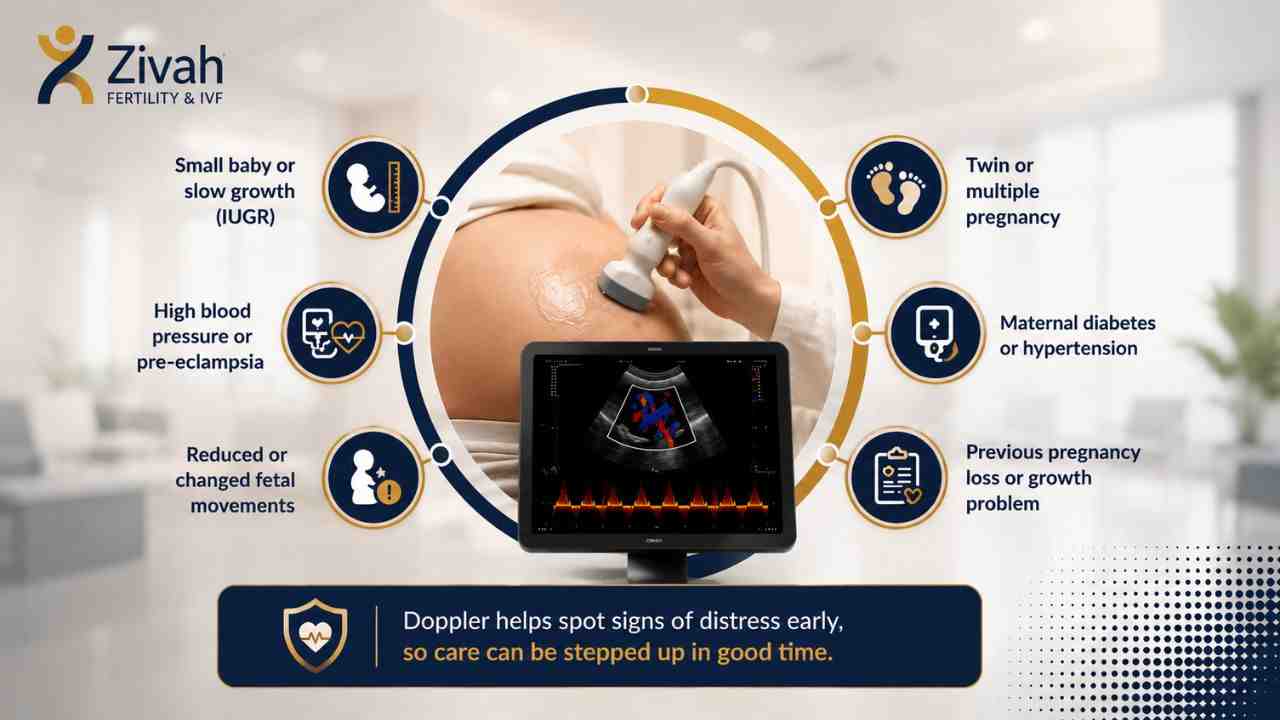
A fetal Doppler study is usually suggested when there's extra reason to keep a close watch, such as:
- A baby who is small or growing slowly (possible IUGR)
- High blood pressure or pre-eclampsia
- Reduced or changed fetal movements
- A twin or multiple pregnancy
- Maternal diabetes or hypertension
- A previous pregnancy loss or growth problem
In these cases, Doppler helps spot signs of distress early, so care can be stepped up in good time.
How Is a Doppler Study Performed In Zivah?
If you've had a regular pregnancy scan, this will feel just the same. You lean back, a small amount of gel on your stomach, and the technician glides a probe over your skin, except this time the Doppler mode is on.
The professional lines up a little marker over the vessel they're checking and takes a reading of the blood-flow waveform. They measure each ship individually. The full checkup will normally take somewhere between 20 and 40 minutes, depending on how many vessels are checked and how settled the baby is.
How to Prepare for a Doppler Study
There's not much to do in advance. Loose comfy clothes that you can lift away from your bump, no need to fast or fill your bladder. Bring any prior scans or growth records with you so the specialist can make comparisons. A relaxing period is also helpful, as a relaxed, still baby produces the clearest waveforms.
Is a Doppler Study Safe in Pregnancy?
Yes, Doppler is non-invasive and does not use radiation; thus, it is considered safe in pregnancy. Doppler takes a little more energy than a regular scan; therefore, doctors employ it judiciously, and only when there is a good clinical reason to do so.
Did your doctor advise a Doppler study? Book your Doppler for a pregnant woman at Zivah for a clear, specialist-reviewed blood-flow assessment.
Understanding Your Doppler Study Report
A Doppler report might look like a collection of letters and numbers at first, but the theory behind it is simple. It checks each vessel, gives a number to the ease of blood flow, then compares that number to what's normal for a normal pregnancy.
The important thing to remember here is that these ranges change as the pregnancy progresses; thus, a number is only useful for its specific gestation. If the reading is above that level, that usually means increased resistance.
It’s a sign the placenta may be working harder than it should. That’s not an automatic alert; it’s a signal to your team to go deeper.
Doppler Indices Explained (RI, PI & S/D Ratio)
Most of the data in the study are resistance measures. There are three you'll hear about most commonly, RI (resistivity index), PI (pulsatility index) and the S/D ratio; they are all various ways of saying the same thing. How much the blood flow slows down between heartbeats. The higher the value, the more resistance, and the harder the placenta has to push.
Reading Your Doppler Study Report
| Report Component |
What It Measures |
Why It Matters |
|---|---|---|
| Umbilical artery (UA) index |
Cord flow resistance (RI, PI, S/D) |
Reflects placental function |
| Uterine artery (UtA) index |
Maternal supply, plus any notch |
Flags preeclampsia / FGR risk |
| MCA - PSV |
Peak flow speed in the brain |
Screens for fetal anaemia |
| MCA - PI |
Brain flow resistance |
Shows brain-sparing |
| Ductus venosus |
Fetal venous return |
Flags late cardiac strain |
| CPR (cerebroplacental ratio) |
MCA vs umbilical balance |
Combined wellbeing snapshot |
| Overall interpretation |
All values vs gestation norms |
Summarises the next step |
What Happens If a Doppler Study Is Abnormal?
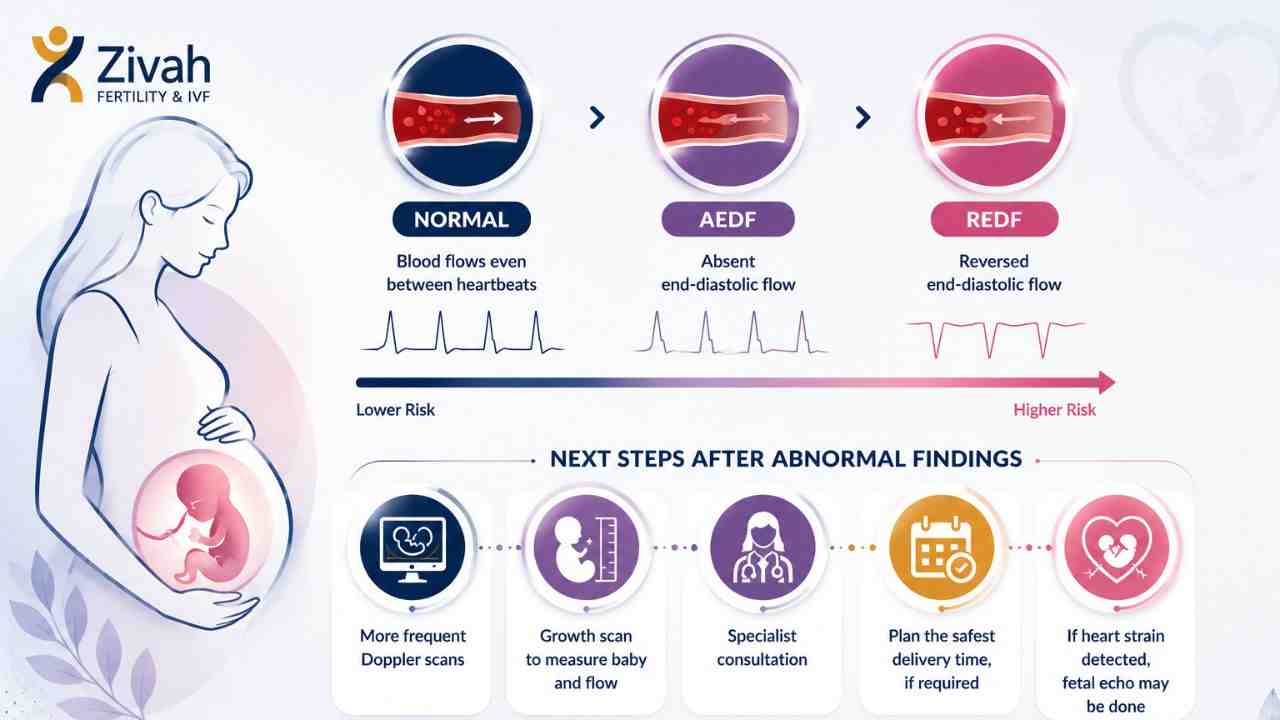
And first, an abnormal Doppler is almost never an emergency. More often than not, it just means your infant needs to be watched more closely, and the outcome helps your team keep one step ahead.It is helpful to know the staged development of the umbilical flow. Normally, blood flows via the chord even between the beats of the baby’s heart.
As resistance in the placenta increases, the between-beat flow may disappear, a phenomenon called absent end-diastolic flow (AEDF), or, less frequently, temporarily reverse, a phenomenon called reversed end-diastolic flow (REDF).
The more up you go, the more monitoring there is.In later, more advanced situations, the doctor also examines the ductus venosus and the umbilical vein. Changes there, such as a missed wave in the venous trace, can show the baby’s heart is under actual strain, which helps in deciding the time.
Next Steps After an Abnormal Doppler: Monitoring Fetal Wellbeing
What happens next will depend on the findings, but will normally include:
- More frequent (serial) Doppler scans to look for any change
- A Growth Scan (Fetal Biometry) to measure the size of the baby and flow
- Maternal-fetal medicine specialist consultation
- Planning the safest delivery time, if required
If heart strain is detected, a Fetal Echocardiography can also be performed.
Normal vs Abnormal Doppler Findings
| Finding |
What It Suggests |
Typical Action |
|---|---|---|
| Normal flow |
Healthy placental function |
Routine monitoring |
| Raised umbilical resistance |
Early placental strain |
Closer Doppler follow-up |
| Absent/reversed EDF (AEDF/REDF) |
Significant placental compromise |
Intensive surveillance |
| Abnormal uterine notch |
Preeclampsia / FGR risk |
Added monitoring |
| Abnormal MCA |
Anaemia or brain-sparing |
Specialist review |
| Abnormal ductus venosus 'a' wave |
Fetal cardiac strain |
Urgent specialist input |
Why Choose Zivah for Doppler Studies?
When you search for a Doppler test near you, the most important things are the accuracy of the reading and the experience behind it. A Doppler is just as good as its interpretation, the proper angle, the right vessel, and the right reference range for your pregnancy age.
Your prenatal Doppler study is performed and reviewed at Zivah with fetal-medicine and radiology skills combined on modern colour and spectral Doppler technology. Each reading is compared to normal ranges adjusted for your stage of pregnancy.
If something needs follow-up, you can get growth monitoring and wellbeing care all in one place so you don’t have to run around trying to figure out what to do next.
Expert Obstetric Doppler Imaging at Zivah
Accurate obstetric Doppler is a matter of experienced hands and good technique. Zivah provides the precision your pregnancy Doppler study demands by combining skilled sonographers with fetal-medicine input, high-resolution Doppler equipment and gestation-specific interpretation.