

Fetal reduction (or multifetal pregnancy reduction, MFPR) is a first-trimester process that reduces the number of fetuses in a multiple pregnancy. It is commonly done to reduce the health concerns of carrying triplets or higher-order multiples. It’s a process most typically associated with pregnancies created through IVF and other fertility procedures.
This guide covers who fetal reduction is for, forms of fetal reduction, when fetal reduction is done, how fetal reduction is done, the legal framework in India, dangers, likely outcomes, recovery, and how this treatment is delivered at Zivah.
The bottom line is that fetal reduction is a balancing act, weighing the dangers to the mother honestly and the remaining fetuses against the risk of the procedure.
What Is Fetal Reduction (Multifetal Pregnancy Reduction)?
Fetal reduction (or multifetal pregnancy reduction) is a treatment that reduces the number of fetuses in a multiple pregnancy, most typically reducing a higher-order pregnancy to twins or a singleton.
The logic is simple: fewer fetuses mean less risk of major prematurity and difficulties and hence better chances for a safe pregnancy for mother and babies.
This type of multiple pregnancy reduction is most usually needed following IVF or other fertility treatments that increase the chance of producing triplets or higher. Sometimes it is called embryo reduction or reduction of pregnancy.
Fetal Reduction vs Selective Reduction - The Difference
These two terms are sometimes confused, but they mean different things. Multifetal pregnancy reduction reduces the number of otherwise healthy fetuses in a higher-order pregnancy.
Selective reduction (or selective termination) is different; it targets a specific fetus with a serious defect. The aim is the same: to protect the pregnancy in progress, but the grounds on which to choose which fetus are different.
Fetal Reduction at a Glance
| Parameter |
Detail |
Notes |
|---|---|---|
| Procedure type |
Prenatal, ultrasound-guided |
Performed by a fetal-medicine specialist |
| Common timing |
First trimester (~11–14 weeks) |
Earlier is generally safer |
| Typical indication |
Higher-order multiples / fetal abnormality |
Reduction vs selective reduction |
| Usual end point |
Twins or a singleton |
Chosen with the patient |
| Technique driver |
Chorionicity |
Shared vs separate placentas |
| Setting |
Specialist fetal-medicine service |
Not a routine outpatient clinic |
Why Fetal Reduction May Be Considered: Indications
Fetal reduction is an option, not a responsibility. It's something to think about when a multiple pregnancy increases the risk of prematurity and other issues to the mother and baby, the more fetuses, the higher those chances tend to rise.
Fetal reduction after IVF is the most typical situation because IVF and other reproductive treatments increase the chances of higher-order multiples so much. One thing that's worth being clear about: reduction is never the only way. You can always continue the pregnancy with tighter monitoring.
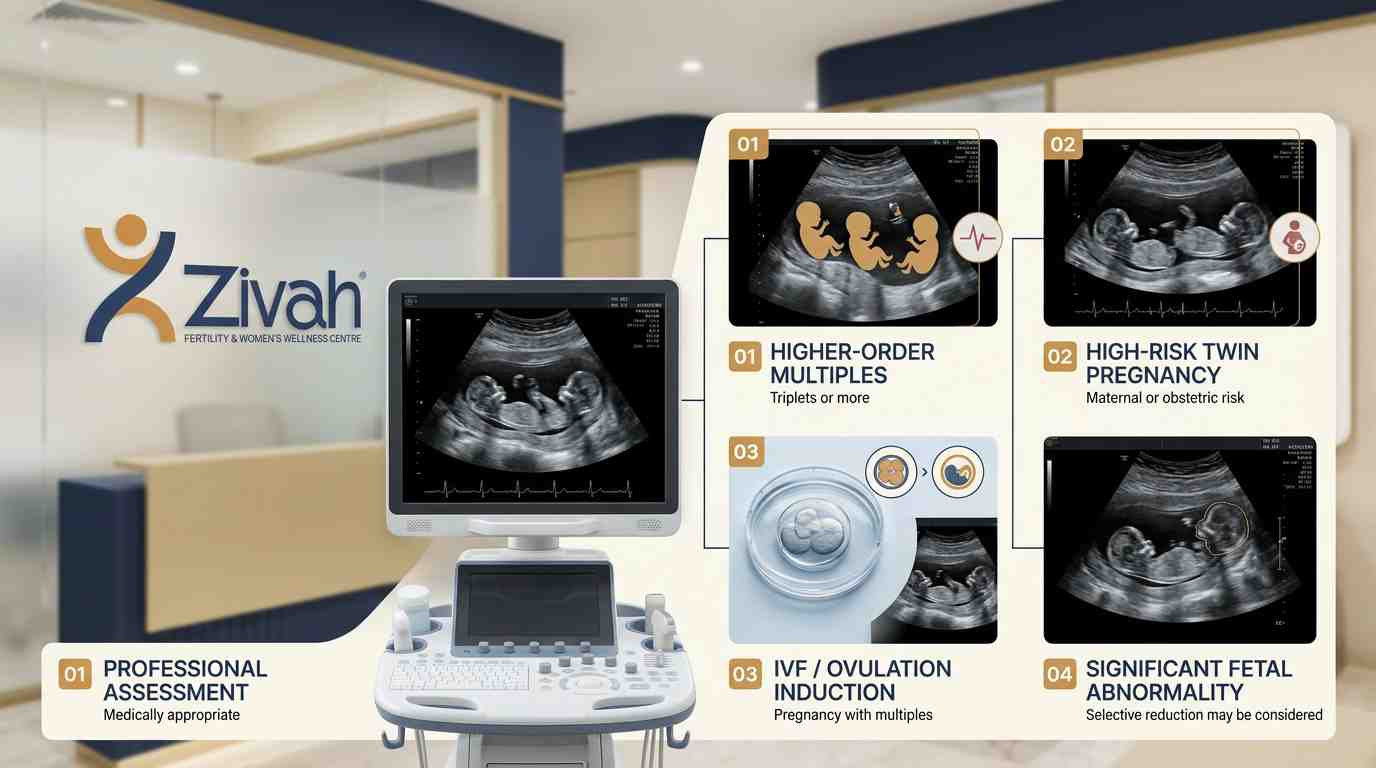
Who May Be a Candidate for Fetal Reduction
Fetal reduction may be an option you are carrying:
- Higher-order multiple pregnancy, triplets, quadruplets or more, with risk increasing greatly with each successive fetus.
- A twin pregnancy in certain situations, when the mother's health or obstetric experience renders having twins a higher risk.
- Pregnancy after IVF or ovulation induction, the most typical way to get multiples.
- One fetus showing significant abnormalities, for which selective reduction may be explored.
Fetal Reduction Due to Fetal Abnormality or Maternal Health
Here, two dissimilar medical factors can lead. One is a significant or incurable defect, identified in the womb, and selective reduction is performed on the affected fetus. The second relates to mother health; for example, uterine abnormalities, a preterm birth history, hypertension, or a renal condition can create a multiple pregnancy with a much higher risk.
Types of Fetal Reduction: MFPR & Selective Reduction
Fetal reduction takes two forms, and which one applies depends on why it's being considered.
- A multifetal pregnancy reduction is a technique to reduce the number of fetuses, usually from triplets or higher-order pregnancy to twins or one fetus, to decrease the danger of carrying multiples.
- Selective reduction is a separate method. Here, a particular fetus is chosen because ultrasound or genetic testing, such as CVS, has found a significant defect. So the difference is straightforward: MFPR is about the quantity of fetuses, selective reduction is about the health of one.
How Fetuses Are Selected and Why Sex Is Never a Factor
In the case of a non-selective MFPR, the fetus to be decreased is chosen solely on practical grounds:
- Accessibility – how accessible it is along the process.
- Position – where it is in relation to the ultrasound probe.
It has nothing to do with its properties. Sex, gender, and chromosomal traits are never used in decisions. And if genetic testing such as CVS has been done, the fetal sex is not known until after the surgery.
MFPR vs Selective Reduction: Quick Comparison
| Factor |
Multifetal Pregnancy Reduction |
Selective Reduction |
Why It Matters |
|---|---|---|---|
| Basis for selection |
Technical accessibility |
Fetal health status |
Decides which fetus is reduced |
| Typical use |
Higher-order multiples |
One fetus with an abnormality |
Different starting situations |
| Usual end point |
Twins or a singleton |
Pregnancy continues minus the affected fetus |
Shapes the ongoing pregnancy |
| Timing |
First trimester |
When the abnormality is confirmed |
Affects technique and planning |
Timing & Chorionicity: When Fetal Reduction Is Done
Fetal reduction is generally performed during the first trimester, usually between 11 and 14 weeks. There is a reason for that window. The timing is early enough to keep the procedure risk lower, but late enough for a structural scan and nuchal translucency measurement to establish that the fetuses are normal before any decision is made.
Timing is critical because the risk of the procedure increases the later it is performed. In some circumstances, there may be a second trimester possibility via cord occlusion, although the first trimester is the favoured choice.
Why Chorionicity Determines the Approach
The safety of the method depends on the chorionicity (Shared placenta or distinct placentas). In utero, fetuses sharing a placenta (monochorionic) are connected via a shared blood supply and hence need a different approach than fetuses with separate placentas (dichorionic). This is why it’s so important to determine chorionicity early and correctly; it lays the groundwork for all that follows.
How Fetal Reduction Is Performed: Ultrasound-Guided Techniques
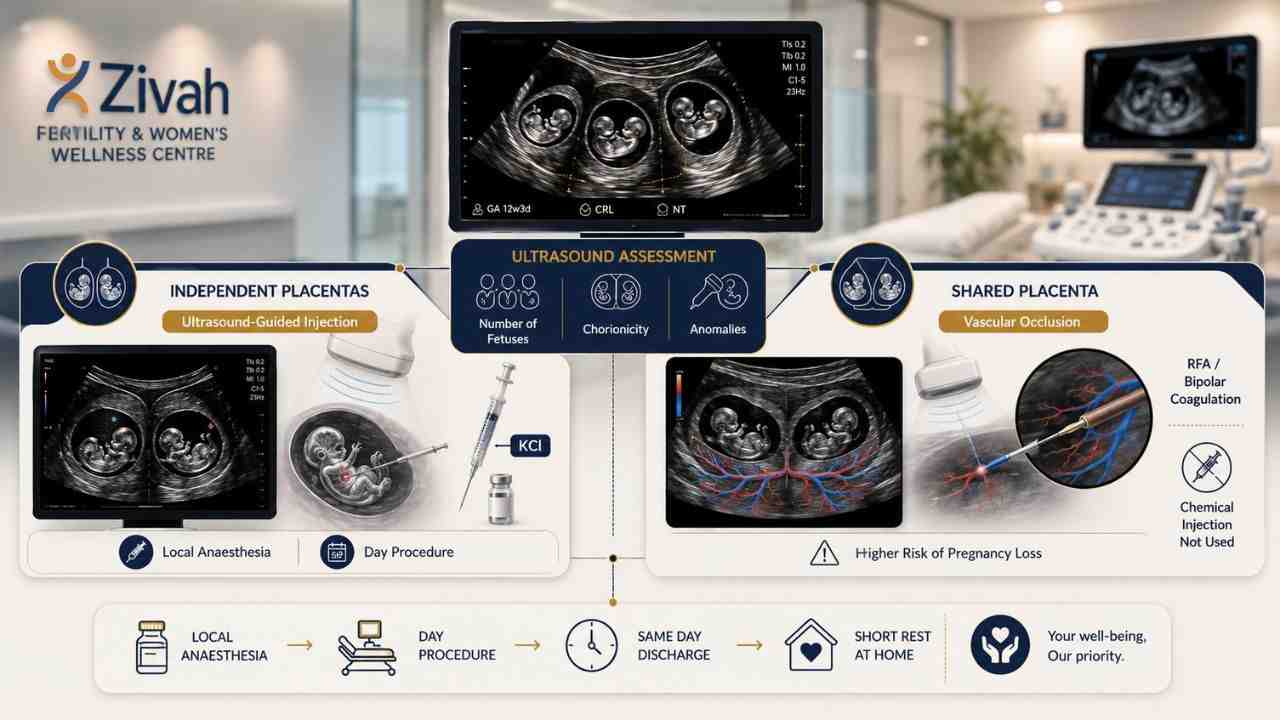
Each fetal reduction is performed by a fetal-medicine specialist under continuous ultrasound guidance, so that the placenta and fetuses are clearly visible during the process. Determining factors include the gestational age and chorionicity. This usually involves two visits; the first is an assessment to determine the number of foetuses, chorionicity, and any anomalies, and the second is the procedure itself.
First-Trimester Reduction (Independent Placentas)
An intracardiac injection guided by ultrasonography is the conventional first trimester procedure in case of different (independent) placentas. A small dose of potassium chloride (KCl) is injected to stop the heart of the chosen foetus.
It is performed as a day surgery with local anaesthetic, and the body naturally absorbs the fetal tissue over time. The deceased fetus is selected by position and accessibility, not by any characteristic.
Reduction in Monochorionic (Shared-Placenta) Pregnancies
In the case of fetuses sharing a placenta, their blood supply is coupled, so chemical treatments cannot be employed. Instead, an ultrasound-guided vascular-occlusion approach is used, most often radiofrequency ablation or bipolar cord coagulation. Their risk of pregnancy loss is larger than the reduction in independent-placenta pregnancies.
An example is the TRAP sequence, in which one twin fails to develop a working heart and is dependent on the other twin, the “pump” twin. Here the method saves that healthy pump twin.
Is Fetal Reduction an Outpatient Procedure?
Yes, First-trimester fetal reduction is usually a day operation under local anaesthesia, not open surgery. Most patients go home the same day, with some rest prescribed for a short time afterwards.
Reduction Technique by Chorionicity & Gestation
| Situation |
Typical Technique |
Setting |
Notes |
|---|---|---|---|
| Independent placentas, first trimester |
Intracardiac KCl injection |
Outpatient, local anaesthesia |
Lower loss risk |
| Shared placenta (monochorionic) |
Radiofrequency ablation |
Specialist FM service |
Higher loss risk |
| Shared placenta, cord-based |
Bipolar cord coagulation |
Specialist FM service |
Second-trimester option |
| TRAP sequence |
RFA or intrafetal laser |
Specialist FM service |
Protects the pump twin |
Counselling, Preparation & Legal Framework at Zivah
Zivah has a specific pathway of preparation before any fetal reduction. Your fetal reduction consultation will generally include:
- Confirming ultrasound to determine the number of fetuses, the chorionicity and the precise date.
- A specialist fetal medicine consultation with the maternal fetal medicine team.
- First trimester screening or NT measurement as indicated.
- Signed informed consent after answering questions.
There is a thread of non-directive counselling running through it all, so the choice is yours. Support is multidisciplinary as standard: maternal-fetal medicine, genetics and psychological support working together as part of your prenatal care for fetal reduction.

Non-Directive Counselling & Informed Decision-Making
Fetal reduction counselling is informational, not directive. A session normally includes:
- The risks of continuing the pregnancy vs ending it.
- All choices are on the table, including doing nothing (expectant management).
- There is emotional and psychological support before and after.
It’s always your decision, and Zivah’s multifetal pregnancy treatment remains patient-directed and judgement-free.
Legal Framework for Fetal Reduction in India
Fetal reduction in India is governed under the Medical Termination of Pregnancy (MTP) Act. This means that it must be performed by a registered medical practitioner, within the limits and conditions of the gestational period set out in the Act, with written informed consent and sufficient documentation.
It’s vital to highlight that this is completely independent from the law on sex-selection; fetal reduction is never utilised for that reason. Your specialist will verify the specific qualifications and evidence that apply to your circumstance.
Fetal Reduction Risks & Safety
There's always some danger involved in any fetal reduction, and the risk level depends mostly on two things: how many fetuses you begin with and their chorionicity.Generally, the risk of loss is lower with reduction of independent-placenta pregnancies in the first trimester and higher with monochorionic (shared-placenta) techniques.
The primary risks to be aware of are loss of the pregnancy, haemorrhage, infection and, particularly with later operations, early rupture of the membranes. Fetal reduction complications are outlined in the table below, along with the time at which each becomes more likely.
Understanding the Miscarriage Risk
The risk of miscarriage is the one most people ask about, and it is the main concern highlighted in counselling.Think of it as a range rather than a single fixed figure.
Pregnancy loss associated with the procedure is generally minimal for first-trimester reduction of pregnancies with separate placentas, and increases with monochorionicity and with a higher beginning number of babies. Your case is unique, and the exact figure will be discussed with you in consultation.
Fetal Reduction Risks & How They Vary
| Risk |
Notes |
When Higher |
|---|---|---|
| Pregnancy loss / miscarriage |
Main risk discussed in counselling |
Monochorionic techniques; higher starting numbers |
| Bleeding |
Uncommon |
Higher with later, cord-based procedures |
| Infection |
Uncommon; aseptic technique used |
Higher if the amniotic sac is entered |
| Preterm prelabour rupture of membranes (PPROM) |
Membranes break early |
Later / cord-based procedures |
| Preterm birth |
Reduced overall vs no reduction, but still possible |
Monochorionic pregnancies; higher starting numbers |
Outcomes, Benefits & Success of Fetal Reduction
The main benefit of fetal reduction is to reduce the chance of severe preterm birth and the long-term consequences that often follow. Benefits are more apparent when the reduction is from a greater beginning number, for example from quadruplets to twins.It helps to be clear on what "success" means here.
A successful outcome isn't a single success rate, but a continued pregnancy closer to term, with a reduced risk of preterm birth. That's the goal; in practice, a healthier, longer pregnancy for the babies that remain.
How Reduction Lowers Prematurity & Maternal Risk
Reducing a triplet or higher-order pregnancy takes the load off the babies and the mother.For the babies, it reduces the chances of extreme prematurity, severe preterm delivery, and the NICU stays and developmental problems that occur with extreme prematurity.
It helps to lower the risk of maternal problems of multiple pregnancy, such as preeclampsia and gestational diabetes. The specific benefit will depend on your starting place and will be discussed in conversation.
Typical Outcome Direction by Starting Number
| Starting Pregnancy |
Common End Point |
Outcome Direction |
|---|---|---|
| Quadruplets and above |
Twins |
Markedly lower preterm-birth and loss risk |
| Triplets |
Twins or a singleton |
Lower severe-preterm-birth risk |
| Twins (selected cases) |
Singleton |
Reduced late-preterm risk; weighed case-by-case |
| All cases |
Individualised |
Figures discussed in your Zivah consultation |
Recovery & Aftercare After Fetal Reduction
Recovery from fetal reduction is usually simple. Schedule a day of relaxation. Expect some mild discomfort. Gradually return to your normal activity as recommended.
An ultrasound follow-up examines the health of the remaining fetus(es), and from then on the pregnancy is managed with standard prenatal care. Emotional support continues after the surgery, too feelings about the decision can last beyond the procedure, and that’s a typical aspect of aftercare.

When to Contact Your Specialist
Some symptoms deserve a call, not a wait. Call your specialist if you notice:
- Fever or shivering
- Bleeding from the vagina
- Fluid coming from the vagina
- Cramping or contractions that become stronger
They are rare, but it is better to highlight them early.
Fetal Reduction at Zivah
Fetal reduction at Zivah is performed by maternal-fetal medicine doctors within an extensive fetal-medicine pathway, with no separate treatment.That approach begins with a precise determination of chorionicity and a procedure customised to your particular pregnancy, all under ultrasound direction. It is surrounded by non-directive therapy, multi-disciplinary and psychological care and co-ordinated follow-up for the ongoing pregnancy.
Each phase is medical indication only, never for sex selection and in compliance with the MTP Act. These fetal reduction services are designed to be accurate, safe and based on your decision.
Cost of Fetal Reduction
Fetal reduction is not a one-size-fits-all procedure, and the price will depend on your case and will vary from person to person. A quick chat will give you the best estimate. For a case-specific quotation, contact Zivah. Fetal reduction costs depends on a few things:
- Number of fetuses and their chorionicity
- The procedure employed, e.g. KCl injection versus radiofrequency ablation
- Assessment and counselling before the surgery
- Monitoring and follow-up after the surgery
Pricing is not pre-set; it is case-by-case and established upon consultation
Why Choose Zivah for Multifetal Pregnancy Care
What sets Zivah apart in this complex multifetal pregnancy is the thoroughness at every step: skilled fetal-medicine experts, ultrasound-guided precision, a counselling-first, no-judgment approach, and ongoing pregnancy care. If you have been offered fetal reduction, speak to the fetal-medicine specialists at Zivah for an assessment.