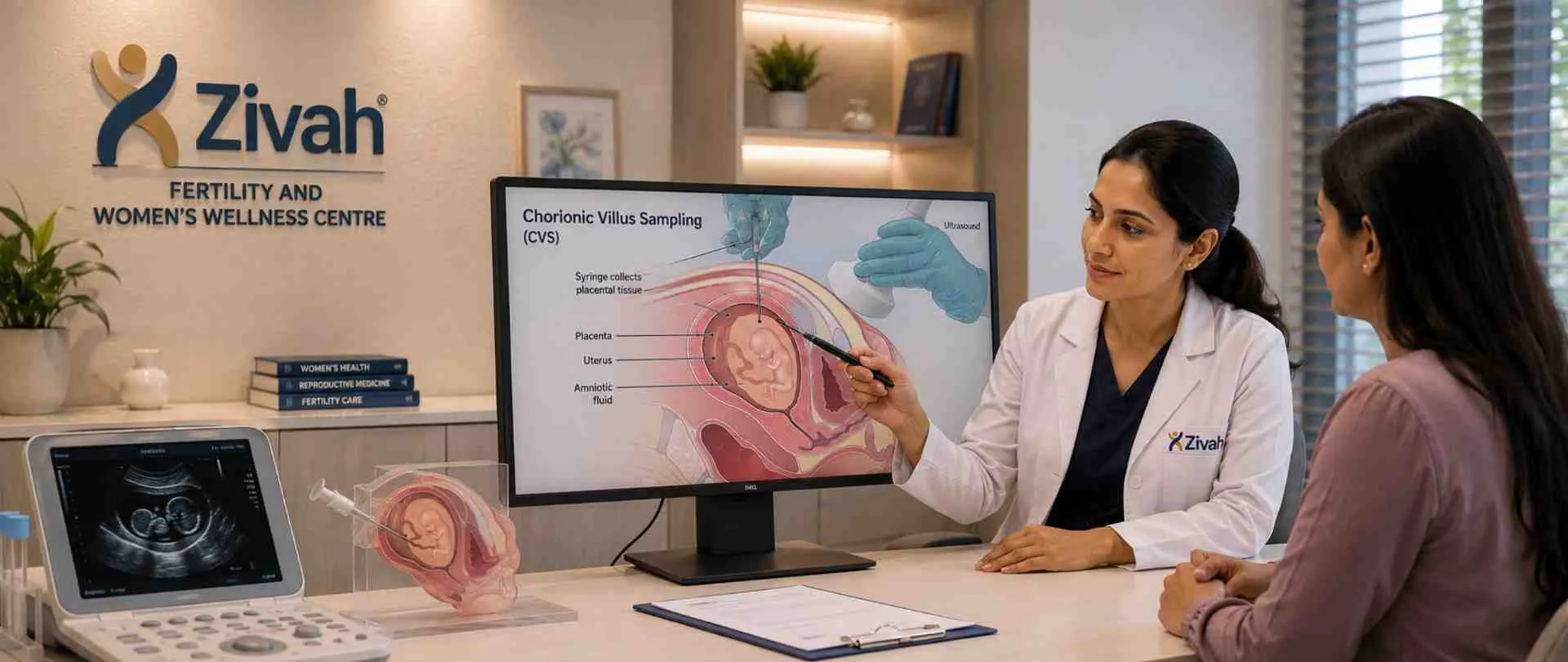
CVS test in pregnancy or chorionic villus sampling is a first-trimester prenatal diagnostic test that checks for chromosomal and genetic problems in your baby by examining a small sample of placental tissue (called chorionic villi). Because these cells include your baby’s genetic material, CVS testing in pregnancy can determine if a problem is present, not just the probability of one.
Here you will learn who CVS genetic testing is for, how the operation works, when it is done, what your results mean, the risks related to it and the aftercare that follows at Zivah. And if you’re left with a “maybe” after a screening test, CVS is the step that turns likelihood into a clear, definitive decision, early, when it counts.
Zivah performs chorionic villus sampling only to detect genetic and chromosomal disorders. This test is not utilised for sex determination in accordance with the PC-PNDT Act, 1994.
Chorionic Villus Sampling (CVS) as a Prenatal Diagnostic Test
In the medical field, CVS stands for chorionic villus sampling, a prenatal diagnostic procedure performed in the first trimester of pregnancy. It works by collecting a tiny sample of the chorionic villi, the finger-like extensions of placental tissue that develop from the same fertilised egg as your baby. They contain your baby’s genetic material, and testing of them gives you information about your baby immediately.
The main difference is that CVS genetic testing is diagnostic, not a screening test. A screening test shows the likelihood of a problem; CVS confirms if it is actually present. CVS prenatal testing is available because of the shift from a probability to a certain result.
Diagnostic Test vs Screening: Where CVS Fits
Knowing where this test fits helps. Screening tools like NIPT and first-trimester combined screening offer you a risk score, a higher or lower possibility, not a yes or no. With a CVS pregnancy test, the result is the opposite: a clear answer. So normally, if a previous screen raises a risk and you want to be sure, the next step is prenatal CVS screening.
CVS at a Glance: Procedure Snapshot
| Parameter |
Detail |
Notes |
|---|---|---|
| Test type |
Diagnostic |
Confirms a condition, not just the chance of one |
| Sample source |
Placental chorionic villi |
Shares the baby's genetic material |
| Timing |
10–13 weeks |
Performed in the first trimester |
| Routes |
Transabdominal / transcervical |
Chosen by placental position |
| Duration |
Under 30–45 minutes |
Start to finish, including ultrasound |
| Guidance |
Continuous ultrasound |
Used throughout for accuracy |
| Result type |
Definitive |
A clear answer, reviewed with a counsellor |
Why CVS Is Recommended: Indications in Pregnancy
CVS test in pregnancy is not a routine step in prenatal care. It’s an optional test, offered when something means a higher chance of a genetic or chromosomal issue, usually following a abnormal NIPT result, an abnormal ultrasound or another high-risk pregnancy screening finding.
In obstetrics, CVS is not available to everybody, but only in certain situations; therefore, the decision to proceed is always yours after a discussion with your specialist.
Who Should Consider CVS Testing
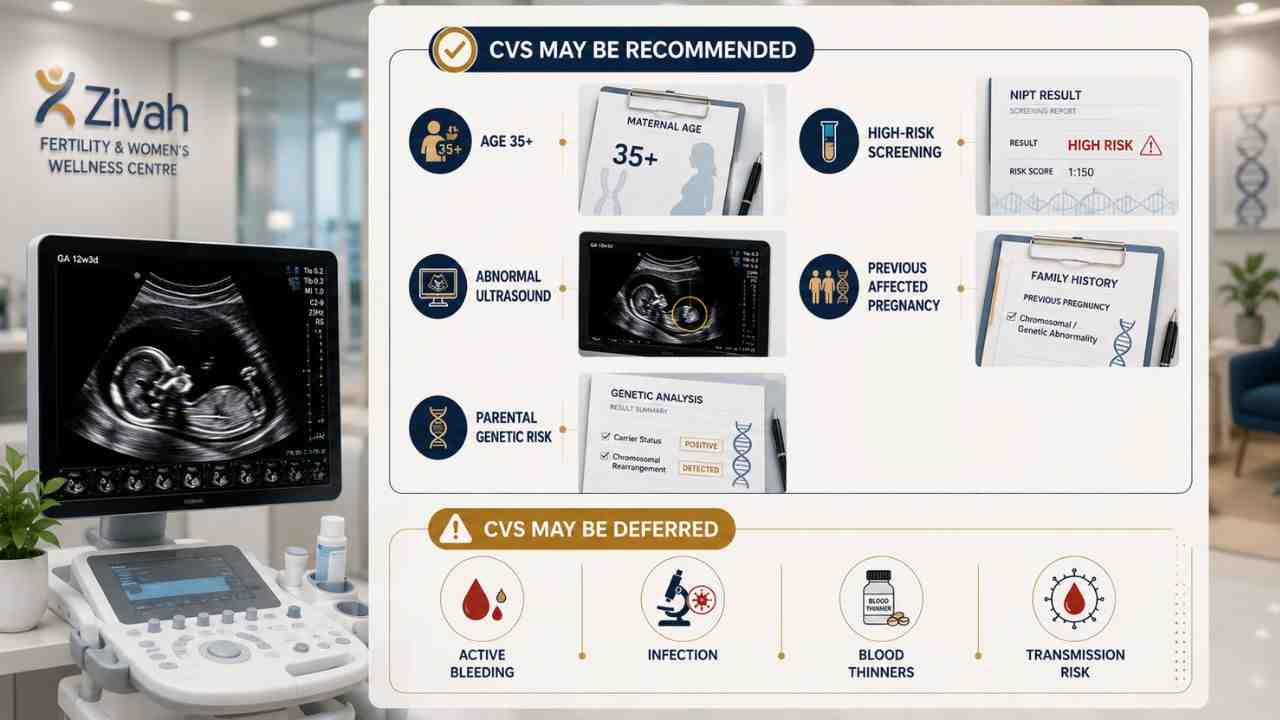
Your doctor might recommend a CVS fetal test if any of the following apply:
- Advanced maternal or paternal age generally 35 or older at your due date, when the risk of chromosomal abnormalities increases.
- An abnormal NIPT or first trimester combination screen with increased risk.
- An abnormal ultrasound with findings that need a definitive answer.
- Previous child with chromosomal or genetic abnormality.
- Parental carrier status - A chromosomal rearrangement (translocation) or single gene abnormality identified in either parent.
This test is also used to confirm disorders such as Down syndrome if earlier screening suggests it.
When CVS May Be Deferred or Avoided
CVS may delay or rethink your provider for your safety if you:
- Have active vaginal bleeding during pregnancy.
- Have a cervical or vaginal infection, including an STI.
- Use of anticoagulants (blood thinners) which increase the risk of bleeding.
- Certain blood-borne illnesses where the danger of transmission must be considered first.
Conditions CVS Can (and Cannot) Detect
A CVS chromosome test looks at your baby’s chromosomes in depth with karyotyping, FISH and chromosomal microarray in the lab. It can therefore detect two main types of abnormalities: chromosomal aneuploidies (missing or extra chromosomes, such as the trisomies) and specific single-gene hereditary diseases.
So a CVS test for genetic disorders can confirm a trisomy and hereditary problems such as thalassemia, sickle cell disease and cystic fibrosis when there is a reason to seek them. It’s as important to know what CVS doesn’t cover.
A CVS test for fetal abnormalities does not detect neural tube defects like spina bifida; these are checked with an AFP blood test. It also can't see structural abnormalities like heart defects or cleft lip and palate. Those are detected later in mid-pregnancy with an anomaly scan. CVS reads the genomes, not the anatomy.
Conditions Detectable Through CVS Testing
| Condition |
Type |
What It Affects |
|---|---|---|
| Down syndrome (Trisomy 21) |
Chromosomal aneuploidy |
Physical and intellectual development |
| Edwards syndrome (Trisomy 18) |
Chromosomal aneuploidy |
Growth, organs, survival |
| Patau syndrome (Trisomy 13) |
Chromosomal aneuploidy |
Brain, heart, and structural development |
| Cystic fibrosis |
Single-gene (inherited) |
Lungs and digestive system |
| Sickle cell disease |
Single-gene (inherited) |
Red blood cells |
| Thalassemia |
Single-gene (inherited) |
Haemoglobin / red blood cells |
| Tay-Sachs disease |
Single-gene (inherited) |
Nervous system |
| Not detected by CVS |
Neural tube defects (spina bifida) |
Screened via AFP test |
| Not detected by CVS |
Structural anomalies (heart, cleft) |
Seen on anomaly scan (TIFFA) |
How CVS Is Performed - Transabdominal & Transcervical Methods
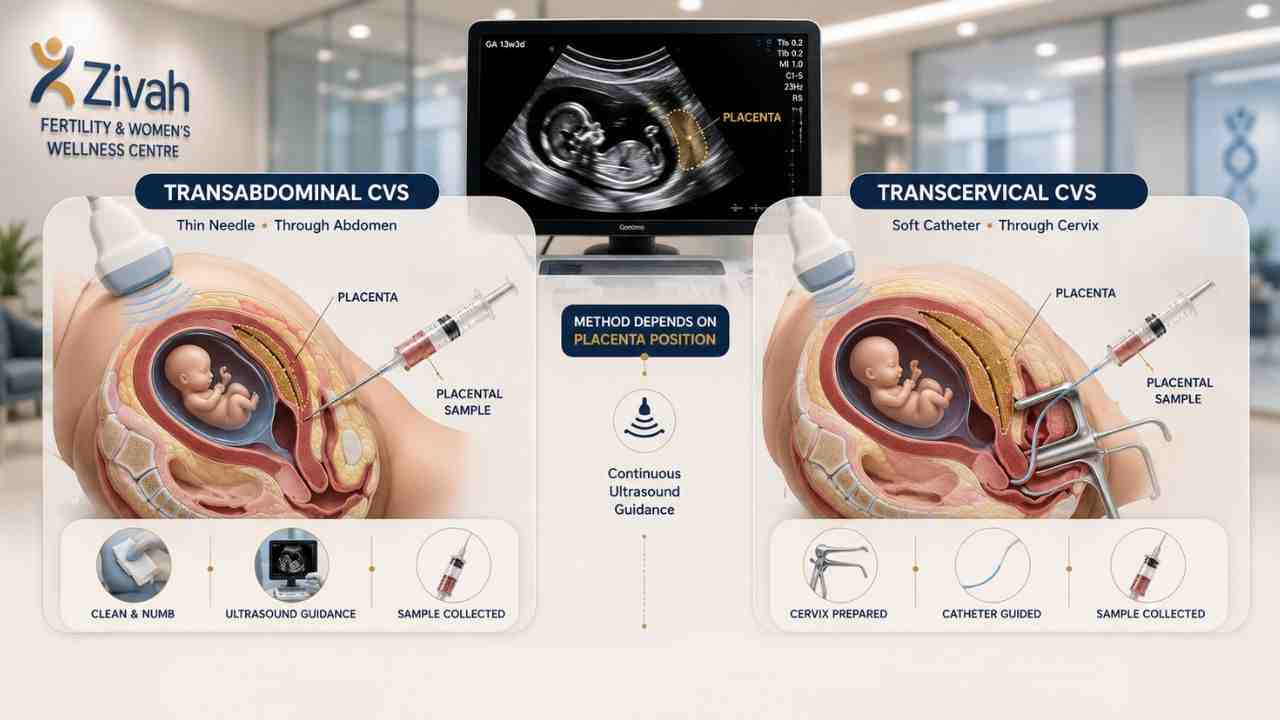
CVS can be done in two ways, either through the abdomen (transabdominal) or through the cervix (transcervical CVS). It depends on where your placenta is sitting and your physician's clinical judgement on the day which one your physician chooses. In either case, the technique of chorionic villus sampling is performed under constant ultrasonography, and hence the placenta is visualised throughout.
Transabdominal CVS Procedure
In a transabdominal CVS, a thin needle is used to take the sample via your abdomen. Here is what a placental biopsy normally looks like:
- Prep – your abdomen is cleaned with an antibacterial solution; you may be provided with an anaesthetic to numb the area.
- Sampling - using ultrasound to guide a thin needle through the uterine wall and into the placenta, your provider carefully pulls out a small sample of villi into a syringe.
- Finish - the needle is removed, and a little band-aid is applied to the spot.
Transcervical CVS Procedure
Transcervical chorionic villus sampling (CVS). This type of CVS involves taking a sample through the cervix using a soft catheter (not a needle).
- First, your provider inserts a speculum and then cleans the cervix with antiseptic.
- Then doctors push a thin, soft catheter up through the cervix to the placenta, watching the ultrasound the whole time, and gently take a little sample of chorionic villi into a syringe.
- The catheter comes out, and that's it. Some women feel a short pang or some cramping when the sample is taken, but it normally passes quickly.
CVS in Twin & Multiple Pregnancies
If there are twins or more, they each sample the placentas independently, so every baby is examined separately. CVS in a multiple pregnancy needs extra precision from the operator and carries a slight risk (about 1%) of cross-contamination between samples, one reason experience is important here.
Is CVS Painful or Invasive? CVS is an invasive diagnostic test, yet it is usually low discomfort. Most women have just a little cramping or a stinging pang during the surgery, not a lot of discomfort.
When Is CVS Done? Timing & the Early-Diagnosis Advantage
CVS is a first-trimester genetic test, usually performed between 10 and 13 weeks of pregnancy. Chorionic villus sampling before 10 weeks has been associated with a minor risk of limb abnormalities; thus, clinicians wait until then to minimise the risk.
That 10-to-13-week timeline makes CVS the earliest conclusive diagnostic option, considerably ahead of amniocentesis, which is routinely performed from approximately 15 weeks.
The actual benefit of this early prenatal genetic screening is the time it saves. Having a clear, confirmed response in the first trimester allows you a bigger window to discuss your results, plan and make any decisions calmly instead of under pressure later in the pregnancy.
Preparing for Your CVS Test at Zivah
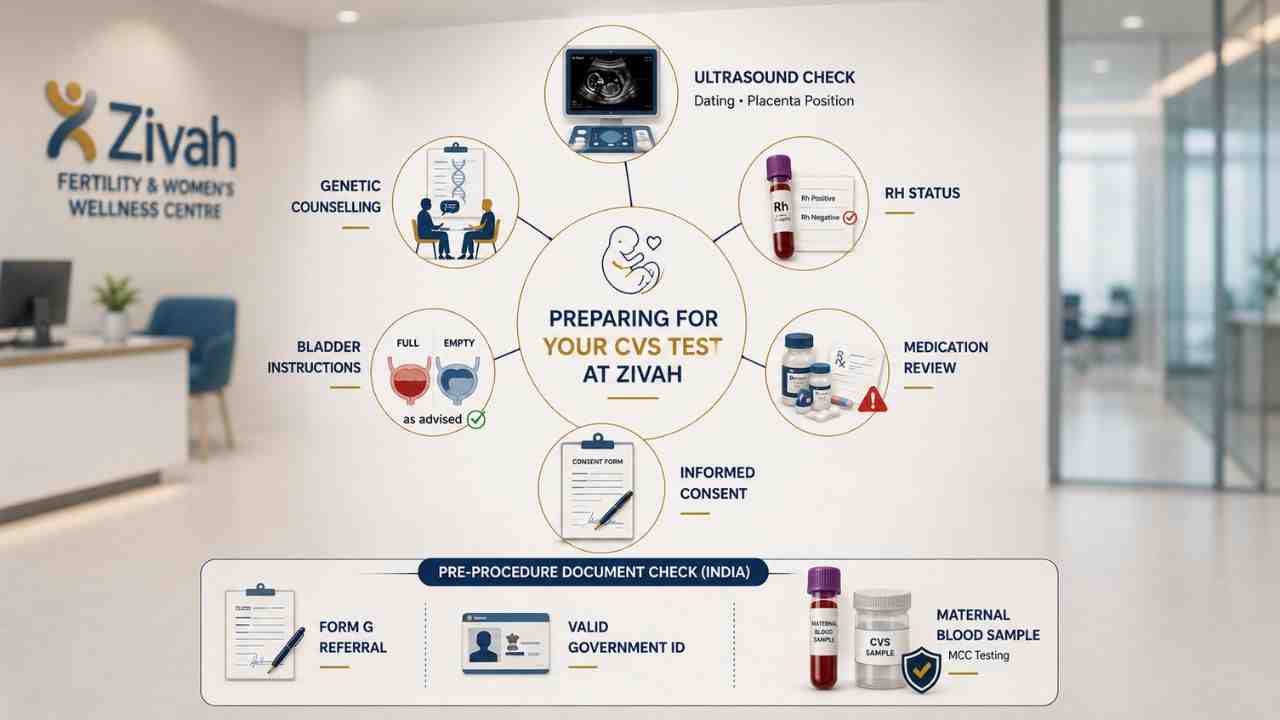
Good CVS exam prep usually involves a few checks upfront, and the Zivah team helps you through each. What to expect before the procedure:
- A confirming ultrasound to see just how many weeks along you are, and where your placenta is situated; this decides the route used.
- Genetic consultation to discuss the test with you before you decide.
- Rh-status check – if you are Rh-negative, a Rhogam plan is set up to protect the pregnancy.
- Medication review - tell your provider about any blood thinners or other medicines, some of which may need to be stopped.
- Bladder instructions if appropriate, as a full or empty bladder might assist in positioning the uterus.
- Informed consent signed once your questions are answered.
There is a legal step in India as well. For the test to proceed, you will require a signed Form G referral from your obstetrician and a valid government ID (such as an Aadhaar card). A small maternal blood sample is also obtained with your CVS sample so that the lab can do Maternal Cell Contamination (MCC) testing, this confirms that the result reflects your baby and not your own cells.
Genetic Counselling Before CVS
At Zivah, CVS test counselling is a routine procedure and not an add-on. In this session, you’ll go over the risks and benefits, what the results can and can’t tell you, and any hereditary problems worth testing for, so you walk into the process clear on what to anticipate and ready to decide.
CVS Risks, Safety & Possible Side Effects
CVS is performed under continuous ultrasonography; hence, it is considered a safe technique. The operator can see exactly where the needle or catheter is going at all times, so the risks are low.
The one people want to know about the most is the CVS miscarriage risk, and the number is modest, less than 1 in 100, or around 1%. Most side effects are modest and short-lived; anything beyond that is rare. But it's good to know the full story, so here are the CVS hazards in plain language and how common each one actually is.
CVS Risks and How Common They Are
| Risk |
Likelihood |
Notes |
|---|---|---|
| Miscarriage |
Less than 1% |
The main risk to discuss with your provider |
| Light spotting / cramping |
Common |
Normal afterward, settles on its own |
| Infection |
Under 0.5% |
Rare, as with most procedures |
| Amniotic fluid leakage |
Rare |
Reported in a small number of cases |
| Rh sensitisation |
Preventable |
Avoided with a Rhogam injection if Rh-negative |
| Limb defects |
Very rare |
Mainly linked to CVS done before 10 weeks |
CVS Results: Accuracy, Timeline & Reports
CVS is a very accurate test around 99 per cent accurate for the conditions it is looking for so a normal result provides you real confidence, and an abnormal one a reliable response. The speed of results varies on the lab method used: a simple FISH check can yield preliminary results in a couple of days, a comprehensive karyotype or chromosomal microarray takes a bit longer.
One thing to remember is that a CVS tells you if a problem is present, not how serious it will be. Sometimes the sample doesn't have enough cells and a second collection is needed.
And in a small percentage of cases (1-2%), the result shows the placenta, not the baby confined placental mosaicism which, together with the maternal cell check, is why MCC testing and the occasional follow-up amnio is important.
What Happens If CVS Results Are Abnormal
If your CVS findings are not normal, you won't be left to interpret them on your own. A genetic counsellor will discuss the report with you and explain what a positive result means and when a confirmation amniocentesis may be required. You will then discuss your options and future steps together.
CVS Result Timeline: When You Get Your Report
| Test Method |
Typical Turnaround |
What It Reports |
|---|---|---|
| Rapid FISH / preliminary |
2–4 days |
Early check on common chromosome conditions |
| Conventional karyotype |
1–2 weeks |
Full chromosome analysis |
| Chromosomal microarray |
1–2 weeks |
Detailed look for smaller changes |
| Final review |
After results |
Discussed with your genetic counsellor |
Recovery & Aftercare After CVS
Recovery from CVS is usually quick and easy. After the surgery, your vitals and your baby's heart rate are monitored for a bit just to make sure all is okay, and then you are free to go home and rest up. The essential advice for the rest of the day is simple, relax. Some moderate spotting or light cramps for a few hours is usual, and it disappears on its own.
As a reasonable precaution, avoid strenuous activity and intercourse for roughly 48 to 72 hours, or as directed by your provider. Most women are back to their normal schedule the next day.
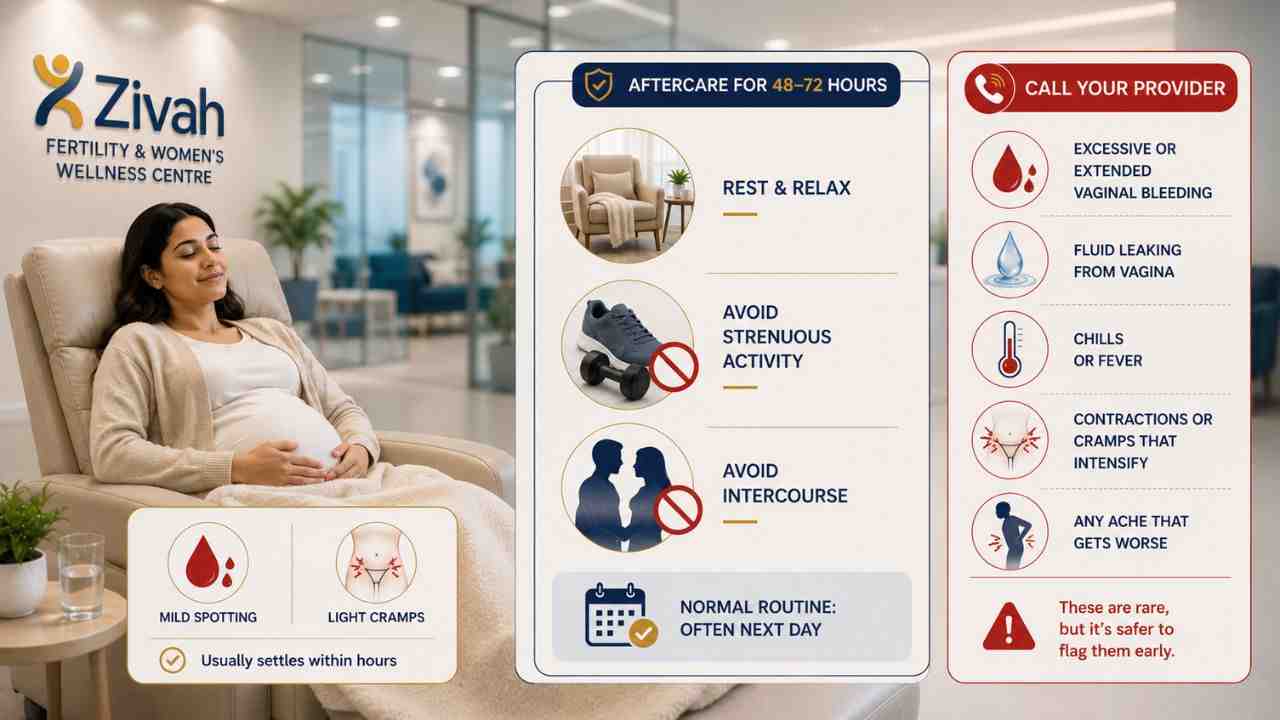
When to Call Your Provider
Some signs mean you should call quickly, not wait. If you see:
- Contact your provider
- Excessive or extended vaginal bleeding
- Fluid leaking from the vagina
- Chills or fever
- Contractions or cramps that intensify instead of getting better
- Any ache that gets worse and worse
These are rare, but it's a safer bet to flag them early.
CVS vs Amniocentesis: Choosing the Right Prenatal Test
CVS or amniocentesis, which is right for you? Zivah offers both CVS and amniocentesis as diagnostic tests, and the best one primarily comes down to timing and what you need it to find. If you are weighing amniocentesis or CVS, the deciding factor is usually how early you want a definitive answer.
The main difference between CVS and amniocentesis is timing: CVS is performed earlier, during the first trimester, making it the quicker approach to a conclusive result.
Amniocentesis is performed later but can detect neural tube defects that CVS can't, and is occasionally used thereafter to confirm a CVS finding. Your specialist will help you decide what is right for your situation.
CVS vs Amniocentesis: Quick Comparison
| Factor |
CVS |
Amniocentesis |
Why It Matters |
|---|---|---|---|
| Timing |
10–13 weeks |
15–20 weeks |
CVS gives answers earlier in pregnancy |
| Sample taken |
Placental villi |
Amniotic fluid |
Different source, similar genetic insight |
| Detects NTDs |
No |
Yes |
Amnio covers spina bifida; CVS does not |
| Earliest definitive result |
Yes |
No |
CVS is the first definitive option |
| Miscarriage risk |
Low |
Slightly lower |
Both small; weighed with your provider |
Chorionic Villus Sampling at Zivah
Chorionic Villus Sampling (CVS) is performed by maternal-fetal medicine specialists at Zivah under continuous ultrasonography from beginning to end. It’s a full pipeline, not just the test: in-house genetic counselling before the test, and coordinated lab work following between karyotype, FISH, chromosomal microarray, and MCC testing. Hence, your findings are quick and accurate.
At Zivah, all CVS tests in pregnancy are performed only as a diagnostic test for genetic and chromosomal problems, in full compliance with the PC-PNDT Act and not for sex determination.
Why Choose Zivah for Prenatal Diagnostic Testing
What you get at Zivah is depth at every step: experienced MFM specialists, ultrasound-guided precision, a counselling-first approach, and reporting that's followed through, not passed off. If you’ve been told to consider a prenatal diagnostic test, contact the Zivah team to see if CVS is suitable for you.