

An endometrial biopsy is a safe, extremely effective in-office test to determine the health of your uterine lining. Instead of surgery, a small endometrial sample is taken for analysis in the lab. If you are having abnormal bleeding, or to help diagnose a thick endometrium, you may be advised to have this test of the endometrium. The EMB procedure gives you accurate, definitive answers.
This is performed with a thin Pipelle catheter that is softly inserted through the cervix, without the need for surgical cuts or general anaesthesia. This page explains why the test is done, what it is like, and how to read your pathology report. What a little tissue sample can tell you that an ultrasound scan often overlooks.
What Is an Endometrial Biopsy?
An endometrial biopsy is a quick test you can have done in the office that extracts a small sample of the lining of your uterus (the endometrium), which can then be investigated in the lab. No cuts, no general anaesthetic. You might hear it called a few different things: endometrial test, uterine lining biopsy, uterus or womb biopsy, gynaecology biopsy, or just endometrial sampling.
They are all the same thing: an endometrial tissue test. They take a little bit of the endometrium from the uterus. The idea is to take a careful look at these cells. By looking at the sample, your specialist can see things a scan can't: abnormal cells, infection or hormone-induced alterations in the lining.
What Does EMB Mean? (Medical Term)
You may see this shortened to EMB in your notes or referral. What is an EMB? In simple terms, EMB is the medical abbreviation for endometrial biopsy used in gynaecology and nothing more technical than that.
The EMB procedure is simply another name for an endometrial biopsy. It may also be written as an EB test or an endometrial test. Whatever it is called, it refers to this one simple way of sampling.
How an Endometrial Biopsy Works
So, what does the procedure involve? Kinder than most people think. The doctor then inserts a very thin, flexible tube called a Pipelle through the cervix into the womb. Then gentle suction pulls a small amount of lining into the tube.
That's the portion about endometrial sampling, and it's usually about a minute or two. The sample is transported to a pathology lab where it is examined under a microscope for normal changes.
Why Is an Endometrial Biopsy Done?
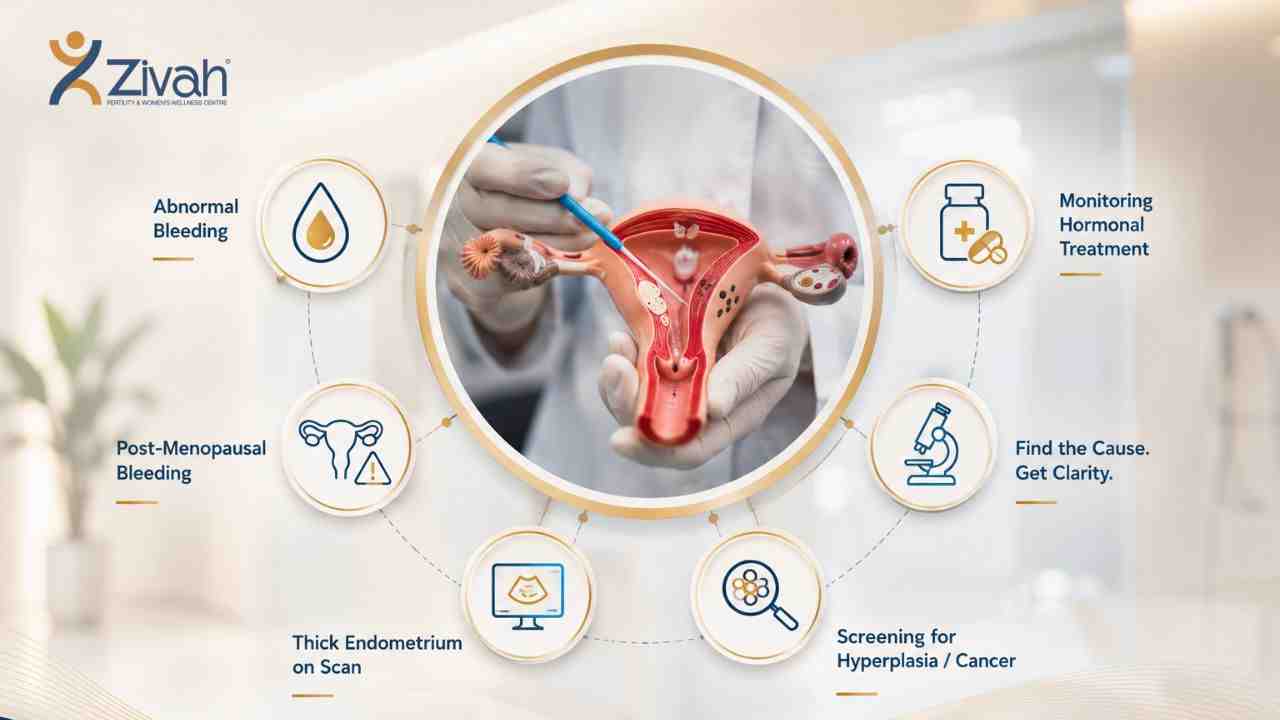
So why do an endometrial biopsy? Usually, to determine the cause of bleeding that isn't acting normally – and to rule out anything harmful.Your specialist may suggest it for:
- Heavy, irregular or abnormal bleeding – one of the most common reasons to perform an endometrial biopsy is for abnormal bleeding
- Post-menopausal haemorrhage – always needs investigation
- Scan shows a broad endometrial stripe - endometrial biopsy for thick endometrium verifies what's happening on
- Screening for endometrial hyperplasia or cancer - Endometrial biopsy is used to detect aberrant cell development early in endometrial hyperplasia
- Monitoring the uterus with tamoxifen or hormonal treatment
Basically, it takes a general symptom and provides a concrete explanation at the tissue level.
Endometrial Biopsy for Chronic Endometritis, Recurrent Loss & Pre-IVF
There's also a fertility angle, and one that deserves an honest explanation. An endometrial biopsy is not a routine test for infertility, and not everyone hoping to get pregnant will have one.
In some circumstances, though, it is really helpful. Chronic endometritis, a subtle, low-grade inflammation of the lining, can be diagnosed by endometrial biopsy in cases of recurrent miscarriage or recurring implantation failure and is typically confirmed with a CD138 stain, then treated before another transfer.
It can also support ERA (endometrial receptivity analysis) to time embryo transfer correctly. This tissue diagnostic at Zivah complements hysteroscopy. The biopsy investigates the cells; hysteroscopy looks at the cavity. Therefore, an endometrial biopsy before IVF is not standard but a targeted procedure.
Who Should Not Have an Endometrial Biopsy
Is endometrial biopsy safe for everyone? Almost. But not quite. It is not done if you are pregnant or might be pregnant, as it can induce a miscarriage, to keep risks minimal. It is also avoided in the presence of an active pelvic, cervical, or vaginal infection, or known cervical cancer. First, your specialist verifies that you are clear.
Conditions an Endometrial Biopsy Can Detect
| Finding |
What It Suggests |
Why It Matters |
|---|---|---|
| Endometrial hyperplasia |
Overgrowth of the uterine lining |
Can be pre-cancerous; caught early |
| Endometrial cancer |
Abnormal or cancerous cells |
Most common reproductive cancer; early diagnosis is key |
| Polyps or fibroids |
Benign growths in the lining |
A common cause of abnormal bleeding |
| Chronic endometritis |
Low-grade lining infection |
Linked to RIF and recurrent loss |
| Hormonal changes |
Effect of hormones or therapy |
Explains irregular bleeding patterns |
What Instruments Are Used for an Endometrial Biopsy?
You don’t need plenty of tools for an endometrial biopsy, and none of them seems as terrifying as they are. The Pipelle is the primary device used for endometrial biopsy, a thin, flexible, straw-like collector that uses mild suction to obtain the tissue. Sometimes a Karman cannula is used as the endometrial biopsy sampler.
A few extra tools for endometrial biopsy help out too: a speculum to open the cervix to look, a tenaculum to steady the uterus, and a uterine sound to measure its depth. Used together, these endometrial biopsy tools help the whole thing go smoothly and quickly.
Endometrial Biopsy Instruments & Their Roles
| Instrument |
Role |
|---|---|
| Pipelle (suction sampler) |
Main tool, draws a small tissue sample by gentle suction |
| Karman cannula |
Alternative sampler used in some cases |
| Speculum |
Holds the vaginal walls open to view the cervix |
| Tenaculum |
Gently steadies the cervix and uterus |
| Uterine sound |
Measures the depth of the uterus before sampling |
How Is an Endometrial Biopsy Performed?
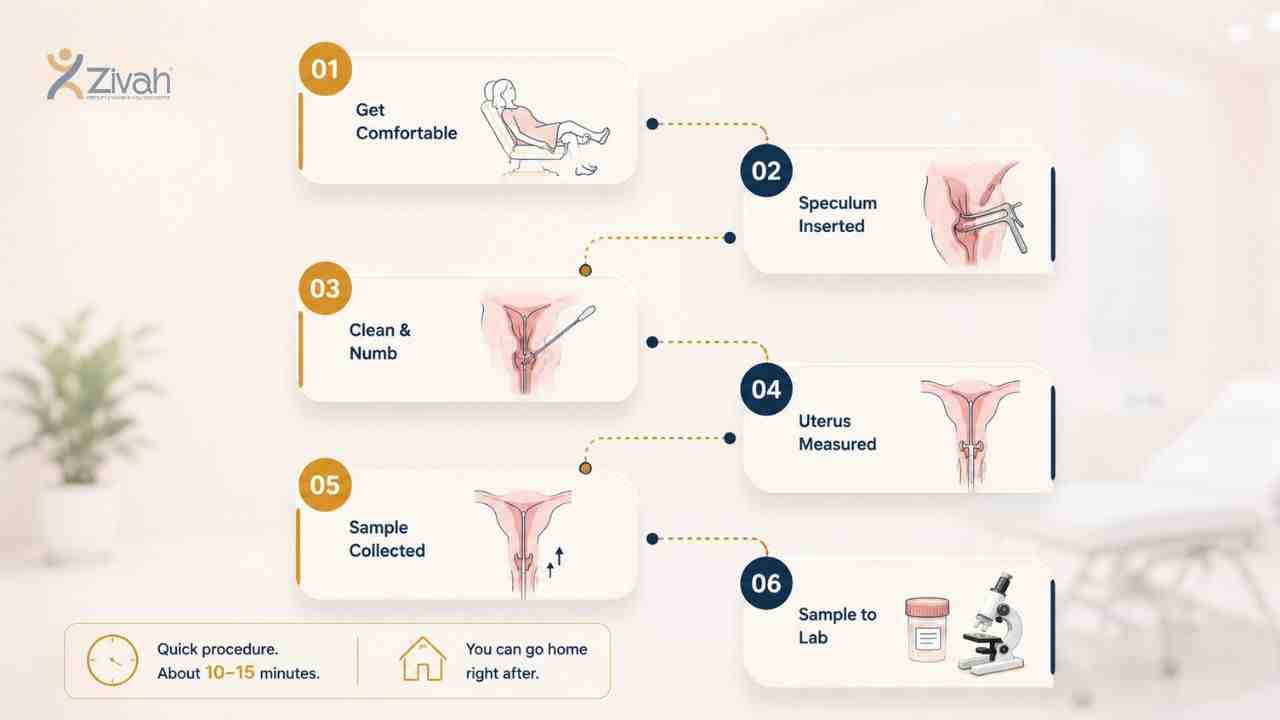
The treatment itself is quick and simple, usually done right there in the clinic, with no general anaesthesia required.Here is the EMB procedure step-by-step:
Step 1 - Getting comfy: You settle back with supports, exactly like a routine pelvic check-up.
Step 2 - Clear view: Your specialist will gently insert a speculum to provide a clear view of your cervix.
Step 3 - Clean and numb: The cervix is cleaned, and, if needed, a small amount of local anaesthesia for the endometrial biopsy numbs the area first.
Step 4 - Staying steady: A small clip, called a tenaculum, holds the uterus in place, and a thin sound is gently passed through the uterus to determine its depth.
Step 5 - Taking the sample: The thin Pipelle is inserted, and a small bit of lining is collected using gentle suction.
Step 6 - Finished: The instruments come out, and your sample heads straight to the lab.
Most of the time, the whole endometrial biopsy procedure is done in about 10 to 15 minutes, and you can go home right after.
Is an Endometrial Biopsy Painful?
Most people find this far more gentle than they fear.The main feeling is a significant menstrual cramp during sample collection. It is brief and self-limiting, usually lasting only a few minutes, and taking an NSAID such as ibuprofen ahead of time will assist.
Everyone does feel things a little differently, of course. Check out our endometrial biopsy blog for actual, first-hand accounts of what the experience is like.
How to Prepare for an Endometrial Biopsy
Luckily, there isn’t a lot you have to do beforehand. Most endometrial biopsy procedures require a brief conversation about your health. Tell your expert about any medications you take; you may have to stop blood thinners or aspirin, and check you’re not likely to be pregnant, as the test is not done during pregnancy. Two basic things that help:
- Take an NSAID like ibuprofen 30-60 minutes ahead of time; it prevents the prostaglandins that induce cramping
- Sometimes a little misoprostol before the endometrial biopsy will relax the cervix for better Pipelle entrance
A quick note: take either of these only on your doctor's advice, never self-medicate before the procedure.
Timing-wise, the biopsy isn’t done while there is active bleeding, so an endometrial biopsy when you’re on your period is generally delayed.
Endometrial Biopsy Recovery, Bleeding & Side Effects
The recovery is generally quick and uneventful. You’ll go home the same day, and most endometrial biopsy recovery consists of nothing more than mild cramping and light spotting for a few days. These endometrial biopsy side effects (often called biopsy of the womb side effects) will disappear on their own. A little aftercare helps too:
- 7 days or so, avoid tampons - thus, how long after an endometrial biopsy can you use tampons? A week or so
- No sex for around 7 days - this is why no sex follows an endometrial biopsy: it allows the lining to recover and reduces the risk of infection.
- Take it easy on heavy lifting and intense activities for a day or two.
Endometrial Biopsy Risks & When to Seek Help
Serious complications are rare but good to know. Sometimes there is an infection in the pelvis, greater bleeding than expected or very infrequently, a tiny perforation of the uterus. Call Zivah if you have fever, smelly discharge, intense pain or heavy or persistent bleeding.
Period & Bleeding After an Endometrial Biopsy
Some bleeding or spotting for several days thereafter is very typical. Usually, your period following an endometrial biopsy will come around the time you expect it. The first cycle may feel a little unusual. Flag anything heavier, e.g., 5 days after an endometrial biopsy, and it’s still heavy, or soaking a pad, as that’s worth a check.
Endometrial Biopsy Results: Timing & What They Mean
Your sample arrives at the lab, and the waiting begins, usually about 7 to 10 days for the findings of a biopsy of the uterus. Why do endometrial biopsy results take so long? Careful analysis cannot be rushed; the tissue needs to be thoroughly processed, stained, and viewed under a microscope by a pathologist. When your report (sample of endometrial biopsy report) comes back, your specialist will explain it to you.
Endometrial Biopsy Report Terms Decoded
| Report Term |
What It Means |
|---|---|
| Proliferative endometrium |
A normal lining building up during the cycle |
| Atrophic endometrium |
A normal thin lining (common after menopause) |
| Hyperplasia |
Overgrowth of the lining, can be pre-cancerous |
| Carcinoma |
Cancerous cells found |
| Endometritis |
Inflammation or infection of the lining |
What Does a Positive or Abnormal Result Mean?
It is all in the language of your report. Normal is a proliferative or atrophic endometrium. If the endometrial biopsy shows abnormalities (hyperplasia, carcinoma, endometritis), these should be treated; however, a positive endometrial biopsy does not always indicate cancer.
If the outcome is inconclusive, a D&C may be needed to get a larger sample. Since a biopsy only takes a small sample of the lining, it can sometimes miss a small lesion. If your result is normal but your symptoms persist, a hysteroscopy or D&C may be the next step.
Endometrial Biopsy vs Pap Smear, Hysteroscopy & D&C
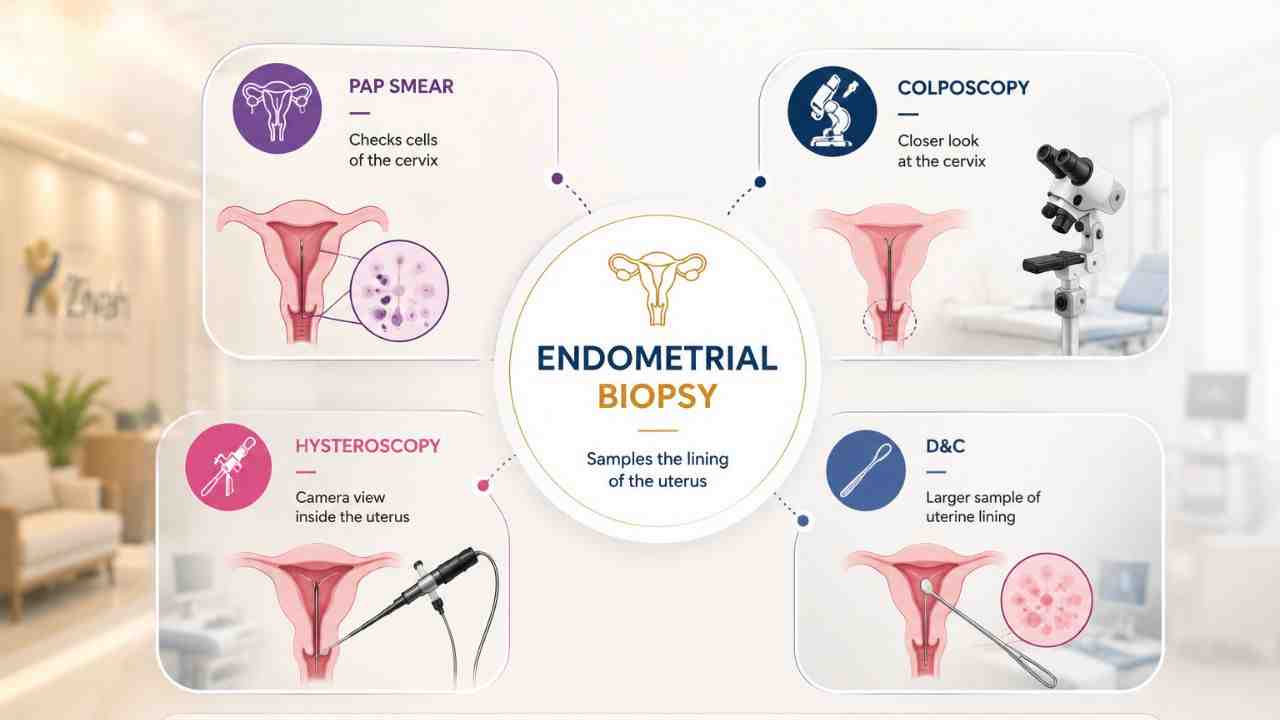
These tests are easy to confuse, so here’s how they are different.The confusion begins between an endometrial biopsy and a Pap smear, although they sample distinct areas. A Pap smear is a sample of the cervix, and an endometrial biopsy takes a sample of the lining of the uterus.
Colposcopy vs endometrial biopsy is a comparable divide; colposcopy looks more closely at the cervix, not the womb.Endometrial biopsy versus hysteroscopy is about technique. Biopsy is the blind sampling of tissue. Hysteroscopy allows your physician to examine the cavity and, if needed, sample tissue.
And with endometrial biopsy and D&C, the D&C just gets a larger sample, often when a biopsy is ambiguous.Your specialist will choose whatever best suits your symptoms.
How Endometrial Biopsy Compares with Pap Smear, Hysteroscopy & D&C
| Test |
What It Samples / Sees |
Best Used For |
|---|---|---|
| Pap smear |
Cells from the cervix |
Cervical screening |
| Endometrial biopsy |
Tissue from the uterine lining |
Abnormal bleeding, lining changes |
| Hysteroscopy |
A visual view of the cavity + targeted sample |
Seeing and treating cavity problems |
| D&C |
A larger lining sample |
Inconclusive biopsy, heavier sampling |
Endometrial Biopsy at Zivah: Cost Factors & Next Steps
An endometrial biopsy provides a clear, tissue-level solution to unclear symptoms, such as uncommon bleeding, a thick lining, or a reproductive problem. That's what makes it so useful, and why Zivah keeps it simple. The test is performed in the clinic, takes just a few minutes, involves no hospital stay or general anaesthesia, so you obtain accurate results without the upheaval of surgery.
It's a little thing that can make a big difference for certain people with abnormal bleeding or trying to conceive.If your doctor has recommended one, the next step is simple: book a consultation with the Zivah team to discuss what's suitable for you.
Cost of Endometrial Biopsy at Zivah
Curious about the cost of an endometrial biopsy? It changes with no single price. It depends on a few things, standard histology vs sophisticated CD138 testing, simple local block vs light sedation, single vs repeat sampling and any hysteroscopy done at the same time. Just get in touch with Zivah's billing desk for a clear, detailed estimate.