

A cyst aspiration is a quick, gentle, minimally invasive way to drain a fluid-filled cyst, without surgery. It uses a small needle to carefully draw off the fluid, relieving pressure and pain fast, rather than an operation.
Whether you’re dealing with a painful pelvic mass or just eliminating an ovarian cyst before a fertility cycle, this minimally invasive cyst needle aspiration gives focused relief. At Zivah, cyst drainage is guided by real-time ultrasound to ensure that it is exact and comfortable.
Here’s all you need to know about which cysts can be drained, what happens during the quick surgery, and healing afterwards. Targeted outpatient drainage is the smarter, safer option than surgery at this time.
What Is Cyst Aspiration? (Definition & How Cyst Drainage Works)
Cyst aspiration is one of the easiest ways to deal with a fluid-filled cyst. The best part of this procedure is that it doesn't involve surgery. Your specialist will use a thin, delicate needle to remove the fluid. Once the liquid is gone, the cyst itself breaks and dissolves.
No cuts, no stitches. As for operation, the difference is clear to imagine. Surgery removes the full cyst. A needle aspiration of a cyst just empties the cyst. That’s why our minimally invasive approach is so much friendlier on your body.
And the cyst drainage is an outpatient procedure, so you don't have to stay overnight. For most individuals, it's a brief visit, in, drained and back home the same day.
How Is Cyst Aspiration Performed? (Needle Drainage Basics)
It’s fast and simple. Your specialist inserts a small needle into the cyst and slowly removes the fluid into a syringe, until the cyst is empty and flat. This small needle aspiration typically just takes a few minutes start to finish.
Most of the time, the fluid is nothing to worry about and gets thrown away, but if it looks funny at all, it goes to the lab to make sure the cyst fluid evacuation was done right.
Ultrasound-Guided Cyst Aspiration Explained
Here, the ultrasonography really comes into its own. The doctor sees the cyst shrink and disappear on the screen as the fluid is pushed out, so the needle can go exactly where it needs to. That live image is what makes cyst aspiration under ultrasound guidance so safe and accurate.
If the cyst is in the pelvis, there are two main approaches, through the lower tummy (transabdominal) or the vagina (transvaginal) - whichever is clearest and safest. Either way, this form of ultrasonography-guided aspiration is mild and minimally invasive.
Types of Cysts Treated by Aspiration at Zivah
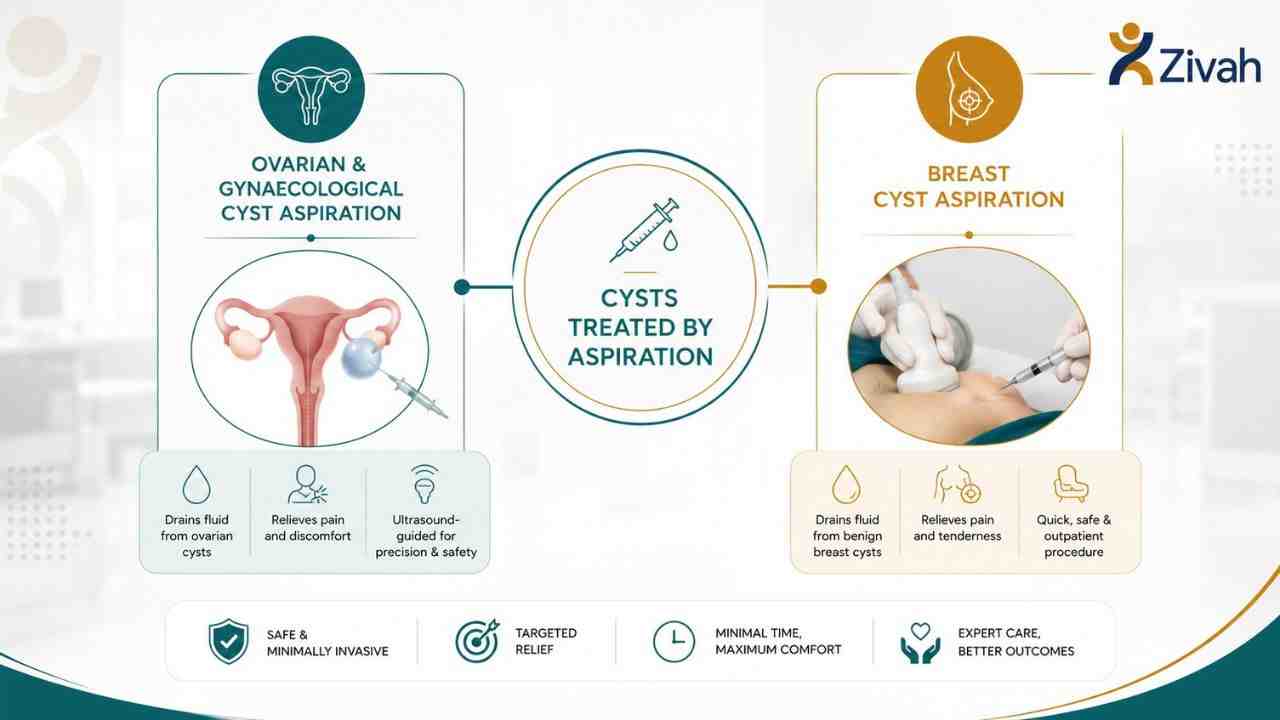
That’s an important starting point: not all lumps can be drained. What types of cysts are resistant to aspiration? Short answer: Those that are filled with liquids. Aspiration works best on plain, harmless cyst aspiration candidates, soft sacs that are filled with fluid and are easy to spot on a scan.
But a solid bulk is another thing. It cannot be drained and usually requires a biopsy or surgery. At Zivah, this kind of cyst treatment and continuing cyst management is carefully matched to what the scan shows.
1. Ovarian & Gynaecological Cyst Aspiration
The most common reason for this surgery is ovarian cysts. Many are simple, functioning cysts, single-chambered sacs that contain fluid solely and are transparent (anechoic) on ultrasonography. Ovarian cyst aspiration can drain a painful or big cyst in the clinic, no operating theatre needed.
This ovarian cyst fluid aspiration provides immediate relief. This makes an ovarian cyst draining a milder, outpatient option than keyhole surgery (laparoscopy). This gynaecological cyst aspiration is performed at Zivah under real-time ultrasound, which makes the aspiration of an ovarian cyst precise and safe.
2. Breast Cyst Aspiration
Breast cyst aspiration operates on the same principle: a small needle drains fluid from a benign breast cyst, frequently relieving pain in one brief visit. This small needle aspiration of a breast cyst is often performed by a breast specialist.
Which Cysts Are Suitable for Aspiration?
| Cyst Type |
Typical Appearance |
Aspiration Suitability |
|---|---|---|
| Simple ovarian (functional) cyst |
Single-chambered, clear fluid (anechoic) |
Well suited |
| Symptomatic breast cyst |
Smooth, fluid-filled |
Suitable (via a breast specialist) |
| Complex / multi-chambered cyst |
Mixed or septated fluid |
Case-by-case assessment |
| Solid mass or lump |
Dense, non-fluid |
Not suitable, needs biopsy or surgery |
Cyst Aspiration vs Cyst Removal Surgery
Wondering about the difference between cyst aspiration and cyst removal? It really comes down to one thing: draining versus removing.With aspiration, the fluid is removed using a needle, and the cyst ruptures. No surgery, no incision, very little downtime, generally home the same day with cyst drainage.
But the disadvantage is that the cyst wall is left behind, thus it might sometimes fill again later.Surgery is a procedure where the whole cyst is taken out (cystectomy). It’s a little more definitive, but recovery is longer.
Is cyst aspiration better than surgery? Not necessarily. It depends on the cyst. This cyst treatment is minimally invasive and typically the gentler first choice for uncomplicated, fluid-filled cysts. For solid or recurring ones, surgery may be more appropriate for you. Your specialist will help you weigh both up.
Cyst Aspiration vs Surgical Cyst Removal
| Factor |
Cyst Aspiration |
Surgical Removal |
|---|---|---|
| Approach |
Drains fluid via a fine needle |
Removes the whole cyst |
| Incision |
None |
Yes (keyhole or open) |
| Anaesthesia |
Local or none |
General or regional |
| Recovery |
Same-day, minimal |
Longer, days to weeks |
| Recurrence |
Possible (cyst wall remains) |
Unlikely (cyst removed) |
| Best suited for |
Simple, fluid-filled cysts |
Solid, complex, or recurring cysts |
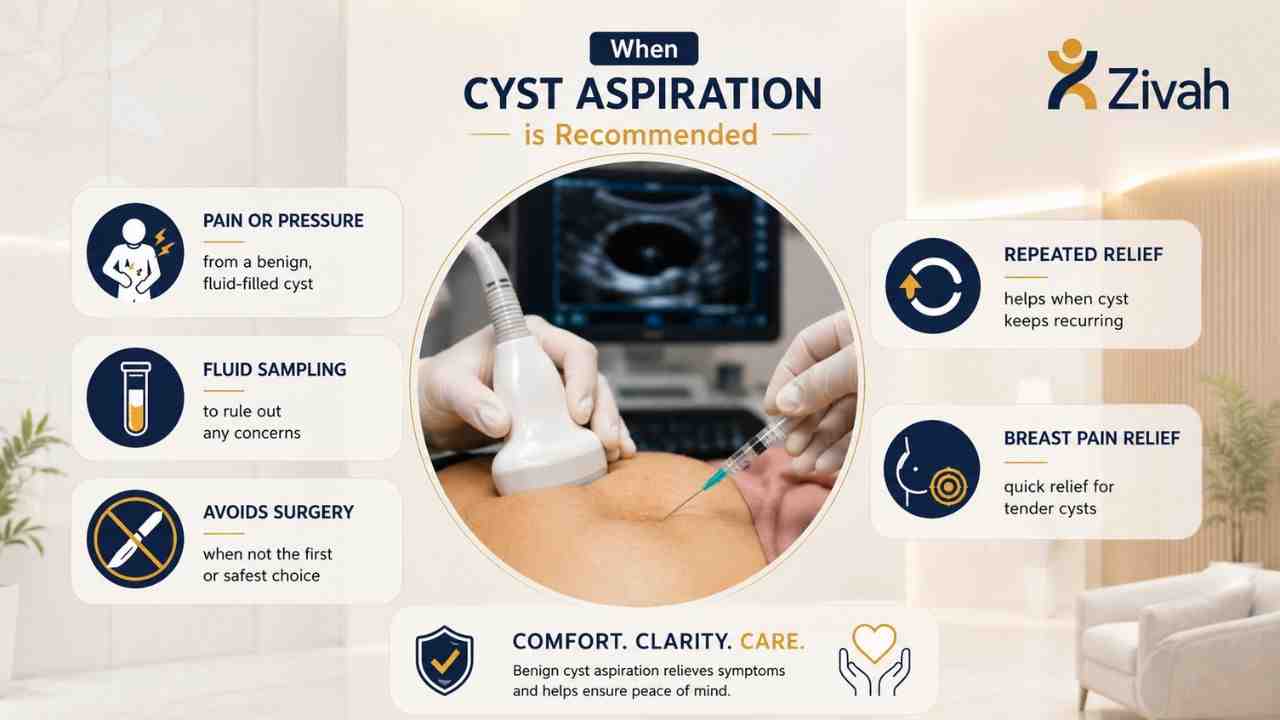
When Is Cyst Aspiration Recommended? (Indications)
Not all cysts need aspiration. Many cysts resolve themselves spontaneously. So when is cyst aspiration recommended? It’s usually symptoms and what the scan shows. When your specialist might suggest it:
- Pain, pressure or a bump from a benign cyst packed with fluid
- The fluid needs to be sampled to rule anything out (diagnostic)
- Surgery is not the first or safest choice
- Cyst aspiration treatment can provide repeated relief; however, a cyst continues to recur
- Cyst aspiration for breast pain is a straightforward way of treating an uncomfortable breast cyst to ease a tender breast cyst
To sum up, a benign cyst aspiration is about comfort and clarity, making patients feel better and ensuring the cyst is not dangerous.
Cyst Aspiration Before IVF & for Fertility
There’s another important reason for anyone undergoing reproductive treatment to clear a cyst. Ovarian cysts often occur at the worst possible time, right before starting an IVF cycle. Cyst aspiration may be required for IVF to open up the space since cysts can block the ultrasound monitoring, interfere with ovarian stimulation, and prevent the egg (oocyte) retrieval.
Zivah’s ovarian cyst treatment before IVF is a delicate ultrasound-guided procedure that is part of our comprehensive fertility cyst therapy and reproductive cyst management.
An ovarian cyst aspiration before the IVF cycle, draining it, protects your ovaries and provides you with a clean start to treatment. It’s a modest step towards fertility treatment for cyst aspiration that keeps your cycle on course.
How Is Cyst Aspiration Performed?
The cyst aspiration procedure is quick and well organised, most of it taking less than half an hour. So how is cyst aspiration performed? Here's how the ultrasound-guided cyst aspiration process works step by step:
What to Expect During Cyst Aspiration: Step, Action & Duration
| Step |
What Happens |
Time |
|---|---|---|
| 1. Positioning |
You're settled comfortably and the skin is cleaned |
1–2 min |
| 2. Ultrasound |
The cyst is located live on screen |
1–2 min |
| 3. Local anaesthetic |
The area is numbed; you stay awake |
1 min |
| 4. Needle & drainage |
A fine needle draws the fluid out until the cyst empties |
3–5 min |
| 5. Check & finish |
The screen confirms the cyst has collapsed, then the needle is removed |
1 min |
The complete process is an outpatient operation that usually takes around 15 minutes from beginning to end. It is just moderately stressful to most people.
How to Prepare for Cyst Aspiration
It's easy to get ready for. So, how do you prepare for cyst aspiration? Your expert will review the medications you are taking; you may have to stop blood thinners or aspirin. You can usually eat and drink normally.
If you have breast cysts, it is most comfortable to book the week after your period and take a painkiller (not aspirin) an hour before. Will I need anaesthesia to have the cyst aspirated? Usually only a local. And how long does cyst aspiration take? Maybe 15 minutes, so not much downtime.
Cyst Aspiration Recovery, Aftercare & Side Effects
So what happens once the cyst is removed? Happily, not much. Most people will go home the same day and feel fine in a matter of hours. Recovery from cyst aspiration is usually smooth, simply minor pain or light bruising at the needle site. Simple cyst aspiration follow-up care helps:
- Leave the area alone for one day
- Avoid heavy lifting or intense activities for a short time
- If you are tender, take a non-aspirin pain reliever
What is the healing time after cyst aspiration? Sometimes it’s just a day or two. The recovery time after cyst aspiration is quick, and any mild side effects resolve on their own.
Cyst Aspiration Risks & When to Seek Help
Is cyst aspiration safe? Yes, significant issues are uncommon. Still good to know what side effects of cyst aspiration to watch for. If you see it, contact Zivah:
- Fever or spreading redness (possible infection)
- Heavy bleeding or bruising more easily
- Severe or worsening pain

There is a minor danger of spreading cells if a lesion is found not to be benign, or a pelvic aspirate may very infrequently involve a nearby structure. Careful screening minimises this.
Aspirated Cyst Fluid: What the Colour & Analysis Mean
The colour of the drained fluid provides your professional with a lot of information. A brief check after removing cyst fluid, and sometimes a lab test, helps establish that the cyst is harmless.
Most fluid is soothing. Fluid from an ovarian cyst is usually clear or straw coloured. Breast cyst aspiration fluid colour (or breast cyst drainage colour) may be yellow to green. These forms are generally safe and rarely need testing.
An exception is bloody or blood-stained fluid. It is identified for cyst fluid examination (cytology), as it may sometimes be a sign of a papilloma or, more rarely, warrant, further investigation.
Aspirated Cyst Fluid: Colour & What It May Indicate
| Fluid Colour |
What It May Indicate |
|---|---|
| Clear or straw |
Typically benign; common in ovarian cysts |
| Yellow to green |
Usually benign breast or simple cyst fluid |
| Milky or cloudy |
Often benign; reflects the cyst's contents |
| Bloody / blood-stained |
Flagged, sent to cytology to rule out a papilloma or rare malignancy |
Will the Cyst Come Back After Aspiration?
This is a good, common question: can a cyst recur after aspiration? Sometimes it can. Yes. Honestly.That is why. Aspiration removes the fluid but not the cyst wall.
So, does the cyst aspiration eliminate the cyst? No. The lining stays and can progressively grow back over time.But how successful is the aspiration of cysts? It provides real relief that lasts for most uncomplicated cysts; many do not recur. If it does return, cyst aspiration treatment can be done again to drain it, or surgery may be recommended to correct it more permanently.
Cyst Aspiration at Zivah: Cost Factors & Next Steps
If a cyst is causing you pain or pressure, it doesn’t require surgery.That’s the reasoning behind cyst aspiration at Zivah. It’s rapid, mild and precise because it’s image-guided, done as an outpatient, and your specialist sees exactly what they’re doing in real time, and you’re usually home the same day.
If you’re planning IVF, it’s an easy way to clear an ovarian cyst and keep treatment on track. If a cyst shows up on a scan, the next step is easy: reach out to the Zivah team to discuss your choices and book a consultation.

Cost of Cyst Aspiration at Zivah
Wondering how much cyst aspiration costs? There is no single number; it depends on a few factors.The total can vary depending on the ultrasonography method (transvaginal or transabdominal), the use of local anaesthesia, whether the fluid is submitted for pathology, how complex the cyst is (simple or multichambered), and whether a single drainage or a repeat drainage is needed. So how much does cyst aspiration cost you? Get a precise estimate from Zivah’s billing desk made according to your needs.