

AI embryo selection uses artificial intelligence to analyse your embryos and help your fertility team choose the embryo most likely to lead to a healthy pregnancy. The device doesn’t provide a single look under the microscope; instead, it follows each embryo as it develops, translating what it discovers into clear, comparative information.
If you’re looking at AI in IVF, this guide talks you through what it truly does, from AI embryo grading and analysis to scoring that rates your embryos before transfer. You’ll know what the technology measures, who benefits most, and how it sits alongside an experienced embryologist rather than replacing one.
But what surprises most patients is that two embryos that look similar to the human eye can behave radically differently, and that hidden difference is exactly what AI is designed to catch.
What Is AI Embryo Selection?
In simple terms, it's software that monitors your embryos while they're growing and helps your fertility team determine which one to transfer first. It does this by examining thousands of time-lapse images of each embryo, significantly more information than the eye can pick up on a fast glance.
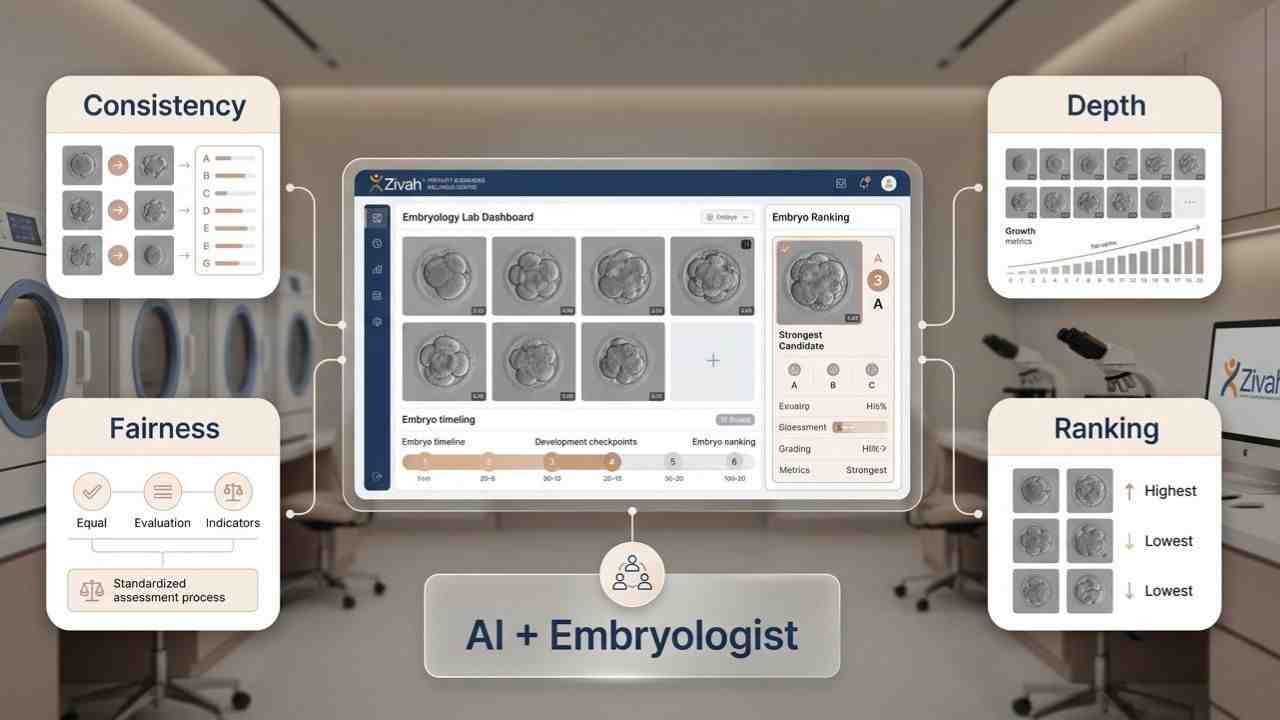
The main thing is to know what it doesn't do. It doesn't make the final decision. It doesn't replace your embryologist. It is a helper: the technology provides clear data, and your embryologist uses that data to select the best embryo for you. That's where the benefit of teamwork is. What AI embryo analysis adds is:
- Consistency - all embryos receive the same level of care, with no weariness or hasty assessments
- Depth - it detects the subtle signs of growth impossible to discern by sight
- Fairness - it reduces the discrepancies you get between one embryologist and another
- Ranking - It ranks your embryos from most to least likely to lead to pregnancy
But to understand why this is important, it helps to first know how the old approach worked.
How AI Differs from Traditional Embryo Grading
The traditional embryo grading system is for an embryologist to look at an embryo at set times and determine how it looks. It's good work. But it's a snapshot, a still photo, at one instant in time.
AI changes that. For IVF embryo selection, it's a huge improvement. It watches the embryo grow non-stop rather than one frozen moment. It's worth taking a closer look at the engine guiding that change.
Machine Learning Behind Smart Embryo Selection
That's where machine learning embryo selection in IVF comes in. The AI is trained on large numbers of past embryos whose results are already known, so it learns what growth patterns usually lead to success. From that, it provides you with an AI embryo rating result, a simple ranking that makes wise embryo selection a data-backed option, not a guess.
How Does AI Embryo Selection Work in IVF?
So, how does AI embryo selection work after you have embryos in the lab? The idea is simple: look hard, and keep looking. From the moment of fertilisation, the embryo is placed in a special incubator with a camera, and the AI monitors every stage of its development.
What actually happens, from the cameras following your embryos to the score that ranks them before transfer, is explained in the rest of this section.
Time-Lapse Imaging & AI Embryo Monitoring
Ever wonder what your embryos do during those five or six days in the lab? With IVF, AI embryo monitoring is used to image them every few minutes, day and night, without disturbing them. These images provide a time-lapse movie of each growing embryo.
The AI carefully examines each cell and sees how it divides. AI blastocyst analysis for IVF chooses up features that a few short microscope checks would miss by the blastocyst stage.
How AI Predicts Embryo Implantation Potential
But monitoring is just half the job, so how does the AI identify which embryo is most likely to succeed? This is where AI-based prediction of embryo implantation comes into play.
The method has learned from thousands of past embryos whose results are already known and knows which growth patterns tend to result in a healthy pregnancy. AI-based embryo implantation prediction analyses your embryos, compares them to these patterns and rates their potential.
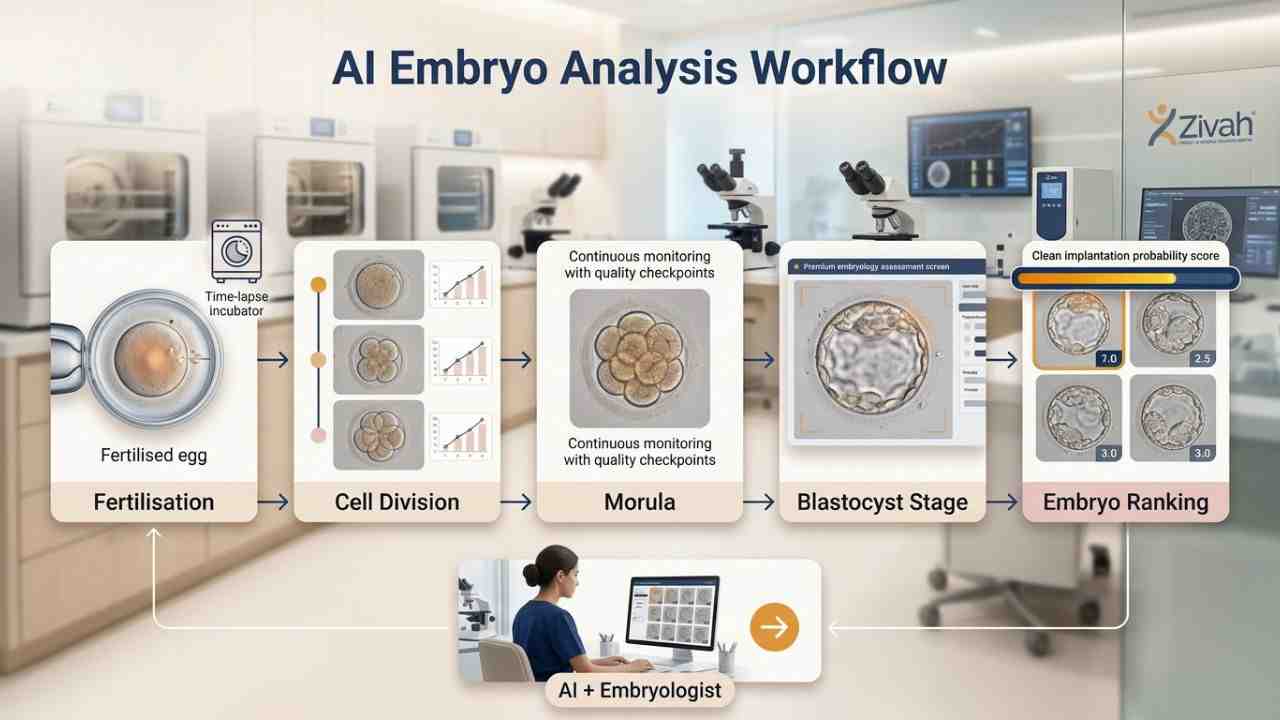
Step-by-Step AI Embryo Analysis Workflow
What does AI embryo analysis involve? And how does AI select the best embryo? Here's the simple version.
| Stage |
What Happens |
What AI Measures |
|---|---|---|
| Day 0–1 Fertilisation |
Embryo placed in time-lapse incubator |
Pronuclei formation, fertilisation timing |
| Day 2–3 Cleavage |
Continuous image capture |
Cell-division timing, symmetry, fragmentation |
| Day 4 Morula |
Compaction tracked |
Compaction quality, abnormal cleavage flags |
| Day 5–6 Blastocyst |
Expansion and grading |
Inner cell mass, trophectoderm, expansion stage |
| Scoring |
AI ranks the whole batch |
Implantation probability score per embryo |
At the end, your embryologist has a clear, ranked shortlist and a strong, data-backed starting point for which embryo to transfer first.
AI Embryo Grading: How the Embryo Score Works
The AI has to take all that detail, now that it has seen your embryos develop, and make it helpful. That's what the AI embryo grading system does: it takes everything the technology observes and reduces it to a single number for each embryo.
And so you get AI embryo grading: a simple, comparable score that lets your team know how that particular embryo measures up to the rest. But what is that score really worth to you?
Understanding the AI Embryo Score and Ranking
AI embryo grading is a ranking, not a pass/fail grade. The AI-based embryo rating system gives each embryo a score and arranges them from the highest potential to the lowest. The great thing about it is that it is fair.
Instead of two embryologists maybe scoring the same embryo slightly differently, the AI applies the same guidelines to every embryo, every time. This provides your team with a clear, consistent order for embryo transfer.
AI Embryo Grading vs Gardner Blastocyst Grading
You may have heard of the traditional grading procedure for embryos, sometimes known as Gardner grading. It scores a blastocyst on three things: expansion, inner cell mass, and trophectoderm. AI blastocyst grading doesn't throw this out; it builds on it.
The standard Gardner letters show you what the embryo looks like, and the AI score gives you a data-backed representation of how it's expected to perform. Together, they provide a comprehensive view before transfer.
AI Embryo Analysis: What the Images Reveal
If the score is the result, AI embryo analysis is the work that goes into it beforehand. This is where the technology appears in real pictures of your embryos, pulling out the minute features that determine quality. So what is it really looking at? The key to a good embryo quality analysis is to look for a few signals:
- Timing – the precise time each cell divides, down to the minute
- Symmetry - are the cells even and well-formed
- Fragmentation - the amount of broken-off cell material
- Expansion - how well the blastocyst grows and fills out
What AI Detects That Human Eyes Miss
And here’s the honest part: most of this is tough to judge by eye. It’s hard to identify the exact minute a cell divides by looking at it quickly because small quantities of fragmentation are easy to miss.
That’s where AI embryo quality analysis comes in. It scans each frame, so it can spot developments a busy embryologist may overlook, and yes, it can signal the early warning signs.
Can AI tell bad quality embryos? “It can spot the signals that tend to point that way.”
AI Embryo Screening for a Healthy Pregnancy
In the end, it is all about one objective. AI embryo screening for a healthy pregnancy focuses on giving the strongest embryos the best chance, and AI embryo screening helps your team do so by providing clearer, more complete information.
Manual Review vs AI Embryo Analysis
| Assessment Factor |
Manual Embryologist |
AI Embryo Analysis |
|---|---|---|
| Data points reviewed |
Limited static snapshots |
Thousands of time-lapse frames |
| Cell-division timing |
Hard to quantify |
Measured to the minute |
| Consistency across batch |
Varies with fatigue |
Same attention to every embryo |
| Subjectivity |
Differs between people |
Standardised and objective |
| Output |
Morphology grade |
Ranked implantation probability |
AI vs Manual Embryo Selection: What Research Shows
It's a valid thing to ask: Is AI embryo selection better than manual grading? The honest answer is that it's hopeful, but it's still early days, and it's important to know what the research actually says before you read too much into the headlines. What research tends to agree on is this:
- AI offers better uniformity than human grading alone
- It can detect patterns that are hard to measure by sight
- It works together with an embryologist, not as a substitute for one
So it's not so much "AI vs human" but "AI + human." Let's take a deeper look at the accuracy question.
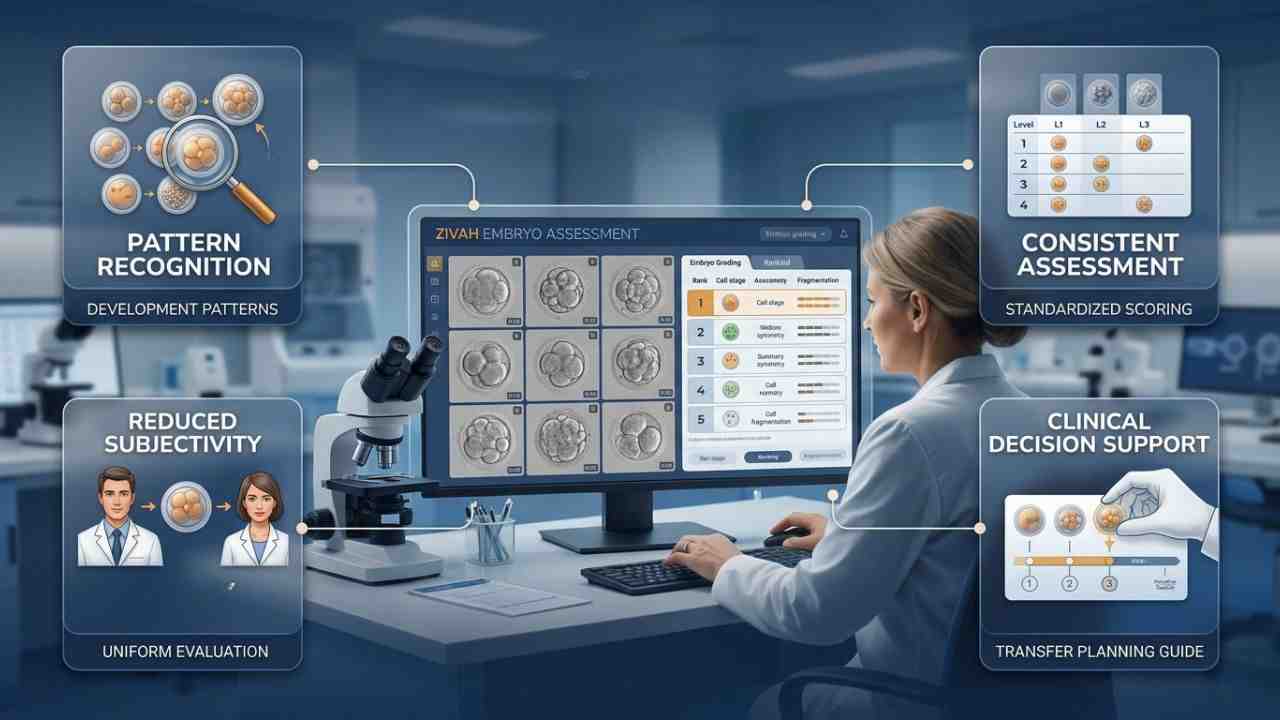
How Accurate Is AI Embryo Analysis?
When people ask how accurate AI embryo analysis is, they usually want a number. The problem is that most studies thus far have been retrospective, looking back at embryos rather than reviewing live patients, so firm figures can be deceptive. What is clearer is the major trend. The use of AI in IVF has shown great promise across studies, and, curiously, simpler models have occasionally performed as well or better than more complex ones.
AI Embryo Grading and Reduced Subjectivity
The most agreed-upon benefit is fairness. The use of AI embryo grading before embryo transfer means that all embryos are graded to the same standard, and helps to reduce the natural diversity between people. And that's why AI-assisted embryo screening in IVF should be considered as a tool to bring consistency, not a guarantee of success.
What the Research Currently Shows
| What Research Indicates |
Current Evidence Status |
|---|---|
| AI can reduce operator subjectivity in grading |
Consistently reported across studies |
| AI may match or exceed embryologist consistency |
Reported, but mostly retrospective data |
| AI predicts implantation potential |
Promising; needs prospective trials (RCTs) |
| Interpretable models vs black-box models |
Interpretable ones have sometimes done as well or better |
| Live-birth prediction (the goal that matters) |
Still an emerging focus, not settled |
AI Embryo Selection for IVF Success Rates
Of course, the main question is whether all this improves your chances, so what is the AI embryo grading success rate? So be hopeful here, but be realistic, like I said. AI does not make you pregnant. What it can do is help your team make a better-informed, consistent choice, and that’s where the actual benefit is.
So can AI improve IVF success rates? The honest answer is that a greater, more reliable embryo rating provides a stronger starting point to every transfer.
AI Embryo Selection and Single Embryo Transfer
One of the easiest wins is in AI embryo transfer planning. Your team feels more comfortable transferring just one when AI can trust the strongest embryo. This matters because transferring only one embryo lowers the chance of twins or triplets, without reducing your probabilities. To summarise, AI embryo transfer success prediction makes single-embryo transfer safer and smarter.
AI for Vitrified Blastocyst Selection in Frozen Transfers
AI helps with frozen embryos, too. Once frozen, a blastocyst is supposed to “re-expand”, and how effectively it re-expands is a useful quality signal. This AI blastocyst grading can measure re-expansion here and help choose which embryo to thaw first; one method of AI embryo selection may increase the success of frozen embryo transfer.
Who Should Choose AI Embryo Selection?
The honest answer is it can help practically anyone doing IVF, but it can be especially successful if you have limited embryo choices or previous cycles haven't gone to plan. Let's look at who benefits most.
 1. AI Embryo Selection for Older Women
 1. AI Embryo Selection for Older Women
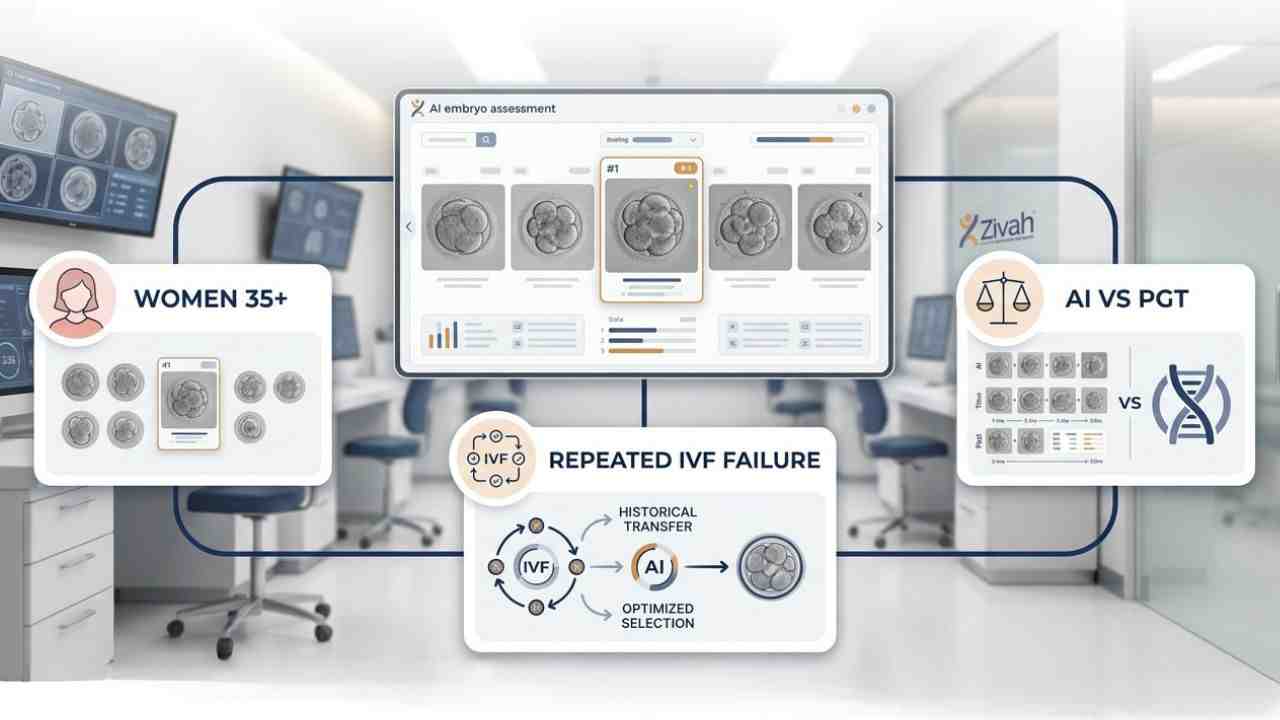
In older patients, fewer embryos are available, so each decision carries more weight. AI embryo selection assists older women by giving a clear ranking to those few embryos. So does AI embryo selection help older women get pregnant? It can't change egg age, but it helps you make the most of the embryos you have.
2. AI for Recurrent Implantation Failure & Failed IVF Cycles
If the transfers keep failing, you want a new, better view. AI embryo selection rechecks the signals of each embryo in the case of repeated implantation failure, and for those with failed IVF cycles, it provides a consistent score to help with the transfer order.
3. AI Embryo Grading vs PGT Testing
People commonly question what the difference is between AI embryo grading and PGT testing. The simple version: AI looks at how an embryo develops and what it looks like; PGT tests for its chromosomes through a embryo biopsy. They ask different questions, and can be interconnected.
Who Benefits Most from AI Embryo Selection
| Patient Profile |
Why AI Embryo Selection Helps |
|---|---|
| Advanced maternal age |
Better ranking when fewer viable embryos are available |
| Recurrent implantation failure |
Objective re-assessment of embryo viability signals |
| Multiple failed IVF cycles |
Consistent scoring to inform transfer order |
| Choosing single embryo transfer |
Confidence in selecting the top-ranked embryo |
| Avoiding invasive testing |
Non-invasive complement (PGT is still the standard for chromosomes) |