

Ovarian cyst surgery, also called an ovarian cystectomy, removes a cyst from the ovary when it won't clear on its own or starts causing problems. This is normally done either by keyhole (laparoscopy) or open surgery, depending on the nature and size of the cyst. For most women, ovarian cyst removal is a simple procedure, and they quickly return to their usual lives.
This page helps you understand the bigger picture: if you do require surgery, what size cyst generally requires surgery, the process, recovery, and effects on fertility.
Most ovarian cysts never require surgery, which is the good news. So the question is not simply how it’s done, but whether yours needs treatment at all.
When Is Ovarian Cyst Surgery Needed?
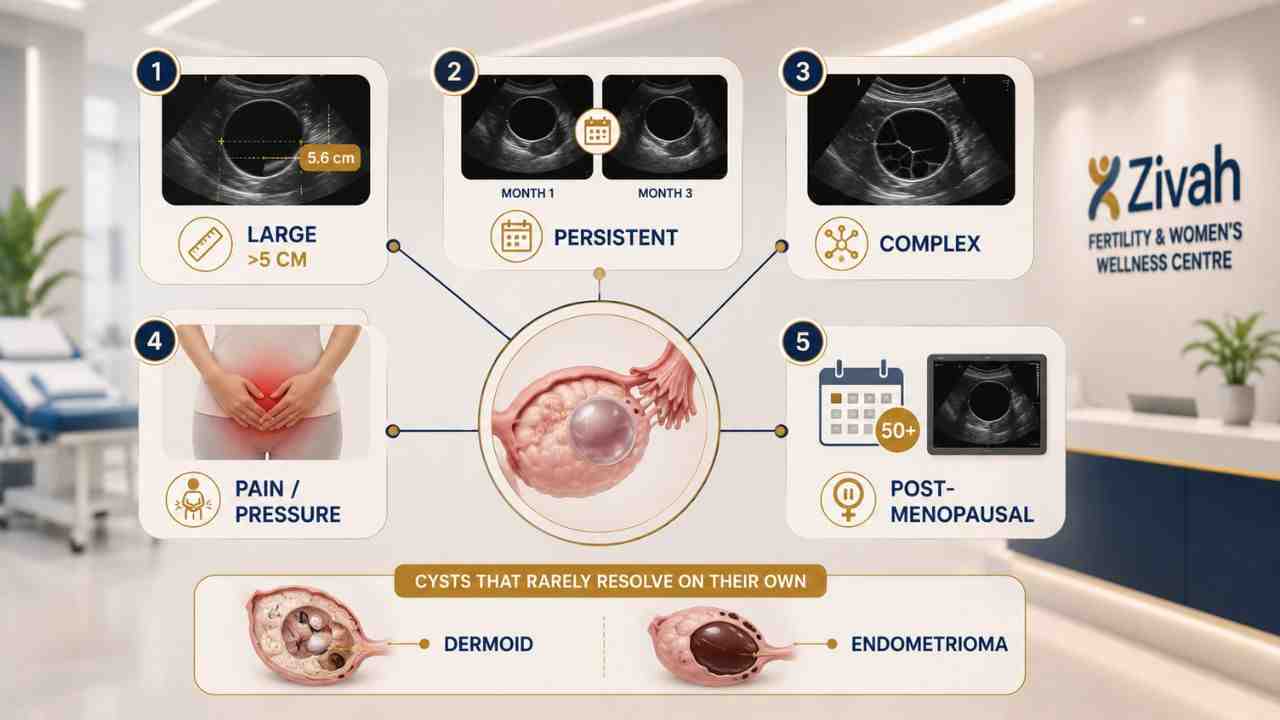
Many women are surprised to learn that most ovarian cysts do not require surgery. There are several that come and go with your menstrual cycle, and you'd never know they were there. So when is ovarian cyst surgery needed? Cysts are frequently considered for surgical management when:
- Large – more than about 5cm long
- Persistent – still there after months of monitoring
- Complex – on a scan it looks smooth or uneven
- Symptomatic – producing constant pain or pressure
- Post-menopausal – a new cyst after the menopause
Some types are also more important: dermoids and endometriomas almost always have to be removed because they rarely go away on their own. So certainly, ovarian cysts may be safely removed when necessary, and understanding when is half the answer.
What Size Ovarian Cyst Needs Surgery?
Size is one of the key factors. Generally speaking, cysts larger than about 5 cm are more likely to need removal, especially if they persist or continue to grow.
But size isn’t everything. A large, uncomplicated cyst can only be monitored for a period; a smaller cyst that looks complex on a scan, with solid areas or irregular edges, may still require ovarian cyst surgery.
Watchful Waiting vs Ovarian Cyst Surgery
For many women, the initial step is not surgery at all, it’s watchful waiting. This simply involves keeping an eye on the cyst with follow-up scans over a few months to see if it clears on its own, which most do.
Surgery is only an option if the cyst grows, stays, or starts to cause difficulties. The modest risk of something serious increases with age, so doctors are more likely to watch a little more attentively after menopause.
Emergency Surgery for Ovarian Torsion & Rupture
Sometimes, there’s no time to wait. A cyst twisting the ovary (torsion) or bursting causes abrupt, acute pain and is a medical emergency. You may need surgery on the same day to control the bleeding and save the ovary.
When Ovarian Cyst Surgery Is Recommended
| Situation |
What It Means |
Why Surgery Is Considered |
|---|---|---|
| Large cyst (over 5cm) |
Bigger than the usual harmless cyst |
Less likely to clear on its own; may cause symptoms |
| Persistent or growing |
Hasn't gone after months of monitoring |
Unlikely to resolve; removal prevents ongoing issues |
| Complex on scan |
Solid areas or irregular borders |
Needs removal and testing to rule out anything serious |
| After menopause |
New cyst in a post-menopausal woman |
Slightly higher cancer risk with age; safer to remove |
| Torsion or rupture |
Ovary twisted or cyst burst |
Emergency, sudden severe pain; surgery saves the ovary |
| Possible cancer |
Imaging or markers raise concern |
Removal allows testing and early treatment |
Ovarian Cyst Diagnosis & Tests Before Surgery at Zivah
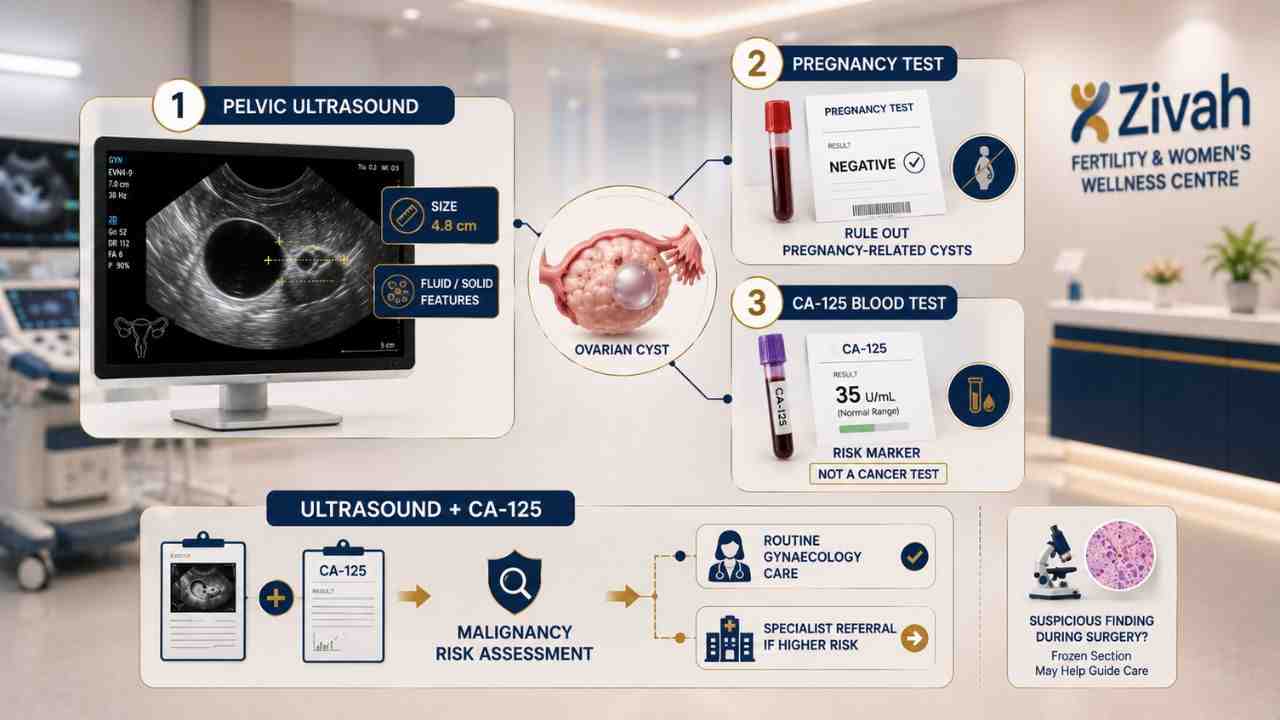
The initial job is to identify exactly what the cyst is before any decision about surgery is made. Everything that follows depends on the exact diagnosis of an ovarian cyst, whether you need an operation at all, and if so, what kind. A few key checks accomplish the trick:
- Pelvic ultrasound - a transvaginal scan to figure out the size of the cyst and whether it contains fluid or has solid sections, the crucial clues to how it should be treated.
- Pregnancy test - must be done first, since some harmless cysts are only part of early pregnancy (see below).
- CA-125 blood test - a marker with the scan that helps measure risk of anything serious. Importantly, it's not a cancer test, but a risk indicator, as it can increase with innocuous diseases also.
These are from our pelvic ultrasound imaging and Doppler studies at Zivah. And if results ever indicate a higher risk, Zivah arranges for instant referral to an onco-gynaecology specialist, leaving nothing to chance.
Ultrasound, CA-125 & Malignancy Risk Assessment
The scan and CA-125 are used together to calculate a Risk of Malignancy Index (RMI), a simple number that helps decide whether surgery is needed. If, during the procedure itself, a cyst looks suspicious, it can be tested immediately with a rapid frozen-section test.
Zivah performs all diagnostic imaging strictly in accordance with the PC&PNDT Act for clinical diagnostic purposes exclusively.
Ovarian Cyst Removal Options: Laparoscopic vs Open Surgery
So how do doctors actually remove cysts from the ovaries? There are two different ways to go. Which is best depends on the size and nature of your cyst and whether docs are worried about it.
About 95% of them are performed laparoscopically, or keyhole surgery. The surgeon removes the cyst by a few small incisions, and you frequently go home the same day. It can deal with unusually large cysts, up to roughly 20cm.
The other option is open surgery (laparotomy) for particularly large, difficult or troubling cysts. Both are done under general anaesthesia, and an ovarian cystectomy always sends the cyst off for testing, with a quick check during surgery if anything appears unusual.
Laparoscopic (Keyhole) Ovarian Cyst Removal
There’s a good reason why most women choose laparoscopic ovarian cyst surgery. These small cuts lead to less discomfort, a shorter hospital stay, smaller scars, and fewer complications, and are the least invasive technique for protecting viable ovarian tissue. A complete step-by-step can be found in our Laparoscopic Ovarian Cystectomy.
Open (Laparotomy) Ovarian Cyst Surgery
Sometimes open ovarian cyst surgery is the safer method. If the cyst is very large, or if there is suspicion that it may be cancerous, a single larger incision provides the surgeon with better, fuller access. It is a conscious and smart decision, never a step backwards.
Ovarian Cystectomy vs Oophorectomy: What's Removed
This difference is important for your ability to conceive. Ovarian cystectomy removes the cyst but leaves the ovary healthy. An oophorectomy is the removal of a whole ovary. If it is safe, surgeons choose cystectomy, and the ovary functions normally.
Laparoscopic vs Open Ovarian Cyst Surgery
| Feature |
Laparoscopic |
Open (Laparotomy) |
|---|---|---|
| Incision size |
A few small cuts (5–12mm) |
One larger cut |
| Hospital stay |
Same day or overnight |
1–2 nights |
| Recovery time |
Around 1–2 weeks |
Up to 6 weeks |
| Scarring |
Minimal, fades over time |
More noticeable, at bikini line |
| Pain level |
Generally mild |
More significant |
| Best for |
Most cysts (up to ~20cm) |
Large, complex, or suspicious cysts |
| Fertility preservation |
High, ovary-sparing |
Preserved where possible |
How Is Ovarian Cyst Surgery Performed? Step by Step
Want to know what really happens when this is done? It helps so much to know what to expect. It makes the whole affair seem less frightening. Whatever your surgery is, the ovarian cyst surgery technique is done in a clear, cautious order. Here’s how it goes from start to finish:
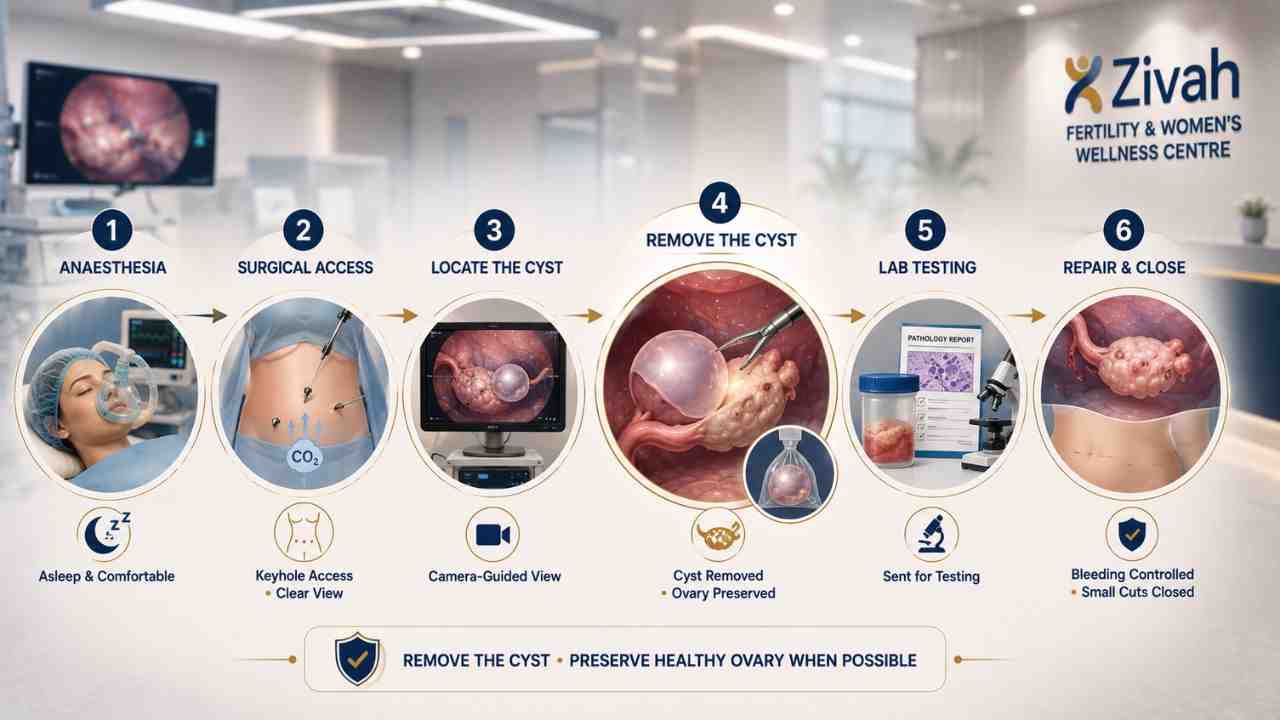
- Anaesthesiology: They anaesthetise you generally so you are asleep and don’t feel anything the whole time.
- Access: The surgeon makes a couple of small keyhole incisions or one larger incision, then gently inflates the abdomen with gas to provide a clear view.
- Identifying the cyst: A laparoscope is a small camera that directs the surgeon to the ovary and the cyst.
- Removing the cyst: The cyst is carefully moved away from the good tissue in the ovary. Bigger cysts are sometimes drained or slipped into a small bag first, so nothing spills.
- Getting it tested: The cyst goes off to the lab, and if anything looks off, it can be checked right there during surgery.
- Repair and closing up: The ovary is saved wherever possible, any bleeding is settled, and the small cuts are closed.
That's the essence of how ovarian cyst surgery is done. For the full keyhole technique in detail, see our guide to Laparoscopic Ovarian Cystectomy.
How Long Does Ovarian Cyst Surgery Take?
Most procedures take between 30 minutes and 2 hours, depending on the size and intricacy of the cyst and the surgical method used. Your surgeon can give you a better idea beforehand.
How to Prepare for Ovarian Cyst Surgery
There's not much to it: getting ready for the day makes everything go more easily. Most of the stress is taken away when you know how to get ready for surgery on an ovarian cyst ahead of time. First, you'll have a consultation to go over the plan, ask any questions you have, and sign off on it.
You'll need to go through a few tests, usually blood tests and a scan, to make sure you're ready before the ovarian cyst removal. Your team will also look at the medicines you take. For a few days, they may ask you to stop taking blood thinners.
You'll be told to fast and asked to arrange a lift home because you can't drive after anaesthesia closer to the time. Making your home a nice place to rest also helps.
Fasting and Pre-Surgery Instructions
Usually, you'll be told to stop eating and drinking at midnight the night before surgery. This is because fasting before surgery for an ovarian cyst keeps the anaesthesia safe. Stop taking any blood thinners only if your doctor tells you to. Get someone to drive you home, and get ready for a simple first day or two of recovery.
Recovery After Ovarian Cyst Surgery
How fast you get back on your feet depends a lot on what kind of surgery you underwent. Most women are up and about within a week of keyhole surgery. It might take a few weeks to feel entirely back to normal after ovarian cyst surgery. Sometimes a bit longer. After open surgery it's a sluggish six weeks or more.
Is laparoscopic surgery for ovarian cysts painful? In general, no; the little cuts will at best cause little discomfort, and can be readily handled with basic pain treatment. You may also get a weird pain in your shoulders, but this is just residual gas from the procedure and will go away quickly. Keep your wounds dry and clean. If you observe any of these, notify your clinic:
- Feeling sick or fever
- Bleeding severely
- Severe stomach pain or bloating
- Very bad-smelling discharge
Ovarian Cyst Surgery Recovery Time by Type
Recovery times vary widely depending on the route. After laparoscopic surgery, modest activity frequently resumes within a week, with a thorough recovery over a few weeks. Open surgery takes longer, expect to take it easy for around six weeks before you're back to your usual self.
Scars & Returning to Normal Activity
Scars after ovarian cyst laparoscopy are small, generally 5 to 12mm, and disappear with time. Open surgery has one major scar, which is low down at the bikini line, therefore simple to hide. Ease back into things slowly, don't do any hard lifting or intercourse for a couple of weeks and wait till you're off pain medication to drive.
Recovery Timeline After Ovarian Cyst Surgery
| Milestone |
Laparoscopic |
Open Surgery |
|---|---|---|
| Hospital stay |
Same day or overnight |
1–2 nights |
| Light activity |
Within about a week |
2–3 weeks |
| Return to work |
1–2 weeks |
4–6 weeks |
| Full recovery |
A few weeks (sometimes up to 12) |
6 weeks or more |
Risks, Side Effects & Recurrence of Ovarian Cyst Surgery
So is it safe to get ovarian cyst surgery? Yes, for most women, it's a routine, well-practised surgery and problems are not prevalent, especially via the keyhole approach. That said, it's only fair to be honest about both the dangers and the reassurance.
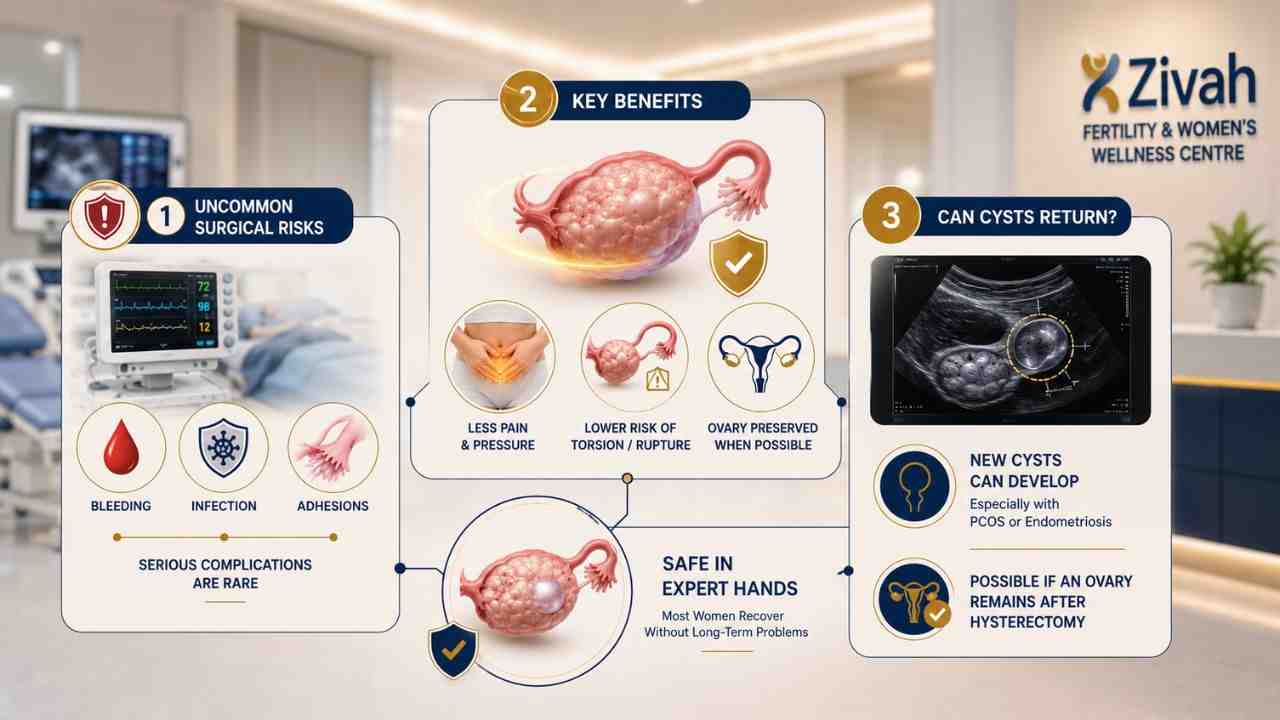
Ovarian cyst surgery carries certain primary risks that are rare but worth knowing about. These include minor bleeding, infection, or a slight risk of damage to neighbouring organs such as the bladder or intestine. The rarer ones are blood clots, reaction to anaesthesia, scar tissue or, very rarely, having to remove the ovary if it is significantly injured.
Benefits of Ovarian Cyst Removal
The advantages are obvious. Draining a pesky cyst takes away discomfort and pressure, eliminates problems such as rupture or torsion, and if done in an ovary-saving method, preserves your fertility for the future.
Risks and Long-Term Side Effects
For most women, there are no long-term negative effects. The strongest long-term possibility is scar tissue (adhesions), which can occasionally cause discomfort, more probable after open surgery than keyhole surgery. Serious problems are still rare.
Can Ovarian Cysts Come Back After Surgery or Hysterectomy?
Removing one cyst doesn't stop new ones turning up, especially if you have PCOS or endometriosis. And yes, you can still get an ovarian cyst after a hysterectomy. If an ovary was left behind, it can carry on forming cysts, which is why the odd check-up is worth keeping up.
Ovarian Cyst Surgery and Fertility at Zivah
For many women, this is the biggest worry, and the comfort is true. If surgery is performed using the ovary-sparing approach, your fertility is typically very effectively safeguarded. Most women can get pregnant later on their own, as just the cyst is removed and the healthy ovary is left.
Even if one ovary has to be removed, the other continues releasing eggs as normal, so pregnancy remains possible. This is exactly where Zivah's joined-up care shows: surgical skill and fertility expertise working side by side, with your future firmly in mind.
Does Ovarian Cyst Surgery Affect Fertility?
No, for most women. It is possible to get pregnant after ovarian cyst removal, as long as your doctor was able to save your ovary. In fact, surgery can even help if a cyst is blocking you. If you need our Fertility Services, we’re here for you.
Fertility After One or Both Ovaries Are Removed
If one ovary is removed, the other will usually continue to work properly and becoming pregnant is still possible. Rarely, if both are removed before menopause, a natural birth is not an option, but IVF with donor eggs might open a different road.
Why Choose Zivah for Ovarian Cyst Surgery
When you’re having surgery, the hands you’re in make all the difference. The difference with Zivah is real attention to preserving what matters most. Our strategy is founded on precise ovary-sparing cystectomy that protects your ovarian reserve and future fertility.
Our team of experienced ovarian cyst surgery specialists offer both keyhole and open skills, meticulous risk-stratification and a clear pathway to specialised cancer treatment should it ever be required.
Expert Ovarian Cyst Surgeons at Zivah
If you have been looking for the finest doctor for ovarian cyst removal near you, Zivah’s skilled gynaecologists for ovarian cyst surgery provide surgical accuracy with fertility-focused care and stay with you much beyond the procedure itself.
Are you ready for the next step? Schedule an appointment to discuss your choices, and see our associated Laparoscopic Ovarian Cystectomy, Fertility Services, and High-Risk Pregnancy Care for full, integrated care.