
IVF, which stands for "In Vitro Fertilisation," is one of the most accepted ways for couples who can't get pregnant. As part of Assisted Reproductive Technology (ART), egg and sperm are combined outside the body in a lab. This is also known as "test tube baby treatment." After the egg is fertilised, it is placed in the uterus to begin a pregnancy. IVF is now used in India to treat problems like bilateral fallopian tube blockage, endometriosis, PCOS, low sperm count, weak sperm movement, and infertility that can't be explained.
At Zivah Fertility, IVF treatment is offered along with other ART procedures, genetic testing, and lab-based preservation services. This page explains what IVF is, how it works, its types, success rates, risks, and the rules that guide IVF treatment in India.
What Is IVF and How Does It Actually Work?
In vitro fertilisation, or IVF, is a way to treat infertility in which the egg and sperm are combined outside of the body. "In vitro" is a Latin term meaning "in glass." In other words, the egg and sperm meet in a small lab dish, not inside the woman. Once the egg is fertilised, it grows into a tiny embryo. The embryo is then put into the uterus to begin a pregnancy.
What Does IVF Mean and What Is Its Full Form?
The full form of IVF is In Vitro Fertilisation. It just means putting the egg and sperm together in a lab. IVF is a type of Assisted Reproductive Technology (ART), which is a broad term for all medical ways that people can have babies.
Is IVF the Same as a Test Tube Baby?
Yes. IVF is also called the test tube baby treatment. The world's first test tube baby, Louise Brown, was born in 1978 in the United Kingdom. Since then, millions of babies have been born through IVF.
Who Is IVF Treatment Recommended For?
Wondering if IVF treatment is meant for you? The truth is that not all couples who are having trouble getting pregnant need IVF. IVF, also called "test tube baby treatment," is often the best next step when certain medical problems make it impossible to get pregnant naturally or when other treatments have not worked.
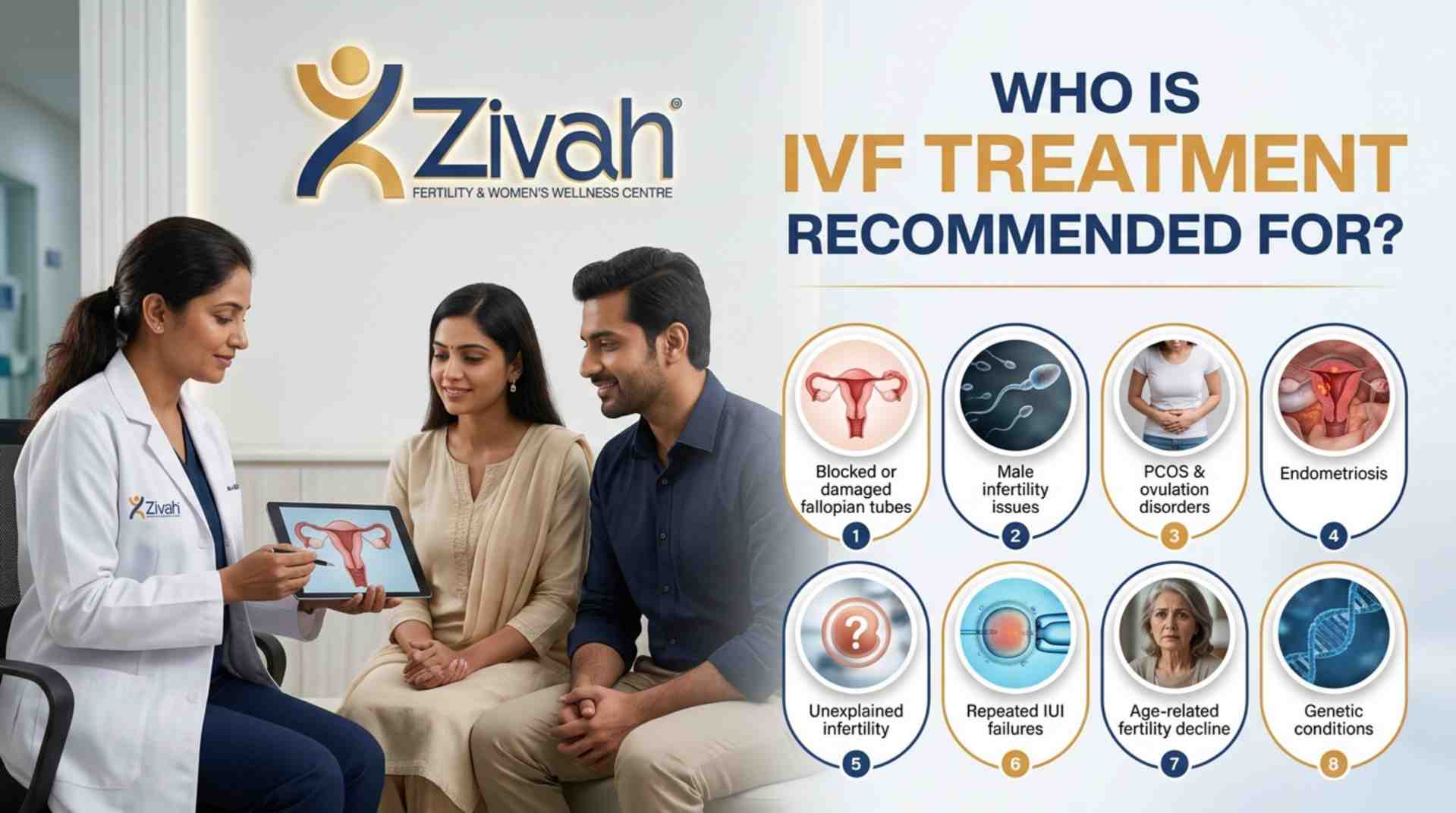
In most cases, IVF treatment is recommended for the following situations:
- Blocked or damaged fallopian tubes: In IVF, this step is skipped if the egg can't get through the tubes to meet the sperm.
- Male infertility issues: IVF or ICSI can be used to treat a low sperm count, weak sperm movement, or bad sperm shape.
- PCOS and ovulation disorders: When the body does not release eggs regularly, and simpler medicines have not helped.
- Endometriosis: a condition in which tissue growth affects the eggs, tubes, or uterus and makes it less likely that a woman will get pregnant naturally.
- Unexplained infertility: There are times when test results look good, but there is still no baby.
- Repeated IUI failures: When simpler options, such as IUI, have been tried more than once without success.
- Age-related fertility decline: Mostly for women above 35, when egg quality and number naturally start to fall.
- Genetic conditions: IVF can be used with PGT tests when parents don't want to pass on an inherited disorder.
When Should You Start Thinking About IVF Treatment?
In general, doctors say that a woman under 35 who has been trying for more than a year without success or a woman over 35 who has been trying for more than six months should think about IVF. It is always best to get checked out early, especially if the person is older, has hormone problems, or has had pregnancy issues in the past.
Quick Look - Who Is IVF Recommended For?
| Type of Issue |
Who It Affects |
|---|---|
| Tubal factor |
Women with blocked or damaged fallopian tubes |
| Male factor |
Men with low sperm count, poor motility, or azoospermia |
| Ovulation factor |
Women with Polycystic Ovary Syndrome or irregular ovulation |
| Uterine factor |
Women with Endometriosis or fibroids |
| Combined / unknown |
Couples with unexplained infertility |
| Age-related |
Women above 35 with reduced egg reserve |
| Genetic |
Couples carrying inherited disorders (IVF + PGT) |
A Note from the Fertility Team at Zivah Fertility: "Many couples come to us feeling unsure about IVF; they wonder if it is too soon, too much, or simply not for them. The truth is, IVF treatment is not about giving up on nature; it is about giving nature a helping hand when it needs one. The sooner couples reach out, the higher the chances of success. There is no harm in seeking guidance early."
IVF Treatment Process at Zivah Fertility
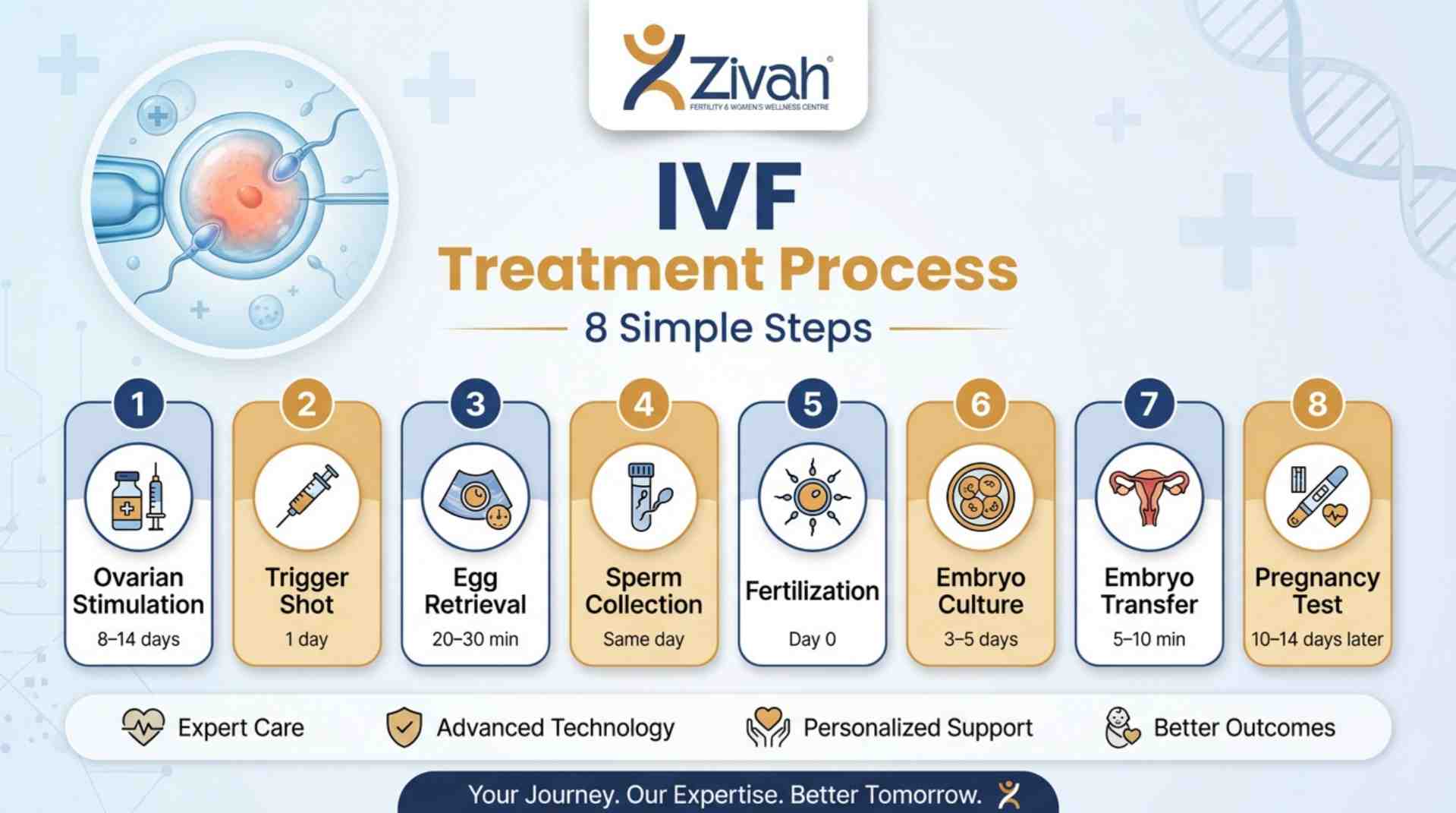
Want to know what really happens during IVF at Zivah Fertility? The steps are very clear and well thought out, even though the process sounds complicated. There is careful medical care during every IVF cycle at Zivah Fertility. The whole process takes 4 to 6 weeks from start to finish. And let's take a look at IVF step by step.
IVF Treatment Timeline at a Glance
| Step |
Stage |
Duration |
What Happens |
|---|---|---|---|
| 1 | Ovarian stimulation |
8–14 days |
Hormonal injections help grow multiple eggs |
| 2 | Trigger shot |
1 day |
Human Chorionic Gonadotropin injection prepares the eggs for release |
| 3 | Egg retrieval |
20–30 min |
Eggs are collected under sedation |
| 4 | Sperm collection |
Same day |
Fresh or surgically retrieved sperm |
| 5 | Fertilization |
Day 0 |
IVF or Intracytoplasmic Sperm Injection in the lab |
| 6 | Embryo culture |
3–5 days |
Embryos grow inside an incubator |
| 7 | Embryo transfer |
5–10 min |
The embryo is placed into the uterus |
| 8 | Pregnancy test |
10–14 days later |
Beta-hCG blood test confirms pregnancy |
How Does Ovarian Stimulation Work in IVF?
The first step is ovarian stimulation. And how many days are the shots given? A woman gets light shots of hormones for 8 to 14 days. When these shots are given, the ovaries make more than one egg at a time, which increases the chances of a good cycle.
What Is the Trigger Shot Before Egg Retrieval?
Once the eggs are mature, a final injection called the trigger shot is given. Usually, this is an hCG shot that prepares the eggs for release, and it is carefully timed to occur about 36 hours before the eggs are retrieved.
What Happens During Egg Retrieval (Ovum Pick-Up)?
Egg retrieval, also called Ovum Pick-Up (OPU), is a small lab procedure done under light sedation (sleep). The eggs are gently retrieved from the ovaries with a thin needle, which is guided by ultrasound. It only takes twenty to thirty minutes to do everything.
How Is Sperm Collected for IVF?
On the same day as egg retrieval, the male partner gives a fresh sperm sample. If the male partner has a problem like azoospermia, a small treatment such as TESA or PESA is used. After that, the sperm is washed and set up in the lab.
How Are the Egg and Sperm Joined in the Lab?
This is what IVF is all about. The egg and sperm are combined in the lab. Every day, IVF is used if the sperm is healthy. When sperm problems occur, ICSI (Intracytoplasmic Sperm Injection) is used to inject a single sperm directly into the egg.
What Happens During Embryo Culture?
Once fertilised, the eggs are placed in an incubator for 3 to 5 days. They are watched closely as they grow. If the embryos are in the best condition, then they are transferred by Day 5, when they reach the blastocyst stage.
How Is Embryo Transfer Done?
Embryo transfer is a quick and painless step. The embryo is put into the uterus through the cervix with a thin, soft catheter. It only takes 5 to 10 minutes, and you don't need to be sedated.
When Is the Pregnancy Test After IVF Done?
It's like 10 to 14 days after embryo transfer that a Beta-hCG blood test confirms pregnancy. This test measures the amount of a pregnancy hormone in the blood. If the test comes back positive, it means the IVF cycle worked.
IVF Cost - What Affects the Treatment Charges?
When two people think about IVF, money is one of the first things that comes to mind. Also, it is a valid one. Actually, there is no set cost for IVF treatment. The price will vary based on your health and treatment plan.
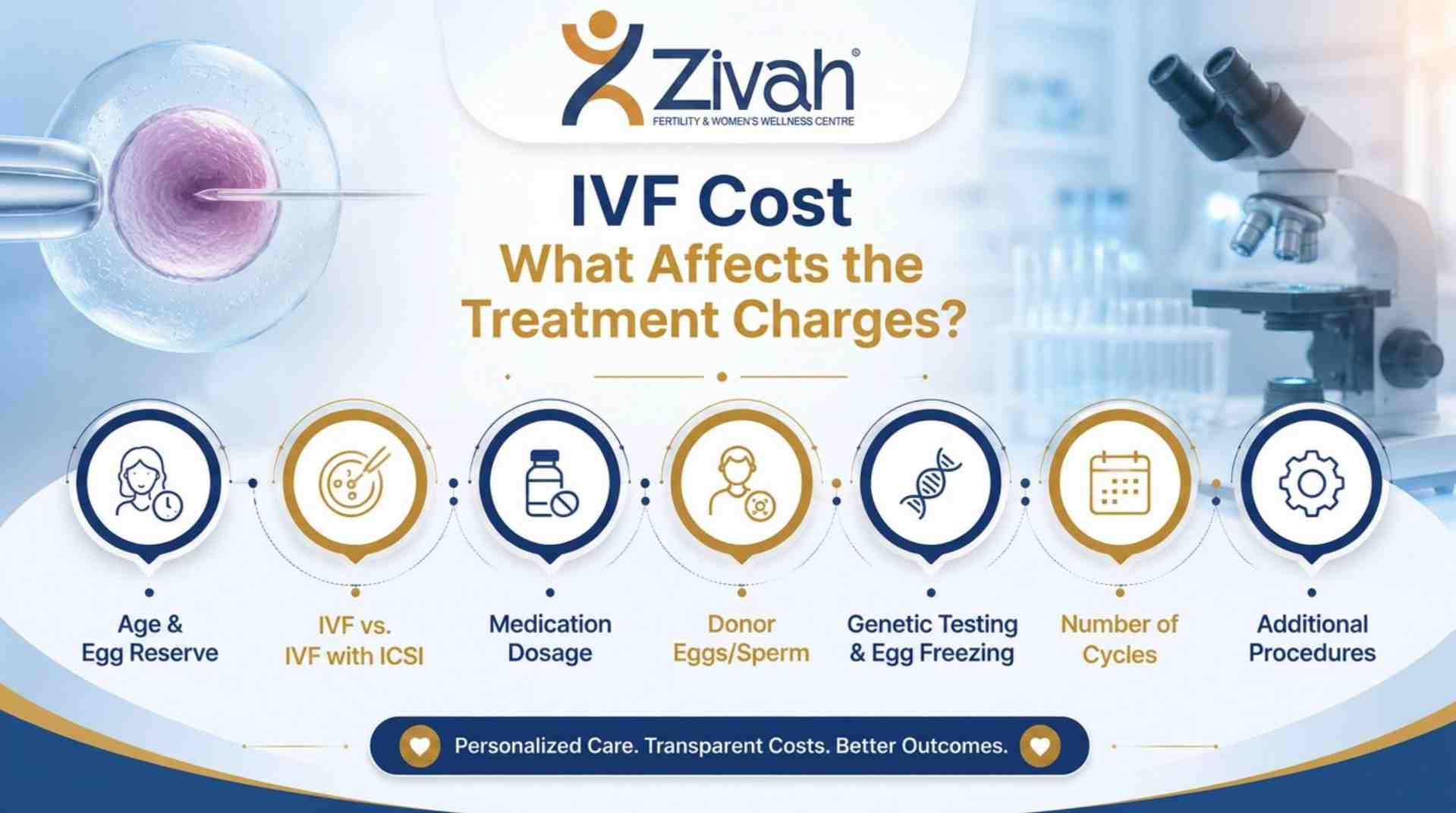
IVF costs depend on the following important factors:
- Your age and egg reserve: Younger people need fewer drugs, so the cost is lower.
- Compare IVF to IVF with ICSI: Adding ICSI to a standard IVF cycle costs a little more.
- Dosage of medicine: Higher amounts cost more. Donor eggs or sperm: It costs more to use a donor. egg freezing or genetic testing: Steps like PGT-A or egg freezing add to the total.
- Number of cycles: Some couples get pregnant on their first try, while others may need more.
- Extra steps: Laser-assisted hatching, AI embryo selection, and TESA/PESA are among the steps that can affect the final cost.
Factors That Influence IVF Cost
| Factor |
Effect on Cost |
|---|---|
| Patient's age and egg reserve |
Younger patients usually cost less |
| Type of IVF (standard vs ICSI) |
Intracytoplasmic Sperm Injection adds extra lab cost |
| Use of donor egg or sperm |
Increases overall cost |
| Genetic testing or embryo freezing |
Adds steps and lab charges |
| Number of IVF cycles required |
More cycles raise the total cost |
| Add-on procedures (LAH, AI, TESA/PESA) |
Each adds to the final price |
Honest and Clear Pricing at Zivah Fertility
We keep our IVF prices simple and clear at Zivah Fertility. Every cost is explained right at your first consultation, no hidden charges, no surprises later. We believe good fertility care should never feel out of reach. So our IVF costs are kept fair and transparent, without ever compromising the quality of care you receive.
What Are the Different Types of IVF Treatment?
IVF isn't the same for everyone. Each couple is different, and so is their treatment. The right type of IVF depends on factors like your age, your health, and what's causing trouble with conception. That's why at Zivah Fertility, we offer many IVF options so every couple can find the one that truly suits them.
Types of IVF Procedures Compared
| IVF Type |
How It Works |
Best Suited For |
|---|---|---|
| Conventional IVF |
Egg and sperm are placed together in a lab dish |
Tubal factor, unexplained infertility |
| ICSI (Intracytoplasmic Sperm Injection) |
One sperm is injected directly into each egg |
Male factor infertility |
| IMSI |
High-magnification sperm selection before ICSI |
Severe male factor cases |
| Frozen Embryo Transfer (FET) |
Frozen embryos are thawed and transferred later |
Repeat cycles, PGT users |
| Natural Cycle IVF |
No stimulation drugs; one naturally grown egg |
Drug-sensitive or low reserve patients |
| Mini IVF (Mild Stimulation) |
Low-dose medicine protocol |
Older patients, poor responders |
| IVF with Donor Eggs |
Donor's eggs combined with partner's or donor's sperm |
Premature ovarian failure, low egg quality |
| IVF with Donor Sperm |
Recipient's eggs with donor sperm |
Severe male factor, single women, same-sex couples |
| IVF with PGT |
Embryos are tested genetically before transfer |
Recurrent miscarriage, genetic disorders, advanced age |
What Is the Difference Between IVF and ICSI?
A lot of couples ask us this, so let's keep it simple. In regular IVF, the egg and sperm are placed together in a small dish, and the sperm fertilises the egg on its own. In ICSI, the doctor picks one healthy sperm and gently places it inside the egg using a tiny needle. ICSI is usually chosen when there are sperm-related issues, like low count, slow movement, or unusual shape.
The right choice depends on each couple's case. At Zivah Fertility, both IVF and ICSI are done with full care and under proper medical rules.
Why Choose Zivah Fertility for IVF Treatment?
One of the most important choices a couple makes on their path to having a child is choosing the right IVF centre. Not just the care, but also the people who are with you during it. We work hard every day at Zivah Fertility to make sure that every couple feels safe, heard, and cared for.
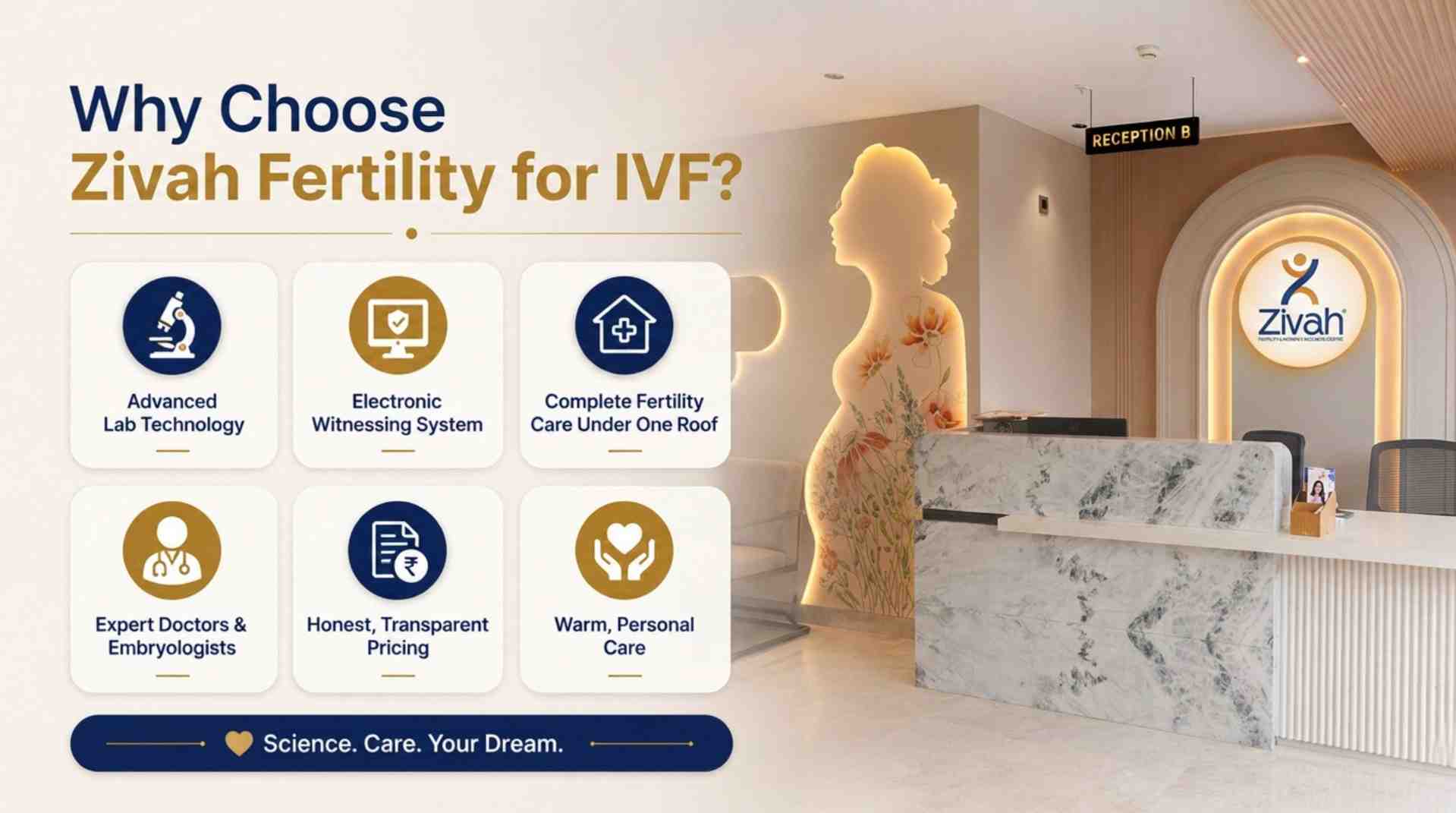
What makes us different:
- Advanced Lab Technology: To give every cell the best chance, we use AI to choose which ones to keep, lasers to help them hatch, and modern blastocyst culture.
- Electronic Witnessing System: Each egg, sperm, and baby is digitally tracked, so they can't get lost.
- Complete Fertility Care Under One Roof: With ICSI, transfer programs, surrogacy, IUI, and IVF, you can get a full genetic test (PGT-A, PGT-M, or PGT-SR).
- Expert Doctors and Embryologists: A skilled group that knows the newest ways to help people get pregnant.
- Honest, Transparent Pricing: There are no secret fees; all costs are made clear to you on your first visit. Warm, Personal Care: Kindness, patience, and full medical care are given to every pair.
In short, Zivah Fertility isn't just an IVF centre, it's a place where science meets care, and where every step is taken with your family's dream in mind.
What Services Are Included in IVF Treatment?
A modern IVF program is much more than a single procedure. There are a lot of medical, lab, and support services that work together to give partners the best chance of success. Every IVF journey at Zivah Fertility is backed by a full range of treatments and cutting-edge lab processes, all in one place.
IVF Services Available at Zivah Fertility
| Service Category |
Services Included |
|---|---|
| Fertility & IVF Treatments |
IVF, Intracytoplasmic Sperm Injection, IUI, Donor Egg/Sperm IVF, Surrogacy Programme |
| IVF Procedures |
Ovum Pick Up (OPU), Embryo Transfer (ET), TESA, PESA |
| Genetic Testing & Advanced IVF |
Embryo Biopsy, PGT-A, PGT-M, PGT-SR, Laser Assisted Hatching, AI Embryo Selection, Witnessing System |
| Preservation & Lab |
Egg Freezing, Embryo Freezing, Sperm Freezing, Blastocyst Culture, Semen Analysis |
All services are done in line with the ICMR, the Assisted Reproductive Technology (Regulation) Act, 2021, and the Surrogacy (Regulation) Act, 2021. This means that couples can trust each other and feel safe moving forward.
Conclusion
One of the safest ways to become a parent today is through IVF. In Assisted Reproductive Technology (ART), the egg and sperm are joined in a lab, and then the baby is put into the uterus. It is a step-by-step process. What kind of IVF is best for each couple varies on their needs, and how well it works mostly depends on their age and health.
Every IVF clinic in India follows the rules set by the ICMR, the ART Act 2021, and the Surrogacy Act 2021. There is a lot of IVF treatment, high-tech lab care, and friendly human support all in one place at Zivah Fertility.
"Wherever you are in your journey, you don't have to walk it alone. Connect with Zivah Fertility today, and let's take the first step toward parenthood together."