Here's the uncomfortable part about diabetes: It doesn't generally give you any warning. Prediabetes and type 2 diabetes can creep up for years, with no thirst, no weariness, no warning at all.
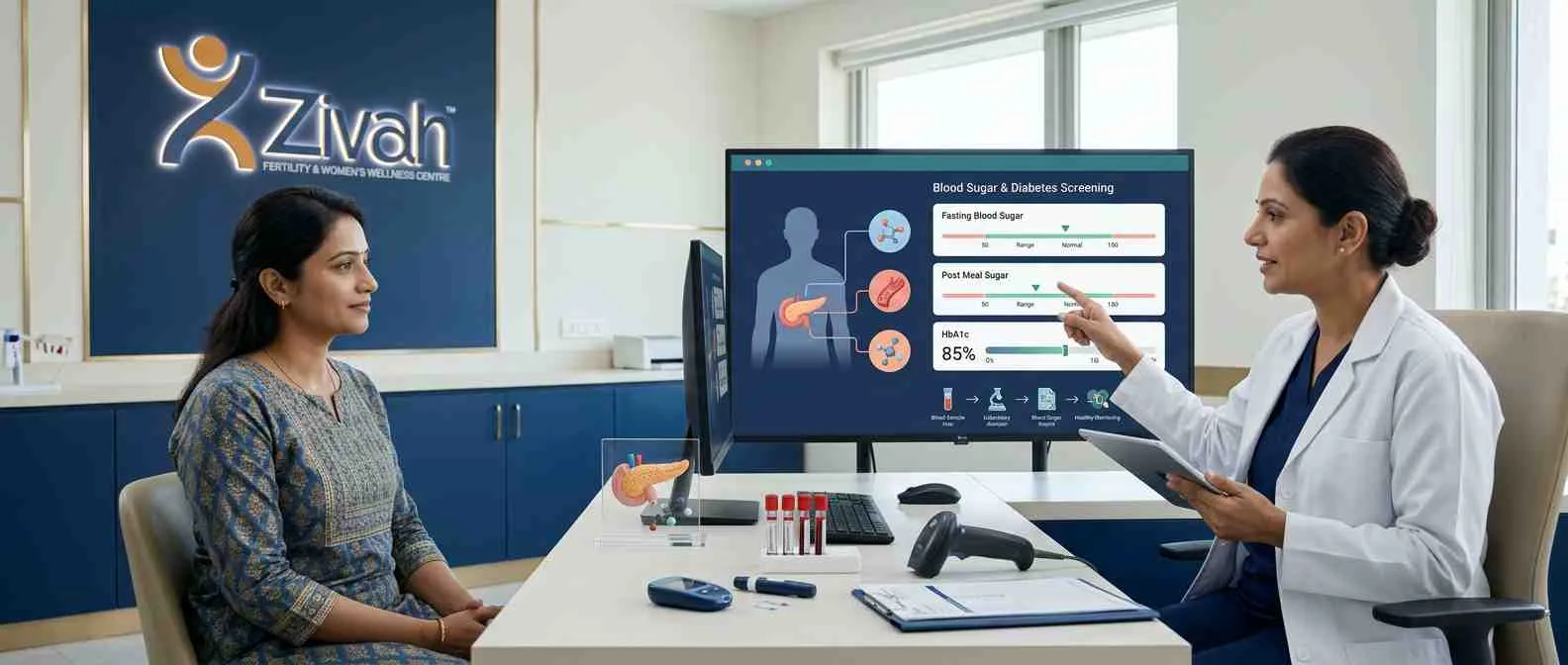
That's precisely why we have blood sugar screening: a simple blood glucose test that tells you what your body hasn't informed you yet. The tests are easy. This might be a fasting blood sugar test, an HbA1c test, or a glucose tolerance test, depending on what your doctor wants to know.
This page covers what each test measures, how to prepare, what your numbers really show and how screening works in pregnancy, where the rules and the figures are different.You don't experience high blood sugar levels. You can measure it.
What Is a Blood Sugar Test? Types of Diabetes Screening Tests
A blood sugar test checks the glucose (the sugar your body consumes for energy) in your blood. Glucose is supposed to stay in a narrow band, and insulin maintains it there. When that mechanism fails, diabetes develops. Either the pancreas doesn't make enough insulin or the body's cells don't respond to insulin.
Glucose goes up, stays up, and, over time, silently affects blood vessels, neurons, kidneys, and eyes. All of the following tests are used to determine the same glucose. The only difference is the sample time.
Fasting Blood Sugar (FBS) and Random Blood Sugar
A fasting blood sugar test is required after eight hours of not eating any meal. Fasting cuts through the noise of your last meal to leave your genuine baseline. It's the most prevalent test for screening. A random blood sugar test does not need fasting. Less exact, yet a very high reading suggests anything.
HbA1c: Your Average Over Three Months
HbA1c is the one you can't cheat with two good days of eating. It measures your average glucose level over two to three months, and requires no fasting. One caveat: it isn't always dependable. It may be distorted by later pregnancy and anaemia.
Oral Glucose Tolerance Test (OGTT)
This tests how your body handles sugar, not simply where it sits.You go in, donate blood, drink a glucose solution, and then provide blood at 1 and 2 hours. How quickly you remove that load shows what other tests don't, and it's the standard pregnancy test.
Which Blood Sugar Test Do You Need? Tests Compared
| Test |
What It Measures |
Fasting Needed |
Typically Used For |
|---|---|---|---|
| Fasting blood sugar (FBS) |
Your baseline glucose, unfed |
Yes, 8 hours |
Routine screening and diagnosis |
| Random blood sugar |
Glucose at any given moment |
No |
When symptoms are present |
| HbA1c |
Average glucose over 2–3 months |
No |
Screening, and tracking control over time |
| OGTT |
How your body handles a glucose load |
Yes |
Diagnosis, and gestational diabetes |
| Glucose challenge (pregnancy) |
Response one hour after a sweet drink |
No |
Routine GDM screening at 24–28 weeks |
| Postprandial (PP) |
Glucose two hours after a meal |
No, timed after eating |
Checking post-meal spikes |
Knowing which test to take is the easy part. The harder question is why you'd take one at all, when nothing feels wrong.
Why Diabetes Screening Matters: Symptoms and Risk Factors
Since nothing that feels incorrect means anything. Prediabetes and type 2 diabetes may have no signs at all. They build up gradually for years while you feel healthy, and by the time you discover it, damage may have begun. The argument in one sentence: you test because you feel fine.
Symptoms of High Blood Sugar You Shouldn't Ignore
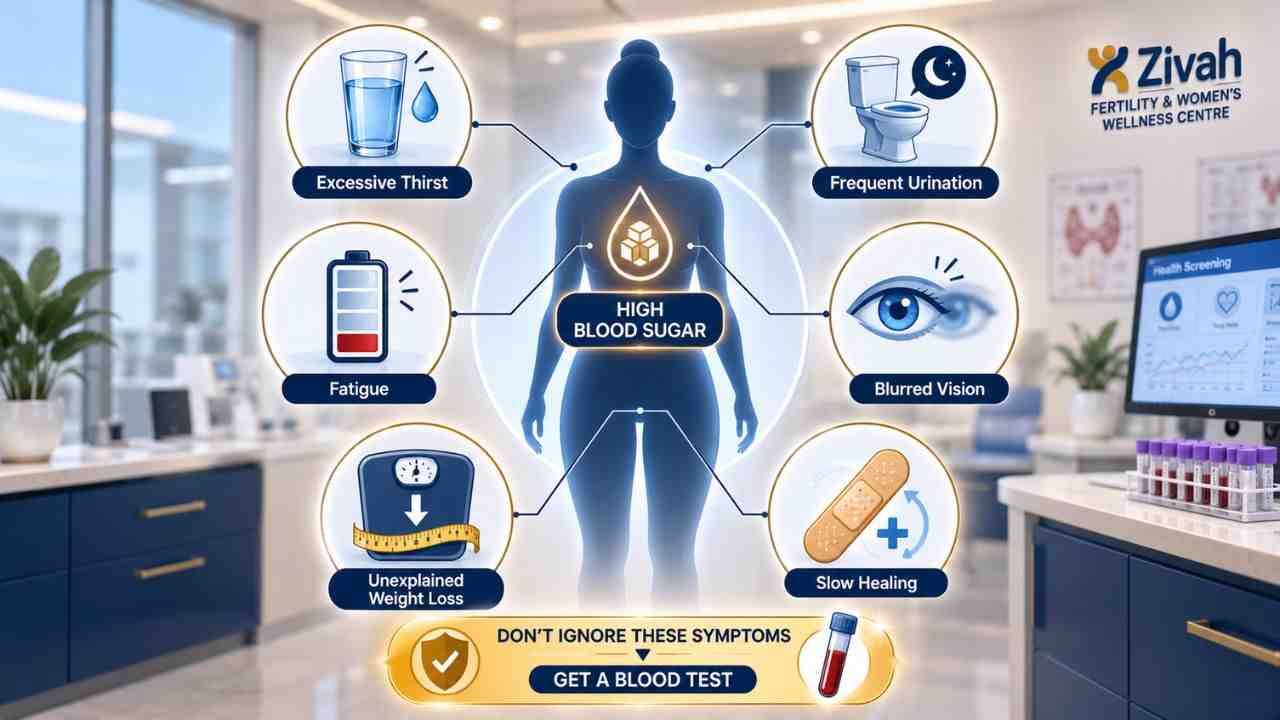
When symptoms do appear, it’s simple to attribute them to something else:
- Dry mouth and excessive thirst
- More frequent urinating, particularly at night
- Fatigue that doesn’t respond to rest
- Blurred vision
- Slow healing cuts and wounds
- Unexplained weight loss
None of these rule out diabetes. All deserve a blood test.
Who Should Be Screened, and How Often
If you are over 35, overweight or have a family history, you should get screened. Also, if you have PCOS, gestational diabetes, or are intending on becoming pregnant. Normal: recheck every several years; prediabetes range: annually.
What Prediabetes Means and Why It's Reversible
Prediabetes means your blood sugar is more than it should be, but not high enough to be diabetes. This is a warning. Not a punishment. Keep this.
Many pull it back down and never develop type 2. But you can only act upon what you know about. Most people find a slow problem early with screening. It’s faster with pregnancy, and there are two individuals, not one.
Blood Sugar Screening in Pregnancy: Gestational Diabetes at Zivah
Two, not just one. That's a game changer in how blood sugar is managed in pregnancy. Gestational diabetes normally doesn't create any symptoms. Your body handles glucose differently during pregnancy. That's why it's routinely checked for, rather than waited for.
When Gestational Diabetes Screening Is Done
Most women are screened for gestational diabetes between 24 and 28 weeks of pregnancy, when pregnancy hormones that mess with insulin are at their peak.
If you have a greater risk, such as PCOS, a family history or GDM in a prior pregnancy, you may also be examined earlier. One key element: a normal early test does not rule out GDM developing later. So what is that morning really like? More than anyone will say.
The Glucose Challenge Test and OGTT: What the Morning Actually Involves
You will fast overnight and then take a first blood sample. Then you drink a measured, very sweet glucose drink and then the wait. At one hour, and typically two, your blood is drawn again to see how your body clears the load.
One thing they don't tell you is that the drink might make you feel uneasy on an empty stomach. If you vomit, the test is rejected and has to be rescheduled. So if you feel unwell, inform the crew immediately. Pregnancy is when blood sugar levels show up the most. But it begins to matter far before you conceive.
Insulin Resistance, PCOS and Fertility: Screening Before Pregnancy
Insulin resistance isn't only about diabetes risk. When the body doesn't adjust to insulin, levels rise, and high circulating insulin prompts the ovaries to overproduce testosterone, which disturbs the cycle and can block ovulation.
That's the process behind PCOS, and why metabolic screening should be part of a reproductive workup, not after one; it can uncover a treatable issue that a routine blood panel usually overlooks. Which raises the question that every reader, whatever level they are at, enters with: what does my number mean, in fact?
Gestational Diabetes: How the Numbers Differ in Pregnancy
| Test |
Non-Pregnant Threshold |
Pregnancy Threshold |
Why It's Tighter |
|---|---|---|---|
| Fasting glucose |
(reviewer to supply) |
Lower in pregnancy |
A level that's healthy for you may still be too high for your baby |
| 1-hour post-glucose |
Not routinely used |
Applied in pregnancy |
Screens how fast you clear a glucose load |
| 2-hour post-glucose |
(reviewer to supply) |
Lower in pregnanc |
Fetal glucose depends directly on yours |
The pregnancy limits are lower than the non-pregnancy levels. Numbers change according to guideline and verified by your doctor, this chart is for orientation, not diagnosis.
Understanding Blood Sugar Levels: Normal, Prediabetes and Diabetes
So here's the honest answer, and it's before the numbers: one reading is a snapshot, not a diagnosis. Diabetes is not diagnosed by one blood sugar test-it is verified by a second blood sugar test on another day. And if you are pregnant, normal glucose levels don't apply, since the cutoffs are lower. With that said, here's what a normal blood sugar level typically looks like.
Normal Fasting, Post-Meal and Random Blood Sugar Levels
Fasting blood sugar is measured after eight hours of not eating. In most individuals, fasting blood sugar less than 100 mg/dL is typical. Prediabetes range between 100 and 125, and 126 or higher on two successive tests refers to diabetes. Post-meal, also called postprandial glucose, is measured two hours after eating. Below 140 mg/dL is normal, and it goes up from there.
What Your HbA1c Percentage Means
HbA1c is another matter. It is reported as a percentage and reflects your average blood sugar over the past two to three months. Normal is less than 5.7 per cent, prediabetes is from 5.7 to 6.4 per cent, and diabetes is 6.5 per cent or more.
Your HbA1c is an average, so it can't be thrown off by one decadent weekend, which is why it's important. And it's worth slowing down here: One high blood sugar level is not equal to diabetes. A single number can go up after a recent meal, an illness, stress or steroid medication, all of which might cause an increase without anything being wrong.
And that's why diagnosis takes more than one test and a doctor reading the complete picture. All that presupposes the number is correct, starting with that, and that depends totally on how the sample was obtained.
How the Blood Sugar Test Is Done at Zivah
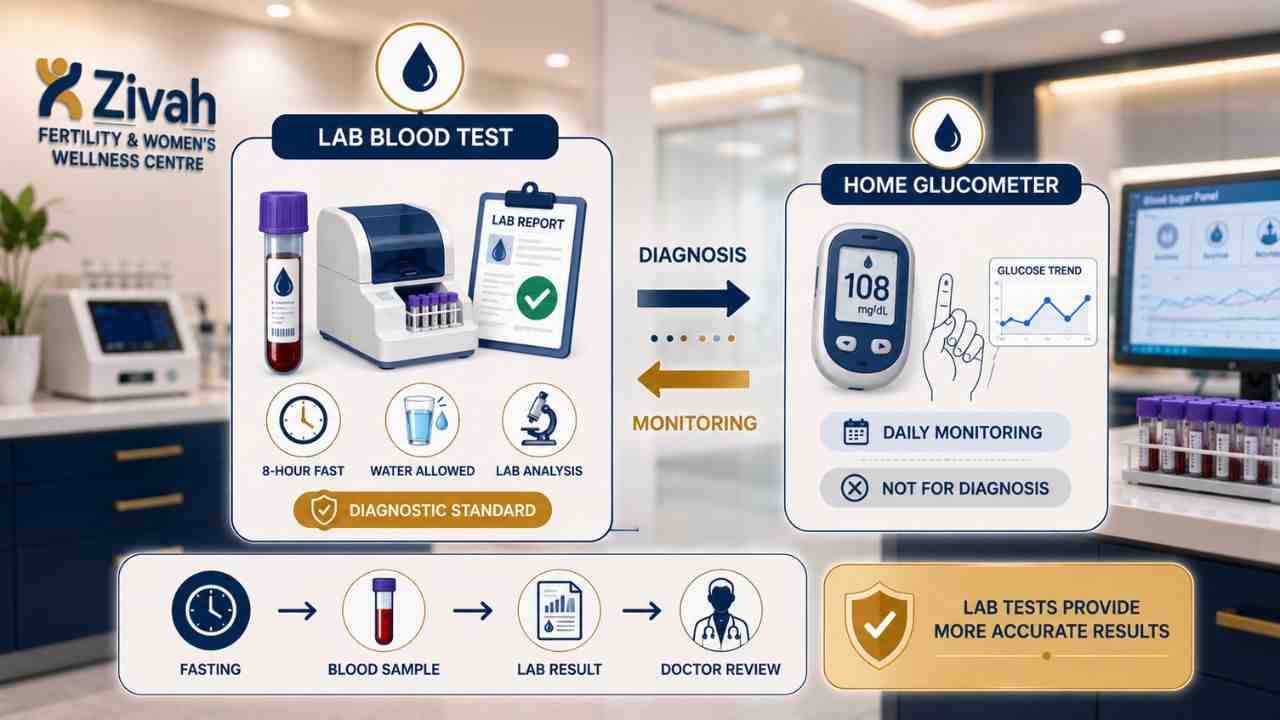
Accuracy depends on the way the sample is collected. A blood sugar test at Zivah uses a sample from a vein in your arm, which is more accurate than a finger prick and is the standard for diagnosing diabetes. Results are often back within a day. The outcome is dependable because of a few basic things:
- If you are having a fasting blood sugar test, fast for 8 hours. First thing in the morning is simplest.
- Plain water's okay; it hydrates you and doesn't impact your glucose.
- If you are sick or on steroids, let us know. Steroids can increase your blood sugar and provide a false reading.
Venous Blood Draw vs Finger-Prick: Why It Matters
First, the finger-prick glucometer is a monitoring device, not a diagnostic device. It's good for keeping tabs on day-to-day, but not as accurate as a lab test, and you can't diagnose diabetes with a home meter.
A sample of venous blood is taken and sent to a lab for analysis. A second test confirms the diagnosis. Not that a home meter is worthless. It merely does a different task, and it matters that you know which job it does.
Preparing for Your Blood Sugar Test: What to Do and Why
| Preparation |
What to Do |
Why It Matters |
|---|---|---|
| Fasting |
No food for 8 hours before |
Removes the effect of your last meal |
| Water |
Plain water is fine |
Keeps you hydrated; doesn't affect glucose |
| Morning timing |
Book an early slot |
You sleep through most of the fast |
| Medications |
Tell your doctor what you take |
Some raise blood sugar |
| Steroids |
Disclose them |
They can significantly lift glucose |
| Recent illness |
Mention it |
Infection temporarily raises glucose |
Home Blood Sugar Monitoring: Glucometers and When to Test
Screening and monitoring are two separate jobs. Screening offers one question: Is your blood sugar in a healthy range? Monitoring is the continual response, the day-to-day tracking that happens after you know where you stand.
How and When to Check Blood Sugar at Home
Using a glucometer, you can check your blood sugar at home with just a quick finger prick and a drop of blood on a test strip. You test according to what you are tracking, e.g. fasting first thing in the morning, before meals or two hours after eating to identify post-meal surges.
A basic log lets you and your physician see the pattern, not just isolated data. But monitoring is later. First, there's the result, and what to do if it's not the one you wanted.
What Happens After an Abnormal Result Of Blood Sugar Test
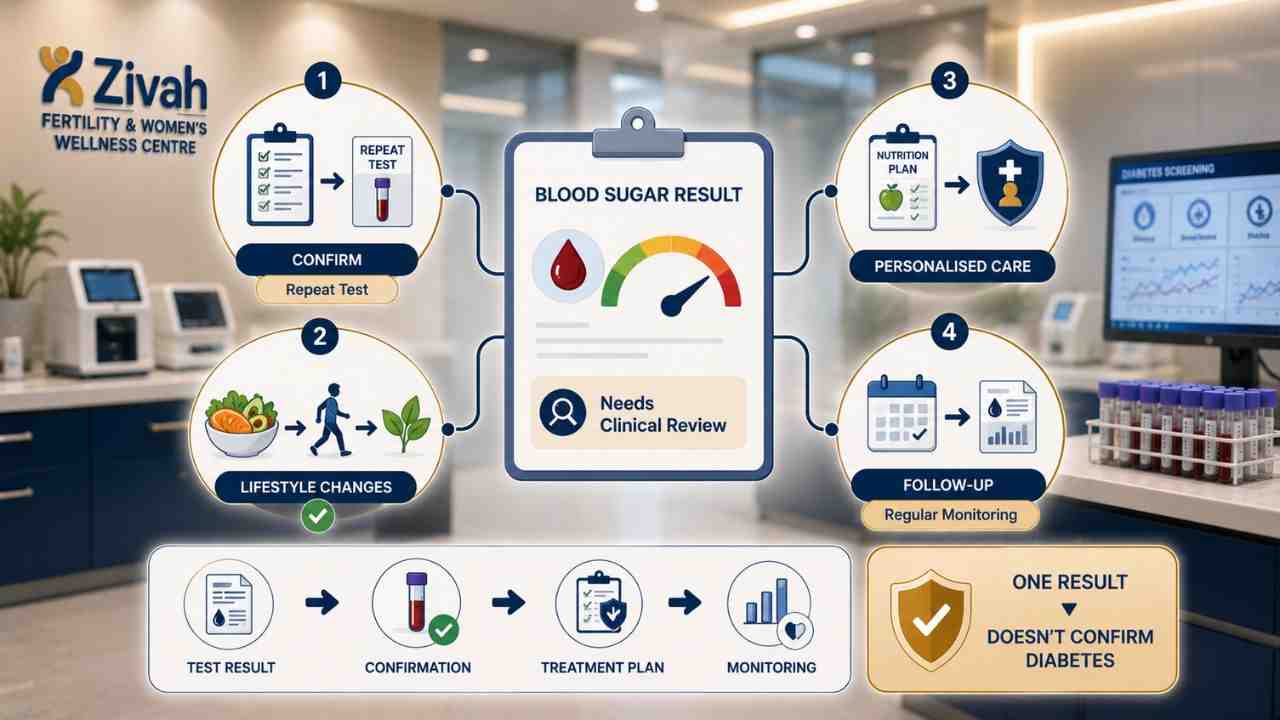
An abnormal test result starts a discussion, not ends it. Having high blood sugar results doesn't mean that you have been diagnosed with anything. This means the next step is obvious.
Confirmatory Testing and Diagnosis
As we have stated, one reading is not enough. A diagnosis of diabetes is only made once a high result is confirmed with a second test, generally on a separate day. This protects against the common things a recent meal, a sickness, a stressful week that raise a single number without anything being wrong.
What Follows: Monitoring, Lifestyle and Referral
What happens next will depend on the result. In many cases, pre-diabetes may be corrected by lifestyle adjustments. A verified diagnosis may imply a referral to a nutritionist or expert, and a strategy developed around you. Your doctor will take you through it; you don't do this on your own. All depending on one thing. Who reads the number, and what they know about you.
After Your Result: What It Means and What Happens Next
| Result |
What It Suggests |
Usual Next Step |
|---|---|---|
| Normal |
Blood sugar in a healthy range |
Routine re-screening at the usual interval |
| Prediabetes |
Higher than normal, not yet diabetic |
Lifestyle changes; retest, often reversible |
| Diabetes |
Confirmed on a second test |
Referral and a management plan |
| High in pregnancy (GDM) |
Above the pregnancy threshold |
Close monitoring through pregnancy |
| Borderline / unclear |
Doesn't fit a clear category |
Repeat or additional testing |
Why Choose Zivah for Blood Sugar and Diabetes Screening
The number itself is important, but who reads it is just as important. A lab gives you a printout. At Zivah, we apply the same result regardless of your pregnancy, PCOS, or reproductive plans, since a glucose measurement means something different depending on who you are and what you’re planning.
Screening With Clinical Interpretation, Cost and Booking at Zivah
Our clinicians consider your result in context, not as a single factor. The cost depends on the test (single fasting glucose, HbA1c, or full screen) and whether a consultation is included. Speak to our experts for a quote, and when you’re ready, book in a diabetes screening.
You still do not experience high blood sugar. But you don’t have to anymore. One blood sample provides actual answers, detecting a condition with no symptoms, confirming prediabetes when it’s still treatable, and preserving two lives in pregnancy, where screening is not optional. Now you know where to search.