

Zivah’s blastocyst culture allows your embryos additional time to develop before transfer, allowing the strongest embryo to show itself. In a tightly controlled facility, our embryology team nurtures your embryos to Day 5, rather than Day 3, and closely monitors their development. The outcome is a more informed decision and, often, the confidence to transfer only one embryo.
For many couples going through IVF (in-vitro fertilisation), this extra step gives significant clarity at a time that can seem uncertain. In this guide, we’ll take you through how blastocyst culture works, who it’s suitable for, how embryos are rated, what the success rates are like and what it costs, all in simple language.
What Is Blastocyst Culture?
Blastocyst culture is the practice of growing embryos in the lab for 5 days rather than 3. In traditional IVF, early embryo transfer on Day 3 was the standard. At Zivah, we maintain a highly controlled environment in our embryology lab that closely simulates conditions in the fallopian tubes, allowing your embryos to continue developing safely to the blastocyst stage. At this point, they are ready to implant.
Why Is Blastocyst Culture Done?
Those two additional days impact what the team can view. Just because an embryo looks good on Day 3 doesn’t mean it will continue to develop, and a stronger embryo may not be apparent until Day 5. So what is the point of blastocyst culture anyway? This is because it allows the strongest embryo to present itself naturally, giving your specialist far more information before transfer. This usually involves the confident transfer of a single embryo rather than the hope of transferring many embryos.
How Does Blastocyst Culture Work?
The journey is simpler than it sounds. Once your eggs have been fertilised, your embryos start to divide. By Day 3, they are in the cleavage process stage. By Day 4, the cells have packed together to form a morula (a tight ball of cells), and by Day 5, the strongest form a blastocyst. In this embryo culture, Zivah’s lab adjusts the nutrition your embryos receive as their needs change day to day. On Day 5, each blastocyst is rated, and the best one is chosen for transfer or later preservation. Here’s what happens at each stage:
| Stage |
What Happens |
Why It Matters |
|---|---|---|
| Day 3 - Cleavage stage |
The embryo divides into several cells |
The traditional transfer point, but it tells the team less |
| Day 4 - Morula |
The cells compact tightly together |
A key step; embryos that stall here would likely not implant |
| Day 5 - Blastocyst |
A fluid cavity forms and the embryo expands |
Shows the embryo is developing well and ready to implant |
| Grading & selection |
The team scores each blastocyst |
Helps choose the strongest embryo for your transfer |
Each stage is so carefully observed that by transfer day your specialist will have a much clearer picture of which embryo gives you the best chance.
Blastocyst culture is helpful for many individuals, but there are some cases where it is the best choice.
Who Is Blastocyst Culture Right For?
For many IVF patients, blastocyst culture is suitable, but for some it is a noticeable difference. Your Zivah specialist may prescribe this if you are in any of the situations below.
Couples with Multiple Embryos
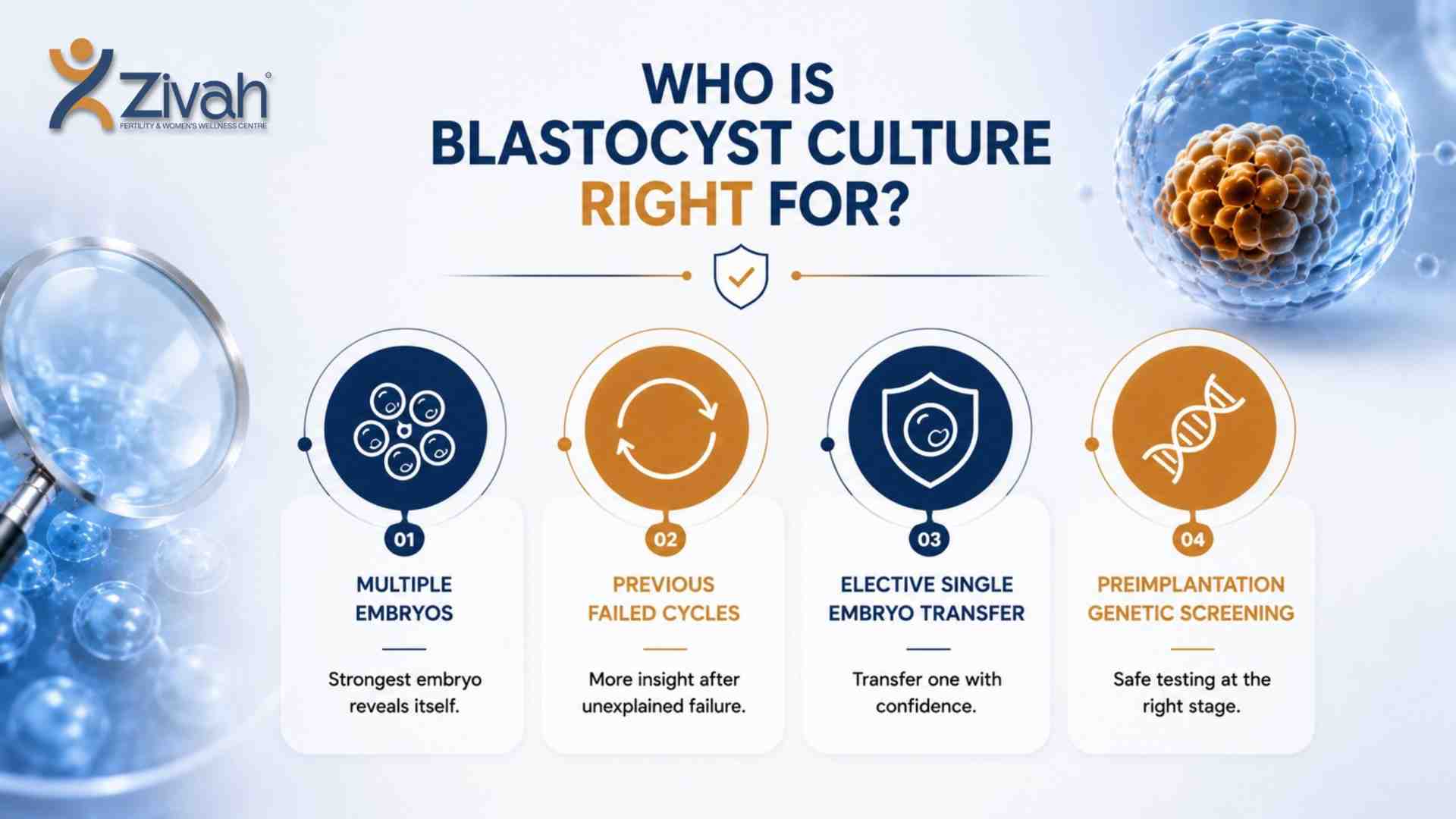
If multiple embryos fertilise and develop well by Day 3, it can be difficult to choose between them as they often seem extremely similar at this stage. When you grow your embryos out to Day 5, the strong embryos naturally identify themselves, and you don’t have to guess when you have a lot of embryos that are high potential. Then the decision is performance-based and not appearance-based. That’s among the top reasons Zivah’s team recommends it.
Previous IVF Cycles & Other Reasons
There are also more scenarios in which blastocyst transfer is the best option. So who are the patients who benefit most from reaching Day 5? Often it’s the people in these situations:
- Previous failed cycles: If you have unexplained problems following a standard Day 3 transfer, an extended cultural strategy is often required.
- Elective single embryo transfer: Growing embryos to Day 5 offers the embryology team confidence to transfer a single blastocyst (eSET), lowering the chance of multiple pregnancies.
- Preimplantation genetic screening: improved blastocyst structure enables safe outer-cell biopsy when clinical screening is required.
Blastocysts also freeze and thaw very well, so any healthy embryos you don't transfer this round can be securely preserved for a later cycle. Whatever has brought you here, the aim is the same: a better informed transfer. Here's a look at who will benefit most, and what blastocyst culture truly gives them.
| Who |
Why Blastocyst Culture Helps |
|---|---|
| The patient with several embryos to choose from |
Lets the strongest embryo reveal itself before transfer |
| The couple whose earlier cycle didn't work |
Offers more information after an unexplained failure |
| The patient hoping to avoid twins |
Supports transferring one embryo with confidence |
| The couple seeking genetic answers |
Allows safe testing at the right stage of development |
If any of these sound accurate, it’s worth bringing them up with the Zivah staff at your next appointment.
So once you agree to blastocyst culture, here is exactly what happens to your embryos at Zivah.
The Blastocyst Culture Process at Zivah
Zivah has a competent embryology team that takes care of every single embryo, every day. You wait while the procedure runs quietly in the background, and the team keeps you updated at each step rather than leaving you guessing.
From Fertilisation to Day 5
Once your eggs are fertilised, your embryos are placed in an incubator that is kept perfectly still. The incubator digitally monitors and maintains constant oxygen, carbon dioxide, and temperature levels so your embryos develop in stable conditions and are never disturbed or stressed. So what is the reality of embryo culture at Zivah? We monitor the development of your embryos daily, looking for even cell division and healthy, consistent growth, and we update you on what we are seeing. Day 5: The strongest have developed into blastocysts and are ready for the next phase.
Which Embryos Reach the Blastocyst Stage?
Here’s the truth, and the comforting part. Not all embryos will make it to Day 5, and that is absolutely normal; it happens in every clinic, often with embryos that looked fine on Day 3. So which embryos make it to the blastocyst stage? Those possess the inherent strength to continue evolving on their own.
When an embryo stops growing, it’s sending the team a message. Knowing in the lab saves you a transfer that was unlikely to work. This is unpleasant news to hear, but it’s actually quite helpful, and your Zivah team will walk you through what it means for you. This is how the days are.
| Day |
What Happens |
What the Team Checks |
|---|---|---|
| Day 0 |
Your eggs are fertilised |
That fertilisation has taken place |
| Day 1 |
The first check |
Early signs the embryo is developing |
| Day 3 |
Cleavage stage |
Even cell division and steady growth |
| Day 5 |
Blastocyst forms |
The fluid cavity opening up and expanding |
| Day 6 |
Late developers |
Any embryos reaching the stage a day later |
By the end of Day 5 or 6, your specialist will know which of your embryos have matured nicely and can schedule your transfer with genuine clarity.
With your day 5 embryos prepared, the next question is how the team determines which one to transfer.
Blastocyst Grading & Success Rates
If you have embryos, on Day 5 the embryology team will grade each embryo to determine which has the best chance of success. It seems complicated, yet the concept is simple.
How Are Blastocysts Graded?
Zivah employs the Gardner system, which is what most fertility laboratories use. How do we compare blastocysts in practice? Every embryo gets a number and 2 letters. The number (1 to 6) indicates the amount of growth. The first letter (A to C) grades the inner cell mass (ICM - the component that becomes the fetus), the second the trophectoderm (TE - the part that becomes the placenta). A 4AA grade is a blastocyst that is well enlarged and scores well on both. Your specialist will explain your ratings in simple words.
| Feature |
Day 3 Embryo |
Day 5 Blastocyst |
|---|---|---|
| How developed it is |
A few cells, early stage |
Fully formed, ready to implant |
| What the team can tell |
Limited - many look alike |
Much clearer picture of strength |
| Natural timing in the womb |
Earlier than nature intended |
Matches when an embryo would naturally arrive |
| Chance of implanting |
Lower per embryo |
Higher per embryo |
Seeing the two together poses the question most couples ask next.
Does Blastocyst Culture Improve Success Rates?
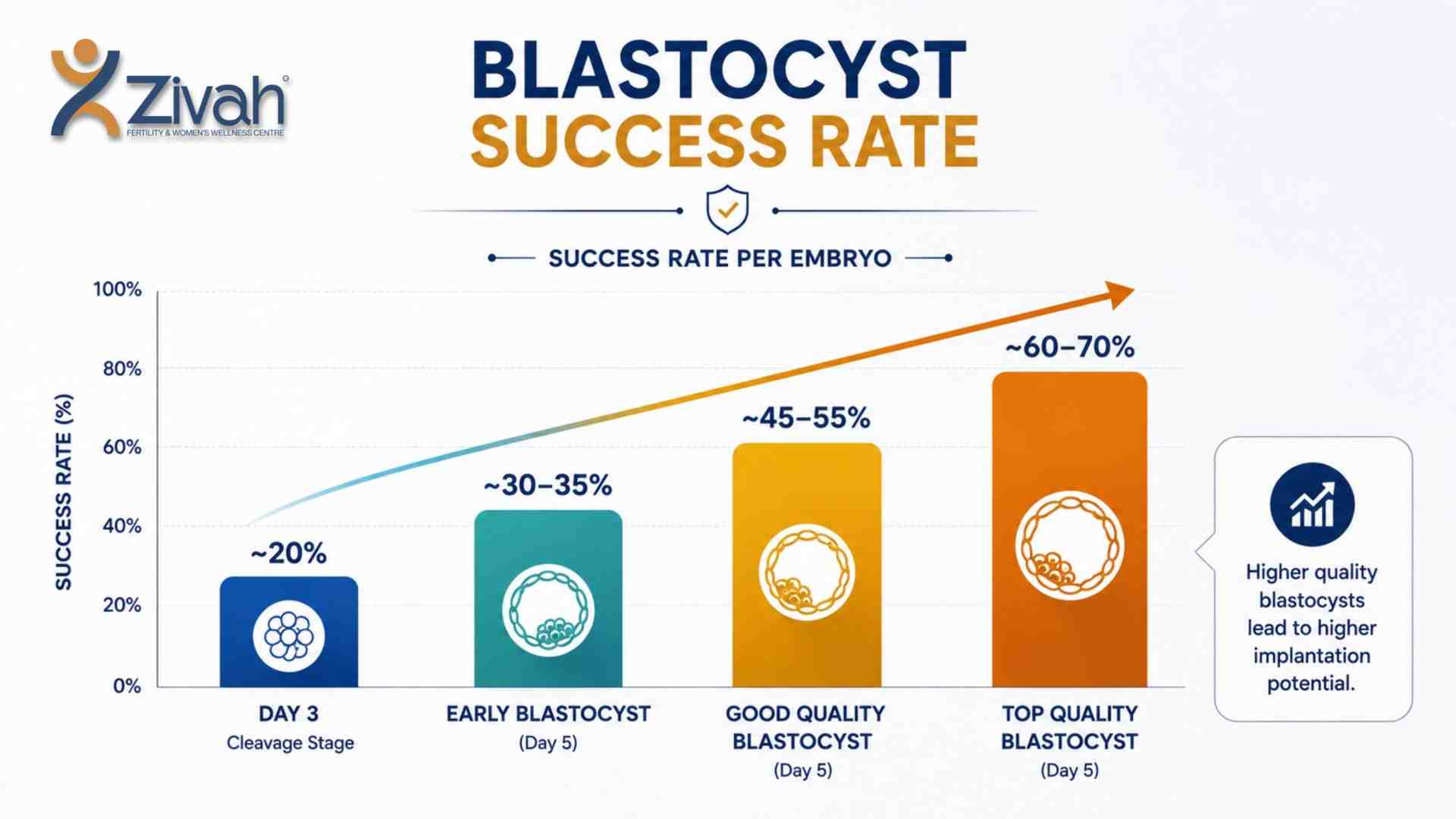
Is blastocyst transfer better than day 3 transfer? Yes, for most patients – a Day 5 blastocyst tends to implant more readily, and the option of day 3 vs day 5 embryo implantation normally favours waiting if you have embryos to spare. But the real story is:
- Not all embryos make it to Day 5: With only one or two embryos, a Day 3 transfer may be the better choice.
- Good grading is a good sign: Good grading improves the chances but does not guarantee that the embryo will implant.
- The most important are your personal factors: Age and the womb lining have a big impact on the eventual outcome.
The success rate of blastocyst culture is quite encouraging, but the best option is always the one created around your cycle.
Now that we've addressed the science, most couples want to know the actual cost of blastocyst culture.
Blastocyst Culture Cost at Zivah
There is no fixed price for blastocyst culture in India; it varies depending on your cycle and the number of embryos being developed. What Zivah provides is clarity. You’ll know precisely what you’re getting for your money when you start, with no surprises along the way.
What Influences the Cost?
A couple of practical things shape the final figure:
- Included in your IVF cycle or as a stand-alone procedure: blastocyst culture is normally part of your IVF cycle and not paid separately.
- Number of embryos: More embryos to grow and more lab time to watch.
- Extended culture and observation: two further days on specialised nutrition with continuous incubation.\
- Freeze unused blastocysts: preserving healthy embryos not transferred in this cycle.
It is helpful to conceive of the cost in two pieces. The first is what's previously covered as part of your IVF cycle. The second is any optional items you want to add. This is what each half covers.
| Component |
What It Covers |
|---|---|
| Extended embryo culture |
Growing your embryos on to Day 5 |
| Daily monitoring |
The team checking development each day |
| Grading |
Scoring each blastocyst to guide your transfer |
That's the standard treatment. Beyond that, there are a few possible options if they suit your strategy.
| Component |
What It Covers |
|---|---|
| Freezing surplus blastocysts |
Preserving good embryos you don't transfer now |
| Annual storage |
Keeping frozen embryos safe year to year |
| Genetic testing |
Screening embryos where it's clinically advised |
Dividing it this manner makes it transparent so you always know what's in and what's an option.
Accessible Blastocyst Culture Near You
Many couples start by searching for a blastocyst transfer near me, and Zivah makes that step easy. The facility is welcoming and easy to reach, with advanced embryology performed locally, so you receive thorough, well-monitored therapy near home without long journeys or complex arrangements.
Besides the cost, the key difference is where your embryos are examined afterwards.
Why Choose Zivah for Blastocyst Culture
Choosing to grow your embryos is a big decision, and so is choosing where they are developed. Zivah’s goal is simple: watchfulness, skill and honesty all the way.
Advanced Embryology Lab & Skilled Team
The reliability of blastocyst culture really depends on the lab and the people working in the lab. From day 0 to day 5, the embryos are cared for with real care. They live in safe, carefully controlled incubators, so conditions are stable, and they can grow undisturbed.
Every embryo, every day, is reviewed by two expert embryologists. And each blastocyst is thoroughly examined, so your transfer is based on solid facts, not opinion. A double-check method provides an additional layer of safety; every sample is electronically matched and validated by two persons, so nothing ever gets mixed up. This is the level of detail that gives your specialist a clear picture on the day of transfer.
Supportive Care Through Every Step
Waiting to find out how your embryos are doing is one of the hardest parts of IVF, and we understand that here. The days go by, and you’re in the routine, never left waiting in the dark. The Zivah team calls to update you, explains each stage in simple terms, and treats you with genuine care through what might be a stressful wait. Because how you feel matters as much as the result.
Wherever you are, Zivah is here to help you navigate that next step. It's easier than it looks.
Book Your Blastocyst Culture Consultation at Zivah
The next step in your IVF journey is easier than most people realise. Whether you’re considering your options or ready to take the next step, reserving a blastocyst culture consultation at Zivah is simple & easy. No pressure, no hurry just a team that’s happy to listen, answer your questions, and walk you through what fits your circle and what makes sense for your cycle.
Blastocyst culture allows your embryos to exhibit their strength, so your transfer is based on solid knowledge, not conjecture. If that sounds like the appropriate path for you, here’s your simple first step. The Zivah team will walk you through it with care and clarity, from beginning to end.