

A thyroid function test is a simple blood test that measures the hormones that regulate your metabolism, starting with TSH, then T4 and, if necessary, T3. One little gland in your neck, and it affects your energy, your weight, your mood, your heart rate, and more than most people know, your menstrual cycle and your fertility.
The test itself is minutes long. Single draw from arm, usually no fasting required, with results returned in a day or two. This page covers what a TFT measures, why it's advised, how to prepare, what your report actually means, and why thyroid testing matters if you're trying to conceive or already pregnant.
What Is a Thyroid Function Test (TFT)?
The TFT full form in medical terms is thyroid function test. It works a little like a test of a thermostat, your pituitary gland counts how much thyroid hormone is floating around. If the levels fall, the signal increases. If they go up, it dials back.
The thyroid is the heater, the pituitary the thermostat. So what does a TFT test mean in practice? A thyroid function test (TFT) is a blood test that measures both sides of that conversation: your doctor can identify whether the system is balanced, overworking, or falling short.
What a Thyroid Profile Test Includes: TSH, T4 and T3
A complete thyroid panel will generally test:
- TSH – the pituitary’s message to the thyroid
- Free T4 – your thyroid’s major hormone, in its active, accessible form
- Free T3 – the more active hormone derived from T4
- Anti-TPO antibodies – add if an autoimmune cause is suspected 5.
What’s ordered depends on your symptoms and what your doctor is looking for.
Why TSH Is Tested First, and What "TSH with Reflex to FT4" Means
TSH is the first to change, before your hormone levels go outside the normal range; therefore, it’s an early-warning indication and the standard opening test. Your lab form may say, TSH with reflex to FT4. This is not a warning. "That just means the lab will only do a free T4 if your TSH is abnormal, and they’ll use the same blood sample, so you get the follow-up test without the second needle."
Why a Thyroid Function Test Is Advised: Symptoms and Risk Factors
Thyroid symptoms rarely provide a warning. Tiredness gets blamed on work. Age is to blame for weight gain. Hair fall is blamed on stress. That's how a thyroid problem can go undetected for years, and why testing is important when symptoms don't go away.
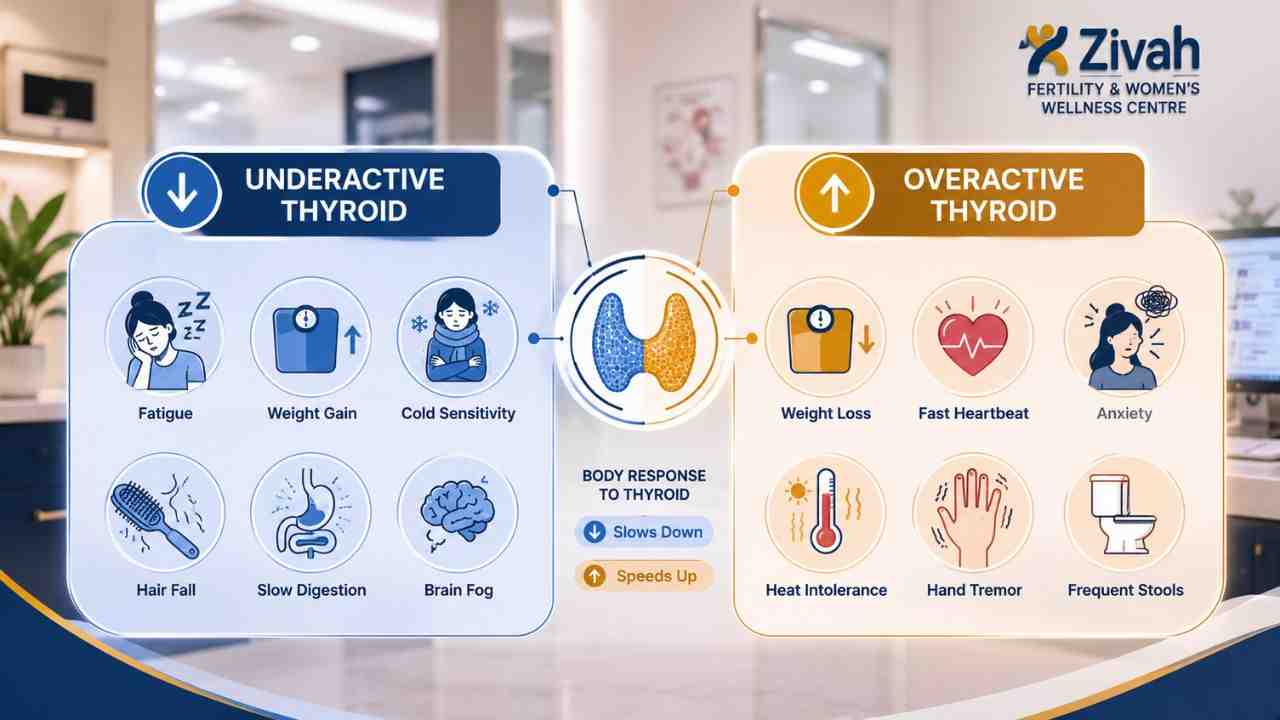
Underactive Hypothyroidism Symptoms: Fatigue, Weight Gain, Hair Fall
Everything in the body moves more slowly when the thyroid is not working properly:
- Fatigue that sleep doesn't fix
- Weight gain when your diet and exercise haven't changed
- Feeling cold when nobody around you does
- Hair loss, dry skin, brittle nails
- Slow digestion and constipation
- Low mood, mental fog, poor concentration
- Irregular or heavier periods
Overactive Hyperthyroidism Symptoms: Weight Loss, Palpitations, Anxiety
When the thyroid is overactive, the reverse happens: the body speeds up. And it is taxing differently:
- Weight reduction with normal or increased hunger
- Rapid heartbeat or palpitations
- Nervousness, anxiety, disturbances
- Excessive sweating and heat intolerance
- Tremors ( shaking ), especially of the hands Loose or frequent stools
- Lighter or absence of menstruation
Who Should Get Tested and How Often
If you have these symptoms, ask for a thyroid test. Testing is especially recommended if you have a family history of thyroid illness, an autoimmune disorder, are over 30, planning a pregnancy or have had thyroid problems in the past. If you are currently on treatment, your levels are generally rechecked occasionally to make sure you are on the proper dose.
Hypothyroidism vs Hyperthyroidism: Symptoms Side by Side
| Body System |
Underactive Thyroid |
Overactive Thyroid |
|---|---|---|
| Energy |
Persistent fatigue |
Restlessness, poor sleep |
| Weight |
Gain, despite normal eating |
Loss, despite normal appetite |
| Temperature |
Feeling cold |
Feeling hot, sweating |
| Heart rate |
Slow |
Fast, palpitations |
| Mood |
Low mood, brain fog |
Anxiety, irritability |
| Skin & hair |
Dry skin, hair fall |
Thinning hair, warm moist skin |
| Bowel |
Constipation |
Frequent, loose motions |
| Periods |
Heavier or irregular |
Lighter or absent |
Thyroid Testing for Women: Periods, Fertility and Pregnancy at Zivah
The thyroid is upstream of the reproductive system. It doesn't operate your cycle, but it provides the conditions under which your cycle runs. Thyroid hormones influence menstruation, ovulation, and early pregnancy.
How Thyroid Imbalance Affects Periods and Ovulation
Irregular periods are one of the first signs and one of the most common misunderstandings. Heavier, longer and more frequent periods. This is often caused by an underactive thyroid. An overactive one makes them lighter, shorter or missing.
Either way, cycles turn irregularly, and unpredictable cycles generally indicate ovulation isn't happening reliably, which is where conception silently pauses. The picture overlaps with PCOS, which is why thyroid testing belongs early in any workup for irregular periods, not late.
Thyroid Testing Before Conception and Before IVF
An untreated thyroid imbalance can throw off a cycle that would otherwise be going smoothly, affecting ovulation, the uterine lining, and early implantation. You can easily fix it before, and it takes away a variable you don't want when you're doing IVF or putting embryos back in.
It is also worth investigating in unexplained infertility. Thyroid function is one of the most delicate things to rule in or out, if everything else is normal–although normal doesn't conclude the search. It reduces it.
Thyroid Monitoring During Pregnancy and After Delivery
Pregnancy changes the strain on the thyroid gland and alters the meaning of the test. Rising oestrogen doubles the amount of protein that carries thyroid hormone through your blood by around two.
The result raises concern: a total T4 measurement may appear falsely high during pregnancy, even if the thyroid is absolutely normal. So once you are pregnant, TSH and free T4 are the important values since the free portion is what your body can truly use.
Function is also worth testing again post-delivery. Postpartum thyroiditis is more frequent than most women understand, and the symptoms tiredness, low mood, hair fall are instead linked to new parenthood.
Clinical Thyroid Targets by Reproductive Stage
Normal and optimal are two different things. A TSH result might be within the normal reference range and still be greater than your fertility specialist prefers, since the goal narrows while attempting to conceive.
Why the Target TSH Is Lower When You're Trying to Conceive
Women find this surprising: the report says "normal," and the doctor wants to treat anyway. And both can be true. A normal lab range reflects the general population (those who are not pregnant and are not seeking to become pregnant).
The thyroid is subject to distinct demands during conception and early pregnancy; hence, the permissible window is narrower. It shrinks again while you're pregnant and changes from trimester to trimester. Your target is set by your clinician based on your stage, not on a specified range on a lab slip.
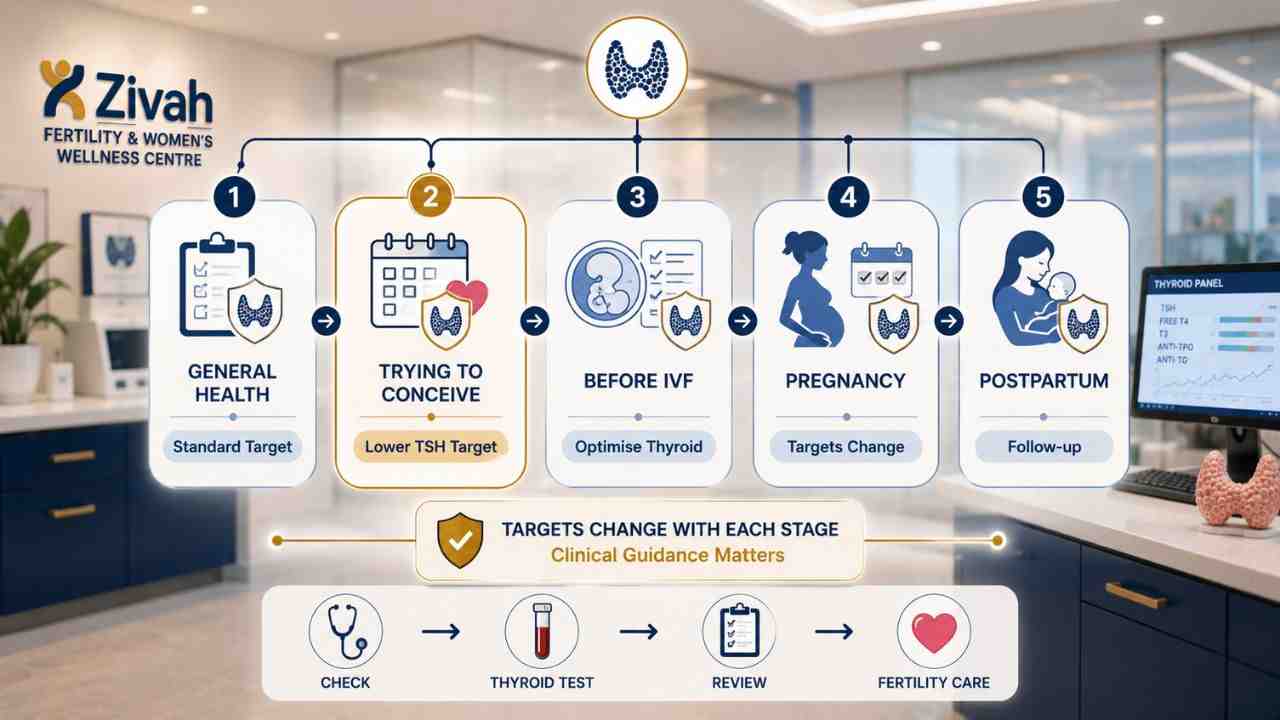
Thyroid Targets by Stage: General Health, Preconception, Pregnancy
| Stage |
What's Assessed |
Why the Target Differs |
|---|---|---|
| General health |
TSH, with free T4 if abnormal |
Standard population reference range applies |
| Trying to conceive |
TSH, free T4, often anti-TPO |
A tighter target supports regular ovulation and implantation |
| Before IVF or embryo transfer |
TSH, free T4, antibodies |
Removes a correctable variable before a cycle begins |
| First trimester |
TSH, free T4 |
Demand on the thyroid rises sharply; total T4 becomes unreliable |
| Later pregnancy |
TSH, free T4 |
Targets shift again as pregnancy progresses |
| Postpartum |
TSH, free T4 |
Screens for postpartum thyroiditis, often missed |
How the Thyroid Function Test Is Done at Zivah
But it’s not much really. A little sample of blood is taken from a vein in your arm and submitted to the laboratory for analysis. The entire process takes just a few minutes, and you can generally get your findings back within a day or so.
Do You Need to Fast for a Thyroid Test?
Not usually. You don’t need to fast for a TSH blood test, so you may eat and drink as normal beforehand unless you’re having other tests done at the same time, in which case follow any advice you’re given. Though timing is important, think about it. TSH peaks in the early morning hours and declines during the day; for a one-off test, that doesn’t really matter.
Suppose your levels are being monitored over months, whether during fertility treatment, pregnancy, or when a dose is being titrated; try to keep your appointment at the same time each visit. Otherwise, you are comparing readings that were never taken on the same basis.
Preparing for Your Test: Biotin and Medication Rules
There isn't much to do before a thyroid function test. No fasting, no special diet. But there are a few factors that might quietly distort your findings, and one of them is in plenty of bathroom cupboards, in a bottle you'd never think to mention.
Why Biotin Supplements Can Fake an Abnormal Result
If you are taking a hair, skin or nail supplement, read this first. Most include biotin, vitamin B7, which chemically interacts with the kits laboratories use to assess thyroid hormones.
It can mistakenly reduce your TSH and falsely boost your T4 and T3: exactly the pattern of an overactive thyroid. So a report can come back looking like hyperthyroidism when your thyroid is perfectly healthy. Let your doctor know what you are taking. Biotin is usually stopped before testing on their advice.
Medications and Hormones That Affect Results
- Oestrogen – the pill, or pregnancy: increases carrier proteins such that total T4 and T3 read high even when the thyroid is normal. Free T4 and TSH remain dependable.
- Thyroid medicine – Don't skip a dosage before a test unless your doctor advises you to.
- Recent sickness – major illness might cause findings to be temporarily incorrect.
Pre-Test Preparation and Interference Checklist
| Item |
What to Do |
Why It Matters |
|---|---|---|
| Fasting |
Not usually required |
TSH isn't affected by food |
| Timing of sample |
Keep it consistent if being monitored |
TSH is highest early morning |
| Biotin supplements |
Disclose; stop before testing if advised |
Falsely lowers TSH, falsely raises T4 and T3 |
| Thyroid medication |
Never stop without instruction |
Ask your doctor about dose timing |
| Oestrogen / pregnancy |
Tell your doctor |
Total T4 and T3 read misleadingly high |
| Recent illness |
Mention it |
Can temporarily distort results |
Thyroid Function Test Normal Range: TSH, T4 and T3 Values
Before any numbers: reference ranges change between laboratories, and they shift in pregnancy. A result sitting just outside the range doesn't automatically mean disease. Your numbers are read in context, by a doctor who knows your symptoms and your stage, never against a range you found online.
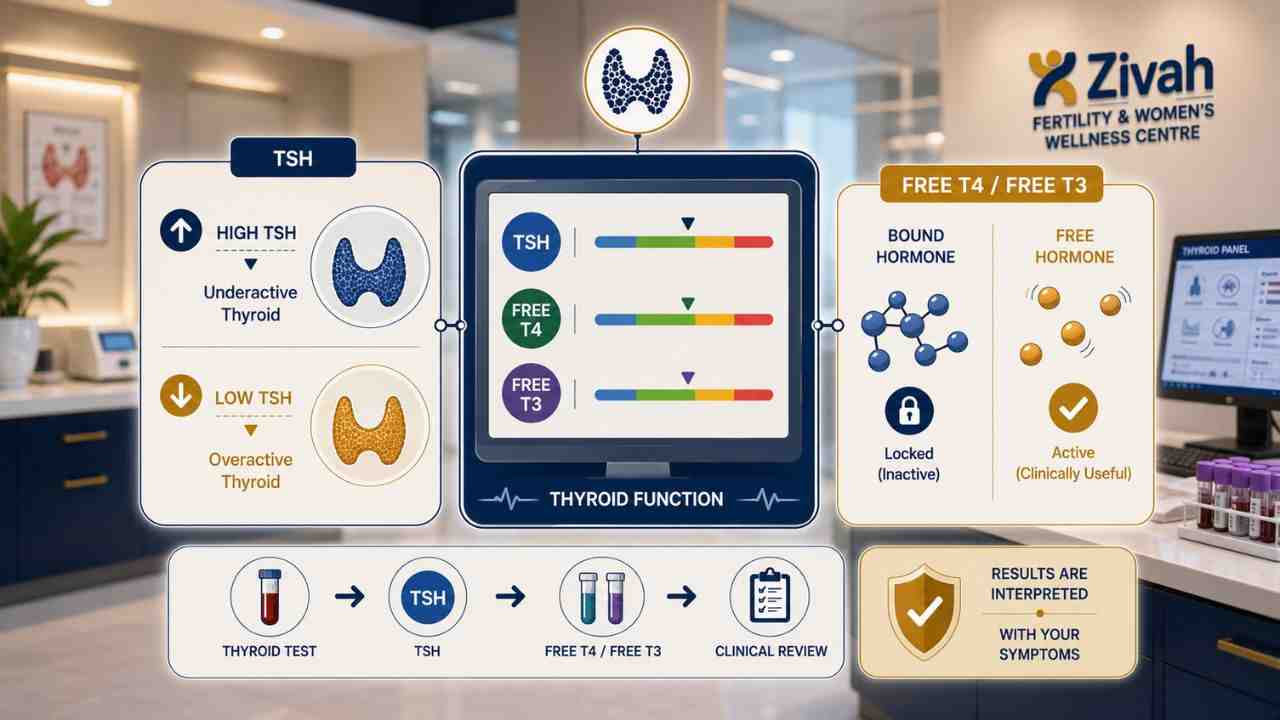
Understanding TSH Levels: What High and Low Mean
This is the portion that trips people up, because it’s the other way round to what you’d think.
- High TSH usually suggests an underactive thyroid. The pituitary is screaming, and the gland is not reacting, the thermostat turning up a heater that would not ignite.
- A low TSH normally indicates an overactive thyroid. There’s enough hormone in the blood, so the pituitary shuts down.
Free T4 and Free T3 vs Total T4 and Total T3
Thyroid hormone is transported in the circulation via binding to carrier proteins. Only the free fraction, the unattached part, can get into your tissues and accomplish anything.
That's the distinction that counts. Total T4 and total T3 are bound and unbound together; thus, the minute carrier proteins fluctuat- in pregnancy or on the contraceptive pill the total reading moves with them, even if your thyroid hasn't changed. Free T4 and free T3: Don't be tricked by it. So those are the numbers your doctor looks at when it counts.
Understanding Your Thyroid Report: What the Results Mean
A thyroid report is regarded as a pattern, not a row of individual figures. It’s the link between TSH and your hormone levels that matters, which is why one number, alone, tells you practically nothing.
High TSH with Low T4: Hypothyroidism
It is the classic underactive picture. The pituitary is working hard; TSH is high, but the thyroid is not producing, so T4 is still low.The symptoms usually match: fatigue, weight gain, feeling cold, hair fall. This is the most common thyroid pattern for women, and the easiest to cure.
Low TSH with High T4 or T3: Hyperthyroidism
A mirror image. The pituitary stops signalling, and TSH drops. There’s plenty of hormone circulating.Sometimes, just T3 increases while T4 is normal. TSH still suppressed. It’s a true trend, easily overlooked if only T4 is monitored, and that’s one reason T3 is added to the panel.
Subclinical Results and What Thyroid Antibodies Tell You
Sometimes TSH is abnormal while T4 and T3 remain normal. That is considered subclinical, an early or moderate alteration, before the hormones themselves have shifted. It doesn’t always need to be treated, but it typically needs to be watched, and the bar for doing something about it is lower if you’re trying to conceive. Antibodies are a different story entirely.
Anti-TPO informs you if your immune system is targeting the thyroid, suggestive of Hashimoto’s, or of Graves’ in hyperactive instances. Antibodies measure the cause, not the action. You can be antibody-positive with a completely normal TSH.
And the antibodies are why. TSH and free T4 tell us how it is functioning.This table is for orienting purposes only and not for self-diagnosis. Every pattern has to be interpreted by a physician based on your symptoms, stage, and history.
Reading Your Thyroid Report: Result Pattern and What It Suggests
| TSH |
T4 / T3 |
Likely Interpretation |
|---|---|---|
| High |
Low T4 |
Hypothyroidism (underactive thyroid) |
| High |
Normal T4 |
Subclinical hypothyroidism |
| Low |
High T4 or T3 |
Hyperthyroidism (overactive thyroid) |
| Low |
Normal T4 and T3 |
Subclinical hyperthyroidism |
| Low |
Low T4 |
Suggests a pituitary cause, not the thyroid |
| Normal |
Normal |
Thyroid functioning normally |
Beyond Blood Tests: Thyroid Ultrasound and Antibody Screening
A thyroid function test informs you how well the thyroid gland is performing. It does not tell what it looks like.Those are different questions, and they require different exams. A thyroid can be structurally abnormal a tumour, a bulge and produce hormones entirely normally. The contrary is true as well.
When a Thyroid Ultrasound Is Advised
If you have a growth in your neck, a lump that you can feel or your doctor detects something on inspection, the next step is a thyroid ultrasound. It's a painless scan, no needles and no radiation, and it tells us the size and form of the gland, if there's a goitre, whether there are nodules, and whether any of them need a closer examination. Blood tests can't see this.
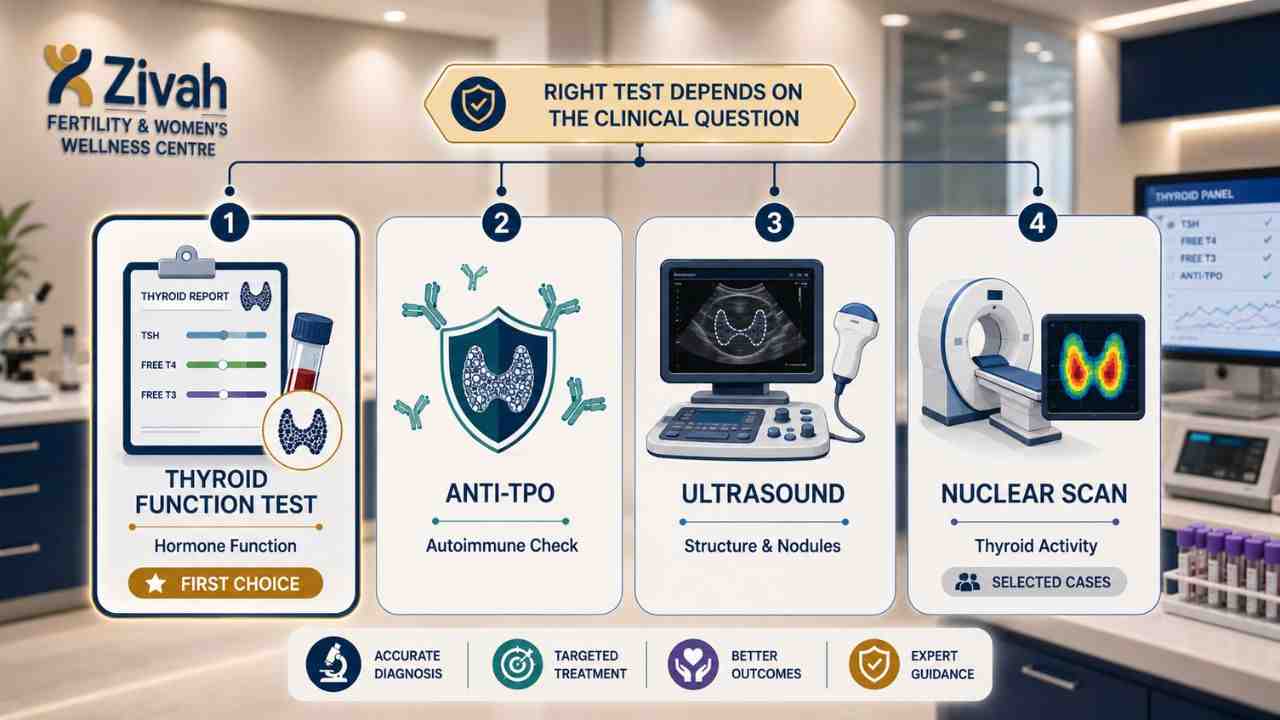
Thyroid Diagnostics Compared: Blood Test vs Ultrasound vs Antibody Screen
| Test | What It Shows | When It's Used |
|---|---|---|
| Thyroid function test (TFT) |
How the gland is working, hormone levels |
First-line, whenever a thyroid problem is suspected |
| Thyroid antibodies (anti-TPO) |
Why, whether the immune system is involved |
When an autoimmune cause is suspected |
| Thyroid ultrasound |
How the gland looks: size, nodules, goitre |
Neck swelling, a palpable lump, or an abnormal exam |
| Nuclear scan |
How active the gland is |
Rarely; to investigate an overactive thyroid further |
Why Choose Zivah for Your Thyroid Function Test
The lab gives you a printout. Numbers on paper, a range next to them and no understanding of what any of it means to you. Most women silently fail thyroid tests here because the number only counts if someone interprets it according to your cycle, your reproductive goals or your pregnancy.
Thyroid Testing With Clinical Interpretation at Zivah
Our clinicians don’t just report your TSH; they interpret it based on your stage and symptoms. Cost varies by whether TSH only, a complete thyroid profile, or antibodies are included. Contact our staff for a precise quote.If you are feeling weary for no reason, your periods are irregular, or you are trying to get pregnant, arrange a thyroid test.
A small gland casts a long shadow. One blood sample may tell a lot, but the statistics need context. Context is what converts a result into a strategy. If you’re pregnant or trying to conceive, thyroid testing is not optional. This is elementary.