

Operative hysteroscopy is a minimally invasive way to treat abnormalities inside the uterus with no exterior cuts. They use a hysteroscope, a narrow, lighted tube that is gently pushed through the cervix so the surgeon can see the cavity of the uterus and treat it immediately. It is a type of hysteroscopic surgery and is one of the least invasive treatments in gynaecology.
This page explains the conditions treated by surgical hysteroscopy, the procedures involved, who it is suited to, how it is done, its role in fertility, the dangers, recuperation and how the treatment is done at Zivah.
The big advantage is simple: in many cases, a problem may be detected and fixed in one sitting, usually as a day procedure, with no open surgery and no overnight stay.
What Is Operative Hysteroscopy?
Operative hysteroscopy is when a hysteroscope (a thin, lighted scope that is put through the cervix) is used to address diseases inside the uterus. The uterus is gently inflated with fluid during the surgery.
This separates the walls of the uterus so the surgeon can see clearly and work within the uterus.Just to be clear on one point: it’s not a major surgery. It is a minimally invasive uterine cavity surgery without any external incision, and most patients go home the same day with no overnight stay.
Operative vs Diagnostic Hysteroscopy: The Difference
The two are commonly confused, but the distinction is clear. A diagnostic hysteroscopy looks into the uterus to detect the problem, while an operative hysteroscopy fixes it. In many cases, the two happen together: the surgeon identifies an issue and, in the same sitting, goes on to treat it, saving you a second procedure.
Diagnostic vs Operative Hysteroscopy
| Factor |
Diagnostic Hysteroscopy |
Operative Hysteroscopy |
Why It Matters |
|---|---|---|---|
| Purpose |
Find the problem |
Treat the problem |
Decides what's done in the procedure |
| Instruments |
Scope only |
Scope + surgical tools |
Operative needs added instruments |
| Typical duration |
5–15 minutes |
Up to an hour or more |
Depends on what's being treated |
| Anaesthesia |
Often none or local |
Local, regional, or general |
Matched to the procedure |
Conditions Operative Hysteroscopy Treats
Operative hysteroscopy is a therapy option for a variety of issues within the uterus that are typically responsible for heavy bleeding, pain or difficulty conceiving. The surgeon goes directly into the uterine cavity so that several problems that previously required open surgery can be handled through the scope. These are the ones it deals with most often.
Common Uterine Conditions Treated
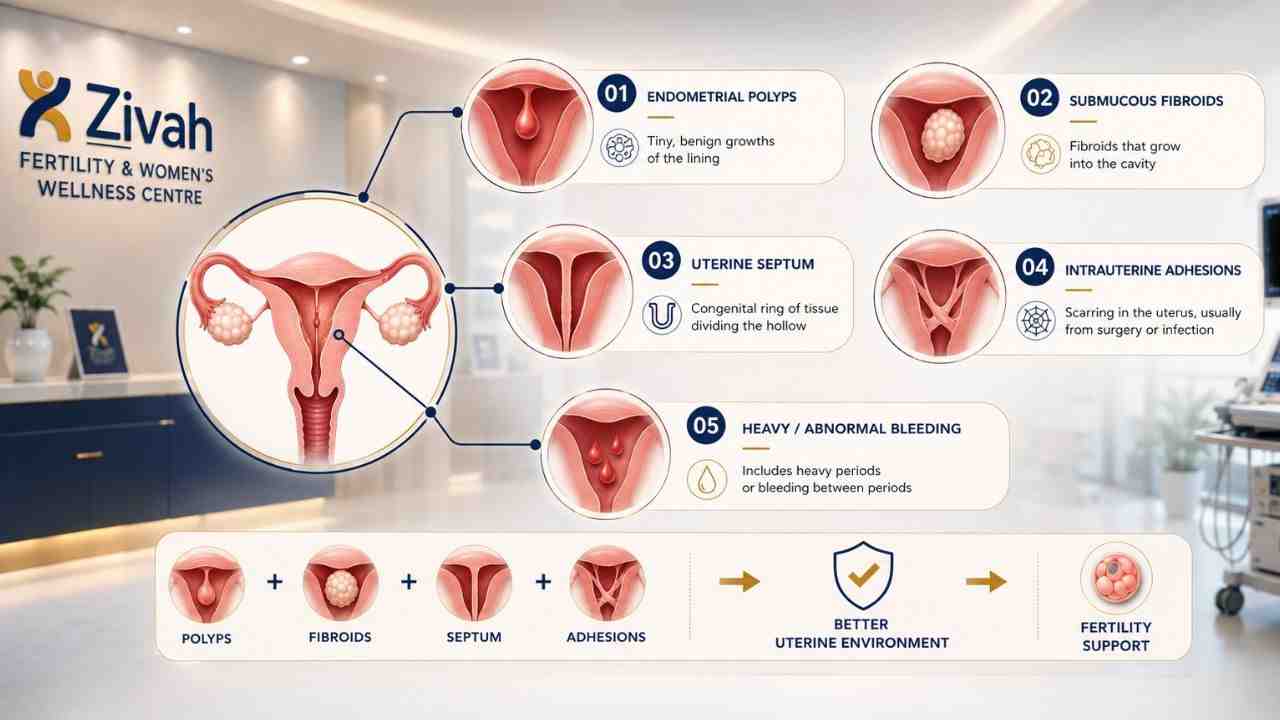
Operative hysteroscopy is performed to treat:
- Endometrial polyps – tiny, usually benign growths of the lining of the uterus
- Submucous fibroids – fibroids that grow into the cavity of the uterus
- Uterine septum – a congenital ring of tissue dividing the hollow
- Intrauterine adhesions - scarring in the uterus, usually caused by previous surgery or infection
- Abnormal or severe bleeding from the womb - including heavy periods or between periods
Some of the abnormalities, such as polyps, fibroids, septum and adhesions, can also influence fertility, which is why operational hysteroscopy has an essential role in reproductive care.
Hysteroscopic Procedures: What Can Be Done
Operative hysteroscopy is actually an umbrella term for a series of specialised treatments, each chosen according to the problem being treated. All of them are hysteroscopic surgeries that are done through the scope. Sometimes a laparoscopy is performed during the same surgery for more complex situations, such as a major myomectomy, a septum resection, or extensive adhesiolysis.
This gives the surgeon a second view from the outside of the uterus to ensure that the uterus is not perforated. It's not a sign of more risk; it's a sign of good surgical care.
Polypectomy & Myomectomy
A hysteroscopic polypectomy removes endometrial polyps, and a hysteroscopic myomectomy removes submucous fibroids, those that develop into the uterine cavity. Both are fully done within the scope, with direct vision and no external cut.
Removal of polyps is typically uncomplicated. Hysteroscopic fibroid ectomy is also an option, albeit a larger fibroid may sometimes be removed in two sittings a few weeks apart, a methodical, safer strategy rather than cramming everything into one treatment.
Septum Resection, Adhesiolysis & Ablation
Hysteroscopic septum resection (or metroplasty) is the cutting of a uterine septum, the strip of tissue dividing the cavity that's associated with recurrent miscarriage. Adhesiolysis is the separation of intrauterine adhesions, the scar tissue that may deform the cavity. Both often boost reproductive performance. Endometrial ablation is another story.
It addresses the lining of the uterus and is used for excessive bleeding. Still, it's important to be clear: it usually decreases bleeding rather than stopping it completely; it's not ideal if you want a future pregnancy and contraception is still needed afterwards.
Hysteroscopic Procedures & What They Treat
| Procedure |
Treats |
Notes |
|---|---|---|
| Polypectomy |
Endometrial polyps |
Removed under direct vision |
| Myomectomy |
Submucous fibroids |
Larger ones may need two sittings |
| Septum resection / metroplasty |
Uterine septum |
Linked to recurrent miscarriage |
| Adhesiolysis |
Intrauterine adhesions |
Restores cavity shape |
| Endometrial ablation |
Heavy bleeding |
Reduces not stops bleeding; not for future pregnancy |
Who Is a Candidate for Operative Hysteroscopy?
Operative hysteroscopy is shown for anyone with a known intra-uterine lesion, such as a polyp, submucous fibroid, uterine septum or adhesions and for those with unexplained abnormal uterine bleeding.
It’s also an average phase for those who are looking into fertility because a hidden uterine condition can be both the cause and the remedy. Candidacy is always proven at consultation and usually after a diagnostic scan or hysteroscopy has revealed exactly what needs addressing.
When Your Doctor May Recommend It
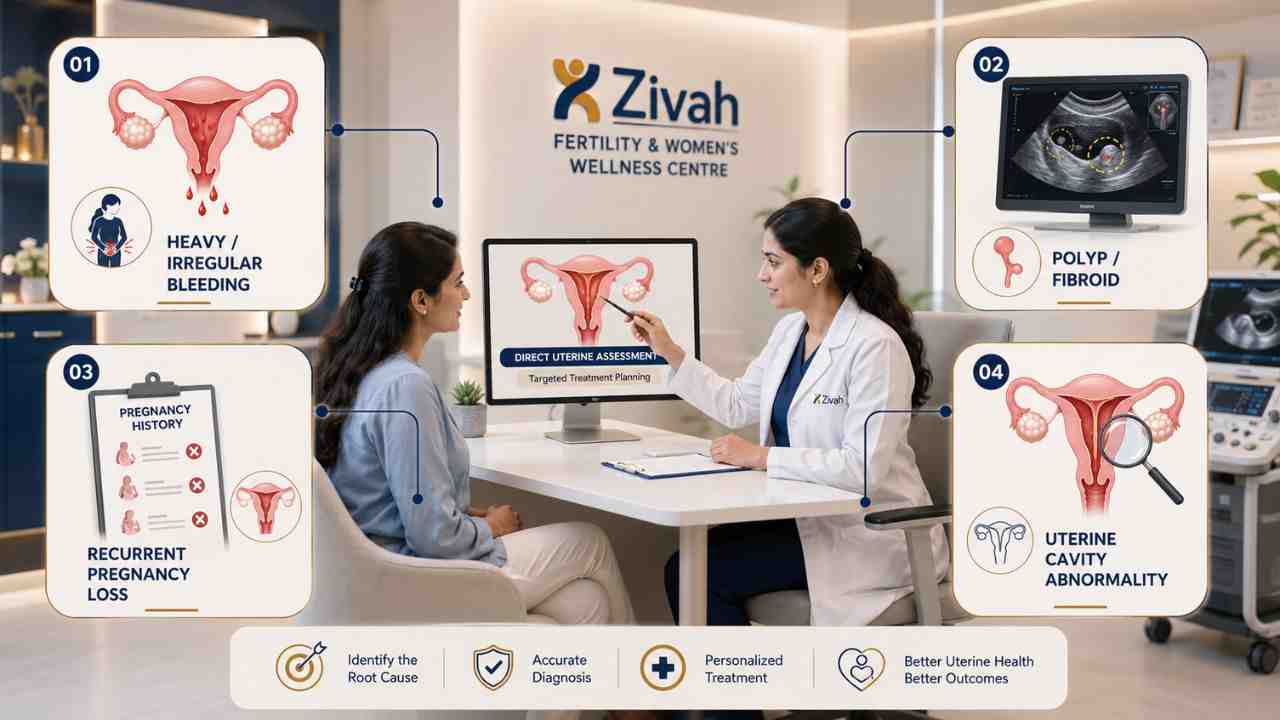
Your doctor may advise surgical hysteroscopy if you have:
- Heavy or irregular bleeding with cramps
- An ultrasound revealing a polyp or fibroid
- Recurrent miscarriage with possible uterine aetiology
- An abnormality of the uterine cavity identified during a reproductive work-up
How Operative Hysteroscopy Is Performed
The operative hysteroscopy procedure is easy at the practical level. The cervix is slightly reduced, and the hysteroscope is inserted through the cervix into the uterus. Fluid is used to widen the uterine cavity. This expands the uterus and allows the surgeon a clear view. The procedure is then carried out using fine surgical instruments inserted through the scope.
Before Your Procedure: Preparation & Timing
With a little preparation, the technique is safer and clearer. A quick pre-operative assessment is usually performed for the week after your period, when the uterine lining is thinnest, and the view is best.
In the case of a wider operational scope than a diagnostic one, your doctor may opt for cervical priming, medicine to soften the cervix beforehand, which reduces the danger. And where indicated, especially before ablation, a diagnostic hysteroscopy and endometrial sampling are performed first to rule out other explanations.
Anaesthesia & Setting
The anaesthesia depends on the procedure. Minor, faster procedures can be done as office hysteroscopy or outpatient hysteroscopy under local anaesthesia or mild sedation. Larger treatments are usually performed as day surgery, with regional or general anaesthesia. If you are having sedation or general anaesthesia, make sure someone drives you home afterwards.
How Long It Takes & What to Expect
Depending on what is being treated, the treatment might last from a few minutes to over an hour. Usually outpatient. You are checked for vitals and are sent home when stable and comfortable. Usually the same day.
Anaesthesia & Setting Options
| Setting |
Anaesthesia |
Typical Use |
|---|---|---|
| Office / outpatient |
None or local |
Quick or minor procedures |
| Day surgery |
Local + sedation, or regional |
Moderate procedures |
| Day surgery |
General |
Larger or longer procedures, e.g. myomectomy |
Operative Hysteroscopy for Fertility & Before IVF
This is where operative hysteroscopy really comes into its own in a fertility-oriented facility. There are several uterine disorders polyps, fibroids, a septum, adhesions that work quietly against conception, and fixing them can improve the chance of pregnancy and prevent early loss.
This is why fertility hysteroscopy is often used to prepare the uterine cavity before IVF or to evaluate after failed IVF cycles. But it also addresses the underlying problem, not just the symptoms: repairing a septum can reduce the risk of miscarriage, and removing polyps or fibroids often stops the bleeding they cause. In cases of recurrent miscarriage with a suspected uterine cause, a hysteroscopy is often the useful next step.
Why the Uterine Cavity Matters for IVF
An embryo is most likely to implant successfully when the uterine cavity is healthy and normally formed. So when hysteroscopy before IVF shows a problem, it makes sense to correct that condition before embryo transfer, especially in the case of repeat IVF failure. This inspection of the uterine cavity is part of the fertility route at Zivah, not an afterthought.
Benefits of Operative Hysteroscopy
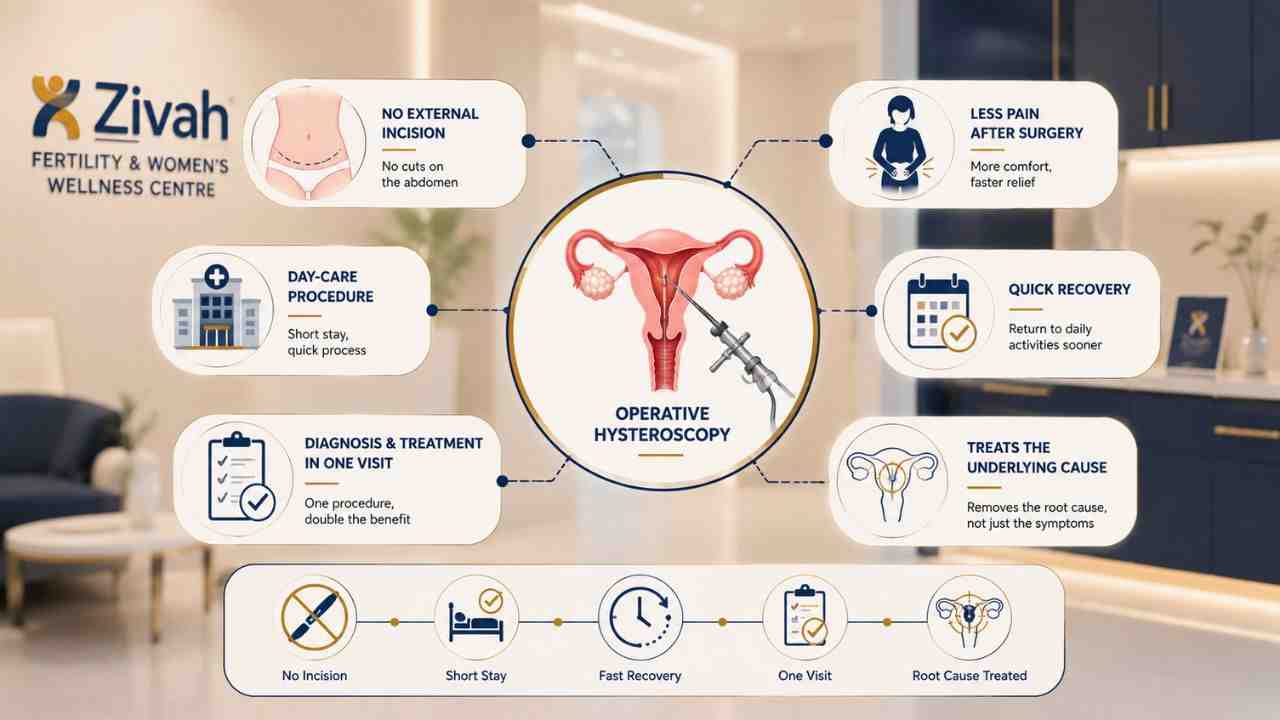
Much of the benefit of hysteroscopy is in what it does not require. Traditional open surgery has practical advantages compared to it:
- No external incision. It works through the cervix, thus nothing is cut on the abdomen.
- Less pain after surgery than open surgery.
- Usually a day-care procedure or a short hospital stay.
- Quickly recuperate and get back to your normal activities.
- Diagnosis and treatment in a single visit, one procedure can do the work of two.
- Treats the underlying problem, the polyp, fibroid or septum itself and not simply the symptoms.
Why Minimally Invasive Matters
The reason it’s so much milder is straightforward. Operative hysteroscopy is a minimally invasive gynecologic surgery that operates through the natural body conduit, the cervix, without a cut in the abdomen. This is why most individuals go home the same day and get back to normal activity quickly, one of the evident victories of an outpatient hysteroscopy.
Risks & Complications of Operative Hysteroscopy
Serious issues with operative hysteroscopy are rare, and it is generally safe. However, because it is a medical procedure that goes into the uterus, it does entail a little bit more risk than a diagnostic-only hysteroscopy. Therefore, it’s worth knowing what those hysteroscopy risks are.
Side effects are often modest, and not for long. The less common problems are, well, less common and are made even less likely by meticulous procedure and monitoring. That’s the whole story, plain and simple.
Understanding the Risks & How They're Managed
The most common hysteroscopy complications to know are:
- Cramping and minor bleeding - frequent, clears up in a day or two
- Infection - rare, treated with medicines
- Uterine perforation - uncommon, minimised by meticulous technique
- Rare problems with absorption of the fluid - the fluid used to enlarge the uterus is closely monitored during the procedure, so any absorption is identified early
- Risks of anaesthesia - rare and dependent on kind used
In expert hands, significant problems are overall infrequent.
Recovery After Operative Hysteroscopy
Recovery after operative hysteroscopy is usually quick and uneven. Mild cramping (like period pain) and little spotting are very typical for the first day or two and settle on their own without any fuss.
Most people get back to their normal routine within a day or two, while major treatments like removal of a fibroid may take a little longer to feel completely back to normal. Some patients are surprised to have short-term discomfort in the shoulder or upper tummy following. It's the gas or fluid used to stretch the uterus during the surgery gently, and it's harmless.
It will pass on its own within a day. A warm compress and gentle movement may help ease it. For the rest, recovery is mainly about taking things easy. Take the rest your care provider recommends and give your body some time before resuming anything demanding.
Aftercare & When to Call
Good hysteroscopy aftercare is basically common sense. Rest and expect some mild spotting for a few days while things settle down. It also helps to avoid tampons, swimming and sex for a little while, or as long as your doctor says, to avoid the minor chance of infection. Most recoveries are smooth; however, please call the clinic soon if you see any of these:
Heavy bleeding, soaking through pads
- Chill or Fever
- Foul-smelling discharge
- Pain that is severe or getting worse
They're rare but always worth a quick call, rather than waiting to see.
Operative Hysteroscopy at Zivah
Operative procedures are performed by experienced gynaecology specialists at Zivah, in one integrated approach from the first scan through treatment and recovery.
The benefit here is that Zivah is a fertility-centred clinic and the same staff that treats the uterine condition also recognises the consequences for your fertility and uses operative hysteroscopy to improve the uterine cavity before IVF where that is applicable.
The care is designed for ease and confidence; most treatments are day care, and all tissue extracted is routinely sent for histology, so nothing is left unexamined.
Operative Hysteroscopy at Zivah: Care Pathway
| Stage |
What Happens |
Notes |
|---|---|---|
| Consultation |
Assessment and review of your scans |
Candidacy confirmed |
| Diagnosis |
Diagnostic hysteroscopy/ultrasound if needed |
A step within this pathway |
| Procedure |
Day-care operative hysteroscopy |
Minimally invasive |
| Histopathology |
Resected tissue sent for lab confirmation |
Standard at Zivah |
| Recovery & follow-up |
Same-day discharge and aftercare |
Fertility planning where relevant |
Cost of Operative Hysteroscopy
The cost of surgical hysteroscopy is not fixed. The cost will depend on the particular surgery, kind of anaesthesia, the institution and any additional testing necessary. Insurance coverage for hysteroscopy varies by policy and insurance provider; however, the procedure is often covered when medically necessary. Please contact Zivah for a quote on a figure that will work for your scenario.
Why Choose Zivah for Hysteroscopic Surgery
At Zivah you get depth at every stage. Skilled minimally invasive surgeons. Fertility expertise under one roof. Diagnosis and treatment tied up in one pathway rather than scattered across sessions.
All of this is supported by meticulous intra-operative safety measures, fluid monitoring, and laparoscopic guiding when a case is difficult. If you have been offered surgical hysteroscopy, please speak to the Zivah team.