

Menstrual disorders are problems with the timing, flow, or comfort of your monthly period, from irregular periods and abnormal menstruation to bleeding that feels too heavy, too light, or too painful. At Zivah Fertility, we see women with these period problems every week, and we want you to know they are far more common than you may think, and almost always treatable.
The real work is finding out why it is happening. Our specialists study your cycle, identify the cause behind your menstruation problems, and build a treatment plan around your body and your goals. A free consultation is the simplest place to begin. Before we get there, it helps to understand exactly what counts as a menstrual disorder and where a normal cycle ends and an irregular one starts.
What Is a Menstrual Disorder?
A menstrual disorder is any ongoing problem with your menstrual cycle, its length, how long bleeding lasts, how heavy it is, or how often it arrives. Doctors group these abnormalities in the menstrual cycle under terms like menstrual cycle disorder or menstrual dysfunction. Still, the idea is simple: something about your cycle has shifted away from your usual pattern.
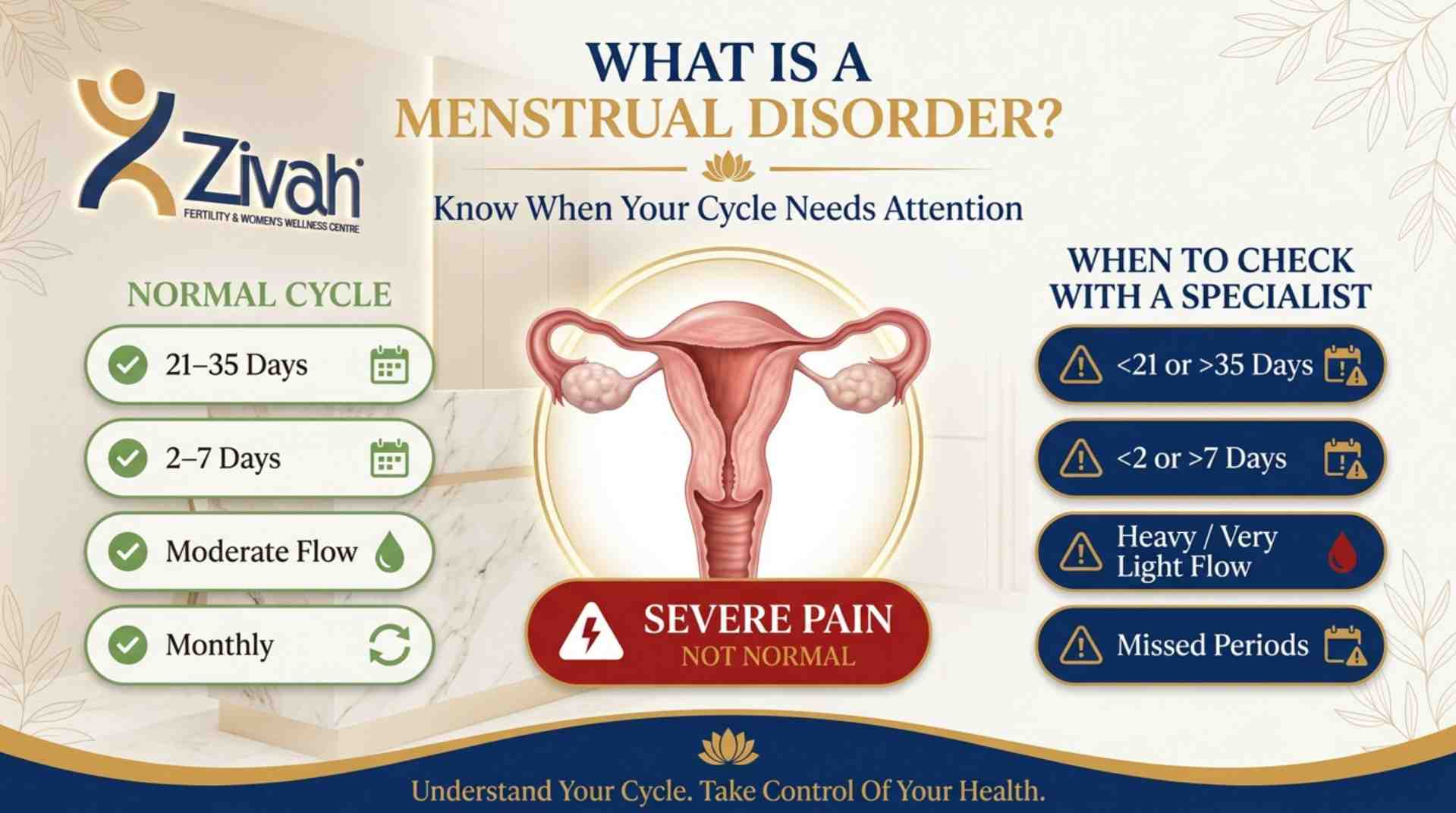
It helps to remember that regular menstruation looks different for every woman; what is normal for you may not match your sister or your closest friend. The table below shows where a typical cycle sits and the points at which an irregular menstrual cycle may signal a problem worth checking. If yours falls into the right-hand column, the team at Zivah Fertility can help you find out why.
| Feature |
A Normal Cycle |
When It May Be a Disorder |
|---|---|---|
| Cycle Length |
Every 21–35 days |
Under 21 or over 35 days apart |
| Period Duration |
2–7 days |
Under 2 or over 7–8 days |
| Bleeding Amount |
Light to moderate |
Soaking a pad in an hour, or barely any bleeding |
| Frequency |
Once a month |
Missed 3+ months or occurring twice a month |
| Pain |
Mild and manageable |
Severe enough to stop daily life activities |
Your cycle is generally considered irregular when it comes fewer than 21 or more than 35 days apart, lasts under 2 or over 7–8 days, or changes sharply from your normal pattern. Once you can see where your cycle stands, the next step is to know which menstrual disorders these patterns point to and which we treat at Zivah Fertility.
Menstrual Disorders We Treat at Zivah Fertility
Menstrual disorders are not one single problem; they cover several different types of menstrual problems, each with its own pattern. You may have come across the commonly listed 8 types of abnormal menstruation, which range from periods that vanish for months to periods that arrive too often, too heavy, too light, or with real pain.
Knowing your menstrual type matters because the right treatment depends on it. The table below sets out the main types of period disorders we treat at Zivah Fertility, in plain language.
| Type |
What It Means (Plain) |
Main Sign |
|---|---|---|
| Amenorrhea |
No periods for 90+ days |
Periods stop or never start |
| Oligomenorrhea |
Infrequent periods |
Fewer than 9 periods a year |
| Polymenorrhea |
Too-frequent periods |
Cycle under 21 days |
| Menorrhagia (AUB) |
Heavy or prolonged bleeding |
Bleeding lasts over 7–8 days |
| Hypomenorrhea |
Unusually light periods |
Bleeding lasts under 2 days or is very light |
| Dysmenorrhea |
Painful periods |
Strong lower-abdomen cramps |
| PMS (Premenstrual Syndrome) |
Symptoms before the period |
Mood changes, bloating, and breast tenderness |
Whatever form your menstrual dysfunction takes, you are not stuck with it. Zivah Fertility treats every one of these conditions, and each has a proven path to relief, often without surgery. The first step is simply to find out which type you have.
Which Period Problems Need Medical Attention?
Not every change in your cycle needs a doctor; a single late or light period is usually nothing to worry about. But when period problems repeat cycle after cycle, or start to affect your daily life or your plans for a baby, they are worth checking and no need to take risks. As a rule, any menstrual period problems in the table above that keep going beyond two or three cycles deserve a closer look. At Zivah Fertility, that look starts with a simple consultation.
Signs Your Periods Need Expert Attention
The numbers tell you when a cycle is off, but it is often the way you feel that pushes you to seek help. The symptoms of irregular and abnormal periods can affect everyday life in ways that are hard to ignore. These are the signs that your period issues deserve expert attention:

- Heavy bleeding and large clots: which are soaking through a pad or tampon every hour or passing clots bigger than a coin, point to bleeding that is heavier than it should be.
- Severe cramps: pain that medicine does not ease, or that keeps you from work, school, or sleep, is not something you simply have to put up with.
- Constant tiredness: heavy or frequent bleeding can drain your iron stores and leave you weak, breathless, or pale, which may signal anaemia (low iron in the blood).
- Bleeding between periods or after sex: Drops of blood or heavy bleeding outside your normal period is one of the clearer signs of abnormal periods.
- Periods that take over your life: when you plan your whole month around your cycle, the effects of irregular periods on your body and mood have moved past normal.
If any of these sound familiar, it is worth speaking to a specialist, because, beyond the daily discomfort, irregular periods can also affect something many women care deeply about: the chance to conceive.
How Irregular Periods Can Affect Your Fertility
Your period is one of the clearest windows into your fertility. Irregular periods often mean ovulation (the release of an egg each month) is not happening on a steady schedule, and without regular ovulation, conceiving with irregular cycles becomes harder to time and to predict.
This is where Zivah Fertility stands apart from a general clinic: we treat the menstrual disorder and protect your fertility at the same time. Whether you hope to have a baby now or down the line, getting your cycle checked early gives you the best head start.
And to set your cycle right, the first question is always the same: what is causing the problem in the first place?
What Causes Irregular & Abnormal Periods?
If you’ve ever wondered why your period is irregular, the answer is almost always one thing: balance. A healthy cycle depends on your hormones working in rhythm, and when that rhythm slips, your periods follow. The causes of irregular menstruation range from everyday factors like stress and weight change to medical conditions that need proper treatment.
Understanding what causes irregular periods is key to getting them back on track. The same handful of root issues sit behind most reasons for irregular period changes, whether your cycle is too frequent (the usual cause of polymenorrhea), too far apart (a cause of oligomenorrhea), or unusually light (a cause of hypomenorrhea). The table below shows the most common culprits and how each one affects your cycle.
| Cause |
How It Affects Your Cycle |
|---|---|
| Hormonal Imbalance |
Disrupts estrogen and progesterone levels, causing changes in cycle timing and flow |
| PCOS (Polycystic Ovary Syndrome) |
Stops regular ovulation, leading to missed or irregular periods |
| Thyroid Disorders |
Alters cycle length and bleeding flow |
| Fibroids or Polyps |
Can cause heavy or prolonged bleeding |
| Stress & Weight Changes |
Shift hormone levels, leading to erratic periods |
| Perimenopause |
Falling hormone levels make cycles increasingly unpredictable |
Most irregular periods trace back to a hormonal imbalance in menstruation, with PCOS, thyroid problems, fibroids, stress, and perimenopause among the leading triggers. Pinpointing the exact cause is the first step we take at Zivah Fertility, because the right treatment depends entirely on what is driving the problem.
Can a Hormonal Imbalance Be Corrected?
In most cases, yes. A hormonal imbalance in menstruation is one of the most treatable causes of an irregular cycle. Depending on what is behind it, the answer may be as simple as lifestyle support or may involve medication to help restore your hormone balance. At Zivah Fertility, we match the causes of irregular menstruation and solutions to you- never a one-size-fits-all fix- and most women see their cycle settle once the underlying balance is back in order.
But before any treatment begins, we need to be sure exactly what we are treating, and that starts with the right tests.
How Zivah Fertility Diagnoses Menstrual Disorders
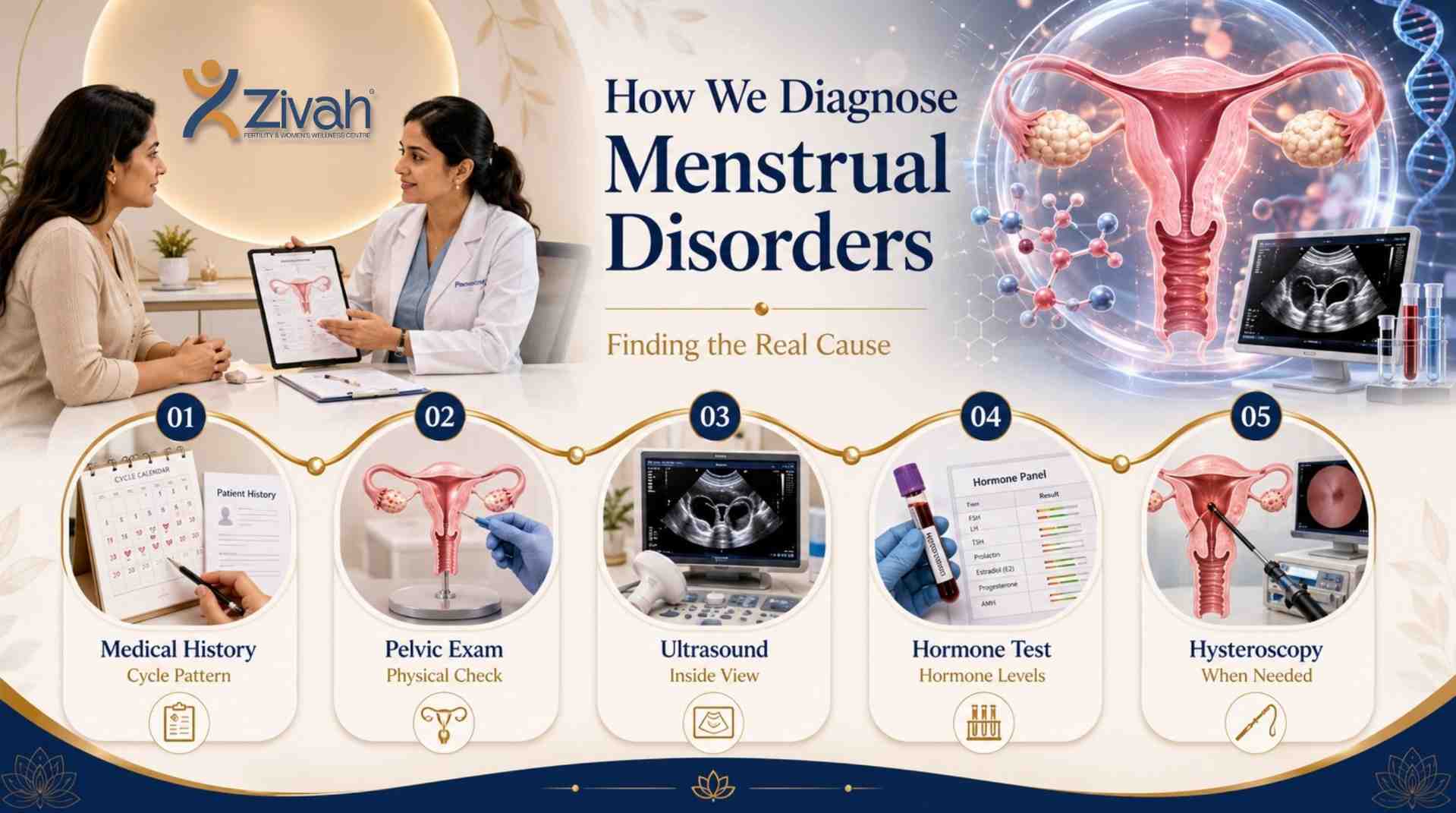
A definitive diagnosis of a menstrual disorder eliminates the guesswork. At Zivah Fertility, your abnormal menstruation checkup is comprehensive, but never rushed; we want to hear the whole story before we make any recommendations. A complete irregular periods evaluation usually draws on a few of these tools, chosen to fit your symptoms:
- Medical history: we start by listening: your cycle pattern, your symptoms, your family history, and your hopes for a baby all help point us toward the cause.
- Pelvic examination: a simple physical check for anything in the uterus or ovaries that could be affecting your periods.
- Pelvic ultrasound: painless imaging that lets us see fibroids, polyps, cysts, or signs of PCOS that a physical exam cannot.
- Hormone panel: a blood test that measures the hormones running your cycle, including thyroid, prolactin, and the markers linked to PCOS.
- Hysteroscopy (if needed): a slim camera is passed into the uterus to look closely when the cause is still unclear after the other tests.
Each test answers a different question, and together they show us exactly why your cycle is behaving the way it is, so the treatment that follows is built on facts, not assumptions.
What to Expect at Your First Consultation
Your first consultation with a menstrual disorder specialist at Zivah Fertility is mostly a conversation. We talk through your history, answer your questions, and carry out any simple checks that can be done on the day. There is no pressure and no rush, just a clear sense of where you stand and what the next steps look like. Many women leave feeling lighter, often because someone has finally taken their period problems seriously.
Once we know the cause, we can talk about the part you have been waiting for and how we treat it.
Menstrual Disorder Treatment Options at Zivah Fertility
Here is the reassuring part: almost every menstrual disorder responds well to treatment. Once we know the cause, the treatment of irregular menstruation becomes a clear path rather than a mystery, because with us, irregular periods causes and treatment always go hand in hand. The right abnormal menstruation treatment depends on what is driving your symptoms and on whether you hope to have a baby.
We always start with the least invasive option that will work. For many women, learning how to treat irregular menses begins with simple lifestyle support or the right abnormal menstruation medicine, and surgery is only considered when it is truly needed. The table below sets out the main options we use at Zivah Fertility and who each one suits best.
| Approach |
What It Involves |
Best Suited For |
|---|---|---|
| Lifestyle Changes |
Diet, weight management, stress reduction, and sleep support |
Mild hormone-linked irregularities |
| Medical / Hormonal Treatment |
Hormonal pills, IUDs, or hormone therapy |
Heavy or irregular bleeding, PCOS |
| Pain Relief |
NSAIDs and supportive care |
Painful periods (dysmenorrhea) |
| Surgical Options |
Ablation, myomectomy, or hysteroscopy |
Fibroids, polyps, and persistent heavy bleeding |
From lifestyle changes to medication and, rarely, surgery, there is a proven way to cure abnormal menstruation for almost every woman, and at Zivah Fertility, we help you find yours
Personalised Treatment for Long-Term Relief
No two cycles are the same, so no two treatment plans should be either. At Zivah Fertility, we don't just give you a general prescription for your irregular menstrual cycle treatment. Instead, we make it fit your body, your symptoms, and your plans. We want to help you with your period problems for good, not just for a short time, and we’ll work with you to continue to make adjustments to the plan as your body adjusts. Our goal is for you to have normal, easy cycles and one less thing to think about.
All of this comes down to one question: why choose Zivah Fertility for your care?
Why Choose Zivah Fertility for Menstrual Disorder Care
When it comes to a lady's period problem, where you go for help matters as much as the help itself. Plenty of clinics can write a prescription, but few look at your cycle and your fertility together. Here is why women trust Zivah Fertility with their menstrual disorder treatment:

- Specialist gynaecologists: your care is led by doctors who treat period problems in ladies every day, not as an afterthought to other work.
- Advanced diagnostics: on-site ultrasound, hormone testing, and hysteroscopy mean faster answers and fewer trips elsewhere
- Personalised, fertility-aware care: we treat your symptoms while protecting your chances of conceiving, now or later.
Still wondering when to see a gynaecologist? The simple answer: if your periods are heavier, more painful, or more unpredictable than usual for more than two or three cycles, it is time. You do not have to wait for it to get worse. Book your free consultation with Zivah Fertility today and take the first step toward calmer, healthier cycles.
Conclusion
Your period is not something you simply have to endure. With the right answers and the right care, an irregular or painful cycle can become a regular, manageable one, and your peace of mind comes back with it. Whatever your cycle has been putting you through, there is a way forward, and you do not have to find it alone.
At Zivah Fertility, we believe no woman should have to plan her life around her period, and with the right care, she rarely has to.