
What Is a Pap Smear and Why Is It Important for Women
A Pap smear checks cervical cells for early changes. Learn the procedure, right age, how often you need one, and how to read your report, explained simply.

Pap smears are one of the simplest tests in women's health and one of the most misunderstood. The Pap smear meaning is simple. A few cells are softly scraped off your cervix and looked at under a microscope for early changes. So the Pap smear test is the backbone of cervical cancer screening since it detects danger years before it becomes cancer.
In this guide, you'll learn what the test is, who needs one and when, how it's done, how to prepare, and how to read your report. It is anxiety, not carelessness, which makes most women postpone. That is important: the test takes less than 10 minutes, but what it finds might take ten years to become dangerous.
What Is a Pap Smear and How Is It Different from an HPV Test?
A Pap smear is a screening test in which cells are gently scraped from the surface of the cervix and studied under a microscope for early abnormalities that may develop into cervical cancer. It merely takes a few minutes to do and is also termed a Pap test or cervical cytology. There are no wounds, no needles, no anaesthetic, and nothing goes into the actual uterus.
Why Is It Called a Pap Smear? Meaning and Other Names
It is named after Dr George Papanicolaou, who invented the process in the 1940s; hence the full form of Pap smear in medical terms is the Papanicolaou test. Pap smear, Pap test and cervical cytology are all the same thing. If your prescription says one thing and your doctor says another, nothing has changed.
And what about the cervix? At the bottom, thin end of your uterus opens into your vagina. To summarise, the test is this, and can be explained over any clinic counter: a small sample collected from the opening of the uterus, tested for early cell changes.
Pap Smear vs HPV Test: What Is the Difference?
This is where most women get confused, and it is important to clarify early. A Pap test looks at your cells. An HPV test finds the virus that causes those cells to change in the first place. Two separate questions are often answered from the same sample.
| Test | What it looks for | Usual age | Frequency |
|---|---|---|---|
| Conventional Pap | Abnormal cervical cells on a glass slide | 21 to 65 | Every 3 years |
| LBC Pap | Same cells, preserved in fluid for clearer reading | 21 to 65 | Every 3 years |
| HPV DNA test | High-risk HPV strains that cause cell changes | 30 to 65 | Every 5 years |
| Co-testing (Pap + HPV) | Cell changes and the virus together | 30 to 65 | Every 5 years |
| VIA | Visible cervical changes after acetic acid is applied | 30 to 49 | Every 5 years |
Quick clarification, as this comes up a lot: a mammography screens breast tissue. It’s not the same as cervical screening, and having one doesn’t protect you from the other.
What Does a Pap Smear Test For, and What It Cannot Detect
It identifies precancerous and cancerous changes in cervical cells, the reason for the existence of the test. Along the way, the sample might also pick up inflammation, trichomonas, bacterial overgrowth, or a yeast infection.
But these are incidental findings, not what the pathologist is looking for. It will not identify ovarian cancer, uterine cancer, gonorrhoea, or chlamydia. Each of them needs its own exam.
So a normal Pap report is telling you that your cervix appears healthy. It doesn’t clean the remainder of your reproductive system, and it’s not an STI screen. It’s not so much about what the exam is looking for, as what it’s silently keeping you from.
Why Is a Pap Smear Important for Women?
Cervical cancer is unusually slow. It can take years for a first abnormal cell shift to become something that could be detected as cancer. And that delay is the goal.
A Pap smear sits in that window and catches the change when it's simply a change. And the window, by design, is silent; pre-cancerous cells create no discomfort, no bleeding, no discharge, no warning at all. You don't feel them coming. This is exactly why the Pap smear test is performed on a schedule and not because you have symptoms.
In almost all instances, cervical cancer is caused by chronic infection with high-risk HPV. In India, cervical cancer is still one of the top diseases among women, and the nation has a disproportionate part of the worldwide burden, much of it due to poor screening coverage, not because the illness is harder to diagnose here.
Cervical Symptoms You Should Not Wait to Screen For
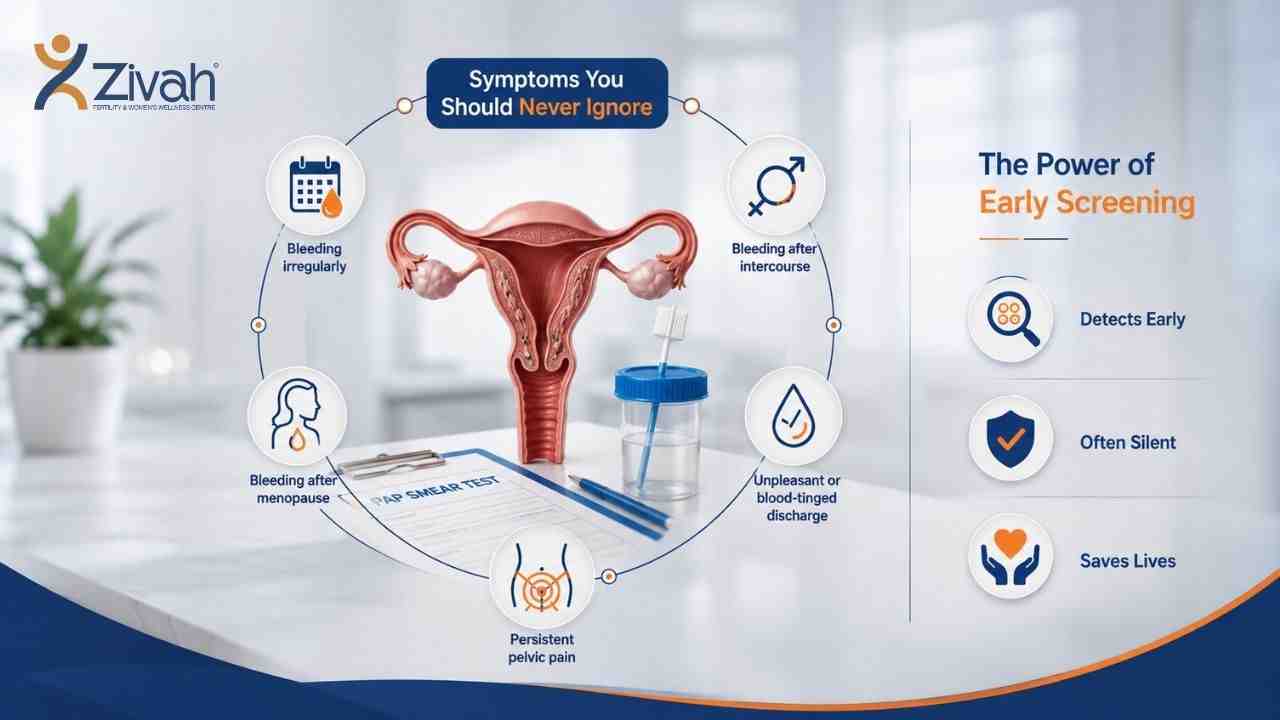
A screening calendar is for women without symptoms. If something's already wrong, you don't wait until your next planned date. If you observe any of these, see a gynaecologist immediately:
- Bleeding irregularly
- Bleeding after intercourse
- Any bleeding after menopause
- Continuous unpleasant-smelling or blood-tinged discharge
- Persistent pelvic pain
None of this is cancer; most of it turns out to be something considerably more mundane. But they need to be looked at now, not in three years.
Is It Okay to Never Get a Pap Smear?
You can say no. It is your consent. No test is required. But it is nice to understand what decline means. Early cervical change is quiet, so if you skip screening, you’ll probably get your first warning in the form of a symptom, and by then the illness has frequently had years to grow.
HPV self-sampling and VIA are present in certain programs, and both are better than nothing. This does not eliminate the requirement for follow-up cytology. If the test's value is in its timing, then the next question answers itself: when should that timing start?
Pap Smear Age and Guidelines: When to Start and How Often
Most women researching when to start a Pap smear find two distinct answers online, and believe that one of them must be wrong. Neither is. They are asking various questions.
International guidance (USPSTF and ACS) suggests starting Pap smear screening at 21, with cytology every three years during your twenties. From age 30 to 65, it's a regular Pap test every three years or Pap plus HPV test every five years.
Based on Indian recommendations from ICMR, FOGSI and WHO, the national program is framed around the 30 to 65 window, including HPV- or VIA-based screening at longer intervals. The difference is not that you disagree.
India's national pap smear recommendations are designed to target population-level screening in a very big country with limited resources; they focus on the years of greatest risk. Screening in a clinic, when you come in and ask for the test, tends to start earlier.
Pap Smear Age and Frequency at a Glance
| Age group | Recommended screening | How often | Note |
|---|---|---|---|
| Under 21 | Not routinely advised | — | Risk is very low at this age |
| 21 to 29 | Pap smear alone | Every 3 years | HPV testing not usually added |
| 30 to 65 | Pap alone, or Pap + HPV | Every 3 or 5 years | Co-testing allows the longer gap |
| Above 65 | May stop | — | Only with adequate normal history |
| After hysterectomy | Depends on the surgery | — | See the section below |
Your gyn will use your history to decide your real interval; the table is a starting point, not the last word.
Who Needs a Pap Smear More Often?
Some women need a shorter time interval between tests:
- A previous abnormal Pap or HPV result
- HIV or other causes of impaired immunity
- Ongoing chemotherapy or immunosuppressive treatments
- History of therapy for cervical dysplasia or cervical cancer
- Prenatal exposure to DES
Do you need a Pap smear every year? For most women, no. Three or five years between tests isn't negligence. It's how slowly cervical cells change. Annual testing isn't the norm. Calendar is set by frequency. What most ladies actually put off is the 10 minutes inside the room.
Pap Smear Procedure: How Is It Done, Step by Step?
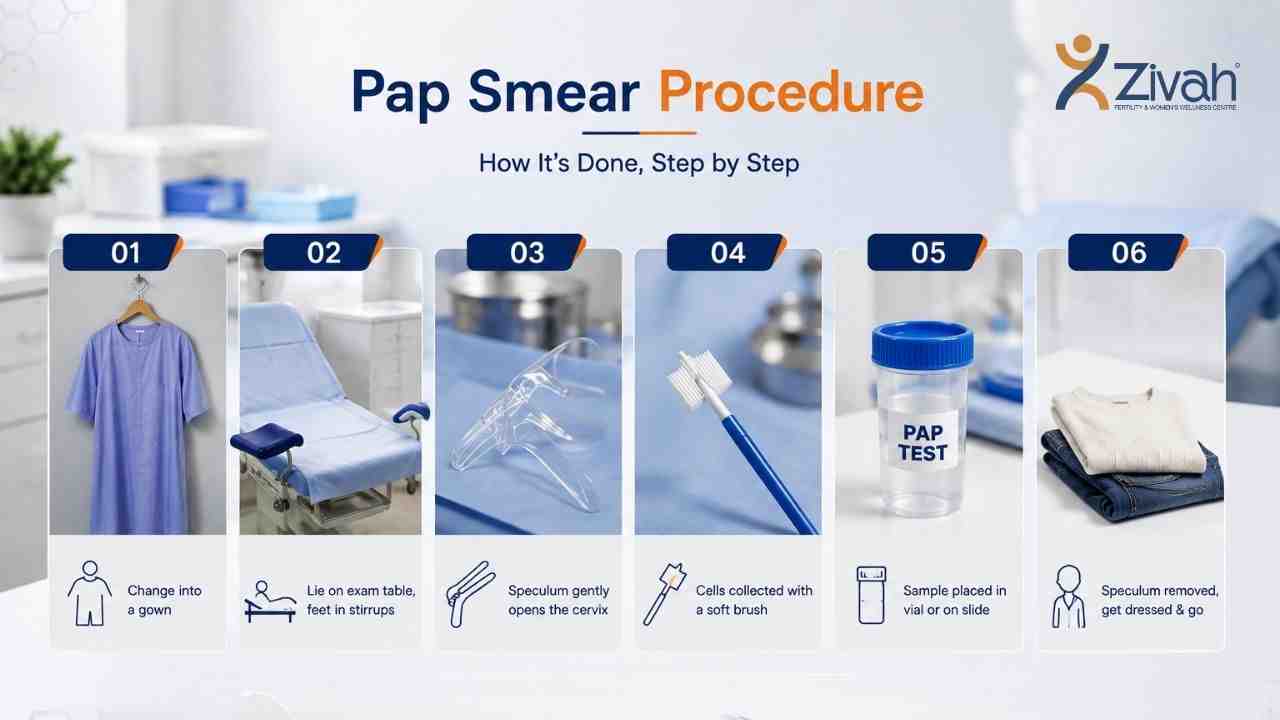
It's all so much less dramatic than most ladies think it's going to be. Here is the Pap smear technique, in steps:
- Undress from the waist down and change into a gown.
- Lie back on the examination table, heels in stirrups, and drape yourself.
- The cervix is brought into view by gently inserting a speculum. Pressure, not pain.
- A gentle brush removes cells from the surface of the cervix. Seconds, not minutes.
- The sample is placed in a liquid vial or on a glass slide.
- The speculum is removed, you dress and go.
The brush is not sweeping randomly. This is the transformation zone, the area where two types of cells meet in the cervix, and where practically all abnormal change starts. Two practical points. A Pap is normally done during a pelvic exam. If you want a female gynaecologist, ask when you make your appointment.
How Long Does a Pap Smear Take?
Cell collection takes 1-2 minutes. The complete visit is generally less than fifteen minutes and includes your history and opportunity for questions. No fasting, no rest following. You can return to work immediately.
Pap Smear by LBC: Liquid-Based Cytology vs the Conventional Smear
They both start the same way. The distinction is what happens to the sample thereafter. The standard smear rolls cells on a glass slide. LBC (liquid-based cytology) suspends them in preservative solution in a vial, preventing blood and mucus from obscuring them, the primary reason a report comes back "unsatisfactory" and needs to be redone.
There's also a benefit in comfort. Because the cells are in fluid, the same vial can be used to test for HPV if the results are borderline. No second look, no call back. Sample quality isn't determined only in the laboratory. A lot of it is decided in the forty-eight hours before you walk in.
How to Prepare for a Pap Smear: Dos and Don'ts
Preparing for a Pap smear is simple: don't touch the cervix for 48 hours beforehand. That means no sex, no douching, no tampons and no vaginal creams, gels, spermicides or lubricants.
It's a mechanical reason, not a moral one. Your cervix naturally breaks down loose surface cells, which the pathologist requires. Anything that washes them away or covers them over results in fewer usable cells, and that's one of the primary causes of defective samples and false negative findings.
When to Book? The cleanest window is around 10 to 20 days following the beginning day of your previous menstruation. One more thing before your exam: If you are pregnant, have had an abnormal Pap before, or are having any symptoms right now, notify your doctor. All three can change how your result is read.
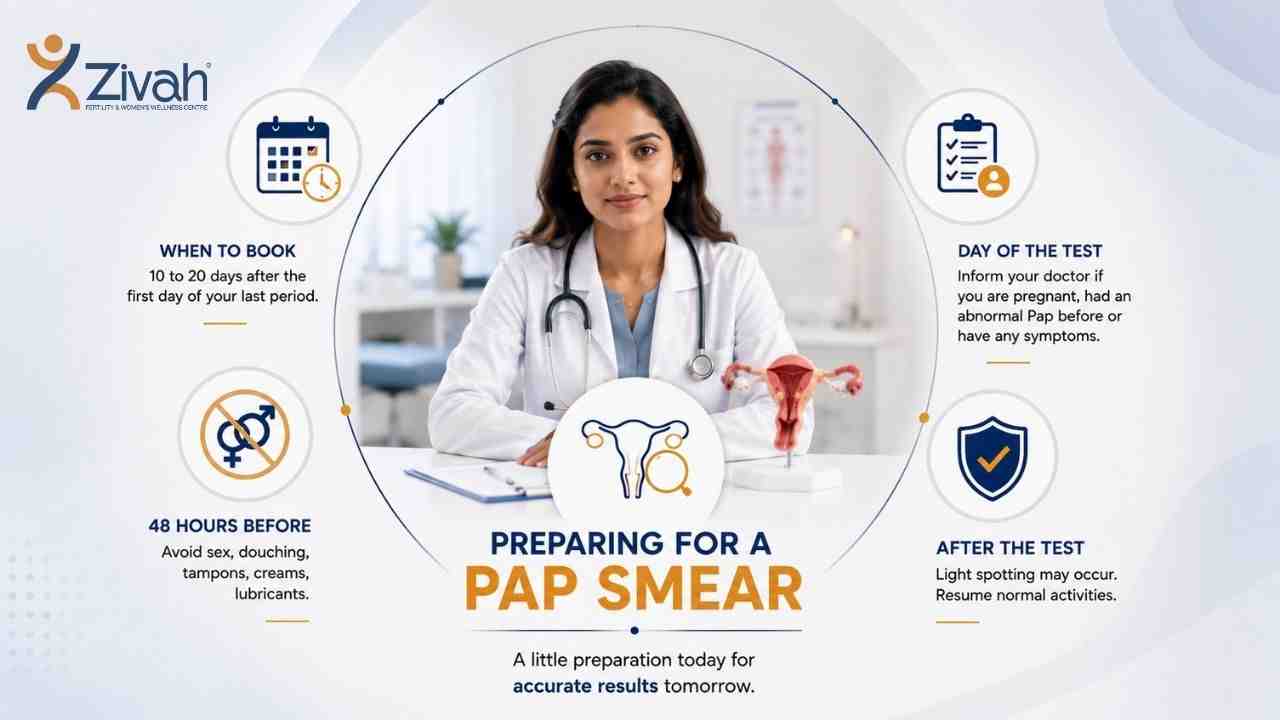
Before and After Your Pap Smear
| When | Do | Avoid | Why it matters |
|---|---|---|---|
| 48 hours before | Book mid-cycle | Sex, douching, tampons, vaginal creams | Protects the cells needed for testing |
| Day of the test | Mention pregnancy, symptoms, past results | Rushing in without saying anything | Changes how the report is interpreted |
| Immediately after | Return to normal activity | Nothing to avoid | Recovery isn't needed |
| Next 24 hours | Expect light spotting | Ignoring heavy bleeding or cramps | Prolonged bleeding needs a call |
Can You Get a Pap Smear During Your Period?
Reschedule, better. Blood can make the cells hard to interpret, and you may be asked to repeat the test. Light spotting at the very end of a period is occasionally OK; consult your doctor.
One exception beats the rule: bleeding that isn't your period is never a cause to delay. It's reason to be seen sooner. Preparation guarantees the result. Preparation doesn't tackle what keeps most women out of the room.
Does a Pap Smear Hurt? Pain, Safety and the Myths That Stop Women
Pressure, not hurt. That's what it comes down to. You will feel the speculum go in, and you will have a quick scraping or pinching feeling as the cells are collected; it takes only a few seconds.
Afterwards, light spotting is common and usually disappears within a day. Contact your doctor if cramping or bleeding lasts beyond 24 hours. What most articles don't tell you is how much power you truly have in that space.
Speculum size varies; a narrower one might be employed. Go slower. Say you are nervous out loud, and the way the examination is done is really changed, excellent physicians alter. You can ask for a female gynaecologist, ask questions halfway through and stop at any time.
Do You Need a Pap Smear If You Are Unmarried?
Yes. And it's worth talking out loud since the common belief that Pap smears are solely for married women keeps many women away for years. Screening is by age, not by marriage.
Cervical cancer risk doesn't start with a wedding. The hymen question needs a straightforward response, too. The speculum is made narrower, and the examination is modified.
If you have never had sex, your doctor will talk to you about whether you need to be screened yet and how that would be done. That chat is confidential. It happens before anything starts. Nothing happens unless you allow it.
Pap Smear During Pregnancy, After Hysterectomy and After 65
- Pregnancy: Cervical screening is believed to be safe during pregnancy, and if you are due for one, it may be done during an early prenatal appointment using a modified sample approach. You may see a little spotting thereafter, and this does no damage. Otherwise, screening is generally deferred until the six-week postnatal visit.
- After a hysterectomy: Many women are surprised that not every hysterectomy means an end to screening. If the cervix was completely removed for a normal reason such as fibroids, normally screening ends. If any section of the cervix was left behind, screening continues. If the operation was for cervical, uterine or ovarian cancer, you may still be advised to have vault sampling.
- After 65: You may cease, but only if you have a record of sufficient normal outcomes; it’s not automatic. The waiting begins as soon as the sample leaves the room, and that is when most of the true confusion occurs.
Understanding Your Pap Smear Report and What Comes Next
In a Pap smear report, NILM stands for "Negative for Intraepithelial Lesion or Malignancy." It means your cervical cells appear healthy, with no precancerous or cancerous changes. Most Pap smears report back within one to three weeks.
What generates unneeded panic: In a Pap smear negative report, negative is the favourable result. Many women read it the opposite way round and spend days worried for nothing. "Unsatisfactory" is not uncommon either. The test is not useful and should be repeated as too few cells were found.
What Your Pap Smear Report Terms Mean
| Report term | What it means | Concern level | Usual next step |
|---|---|---|---|
| NILM | Healthy cervical cells | None | Continue routine screening |
| Unsatisfactory | Too few usable cells | None | Repeat the test |
| ASC-US | Slightly unusual cells | Low | HPV test on the same sample |
| LSIL | Mild cell changes | Low to moderate | Colposcopy or repeat testing |
| HSIL | Significant cell changes | Higher | Colposcopy and biopsy |
| Atypical glandular cells | Unusual glandular cells | Needs clarity | Further testing advised |
| Squamous cell carcinoma / adenocarcinoma | Cancer cells present | Urgent | Prompt specialist referral |
What Does an Abnormal Pap Smear Result Mean?
An abnormal Pap smear is not a cancer diagnosis. Most of the abnormalities are caused by HPV, and many low-grade alterations, especially in younger women, go away by themselves once the immune system has dealt with the infection. Cytology asks the question. Histopathology will tell us.
Colposcopy, HPV Testing and Biopsy: What Comes After
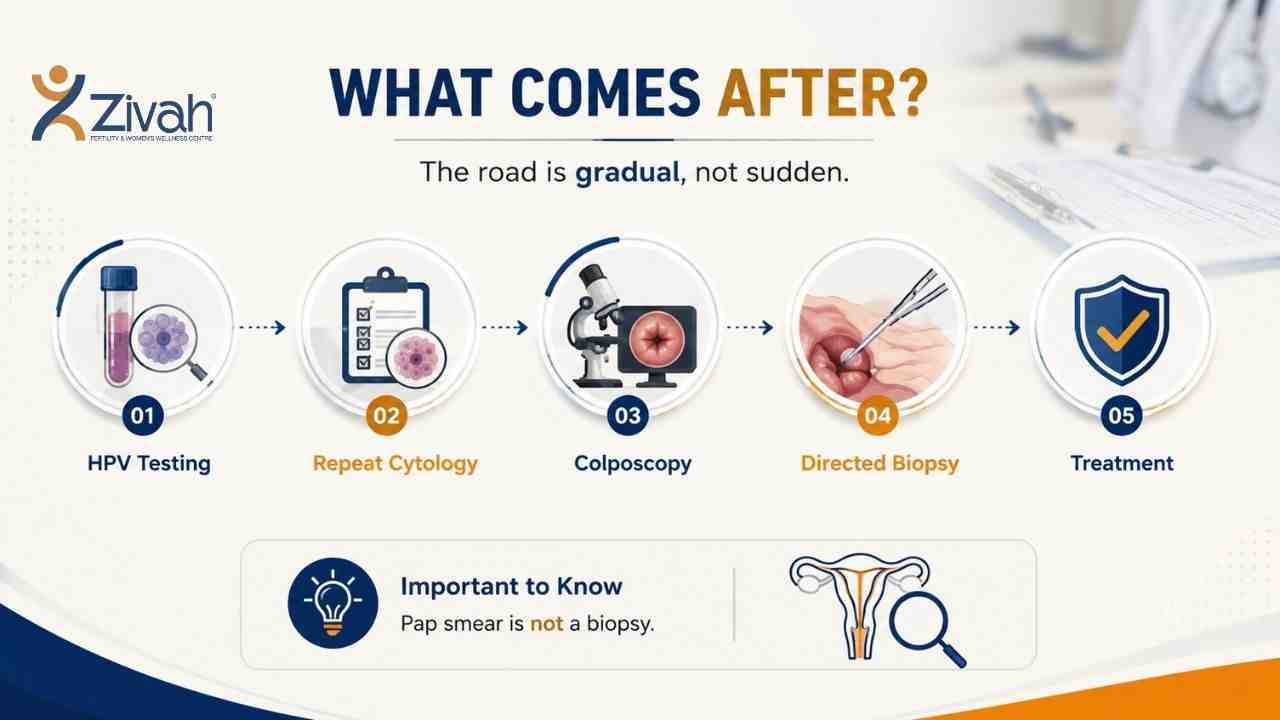
The road is gradual, not sudden:
- Reflex HPV testing of substances already in the lab
- Repeat cytology in borderline
- Colposcopy – Magnified picture of the cervix
- Directed biopsy if only concerning area seen
- Established, only if high-grade change is established
Let's clear up a frequent misconception: a Pap smear is not a biopsy. Pap tests for loose cells; biopsy takes tissue and diagnoses. If the test itself is easy to reach, none of this matters.
Getting a Pap Smear Test in Siliguri at Zivah
If you've been wanting to schedule a Pap smear test in Siliguri but keep pushing it to next month, here's a glimpse of what the appointment means at Zivah.
The consultation is relaxed and confidential. We have female gynaecologists on staff; just let us know when you book. Where appropriate, we use an LBC sample so that a borderline result may be reflex-tested for HPV from the same vial, and we won't call you back. Your report is not a slip that only you decode. You may have it explained to you in person.
What to Expect at Your First Pap Smear Appointment
Then your history and questions, a brief check of preparedness, the test and the sample, a few minutes in all. The charges depend on whether you are recommended for conventional cytology, LBC, or co-testing, and this is determined at consultation.
Final Thoughts on Cervical Screening
A Pap smear is a few cells from your cervix that are screened for abnormalities that might someday become cervical cancer. It's that simple, and that's why it works.
Know your age group. Follow your interval. Don't go it alone when it comes to understanding a report. Don't hang back if symptoms pop up in between. Ten years of peaceful change vs ten minutes every few years. A just trade. Book a Consultation with Zivah
Frequently asked
01 What is a Pap smear in simple words?
02 At what age should a woman start a Pap smear test in India?
03 How often should a Pap smear be done?
04 Does a Pap smear hurt?
05 Can a Pap smear be done during periods?
06 What does NILM mean in a Pap smear report?
07 How many days does a Pap smear report take?
08 Is a Pap smear only for married women?
09 Can a Pap smear detect ovarian cancer?
10 Is a Pap smear the same as an HPV test?