
The embryo transfer is the moment your whole IVF journey has been quietly building toward, the gentle step where your embryo is placed into your womb, and all that hope finally has a home. If you and your partner have come this far, you already understand what an embryo transfer means in your lives: it is not just a procedure, but the doorway to the family you have been dreaming of. And in this final step, the hands you choose truly matter.
At Zivah Fertility, we walk you through this part calmly and carefully, explaining every step in simple words and answering every question along the way, so that what is, for many, the most nervous day becomes one of quiet confidence. Understanding what an embryo transfer is, and knowing you are guided and well cared for, changes everything.
So when you feel ready, we are here, beginning with a warm, free consultation, whenever the time feels right for you.
What Is an Embryo Transfer?
So, what is an embryo transfer, in simple words? An embryo transfer (ET) is the gentle placement of your embryo into your uterus (womb), where it can settle and grow into a pregnancy. That is the whole heart of it. The embryo transfer sounds technical, but in reality, it's soft and quick, far gentler than most couples expect.
In short, embryo transfer is just the careful, hopeful step that gives your embryo its home inside the womb. It’s a very important part of IVF, and at Zivah, we make sure it’s given the care and calm it needs.
How Is an Embryo Formed?
Many of you have been thinking about how the embryo comes to be, so let us explain how IVF works as simply as possible. First, your eggs are carefully collected. Then, in the lab, they meet the sperm and get fertilised. Within a few days, the egg turns into an embryo. This is exactly how embryos and IVF come together to begin your journey toward parenthood.
Is Embryo Transfer Right for You?
You may be wondering if an embryo transfer is the right path for you and your partner, and that is a fair, important question to ask. The truth is, embryo transfer through IVF was created for exactly the situations that make natural conception difficult. So if you have been trying for a while without success, this may be the gentle, hopeful step your journey has been waiting for.
When Embryo Transfer Offers the Best Hope
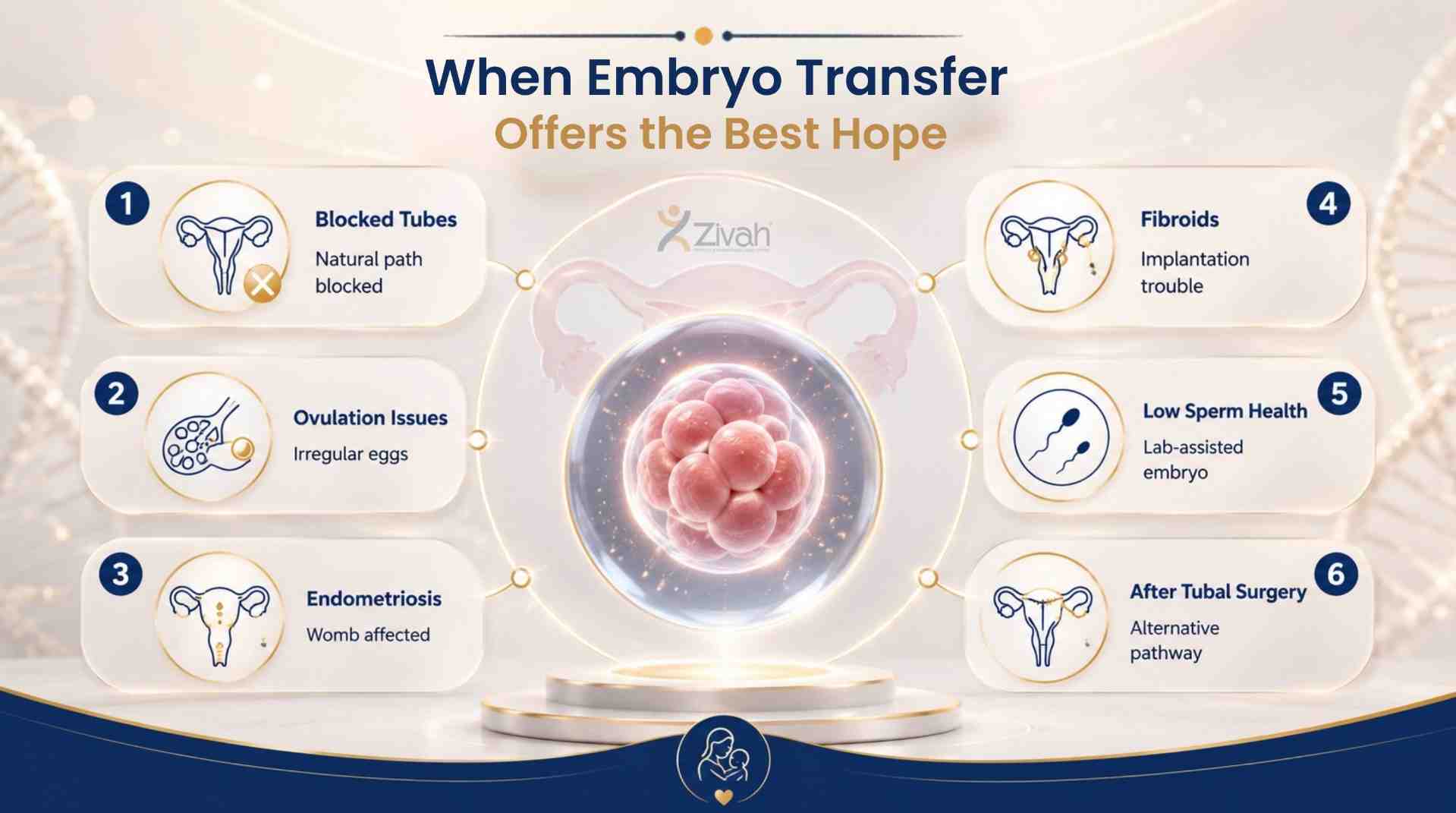
For many couples, an IVF embryo transfer becomes the clearest path to a baby when the body needs a little help along the way. This may be your path if you are facing:
- Blocked or damaged fallopian tubes, which stop the egg and sperm from meeting naturally.
- Ovulation trouble, where eggs are released irregularly or not at all.
- Endometriosis can change the way the ovaries and womb work quietly.
- Uterine fibroids are growths that can make it harder to get pregnant naturally.
- Male-factor concerns, such as low sperm count or motility, in which the embryo is created with extra help in the lab.
- After tubal surgery or tubal ligation, the natural route is no longer open.
In each of these situations, the embryo is created and then carefully placed so that healthy embryos are implanted right where they need to be. If any of this sounds like your story, you are not alone, and you are not out of options.
The kindest next step is simply to talk it through, and a free consultation at Zivah is a gentle, pressure-free place to begin. And once you feel ready to move forward, the next gentle question is simply this: Which kind of embryo transfer is right for you?
Types of Embryo Transfer We Offer
There is no single right answer here; the best choice depends on your body, your embryos, and your story. At Zivah, we guide you through the embryo transfer methods clearly, so the decision never feels overwhelming. Here is a simple look at the main options:
| Type of Embryo Transfer |
What It Means (in Simple Words) |
Best Suited For |
When It’s Done |
|---|---|---|---|
| Frozen Embryo Transfer (FET) |
Embryos are frozen, then thawed and placed later |
Couples wanting genetic testing first, or a calmer body after stimulation |
A later cycle, once your body is ready |
| Fresh Embryo Transfer |
The embryo is placed soon after eggs are collected and fertilised |
Couples preferring the shortest wait |
3 to 5 days after egg retrieval |
| Day 3 Transfer (Cleavage Stage) |
Placed while the embryo’s cells are still dividing |
When fewer embryos are available |
Day 3 after fertilisation |
| Day 5 Transfer (Blastocyst Transfer) |
The embryo grows stronger, then is placed |
Embryos that can safely reach day 5 |
Day 5 after fertilisation |
Frozen Embryo Transfer (FET)
A frozen embryo transfer (FET) is now the most trusted choice in many clinics, and for good reason. So, what is frozen embryo transfer, in simple terms? Your embryos are safely frozen after an IVF cycle, then thawed and placed in your womb at the right time. The definition of frozen embryo transfer really is that gentle. The frozen embryo transfer procedure also allows time for genetic testing first, which is why so many couples choose the FET procedure for a calmer, well-timed transfer.
Fresh, Day 3 & Day 5 Transfers
A fresh transfer places the embryo soon after your eggs are collected, with no freezing in between. From there, timing matters. A day 3 embryo transfer places the embryo while its cells are still dividing, whereas a day 5 embryo transfer waits until it has grown into a stronger blastocyst. This blastocyst transfer often gives the embryo a better chance to settle, and your Zivah specialist will help you choose the timing that best suits your embryos. Choosing the right type is reassuring, but for many couples, one quiet worry still lingers, and it deserves a gentle, honest answer.
Is Embryo Transfer Painful?
If there is one worry that sits quietly in almost every couple's mind, it is this: Is embryo transfer painful? Let us calm you down. An egg transfer doesn't hurt most women at all. It feels a lot like a normal Pap smear; the only pain is mild. Most of the time, anaesthesia is not needed because the move is quick and easy. A lot of people also want to know if the egg transfer hurts. The honest answer is that it might feel a little sharp, but not really hurt.
How We Keep You Comfortable at Zivah During Embryo Transfer
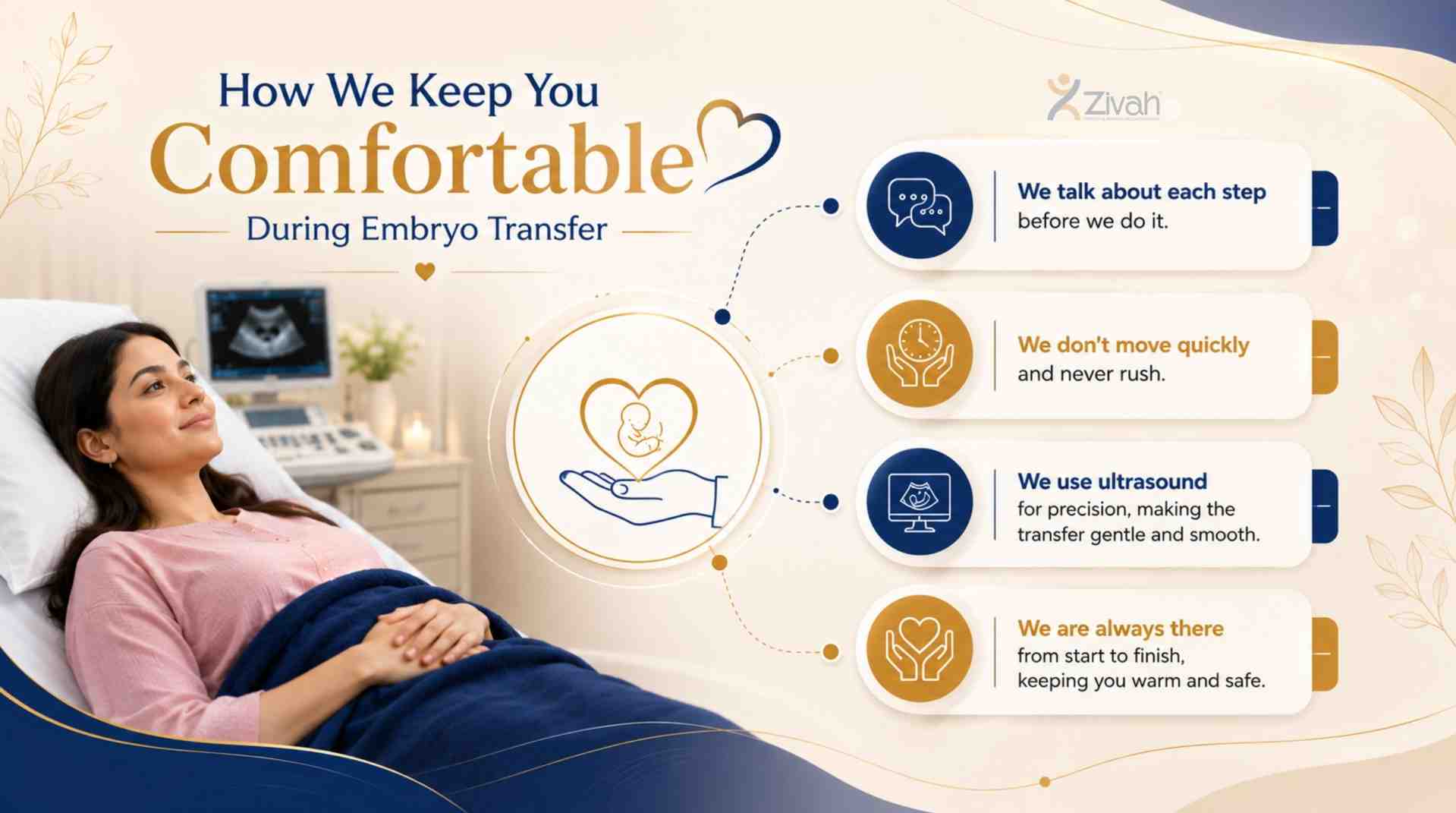
This place always cares about your comfort; it's part of the care itself. Our fertility team has done many gentle transfers and has learned that a calm body makes the whole process go more smoothly. Because we want you to feel at ease, we've built our embryo transfer around small, thoughtful steps that make a big difference:
- We talk about each step before we do it, so nothing is sudden or out of the blue.
- We don't move quickly and never rush through the most important moments.
- We use ultrasound to ensure precision, making the transfer gentle and smooth.
- From the beginning to the end, we are always there for you, keeping you warm and safe.
Not just words, these are the quiet habits of our team at Zivah that have helped many couples get through this day. Most people are shocked by how calm it really is. You can talk to our loving team for free whenever you're ready to feel that calm.
So, with that worry gently set aside, let us walk you through exactly what happens on the day itself.
The Embryo Transfer Procedure at Zivah
When the day finally comes, the embryo transfer procedure is far simpler and calmer than most couples imagine. You arrive with a comfortably full bladder, and a soft speculum is placed, much like a routine check-up. Then, guided by ultrasound for precision, your doctor passes a thin, soft tube (catheter) through the cervix and into the womb. This intra-uterine transfer places your embryo exactly where it needs to be, and the whole moment is watched closely every second. It is quick, careful, and far less daunting than the word "procedure" suggests.
How Long Does an Embryo Transfer Take?
The embryo transfer itself takes only a minute or two, though you will spend a little longer settling in and resting afterwards. Here is how the day of embryo transfer usually unfolds:
| Stage |
What Happens |
Time |
|---|---|---|
| Getting Ready |
You arrive with a comfortably full bladder; a soft speculum is gently placed |
5 minutes |
| Finding the Spot |
Ultrasound guides your doctor to the right place in your womb |
A few minutes |
| The Transfer |
A thin, soft tube (catheter) carries the embryo gently into the uterus |
1–2 minutes |
| Resting |
You lie back and relax before heading home |
30 minutes |
Start to finish, you are usually with us for well under an hour. And once your embryo is safely home, a quiet new chapter begins, the gentle wait to meet your little one.
What Happens After Your Embryo Transfer
So, what happens after embryo transfer? The days that follow are quieter than you might expect. Once your embryo is placed, it begins to settle into the womb lining, and around day 5 after embryo transfer, implantation often takes hold. Through this post-embryo transfer time, your body works quietly, and you may notice a few small signs:
- Mild cramping as the embryo settles in.
- Tender breasts, an early shift in your body.
- Light tiredness, or no symptoms at all, which is equally normal.
There is no need for bed rest these days; gentle movement is perfectly fine. And you are never alone in the waiting; your Zivah team stays close, ready to answer any worry.
Bleeding After Embryo Transfer - Is It Normal?
The first sign of bleeding after embryo transfer can be frightening, so let us reassure you. Light spotting is often normal and can even be a hopeful sign, as the embryo settles into the womb lining during early implantation. Heavier bleeding is uncommon, so if it ever worries you, simply reach out. We would always rather you call than carry the worry alone.
The Two-Week Wait Before Your Test
This is the hardest part, the patient's two-week wait. You may wonder how many days after egg retrieval the embryo transfer is done. From there, it takes about two weeks before a test can give a true answer. Even after 7 days of embryo transfer, it is still too early; the pregnancy hormone (hCG, the hormone a test looks for) needs time to rise. So please resist the early test. When the time is right, a simple blood test at Zivah will give you the clearest, kindest answer.
When that day comes, many couples also wonder what truly shapes their chances, so let us look at that next.
Fresh vs. Frozen - What Affects Your Success
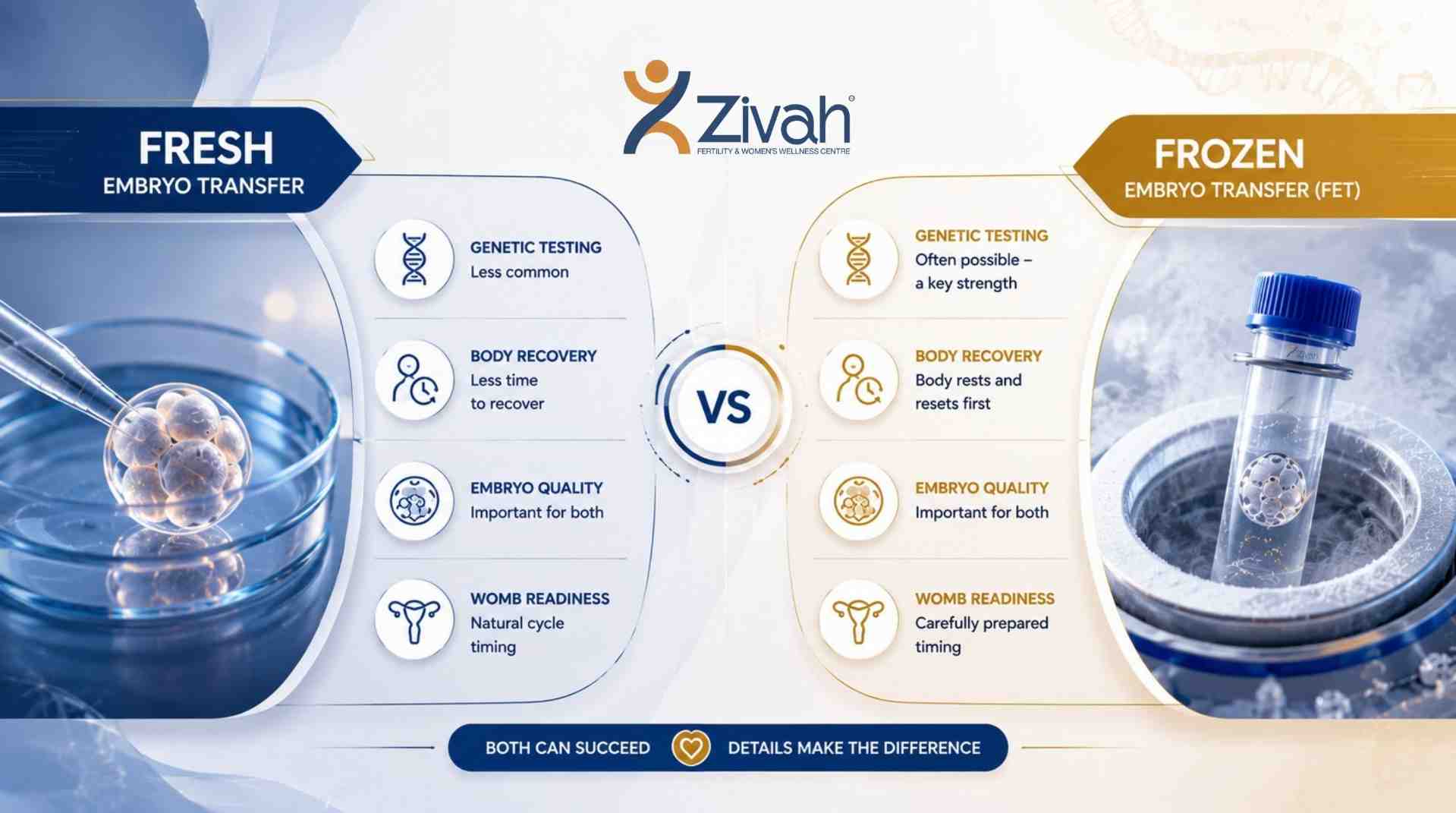
One of the most common questions couples ask is whether a fresh or frozen transfer gives a better chance. The honest answer is that both can succeed beautifully; what matters most are the details around them. A few key factors shape the outcome more than the fresh-or-frozen choice alone:
| What Influences Success |
Fresh Embryo Transfer |
Frozen Embryo Transfer (FET) |
|---|---|---|
| Genetic Testing before Transfer |
Less common |
Often possible — a key strength |
| Body’s Recovery After Stimulation |
Less time to recover |
Body rests and resets first |
| Embryo Quality |
Important for both |
Important for both |
| Womb Lining Readiness |
Natural cycle timing |
Carefully prepared timing |
In recent years, many specialists have focused on frozen transfers because freezing allows time for genetic testing, and embryos checked this way are associated with higher success and fewer setbacks. A frozen blastocyst transfer also lets your body rest and reset before the embryo is placed, which can quietly help things along.
How Many Embryos Should Be Transferred?
It is tempting to think two embryos must double your chances, but the truth is gentler. Today, fertility specialists often recommend transferring just one healthy embryo, because a single embryo transfer is linked to strong live-birth rates with far lower risk to you and your baby. While the 2-embryo transfer success rate can look appealing on paper, more is not always safer. Your Zivah specialist will guide this choice around your age, your embryos, and your story, never a fixed rule.
And once you understand what shapes success, the final question is the most important of all: who you trust to walk this journey with you.
Why Choose Zivah Fertility for Your Embryo Transfer
You know what an embryo transfer is and how it works now, but what really matters are the people who help you through it. This is different about Zivah. We never see your trip as just a step on a calendar. It's your hope, and we hold it with care. Many couples come to us after a long journey somewhere else, tired and unsure. Often, it's the first time they've felt like they could finally breathe.
What Makes Zivah Different
The difference is not one big thing, but many small, caring ones. When you choose Zivah for your embryo transfer, here is what stands beside you:
- Experienced, gentle specialists who have guided many couples through this exact journey.
- Honest, transparent care every step, every cost, and every choice explained, with nothing hidden.
- Comfort-first treatment, where your ease and calm matter as much as the science.
- A team that truly listens, treating each couple the way they would their own family.
- Warmth at every turn, so you never feel like just another file on a desk.
These are the quiet promises behind everything we do. Your dream of a baby is precious, and the months ahead matter, so the kindest thing you can do for yourselves is simply to begin.
Your First Step: A Free Consultation
So, after everything, the science, the choices, the gentle two-week wait, it all comes down to one simple, hopeful step: reaching out. And that is easier than you might fear. Your first consultation at Zivah is completely free, and it asks nothing of you but your questions. You will sit with a caring specialist who listens to your story, explains your options in plain words, and helps you see the path ahead, with no pressure and no rush.
Your embryo transfer is more than a procedure; it is the doorway to the family you have dreamed of. And you do not have to walk toward it alone. Whether you are ready to begin or simply exploring, this first step costs you nothing but brings real clarity and calm. So when you feel ready, we are here.
Reach out today, and let us walk this journey together toward the little one waiting at its end.