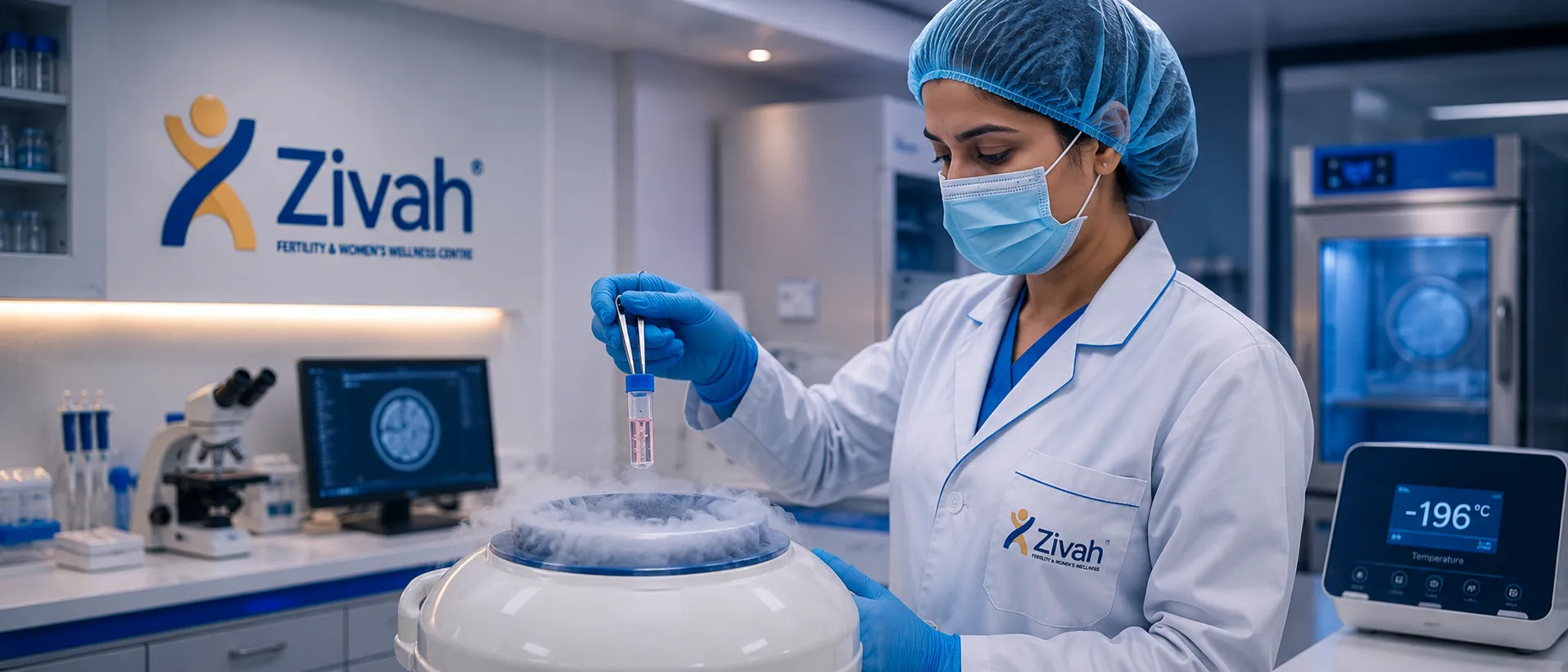

Embryo freezing gives you and your partner a safe way to protect your fertility now, so you can choose the right time to start your family later. Life does not always go to plan. Maybe a medical treatment is coming up, maybe an IVF (in vitro fertilisation) cycle has left you with healthy embryos to spare, or maybe you want to wait until the moment feels right for you.
So many couples quietly wonder, " Is embryo freezing a safe way to save my fertility for the future?" The good news is that, yes, embryo freezing is a safe, trusted method that has helped families for many years.
At Zivah Fertility, we are with you every step of the way, with clear answers, so a big decision starts to feel a little easier. And your first talk with us is always free, whenever you feel ready.
What Is Embryo Freezing?
So, what does embryo freezing really mean for you? Embryo freezing, also called embryo cryopreservation, is the process of freezing fertilised embryos and storing them safely until you are ready to use them.
The meaning of cryopreservation is simple at heart: your embryos are cooled to a very low temperature in liquid nitrogen, around -196°C, at which point all biological activity pauses. Your embryos do not age while they wait. An embryo frozen today stays just as young when you come back for it years later.
In simple terms, the journey works in three steps:
- Create: you and your partner make embryos through IVF (in vitro fertilisation, where egg and sperm join in the lab).
- Freeze: The healthiest embryos are frozen and stored at -196 degrees Celsius.
- Transfer: When you feel ready, they are warmed and placed in the womb, giving you a real chance at the family you hope for.
This is not new or risky; embryo cryopreservation has helped families grow safely for decades, and that long track record is exactly why so many couples feel reassured by it.
Why Couples Choose Zivah for Embryo Freezing
When you are trusting a clinic with something this precious, quiet confidence matters more than big promises. Your embryos are handled in a fully ART-compliant (Assisted Reproductive Technology) lab at Zivah Fertility. They are closely monitored and kept in carefully controlled conditions.
On top of that, our specialists bring years of real-world experience to every cycle and take the time to explain each step so nothing feels confusing. That's why so many couples feel safe choosing us, and that's also why your free first talk is the best place to start.
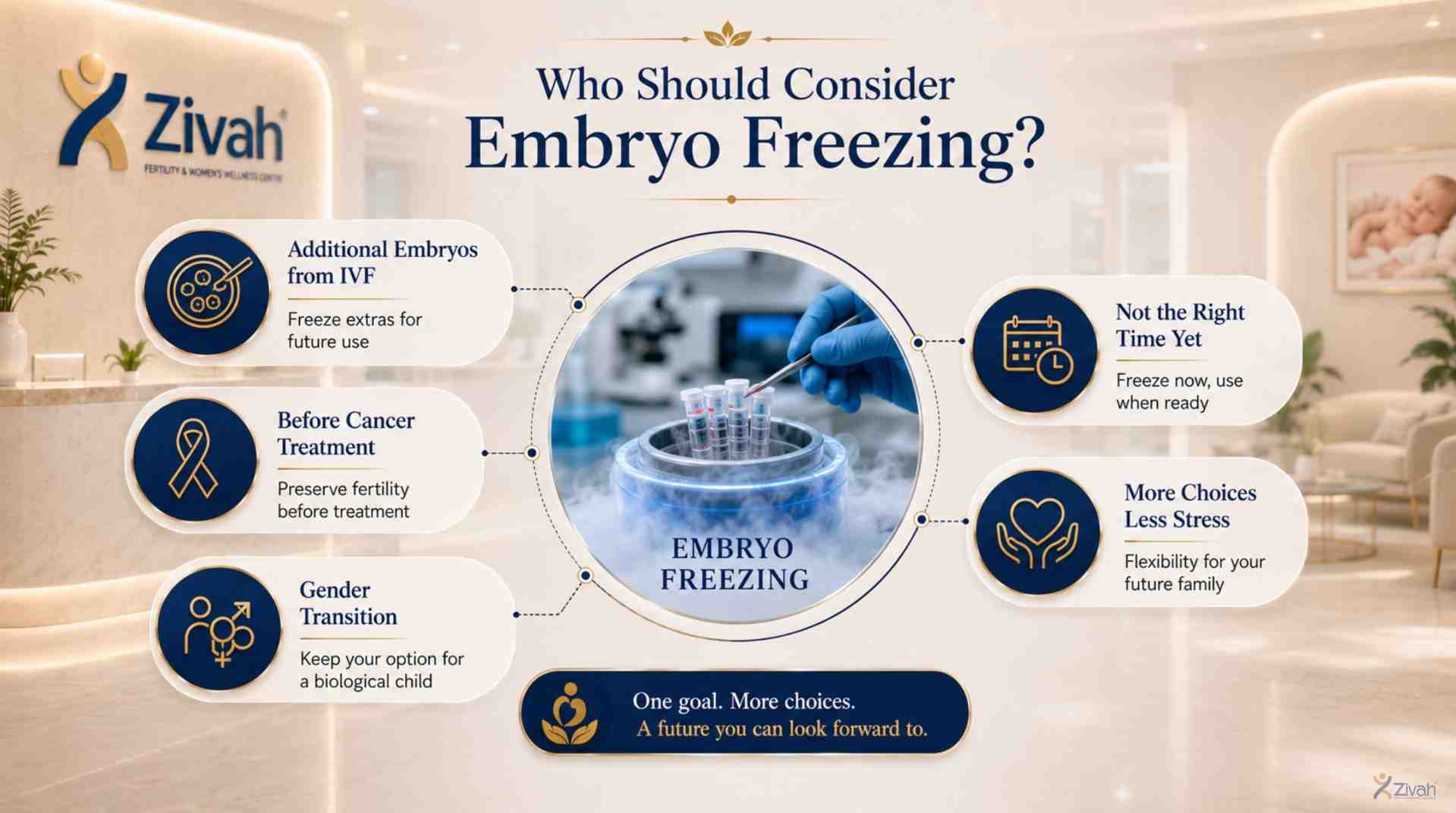
Who Should Consider Embryo Freezing?
Embryo freezing is not just for one kind of person; it can help many couples and individuals, each for their own reason. Some come to it after fertility treatment, some before a medical journey, and some simply because the timing is not right yet. You could be in one of these scenarios:
- You have additional embryos from IVF: If a cycle results in more healthy embryos than you need at the moment, you can freeze the extras and attempt again later without having to go through the egg harvesting process once more.
- You're about to have cancer treatment: Chemo or radiation can make it harder to get pregnant, so freezing embryos before starting treatment will help you have a baby in the future.
- You are going through a gender transition: embryo freezing lets you keep the option of a biological child for the future.
- You can freeze embryos and use them whenever you want: This is great if you want to wait for the right time because of work, health, or just not feeling ready.
The goal is the same no matter what brought you here: to give you more choices and less stress. Also, it's okay if you're not sure where you fit in; talking about it is the best way to start.
| Situation |
Why Embryo Freezing Helps |
|---|---|
| Surplus Embryos from IVF |
Store extras and avoid repeating egg retrieval |
| Before Cancer Treatment |
Protect fertility ahead of chemotherapy or radiation |
| Gender Transition |
Preserve the chance to have a biological child |
| Delaying Parenthood |
Freeze embryos at today’s age and use them later |
Is Embryo Freezing Right for You?
Reading a list is one thing, but your situation is your own, and no two journeys look exactly alike. The truth is, the clearest way to know whether embryo freezing fits your life and hopes is to ask someone who can review your full medical history. That is what a free consultation at Zivah is for: no pressure, just honest answers from a specialist who listens and doesn't judge you. So if even one of these reasons sounds like you, it may be worth a simple conversation.
Embryo Freezing vs. Egg Freezing: What's the Difference?
This is one of the most common questions couples ask us, and it is a fair one. The two sound alike, but the difference comes down to one simple thing: what gets frozen. With embryo freezing, the egg is first joined with sperm to create an embryo (a fertilised egg), and that embryo is what we freeze. With egg freezing, the egg is frozen on its own before any sperm is involved, meaning it's "saving the egg as it is, unfertilised."
So which one suits you? In short, embryo freezing works best when you have a partner or chosen donor sperm ready now, because you need both halves to make an embryo. Egg freezing, on the other hand, lets you keep your options open if you would rather wait on the sperm side of things. If egg freezing better suits your needs, you can read more on our [egg freezing page]. Either way, a quick talk with us can help you decide.
| Feature |
Embryo Freezing |
Egg Freezing |
|---|---|---|
| What’s Frozen |
Fertilised egg (embryo) |
Unfertilised egg |
| Sperm Needed Now? |
Yes |
No |
| Best For |
Couples or those with available donor sperm |
Preserving future options without a partner |
How Does the Embryo Freezing Procedure Work?
If the idea of embryo freezing sounds a bit technical, do not worry; once you see the steps, it is easy to follow. The process starts the same way as IVF (in vitro fertilisation, where the egg and sperm are joined in the lab), so embryos and IVF go hand in hand here. From start to finish, here is how it works:
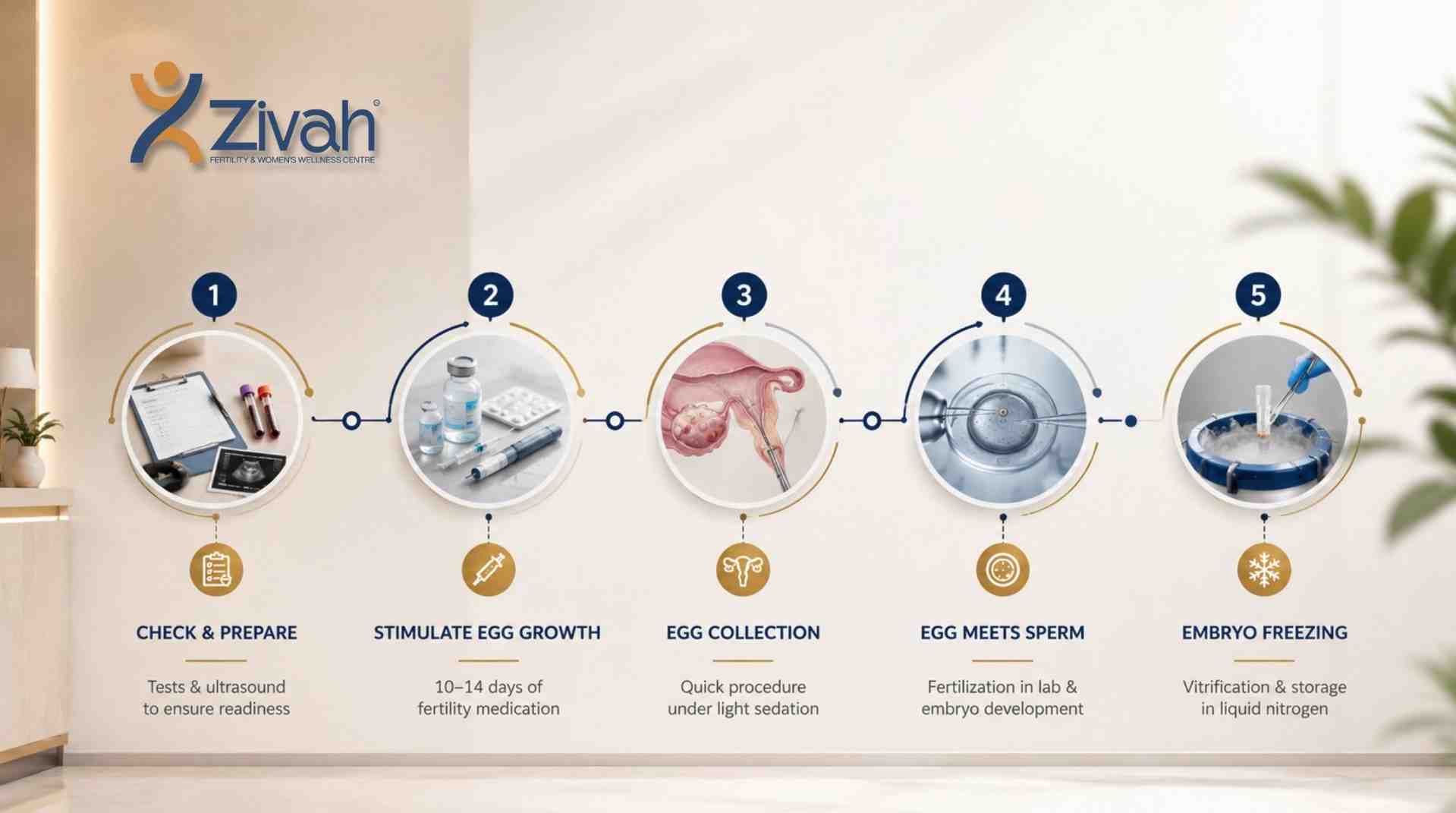
- First, a few simple checks. Before you start, your doctor does blood tests to check your hormone levels and an ultrasound scan to make sure your body is ready. If needed, the sperm is checked too.
- Next, medicine to stimulate egg growth. You take fertility medicine for about 10 to 14 days. This helps your body grow more eggs than usual. Your doctor keeps an eye on you with scans and blood tests.
- Then, the eggs are collected. When your eggs are ready, the doctor collects them in a short, simple procedure while you rest under light sedation. It is quick, and most people feel okay soon after.
- After that, the eggs meet the sperm. In the lab, your eggs are joined with sperm to make embryos. Over the next few days, the team watches the embryos grow.
- Lastly, the embryos are frozen. The healthiest embryos are kept safe from ice damage, then frozen and stored in liquid nitrogen until you are ready to use them.
So even though it sounds like a lot, each step is small, easy, and explained to you as you go. You will never be left wondering what happens next.
Vitrification: How We Protect Your Embryos
It's very important how embryos are frozen. Vitrification is the best and safest way to do this, and we use it at Zivah. When eggs are vitrified, they are frozen rapidly rather than slowly. This keeps them from getting tiny ice crystals inside. What does that matter? Those ice crystals are what are bad for the baby. As a result, many more eggs remain healthy. Usually, 90% or more make it through safely and are ready for use.
| Method |
Survival After Thawing |
Status |
|---|---|---|
| Vitrification |
90%+ |
Best method, used at Zivah |
| Slow Freezing |
60% |
Hardly used now |
Your Safety at Every Step
It is normal to worry about something so precious being in someone else's care, and we take that to heart. All through the process, your care follows the ART (Assisted Reproductive Technology) rules, and you are checked on closely at every stage, never rushed, never left guessing.
Your embryos are looked after in a safe, fully ART-approved lab and stored in conditions that are monitored day and night. In short, every safeguard is there for one reason: so you can feel calm, knowing your future is in good hands.
What Is Frozen Embryo Transfer (FET)?
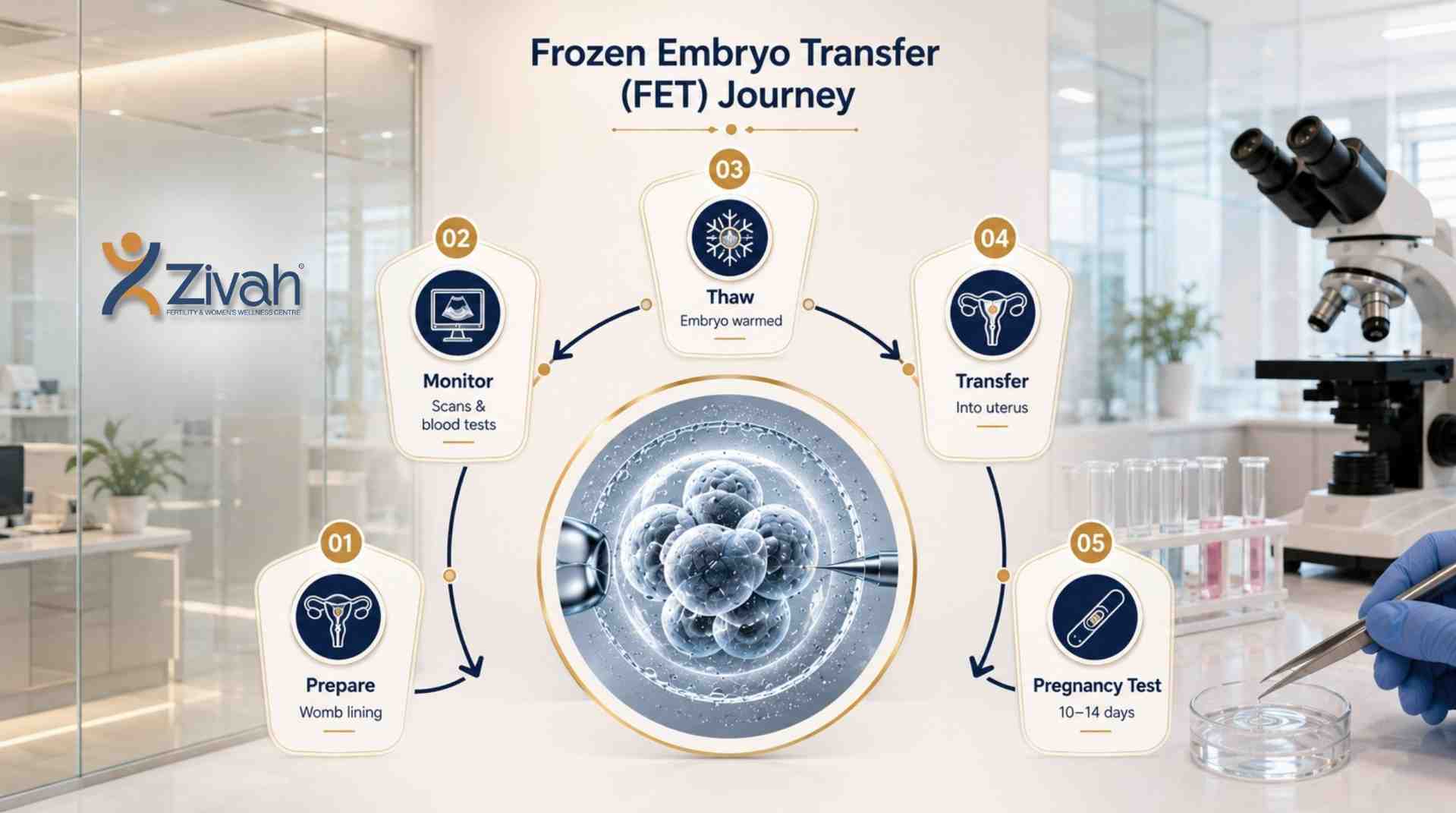
So once your embryos are frozen, what happens when you are ready for a baby? That is where frozen embryo transfer comes in. The meaning of frozen embryo transfer is simple: your frozen embryos are thawed and placed into the womb, in the hope that one will result in a pregnancy. If you are wondering what frozen embryo transfer is, it is just that: using your saved embryos after thawing.
The best part? Frozen embryo transfer is much easier than full IVF because you don’t have to collect eggs. Here’s how the circle works:
- Prepare the womb: hormones thicken the lining.
- Check the timing: blood and scans can help find the best day.
- Thaw and transfer: your embryos are warmed, then implanted into your womb with a thin, soft tube.
About 10 to 14 days later, a simple test shows if it worked.
What to Expect on Your Transfer Day
If transfer day makes you nervous, relax, it is quick, and most people feel little to nothing. No sedation, and you go home soon after. We guide you through every step, so all you have to do is rest.
How Long Can Embryos Be Stored?
One reassuring thing about embryo freezing is how long your embryos can safely wait for you. As they are stored in liquid nitrogen at around -196°C, they do not age, and healthy babies have been born from embryos frozen for many years.
So there is no rush. In India, the Assisted Reproductive Technology Act, 2021, sets the rules for storage periods and consent renewal. Your clinic will tell you when you need to update any paperwork.
How Zivah Keeps Your Embryos Safe
At Zivah, your embryos are never left and forgotten. They are stored in secure, controlled conditions and watched day and night, with close checks on temperature, so they stay in the best shape until you are ready.
How Reliable Are Embryo Freezing Success Rates Today?
It is only natural to want to know your chances, so let us be honest and clear. Thanks to modern freezing methods, the success rate of embryo freezing is very encouraging today. In many clinics, frozen embryo transfers now succeed around 50 to 60% of the time, which is as good as, and sometimes better than, using fresh embryos. Still, every couple is different, and a few things shape your own chances:
- Your age when the embryos were made: younger eggs tend to lead to higher success.
- The quality of the embryos: stronger, higher-grade embryos give better results.
- The freezing method: verification helps more embryos survive thawing.The health of your womb: a healthy lining helps the embryo settle in.
The most helpful thing you can do is ask your clinic for its own success numbers, so you get a true picture.
| Factor |
Impact |
|---|---|
| Age at Embryo Creation |
Younger age = higher success rates |
| Embryo Quality / Grade |
Higher-grade embryos usually lead to better outcomes |
| Freezing Method |
Vitrification improves embryo survival after thawing |
| Uterine Health |
A healthy uterine lining supports implantation |
Why Age Matters Most
Of all these, one stands out: your age when the embryos are made. The younger you are, the healthier your eggs, and the better your chances later on. That is why time really does matter here; freezing sooner can mean stronger embryos waiting for you.
So if embryo freezing is on your mind, it is worth talking to us now rather than later. A free consultation can help you understand your own timing, with no pressure.
How Much Does Embryo Freezing Cost in India?
Let’s talk about money, because no one likes nasty surprises. The fact is, the cost of embryo freezing in India is not a fixed figure; it varies from city to city, clinic to clinic, and depends on what your plan includes. To put it in simpler words, the cost usually comes down to a few simple parts:
| Component |
What It Covers |
|---|---|
| Freezing (Vitrification) |
One-time embryo freezing fee |
| Annual Storage |
Yearly embryo storage charge |
| FET Cycle |
Thawing, preparation, scans, and embryo transfer |
Some clinics bundle freezing and a year of storage into your IVF package; others charge for each separately. The best thing to do is ask for a full breakdown up front so you know exactly what you are paying for.
Get Your Personalised Cost Estimate Free From Zivah Fertility
Since every couple's needs are a little different, the only way to know your real cost is to look at your own situation. That is exactly what we do in your free consultation at Zivah: we listen, explain your options, and give you a clear, honest estimate with no hidden charges and no pressure. So before you worry about numbers, let us give you the real ones. Book your free talk today, and start with clarity.
A quick note: The details here are for general guidance only and are not medical advice. Embryo freezing costs, success rates, and storage rules can change and depend on your own health, your clinic, and the current ART (Assisted Reproductive Technology) Act, 2021 rules. For an exact estimate and advice that fit you, a free consultation at Zivah is the best place to start.
Begin Your Embryo Freezing Journey with Zivah
Choosing embryo freezing is about one thing: giving your future self more choices and more peace of mind. You do not need all the answers today, just a first step and a team that listens.
At Zivah Fertility, we make embryo freezing simple, safe, and clear from the start. Our specialists explain everything in plain words and stay by your side at every stage. And because time can matter with fertility, the sooner you talk to us, the more options you may have.
So take that first step today. Your free consultation is waiting, no pressure, just honest guidance.