

Surrogacy in India has given so many couples a gentle second chance at parenthood, a path that feels less like a medical procedure and more like a circle of care holding you up. If you have carried the weight of failed cycles, a difficult diagnosis, or a pregnancy your body simply cannot safely manage, please know you are not at the end of the road.
Here in India, surrogacy is permitted under the Surrogacy (Regulation) Act 2021, which allows only altruistic surrogacy, safe, legal, and built to protect everyone involved.
At Zivah Fertility, we walk this journey beside you, beginning with a free consultation whenever you feel ready.
What Is Surrogacy and How Does It Work?
Surrogacy is a way of welcoming a baby into your arms when carrying a pregnancy yourself is not possible. Another woman, the surrogate mother, carries and delivers your baby for you.
The form practised in India is gestational surrogacy. Your baby is created in the lab through IVF (In Vitro Fertilisation, egg and sperm joined outside the body), using the intended parents' own eggs and sperm, or approved donor cells where needed.
The embryo is then placed in the surrogate's womb, where she nurtures the pregnancy until birth. Because the egg never comes from her, the surrogate shares no genetic link with the baby; she carries your child, not her own.
Is Surrogacy Legal in India?
Yes, and it is carefully protected. Surrogacy is legal in India under the Surrogacy (Regulation) Act 2021, but only in its altruistic form, where the surrogate is supported with full medical care and insurance rather than paid a commercial fee. Commercial and traditional surrogacy are not permitted. Knowing exactly what the law allows is the first step toward a journey you can trust, so here is a simple breakdown.
| Surrogacy Type |
Simple Meaning |
Legal Status in India |
|---|---|---|
| Gestational Surrogacy |
Baby created by IVF, the surrogate carries only |
Permitted |
| Altruistic Surrogacy |
Surrogate receives care & support, no profit |
Legal |
| Traditional Surrogacy |
Surrogate’s own egg is used |
Not permitted |
| Commercial Surrogacy |
Payment beyond medical & insurance costs |
Not permitted |
What Is Altruistic Surrogacy?
Altruistic surrogacy is the only form that is allowed in India, and it is built around care rather than commerce. In simple terms, the surrogate is not paid a profit or fee for carrying your baby. Instead, the intended parents cover all her medical expenses, her pregnancy-related needs, and her health insurance, so she is looked after completely, but never treated as part of a transaction.
This model is heavily regulated under the Surrogacy (Regulation) Act 2021 and can only be performed at registered ART (Assisted Reproductive Technology) clinics, such as Zivah Fertility. These safeguards are put in place to protect everyone, you, your baby and the surrogate who selflessly helps bring your child into the world.
How Is Altruistic Surrogacy Different From Commercial Surrogacy?
The difference is simple but important. In altruistic surrogacy, the surrogate receives support and care but no commercial payment. According to Indian law, it does not allow commercial surrogacy, which is when a surrogate is paid more than the cost of medical care and insurance. Choosing a registered clinic means your journey stays firmly on the right side of the law, and that peace of mind matters as much as the outcome.
| Aspect |
What It Means for You |
|---|---|
| Allowed Model |
Altruistic gestational surrogacy only |
| Compensation |
No commercial payment to the surrogate |
| Medical Expenses |
Covered by the intended parents |
| Surrogate Insurance |
Mandatory health insurance for the surrogate |
| Where It’s Done |
Only at registered ART clinics like Zivah Fertility |
Once you understand how altruistic surrogacy works, the next natural question is whether it is the right path for you, so let's look at who can opt for surrogacy.
Who Can Opt for Surrogacy in India?
Surrogacy in India is open to couples who genuinely need it, and the law sets clear guidelines on who can opt for this path. At first, these rules may seem strict, but they are all in place to keep you and your future child safe and honest on your journey.
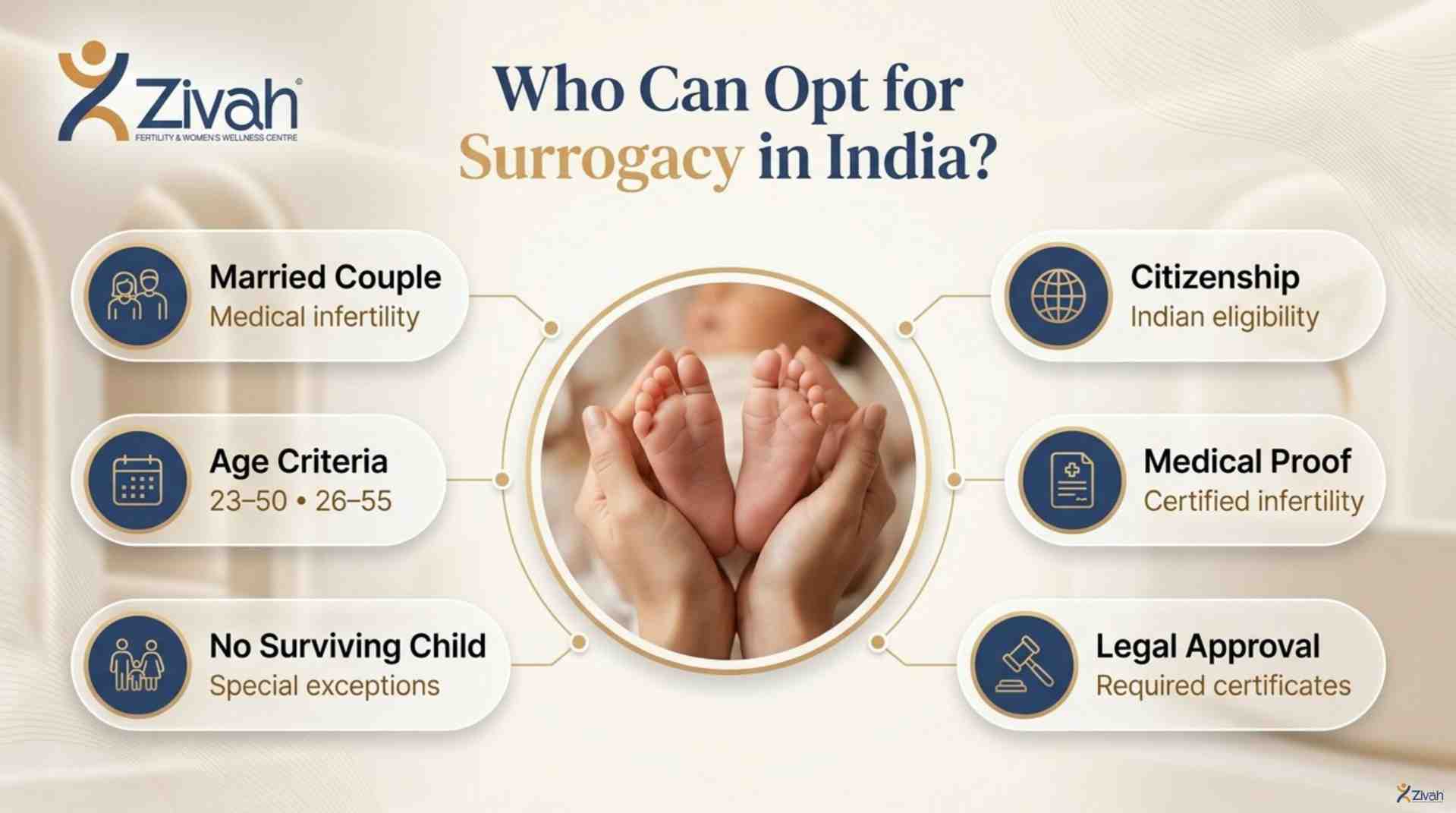
To qualify for surrogacy in India, you will generally need to meet the following:
- Status: an officially married couple who can't have children because of a medical condition
- Age guidelines: Women should be between 23 and 50, and men should be between 26 and 55.
- Existing children: there is no surviving child, but there are exceptions for disabled children.
- Citizenship: Indian people (you should check with a lawyer to make sure you are eligible for NRI and OCI).
- Proof of health: a document from a licensed doctor saying you can't have children
- Legal approval: A Certificate of Essentiality and a Certificate of Eligibility are legal proof.
It may sound like a lot, but you will never face this paperwork alone; we guide you through every form as part of what we do.
Can NRIs and OCI Cardholders Choose Surrogacy in India?
Many families living abroad ask us this, and we believe in giving you an honest answer rather than a hopeful one. Eligibility for NRIs (Non-Resident Indians) and OCI (Overseas Citizen of India) cardholders is not always straightforward, as the rules can change depending on how the Act is interpreted. Before you make any plans, we strongly recommend that you confirm your eligibility with a legal advisor. Our team is happy to help point you in the right direction.
Once you know you are qualified, the next person who matters most in this journey is the surrogate herself, so let's look at who can be one.
Surrogate Mother Requirements in India
The surrogate mother gives one of the kindest gifts anyone can give, so the law looks after her with clear, caring rules. Knowing the surrogate mother requirements in India early helps you plan with an easy mind, and it keeps her safe just as much as it helps you.
Under the Surrogacy (Regulation) Act 2021, a surrogate must be a married woman with at least one healthy child of her own. She must also fall within a certain age group and pass a health check and a mind-and-mood check (a psychological evaluation) before the journey begins. The law permits a woman to be a surrogate only once in her life, a sensible rule that puts her health and dignity first.
Does the Surrogate Have to Be a Relative?
One of the most common questions parents ask is “Can I be a surrogate?” and the answer is often a relief. The original 2019 Bill required a close relative, but the final Surrogacy (Regulation) Act 2021 changed this. As the law stands today, the surrogate must be a willing woman who meets the legal and medical criteria; she does not have to be a relative.
She can be a friend, an acquaintance, or any woman who volunteers, as long as she is an ever-married woman with at least one healthy child, falls within the legal age range, and clears all medical and psychological checks. If you are wondering how to find someone who fits, our team will gently walk you through it during your consultation.
| Requirement |
Legal Detail |
|---|---|
| Willingness |
Must be a willing woman volunteering for surrogacy |
| Marital Status |
Must be an ever-married woman (married, widow, or divorcee) |
| Age |
Must be between 25–35 years on the day of embryo implantation |
| Own Children |
Must have at least one healthy biological child |
| Health Screening |
Must pass medical and psychological evaluations |
| Surrogacy Limit |
A woman may act as a surrogate only once in her lifetime |
| Genetic Link |
Cannot use her own eggs; only gestational surrogacy is permitted |
Now that both the parents' and the surrogate's sides are clear, you might be wondering what the journey really looks like, day by day, so let's walk through the process at Zivah Fertility.
How Does the Surrogacy Process Work at Zivah Fertility?
The surrogacy journey can feel like a puzzle from the outside, but at Zivah Fertility, we have broken it down into clear, gentle steps, each one leading naturally into the next, so you always know where you are and what comes next.
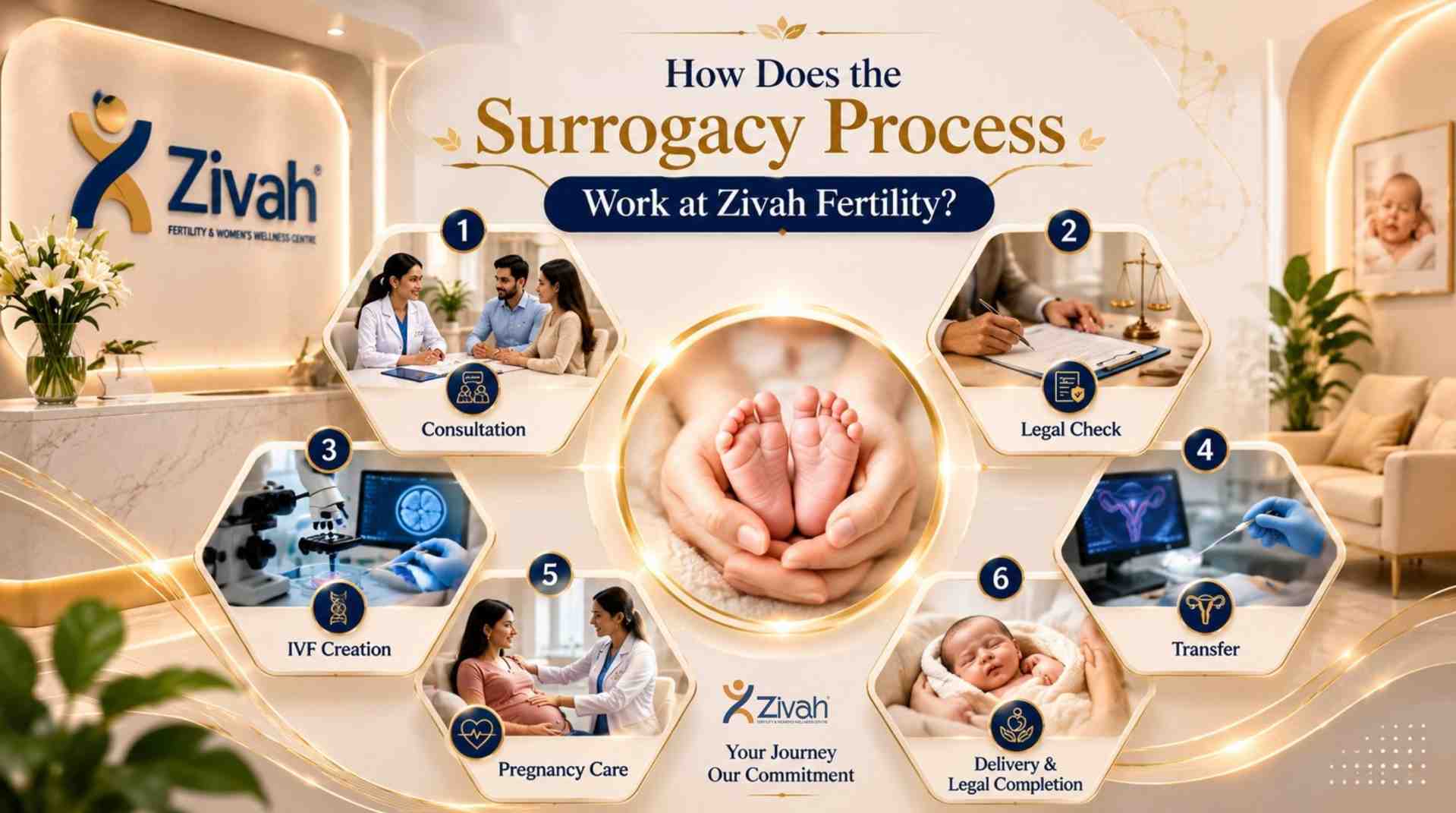
- Step 1: Free consultation and medical evaluation. We start by hearing your story and understanding what you need.
- Step 2: Legal eligibility check. Next, we walk you through the legal papers and certificates you need.
- Step 3: IVF cycle. Once our lab is set up, we carefully make your baby's embryo.
- Step 4: Embryo transfer. The baby is then put into the surrogate's womb with care.
- Step 5: Pregnancy monitoring and prenatal care. From here, good care is given to both the surrogate and your growing child.
- Step 6: Delivery and legal documentation. Finally, your baby comes home to you, fully and legally yours, with all the papers taken care of.
Each step rests on the one before it, which is why we never rush you; we simply walk beside you.
Which Certificates Do You Need Before Treatment Begins?
Before any treatment can be commenced, two legal certificates are required: the Certificate of Essentiality and the Certificate of Eligibility. Both are verified by the District Medical Board and confirm that your surrogacy complies with all legal requirements. It may sound daunting, but you will not go through this alone. Our team helps you gather and submit each one, so the law works for you, not against you.
| Certificate |
What It Confirms |
Verified By |
|---|---|---|
| Certificate of Essentiality |
That you genuinely need surrogacy on medical grounds |
District Medical Board |
| Certificate of Eligibility (Intended Parents) |
That the couple meets every legal condition to opt for surrogacy |
District Medical Board |
| Certificate of Eligibility (Surrogate) |
That the surrogate meets the legal requirements to carry the pregnancy |
District Medical Board |
With your certificates in place, it helps to know exactly which documents ensure everything is legal and secure, so let's look at the full set of documents surrogacy requires.
What Legal Documents Are Required for Surrogacy?
Paperwork is often the part that worries parents most, but the legal documents required for surrogacy in India are simply there to protect you, your baby, and your surrogate. Each one has a clear purpose, and you will never have to decode them alone; we will guide you through every form as part of how we care for you.

Who Helps You Prepare These Documents?
We do, at every step. Beyond the two certificates you have already met, a few more papers complete the legal picture, and our team prepares and submits each one with you:
- Surrogacy Agreement: the legal agreement that sets out the rights and responsibilities of everyone involved.
- District Medical Board approval: the official green light that must be in place before treatment can begin.
- Surrogate insurance: health insurance cover for the surrogate, exactly as the law requires
Once these are ready, you can move forward with confidence, knowing nothing has been left to chance.
| Document / Support |
What It Means for You |
|---|---|
| Surrogacy Agreement |
The legal agreement that clearly defines the rights and responsibilities of everyone involved |
| District Medical Board Approval |
The official approval required before the surrogacy process can legally begin |
| Surrogate Insurance |
Health insurance coverage for the surrogate, exactly as required under Indian law |
| Documentation Support |
Our team helps prepare, organise, and submit every required document with you |
| Legal Guidance |
We guide you step by step so nothing important is missed |
With the paperwork in safe hands, you may be wondering when surrogacy actually becomes the right medical choice, so let's look at the situations where it truly helps.
When Is Surrogacy Medically Needed?
For most couples, surrogacy is not a first choice; it is a path they reach after other doors have gently closed. And that is okay. Sometimes the body simply needs another way to carry a much-wanted baby.
Surrogacy often becomes the right step when one of these situations is present:
- Absence of the uterus: being born without a womb, or having it removed through surgery.
- Severe uterine damage: scarring or a malformation that makes carrying a baby unsafe.
- Repeated IVF failure: embryos that have not implanted despite several careful attempts.
- Recurrent pregnancy loss: more than one miscarriage with no safe way forward.
- A risky health condition: an illness that could put the mother or baby in danger during pregnancy.
If you see your own story here, please take heart; it simply means surrogacy may be the kind, safe option that finally brings your baby home.
How Do You Know If Surrogacy Is Right for You?
No website can tell you for certain; only a proper medical review can. If you have faced any of these situations, a gentle talk with a fertility specialist is the clearest way to understand your options. That is exactly what your free consultation at Zivah Fertility is for: no pressure, just clarity.
Once you know whether surrogacy fits your story, the next thing that matters is choosing the right hands to guide you, so here is why so many families trust Zivah Fertility.
Why Choose Zivah Fertility for Your Surrogacy Programme?
Choosing where to begin your surrogacy journey is one of the most important decisions you will make, and it deserves a clinic that offers more than just treatment. At Zivah Fertility, we bring together medical skill, full legal care, and genuine warmth, so you feel safe in every sense.

Our fertility specialists are experienced in IVF and reproductive medicine, and every surrogacy we support stays fully within Indian surrogacy law, no shortcuts, no grey areas. Our advanced IVF lab gives your baby's embryo the best start, and we wrap the whole journey in emotional support for you and your surrogate alike. From your first call to the day your baby arrives, one caring team stays by your side.
What Support Do You Receive at Every Step?
You are never left to figure things out alone. Choosing Zivah Fertility means you can count on:
- A doctor who knows your story: the same caring team from start to finish.
- A journey that stays legal: every step within Indian surrogacy law.
- Honest answers, always: clarity over pressure.
- Support for the heart, too: emotional care for you and your surrogate.
The table below shows where that support shows up.
| Support Area |
What We Provide |
|---|---|
| Fertility Specialists |
Experienced IVF doctors and reproductive experts |
| Legal Compliance |
Guidance fully aligned with Indian surrogacy law |
| IVF Laboratory |
Advanced embryo creation and monitoring |
| Emotional Counselling |
Support for intended parents and surrogate alike |
| Coordination |
One guided journey, from first call to delivery |
When you are ready to take the first gentle step, we are only a conversation away.
A Gentle Final Word
Surrogacy is a big journey, but you do not have to understand every step today ,you only have to take the first one. If your path to parenthood has been harder than you ever expected, please know that surrogacy offers a safe, legal, and deeply human way forward, and that you deserve to walk it with people who truly care.
"You do not have to carry the weight of this journey alone; let us carry it with you."
At Zivah Fertility, we are here to listen before we ever ask anything of you. Whenever you feel ready, a free consultation is waiting, no pressure, just warmth, honesty, and the quiet hope that your baby may be closer than you think.