Egg freezing is only a method for preserving your fertility today to give you more options tomorrow. In the medical world, it is called oocyte cryopreservation and includes retrieving your eggs, freezing them and storing them safely until you are ready to establish a family.
This guide covers all you need to know about egg freezing in India: how it works, what affects the cost, the right age to consider it, success rates and potential hazards. Whether you are planning around your profession, your health or just your own timing, egg freezing allows you the option to determine when parenting feels right. That choice at Zivah is always met with qualified attention.
What Is Egg Freezing?
It’s a fertility treatment that allows you to freeze your eggs for the future. A doctor removes healthy eggs from your ovaries, freezes them, and preserves them safely. This is also called as egg cryopreservation. Those eggs can be thawed and utilised to try for a pregnancy, years later, when ready.
The idea is simple: Your eggs are healthiest when you're young, so freezing them now keeps that quality on hold for later.
How Egg Freezing Preserves Fertility
Your eggs naturally change both quantity and quality over time. Fertility preservation for women is like reaching the pause button on that clock; you store younger, healthier eggs today and put them in the bank for whenever life seems right. So, can egg freezing save your fertility? Yes. It doesn't stop your body's ageing, but it does protect the eggs you freeze just as they are.
What Is Egg Vitrification?
Today’s egg freezing employs a technique called egg vitrification, a super-fast “flash-freezing” process. So how does egg vitrification actually work? The eggs are chilled so fast that no ice crystals can form inside them. That's important because the main concern with older, slower freezing was ice crystals. So each egg is protected by vitrification, which gives it a much better chance of surviving the thaw later on.
Who Should Consider Egg Freezing?
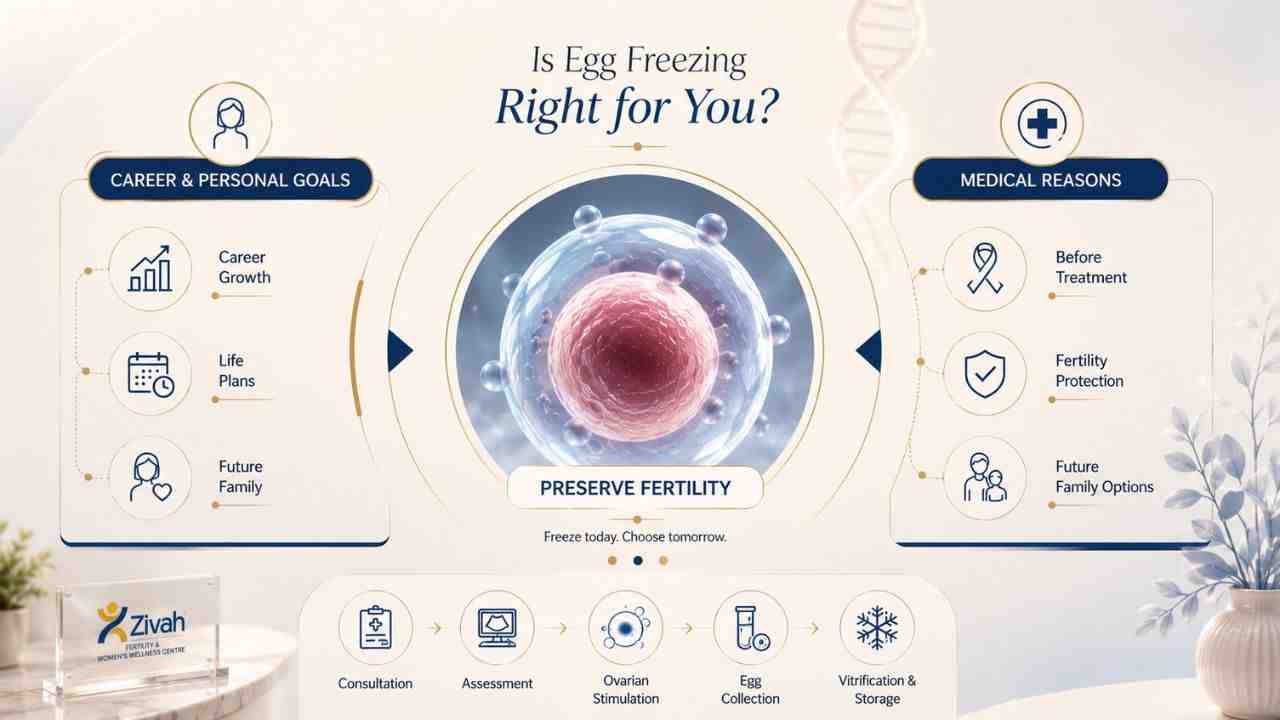
Can a woman freeze eggs in India? Yes. And more women than ever are choosing to. Egg freezing is not just for one kind of person but for everybody who wants to preserve their future fertility, for personal, medical or timing reasons. Let’s see who gets the most.
1. Egg Freezing for Career & Personal Reasons
For many women, egg freezing is a strong and forward-looking choice. Women with careers can freeze their eggs and focus on their objectives, relationships, or personal growth, while their eggs are safely stored at a younger age. This is often referred to as social egg freezing. So what is social egg freezing? It just means conserving your eggs for non-medical reasons, a way to maintain control over your own timing.
2. Egg Freezing for Cancer Patients & Medical Reasons
Some treatments can damage your fertility, and this is where egg freezing for cancer patients comes in. Freezing eggs before chemotherapy or radiation preserves your opportunity for a biological family later. Fertility preservation before cancer treatment is time-sensitive; it’s important to discuss it with your doctor as early as possible.
India ART Act: Eligibility & Age Limits for Egg Freezing
Thinking if single women can freeze eggs in India? Yes, you can. The ART (Regulation) Act, 2021, allows single and unmarried women to freeze their eggs for use later.
The conditions are simple: women up to the age of 50 can have their eggs frozen, and each centre must be registered under the national ART registry. So you can keep your fertility well before marriage, as long as you find a fully registered, trusted facility to do it.
Who Benefits Most from Egg Freezing
| Who Benefits |
Why Egg Freezing Helps |
|---|---|
| Career-focused women |
Proactively preserve egg quality while planning life on your terms |
| Cancer patients (pre-treatment) |
Preserve fertility before chemo/radiation affects the ovaries |
| Women with endometriosis |
Protect egg supply before the condition progresses |
| Family history of early menopause |
Bank eggs ahead of an anticipated earlier decline |
| Single / unmarried women (India) |
Legally keep options open without a partner at present |
Egg Freezing Process Step by Step
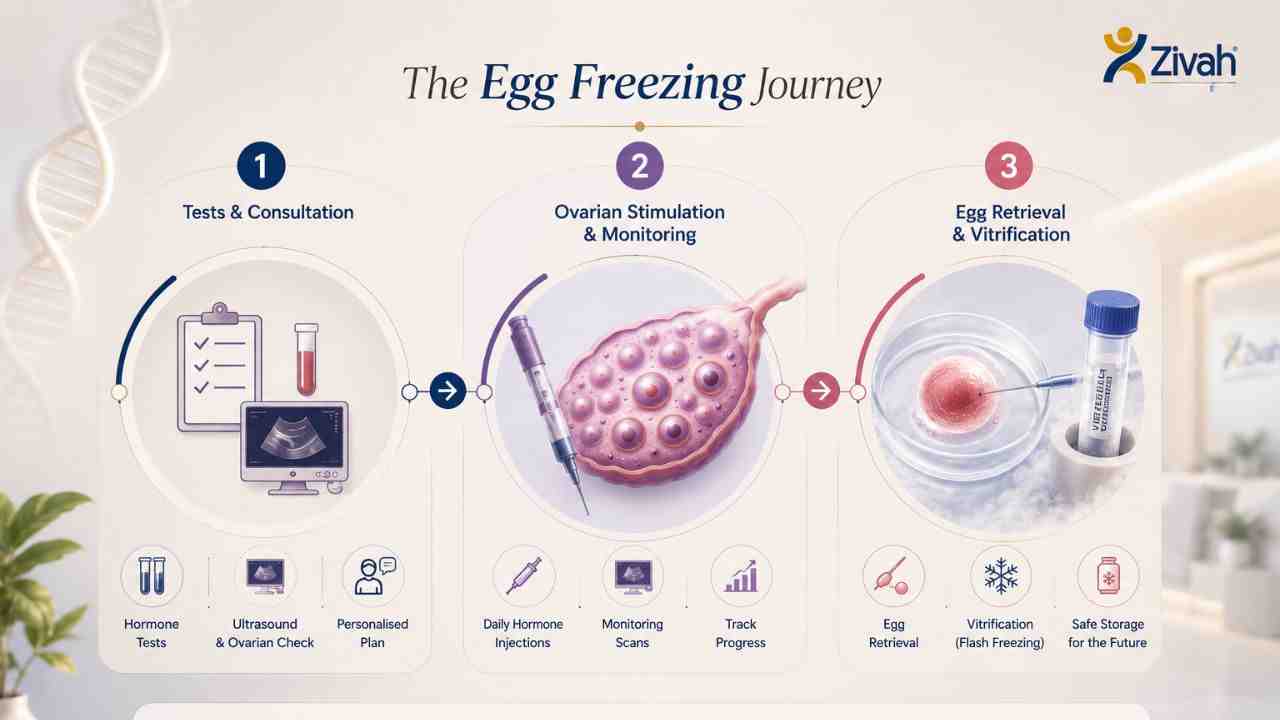
The egg freezing process, step by step, is simpler than most people think. From your first appointment to the day your eggs are safely frozen, the complete journey takes about two to three weeks, and breaks down into three straightforward stages.
Step 1: Tests & Consultation Before Egg Freezing
It begins with an egg freezing consultation. You will meet your fertility specialist, discuss your history and goals and have a few easy checks. So what tests are needed before egg freezing? Usually, hormone blood tests (such as FSH and AMH) and an ultrasound to assess your ovarian reserve, basically, how many eggs you have. Based on this, your doctor creates a plan customised for you.
Step 2: Ovarian Stimulation & Monitoring
Then we stimulate the ovaries. You will inject hormones every day for about 10-14 days. The injections will cause your ovaries to produce numerous eggs at once, as opposed to the one egg produced in a typical cycle.
Want to know how many injections are needed for egg freezing? It changes, but generally it's one or two little shots a day. You will have a few short scans and blood tests along the way, so your doctor can track progress and make changes if needed.
Step 3: Egg Retrieval & Vitrification
The eggs are then finally collected. So, how are eggs collected for freezing? When they’re developed, they can be collected in a quick, ultrasound-guided procedure under light sedation that lasts only 20-30 minutes, and you go home the same day.
The eggs are immediately frozen by vitrification, a rapid freezing method that protects them. How long does the egg freezing process take from beginning to end? Typically two to three weeks.
The Egg Freezing Process at a Glance
| Step |
What Happens |
Timeframe |
|---|---|---|
| 1. Consultation & testing |
Hormone tests (FSH, AMH), ultrasound, ovarian reserve check |
Day 2–3 of cycle |
| 2. Ovarian stimulation |
Daily hormone injections to grow multiple eggs |
10–14 days |
| 3. Monitoring |
Blood tests + ultrasounds to track follicles |
4–6 visits |
| 4. Trigger shot |
Final injection to mature the eggs |
~36 hrs before retrieval |
| 5. Egg retrieval |
Ultrasound-guided procedure under sedation |
20–30 mins |
| 6. Vitrification & storage |
Mature eggs flash-frozen, stored in liquid nitrogen |
Same day |
What Happens When You Use Your Frozen Eggs
When the time comes, your eggs are frozen and ready to go. So, can frozen eggs be used for IVF later? Yes, they are, that's what they're meant for. Using them is just the same stages as a typical IVF cycle.
Thawing, Fertilisation & Embryo Transfer
So, how are eggs thawed for pregnancy treatment? Your eggs are gently warmed and tested to determine which have survived the thawing process. The healthy ones are then fertilized with sperm, commonly by ICSI, where a single sperm is injected directly into each egg.
The fertilized eggs develop into embryos over the next few days, and the best one is placed into your uterus, just as with frozen eggs before IVF in any routine cycle.
One honest note: not all eggs survive thawing or fertilizing; therefore, the number of eggs you freeze early on makes a huge difference. The more healthy eggs you bank, the better your odds later on.
Best Age & Egg Freezing Success Rates
One thing practically every woman wonders is the best age for egg freezing. The truth is comforting; there is no one “right” age, only the right age for you. The good news is that your eggs are at their most fertile when you’re young, so the sooner you freeze them, the more you’ll have to work with down the line.
What Is the Best Age to Freeze Eggs?
Here’s a simple, age-by-age example to help you feel knowledgeable and in control:
- Late 20s to early 30s - top egg quality and number; a perfect, proactive time
- 30 to 35 - still a strong time, but a gradual transition is occurring; a good time to act with confidence
- 35 to 37 - quality begins to shift, and egg freezing after 30 and into this range is still very worthwhile
- 38 to 40 - reserve is naturally lower, but egg freezing remains a good option
- Over 40 - Can older women freeze their eggs? Yes, it depends on the case and your specialist.
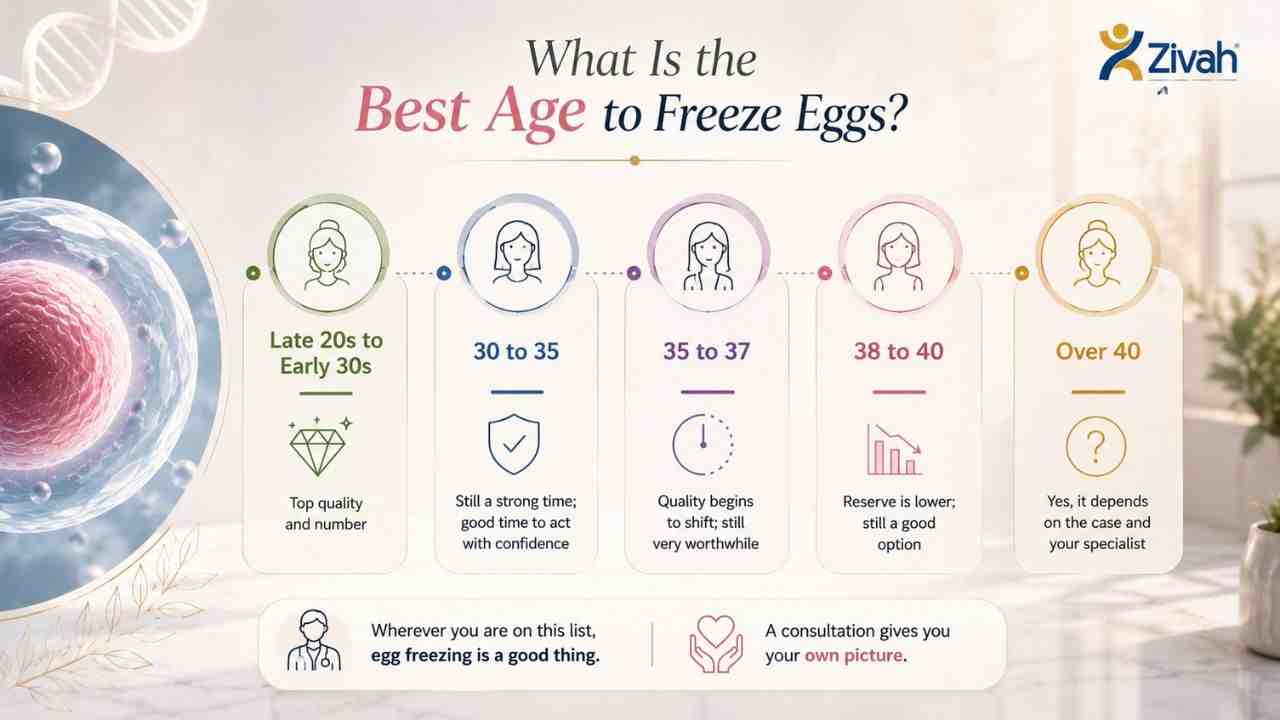
Wherever you are on this list, the message is the same: egg freezing is a good thing, and a consultation provides you with your own particular picture.
So, how many eggs should be frozen for pregnancy? Not every egg will thaw and fertilise; it depends on your age and your goals. Younger women need fewer as a guide, with a few extra eggs frozen to develop a bigger safety margin. Your doctor will suggest a number that works for you.
Egg Freezing by Age
| Age at Freezing |
Egg Quality & Reserve |
Empowering Guidance |
|---|---|---|
| Late 20s – early 30s |
Peak quality and quantity |
An ideal, proactive window to preserve options |
| 30 – 35 |
Strong; gradual change begins |
A great time to act with confidence |
| 35 – 37 |
Quality begins to shift after ~37 |
Still valuable; freezing more eggs helps |
| 38 – 40 |
Reserve naturally lower |
Beneficial; a consultation clarifies your personal picture |
| Over 40 |
Most eggs may be affected |
Considered case-by-case with a specialist |
Egg Freezing Cost in India
When it comes to egg freezing costs in India, you can be assured that there is no general pricing. The cost of egg freezing in India depends on your body and treatment plan, so the most straightforward approach to receive a number is a personalised quote. Nevertheless, it’s good to know what makes up the total.
What Influences Your Egg Freezing Cost?
So, how much does egg freezing cost in India? It comes down to a few moving components. What your egg freezing cost typically includes:
- Consultation & tests - hormone tests, ultrasound & your ovarian reserve evaluation
- Medication - stimulating hormones, dose varies from woman to woman
- Monitoring - blood tests and ultrasound scans during your cycle
- Egg retrieval - a simple operation done under minimal sedation
- Freezing (vitrification) - quick freezing and early storage of your eggs
The main variability here is medication. Because the dose is different from person to person, the total shifts too. Therefore, a single price for all seldom matches reality.
Annual Egg Storage Fees
And there’s storage to consider, too. So, how much does egg storage cost per year? After your eggs are frozen, they get stored in liquid nitrogen for a nominal yearly cost. This repeated egg storage fertility treatment costs just to safeguard your eggs till you choose to use them. The next clear step is to book a financial consultation with the Zivah team for an exact, tailored breakdown.
Egg Freezing Benefits, Side Effects & Risks
Of course, like any treatment, there are obvious benefits and a few things to be mindful of. Knowing both lets you make decisions with confidence. We’ll start with the benefits of egg freezing, then take an honest look at its adverse effects and safety.
Key Benefits of Egg Freezing
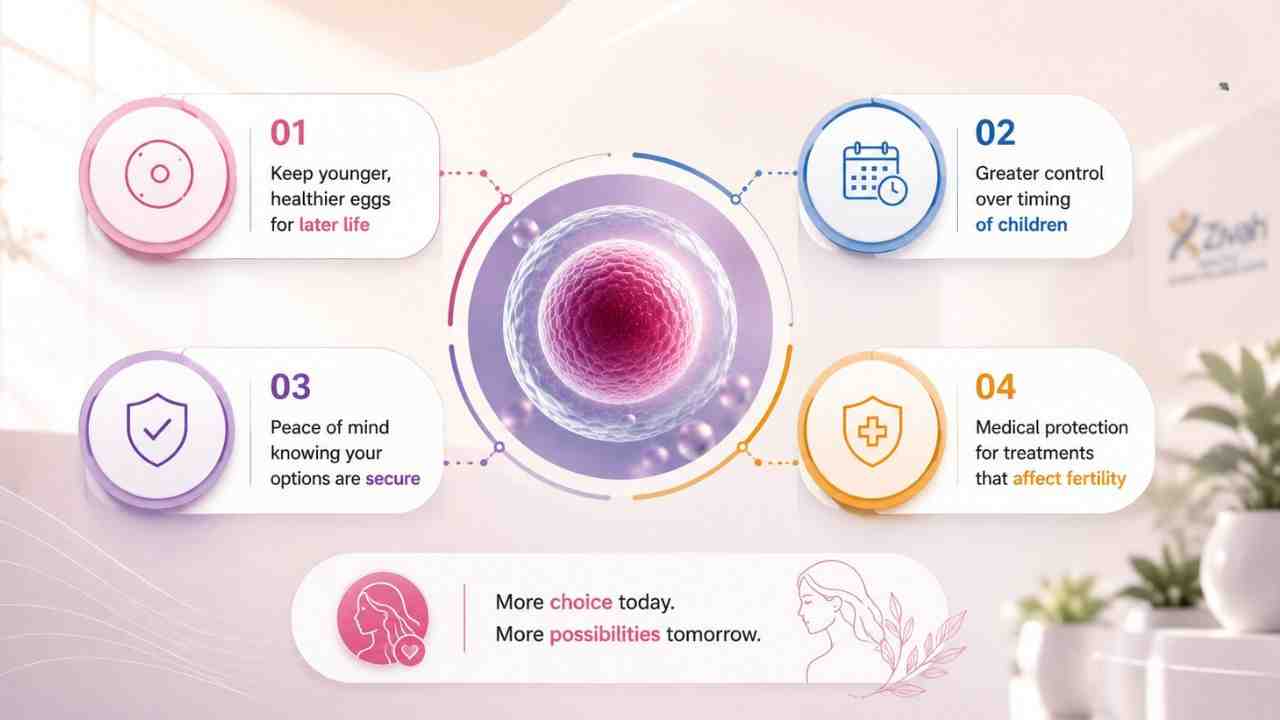
The best draw is freedom. The main advantages of egg freezing are:
- Keeping younger, healthier eggs for later life
- Greater control over the timing of children
- Peace of mind knowing your alternatives are secure
- Medical protection for women facing treatments that affect fertility
So should you freeze your eggs? For many women, that sense of agency and confidence is worth contemplating.
Side Effects & Is Egg Freezing Painful?
The good news is that most of the side effects of egg freezing are moderate and short-lived. The hormones can cause you to feel a little bloated, crampy, or moody, like a more intense menstruation.Is egg freezing painful? Not quite. It is done under a bit of anaesthesia, so you will not feel it, and any discomfort afterwards is usually mild. Usually, you only need one to two days off for egg freezing.
Is Egg Freezing Safe?
Yes, it’s safe for women and well proven. A common worry is that it uses up your future eggs, so here is the reassurance: it doesn’t. Freezing eggs does not impact your fertility afterwards; it’s just taking eggs your body would have released that cycle, regardless. One honest remark, it keeps your options open, but it doesn’t guarantee a future pregnancy.
Egg Freezing vs Embryo Freezing: Which Is Right for You?
In terms of preserving fertility, you have two primary options, and the decision of embryo freezing vs egg freezing essentially comes down to whether you want to fertilise your eggs now or later. What’s the difference between egg freezing and embryo freezing? With egg freezing, your unfertilised eggs are preserved, so you are still free to use any sperm source in the future. With embryo freezing, eggs are fertilised with sperm first, and then frozen, so you need to decide on a partner or donor now.
In short, egg freezing gives you more choices, whereas embryo freezing has somewhat better success rates. Egg freezing is generally best for singles or women who simply want to keep their choices open. Freezing embryos before IVF can be a good option for couples ready to start.
Egg Freezing vs Embryo Freezing
| Feature |
Egg Freezing |
Embryo Freezing |
|---|---|---|
| What's frozen |
Unfertilised eggs |
Fertilised eggs (embryos) |
| Sperm needed now |
No |
Yes |
| Best for |
Women without a current partner |
Couples ready to create embryos |
| Flexibility |
Choose any sperm source later |
Sperm source fixed at freezing |
| Success rate |
Slightly lower |
Slightly higher |
Egg Freezing at Zivah Fertility Clinic
Selecting the right egg freezing clinic can make all the difference to your experience and peace of mind. Through egg freezing treatment, Zivah combines current technology and truly personal care, so you feel supported at every step.
Why Choose Zivah for Egg Freezing
Zivah is an egg-freezing clinic that utilises the latest in vitrification technology, carefully regulated storage, and skilled embryologists who treat your eggs with the utmost care. The difference with our sophisticated fertility preservation procedure is that it’s never one size fits all. Your journey starts with a consultation and ovarian reserve tests, and then a stimulation strategy based on your body and your goals.
Book an Egg Freezing Consultation at Zivah
Ready to make your first step? An egg freezing consultation at Zivah is a pleasant talk with no pressure, so you may ask questions and understand your alternatives. If you’re considering oocyte freezing treatment for personal or medical reasons, our staff is here to advise you. Book your consultation today.