
Going through IVF (in vitro fertilisation) and wondering whether this embryo will finally be the one? That quiet fear after a failed transfer or a miscarriage is something we hear gently, all the time, and PGT-A (Preimplantation Genetic Testing for Aneuploidy) is one of the kindest ways to answer it. In simple words, it's a test that checks an embryo's chromosomes before it's placed in your womb, so you transfer with more confidence and less guesswork.
For many couples, that peace of mind changes everything. At Zivah Fertility, we don't just run the preimplantation genetic testing; we sit with you, explain what it means for your journey, and guide you every step of the way. And the first step is easy: a free consultation, whenever you're ready to talk.
What is PGT-A? (Preimplantation Genetic Testing for Aneuploidy)
So, what is PGT-A? The full form of PGT in medical terms is Preimplantation Genetic Testing for Aneuploidy, and it's simpler than it sounds. "Preimplantation" means before the embryo is placed in your womb. "Aneuploidy" means an embryo has the wrong number of chromosomes (the tiny structures carrying your baby's genetic instructions). So PGT-A is a gentle lab check that counts those chromosomes in each embryo before any transfer.
You may also hear it called preimplantation genetic screening, or see people search "what is PGT" in a hurry; it all points to the same thing. And the reason it matters is human, not technical: an embryo with the right number of chromosomes has a far better chance of a healthy pregnancy.
So instead of transferring and simply hoping, preimplantation testing helps you and your partner choose the embryo most likely to work. That's the real gift of pre-implantation genetics.
Why do couples come to us asking about PGT-A?
More and more couples reach out already asking about PGT-A by name, often after an IVF cycle or a loss, when they are ready for answers. It has quietly become one of the most trusted steps in modern fertility care, and at Zivah Fertility, it's exactly the question we're here to talk through with you, honestly and without rush.
Difference between PGT-A, PGT-M and PGT-SR
When you start reading about a PGT test, you'll quickly notice there isn't just one, there are three close cousins, and it's easy to mix them up. The good news is that the difference is simple once someone explains it kindly. All three are forms of preimplantation genetic screening, meaning they check an embryo in the lab before transfer.
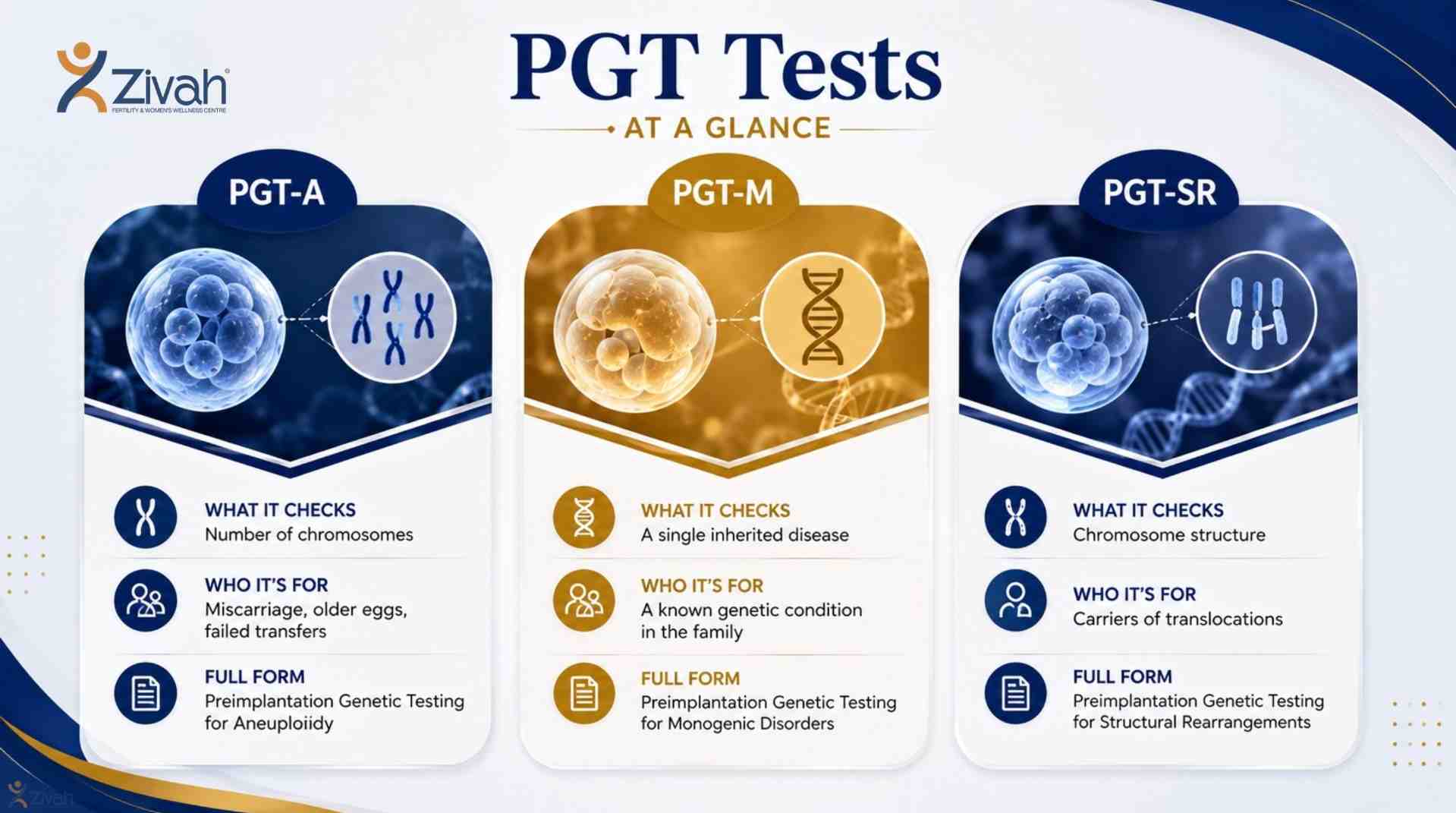
What changes is what each one looks at. PGT-A counts chromosomes, PGT-M looks for one inherited disease the family already knows about, and PGT-SR checks how the chromosomes are arranged. Most couples who come to us are asking specifically about PGT-A, but it always helps to see them side by side.
| Test |
Full Form |
What It Checks |
Who It’s For |
|---|---|---|---|
| PGT-A |
Preimplantation Genetic Testing for Aneuploidy |
Number of chromosomes |
Miscarriage, older eggs, failed transfers |
| PGT-M |
Preimplantation Genetic Testing for Monogenic Disorders |
A single inherited disease |
A known genetic condition in the family |
| PGT-SR |
Preimplantation Genetic Testing for Structural Rearrangements |
Chromosome structure |
Carriers of translocations |
If that first row sounds like your story, older eggs, a loss, or a transfer that didn't take, then PGT-A is likely the one worth exploring, and the next part will help you see if it truly fits.
Who should consider PGT-A?
There's no single "right" person for a PGT-A test, but there are a few situations where it tends to help the most, and you may quietly recognise your own story in them. This is where things often start to make sense if you've been trying for a while or have a worry you can't quite put your finger on. The most common reasons couples choose PGT-A are shown in the table below, along with the reasons each is important. This way, you can see whether it fits your journey in a gentle, clear way.
| You May Benefit From PGT-A If… |
Why It Matters |
|---|---|
| You’re over 35 |
Egg quality declines, so more embryos carry chromosome errors. |
| You’ve had two or more miscarriages |
Chromosome problems are a common cause |
| You’ve had failed IVF transfers |
A normal-count embryo can improve your odds |
| You’ve had a pregnancy with a chromosomal condition |
Screening helps you plan with more confidence |
| There’s severe male-factor infertility |
It can be linked to chromosome issues in embryos |
Not sure if PGT-A is right for you?
Deciding on a PGT-A test usually comes down to a few things, and it helps to see them plainly. It's often worth considering if:
- Your age is over 35: chromosome errors in embryos rise naturally as eggs get older.
- You've had miscarriages or failed transfers: these can point to chromosome problems.
- A past pregnancy involved a chromosomal condition: screening can offer more confidence next time.
Sometimes a single factor makes PGT-A worthwhile; other times it's the pattern across several. And if you're young with no losses behind you, it may add little, which is just as useful to know. That's why a free consultation with Zivah is the clearest next step: we look at your full picture and tell you honestly whether a PGTA test will genuinely help, before you commit to anything.
How PGT-A works at Zivah Fertility
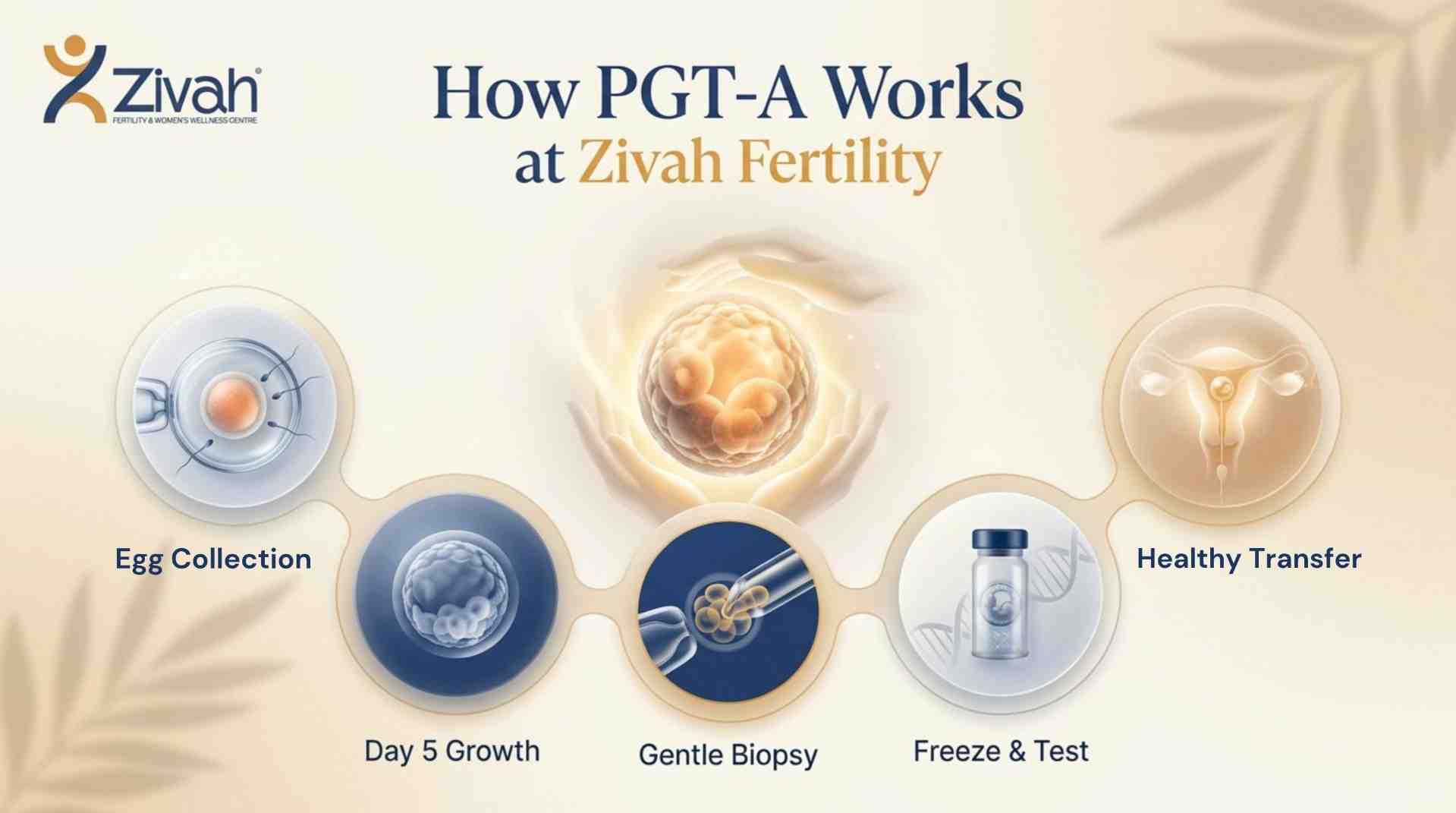
When you choose PGT-A with Zivah, nothing happens in a rush; every step is explained before it begins. Here's how our team take care of your journey, from start to transfer:
- Egg collection and fertilisation: We collect your eggs and fertilise them with sperm in our lab.
- Growing to day 5: the embryos grow to the blastocyst stage, when there are enough cells to sample safely.
- A gentle biopsy: our embryologists carefully remove just a few outer cells (this is the preimplantation testing step).
- Freezing and analysis: your embryos are frozen safely, while the sampled cells go to a specialised genetics lab.
- Healthy transfer: once results are back, we explain them and transfer the strongest embryo in a later cycle.
That's the quiet strength of a PGT, a journey done well. Every stage is deliberate, and you're never left guessing.
Is the embryo biopsy safe?
Yes, you have a right to ask. When an expert embryologist performs the biopsy, they only take a few outer cells. These cells will not become part of your baby for a long time. Your embryos are kept safely frozen throughout, and a PGT-A biopsy doesn't affect their chances of implanting. We take great care with this careful, regular step.
PGT-A results: what they mean for your transfer
Once your PGTA test results come back, we never just hand you a report and leave you to decode it; we sit with you and explain, in plain words, what each result means for your transfer. Most fall into one of three groups:
| Result |
What It Means |
What We Usually Do |
|---|---|---|
| Euploid |
Normal number of chromosomes |
Usually transferred first — best chance of a healthy pregnancy |
| Aneuploid |
Abnormal number of chromosomes |
Generally set aside — a common cause of failed transfers and miscarriage |
| Mosaic |
A mix of normal and abnormal cells |
Talked through gently, case by case, and decided together |
Here's the honest part: a pgt a test improves your odds of choosing a healthy embryo and can lower the risk of miscarriage, but no test can promise a perfect outcome.
How long do PGT-A results take?
Most couples find out the results about one to two weeks after the biopsy. This is because the cells are being studied in a genetics lab. When you're hoping, the wait can seem long, but your embryos stay safe and frozen the whole time, and we keep you informed, so you never have to guess. As soon as the results are ready, we'll quickly go over them with you before moving on to the next step.
Is PGT-A safe and legally allowed in India?
You may be wondering whether PGT-A is permitted here, and the answer is reassuring. Under Indian law, the Assisted Reproductive Technology (ART) Regulation Act 2021 fully permits PGT-A as a valid medical test to assess a baby's chromosomes. So when it's done for the right reason, helping you choose a healthy embryo and lower the risk of miscarriage, you're on firm, legal ground.
There is one important line the law draws, and we want you to know it clearly: PGT-A cannot be used to choose your baby's gender. Sex selection is prohibited by law in India, and no ethical clinic will offer it.
At Zivah Fertility, we follow these rules closely, not just because they're the law, but because honest, responsible care is the only kind we believe in, and it's exactly what you deserve as you take this step.
Why choose Zivah Fertility for PGT-A
If you've had a cycle fail or sat with the quiet fear after a miscarriage, you don't need more pressure; you need a team that listens and tells you the truth. That's what we try to be. Here's what couples find when they choose us for PGT-A:
- Answers before transfer, not after: we help you understand your embryos first, so you move forward with confidence instead of crossed fingers.
- Honest guidance: if PGT-A will genuinely help your case, we'll say so; if it won't, we'll tell you that too.
- Skilled hands: Our embryologists are very careful with every test and transfer they do.
- A free meeting to start: there's no charge, no obligation, just a calm talk about your story.
You may have already had enough of waiting. The sooner we talk, the sooner you'll know what to do next.

PGT-A support across India, including Hyderabad
Wherever you are, distance shouldn't stand between you and answers. We support couples seeking PGT-A right across India, and if you've been searching for pgta clinics in Hyderabad, you're warmly welcome to start with us too. A free consultation is the simplest first step, from anywhere.
Your next step with Zivah Fertility
Choosing PGT-A is really about one quiet wish, to give your next transfer the best, calmest chance you can. And you don't have to figure it out alone. Whether you're carrying the weight of a past loss, a cycle that didn't work, or simply the hope of getting it right this time, we're here to listen and guide you with honesty and care.
Wherever you are in your journey, the first step is gentle and free. Connect with Zivah Fertility today, and let's take that step toward parenthood together.