

So much of this journey is carried quietly, and at Zivah Fertility we hold that weight with you through psychological counselling. The time it takes to get an answer after a scan. The cycle that did not work and the smile you had to force yourself to keep together afterwards. The questions from family that come with love and feel like they weigh a lot. And deep down, the fear of hoping again.
Our counselling sessions are private and one-to-one, with a counsellor who already understands what fertility treatment and loss do to the mind. You do not have to be at breaking point to sit with us. Needing support is not a weakness in you, and here you can begin speaking without having to explain the basics first.
On this page you will find what counselling involves, the signs it is time to speak to someone, who it is for, how the sessions work, and what support looks like after a cycle that did not go your way.
What Is Psychological Counselling?
Psychological counselling at Zivah Fertility is an organised, private conversation with a trained professional who helps you understand what you are feeling and offers something steady to hold on to. It is talking-based work. You speak, your counsellor listens, and together you make sense of what has been sitting heavily inside you. Nothing is prescribed in the room.
Is psychological counselling only for people with a mental illness? No. Most women who come to us are not unwell in any way they can name. They are simply carrying more than one person was meant to carry alone. The meaning of psychological counselling is simpler than most expect. It is a place where you are heard properly.
Is Counselling the Same as Seeing a Psychiatrist?
No, and it's important to be clear about this because many women don't ask for help because they're afraid of being sent to a psychiatrist. A psychiatrist is a doctor who diagnoses illnesses and prescribes medication. A counsellor works by talking to people. A psychological counsellor helps you understand your feelings, your grief, and your patterns, and then they teach you how to deal with them.
If medical support would ever help you, your counsellor would say so honestly. Nothing moves without you. What you bring through the door shapes what happens in the room. Some women arrive with a grief no one has named. Others come because they can no longer feel anything at all. The table below shows the ground our counselling covers.
| Area of Support |
What Brings Women In |
How Zivah Helps You |
|---|---|---|
| Depression & Low Mood |
Persistent sadness, low energy, or loss of interest |
We assess your concerns and provide structured psychological support |
| Anxiety |
Racing thoughts, constant worry, or sleep difficulties |
We identify triggers and teach practical coping strategies |
| Grief After Loss |
Emotional distress after miscarriage or a failed cycle |
We provide space and support to process grief |
| Self-Worth & Body Image |
Feeling that your body has failed you |
We help rebuild self-compassion and healthier thinking |
| Family & Social Pressure |
Comparison, guilt, or difficult questions |
We help you set boundaries and manage emotional pressure |
| Adjustment & Uncertainty |
Difficulty coping with a diagnosis or major life change |
We help you adjust and regain emotional stability |
None of this needs to be severe before it is worth speaking about. You do not have to wait until something breaks. If you are unsure whether what you feel counts, the signs below may help you decide.
Signs You Need Psychological Counselling
A lot of women wait too long. They tell themselves that other people have it worse and that this is just the price of the journey. The pain will go away when the next cycle starts. The signs that you need counselling don't always show up. They come slowly, and you have to get used to them until it's no longer a problem.
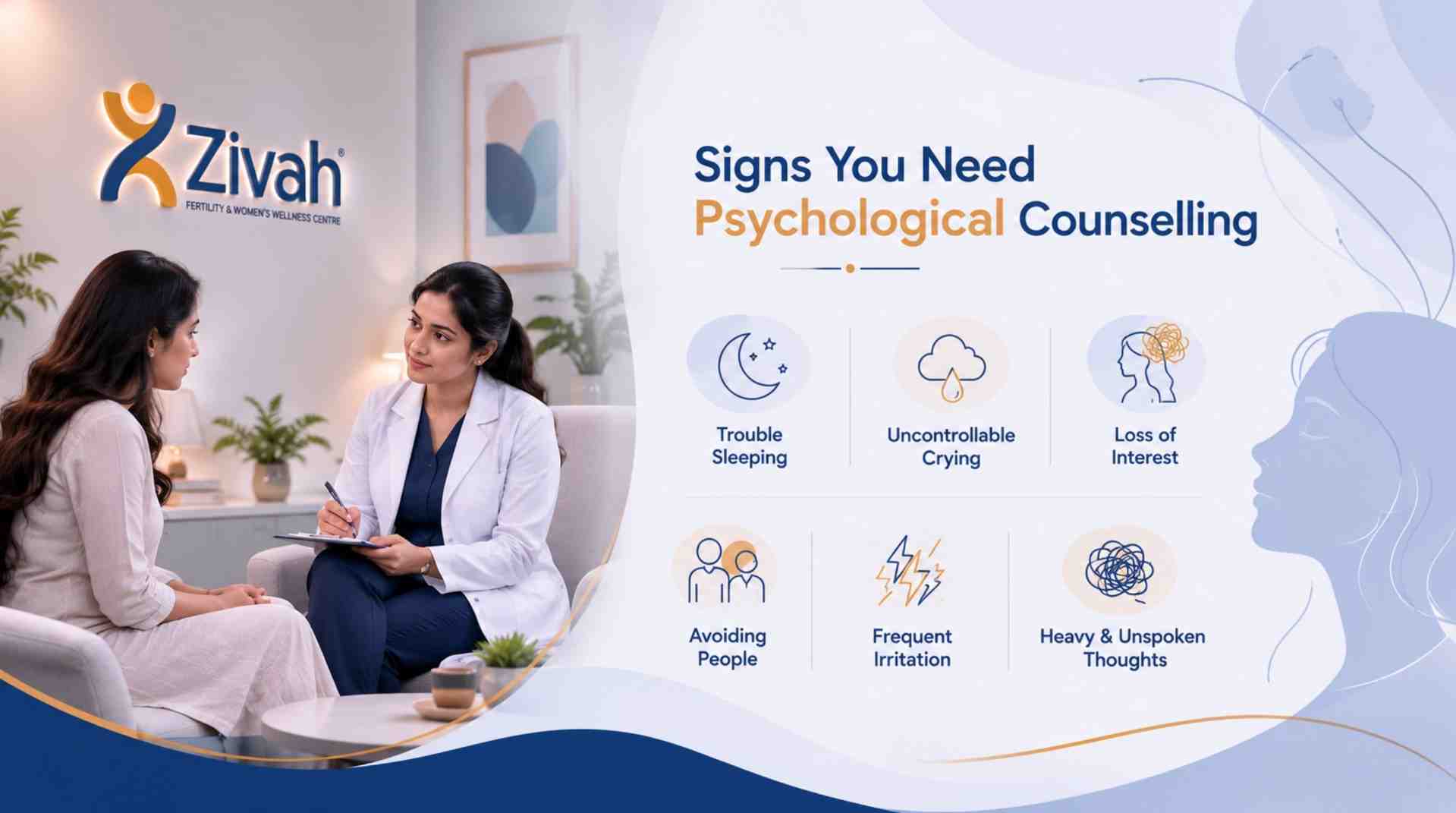
These are the ones that matter, and most of them are quieter than you would expect:
- Sleep that has been gone for weeks, not nights.
- Crying that comes on by itself and won't stop even if you tell it to.
- Things you used to love no longer make you happy.
- Stay away from the people you care about, especially those who are pregnant.
- Get angry with your partner over small things that didn't matter before.
- Not feeling anything at all, which scares you more than being sad ever did.
- Thoughts you haven't been able to tell anyone out loud.
How do I know if my sadness is normal or something more? It comes down to duration and function. Two hard days after bad news is grief, and grief is not an illness. Two weeks where you cannot get through your day is a signal. Not a verdict. A signal. None of this means something is wrong with you. It means you have carried too much for too long.
When Should You Stop Waiting and Speak to Someone?
Sooner than you are probably allowing yourself. Most women who ask when to seek help for depression have already been carrying it quietly for months, waiting for a moment that feels bad enough to justify asking. That moment does not come. There is no threshold you must cross first, and no amount of suffering that qualifies you.
If you have been asking for weeks whether this will pass, that question is your answer. You do not need to be certain you need counselling. You only need to be tired of carrying it alone.
Who Should Book Psychological Counselling at Zivah?
No one type of woman comes to see us for counselling. Some of them are right at the start. Some have been there for years. Some people have never been to a fertility clinic and never will. What they talk about is not a diagnosis. It is a season of life that has grown heavier than they expected. Do I need a diagnosis before I can book? No. You do not need a reason that is good enough. You only need to want to feel better. Nobody at Zivah will ask you to justify the appointment, or decide whether what you carry is serious enough to deserve an hour.
If you are wondering who should see a counsellor during fertility treatment, the answer is anyone for whom it has stopped being only a medical process and started becoming an emotional one. That happens to most women eventually.
Can I Come Even If I Am Not in Fertility Treatment?
Yes, and many women do. Zivah is a women's health clinic, not just a fertility clinic, and our counselling for women is open to you, whatever brought you here. A diagnosis you are still adjusting to.
A daughter you are worried about. Years of low mood that have nothing to do with conception. Mental health support for women should not require a reason that fits a category. If you need to speak to someone, that is reason enough.
Each woman comes to us at a different time and for a different reason. Some people are getting ready for something. Some are recovering from it. The table below sets out who most often sits in that room.
| Who You Are |
Why You Come |
How Zivah Helps You |
|---|---|---|
| Beginning Fertility Treatment |
Fear and uncertainty about treatment |
We provide emotional preparation and coping support |
| After a Failed Cycle |
Grief, anger, or loss of hope |
We help you process emotions before deciding next steps |
| After Pregnancy Loss |
Ongoing grief and emotional distress |
We provide support at your own pace |
| Living with PCOS or Early Menopause |
Diagnosis-related distress or changes in self-image |
We support adjustment and emotional wellbeing |
| Adolescents & Young Women |
Anxiety, body-image concerns, or social pressure |
We provide age-appropriate, confidential support |
| Living with Long-Term Depression |
Persistent emotional difficulties beyond fertility concerns |
We assess your needs and provide or coordinate suitable care |
| Seeking General Mental Health Support |
Stress or emotional difficulties unrelated to fertility |
We provide support based on your individual needs |
If you saw yourself in any of those people, you already know the answer. Even if you didn't, that doesn't mean you can't win. It's still a good idea to get counselling after a loss, a diagnosis, or just about anything else.
How Psychological Counselling Works
Most of the fear women bring to a first appointment stems from the unknown. Nothing is done to you here. How counselling works is simpler and slower than most people imagine.
You talk. Your counsellor listens attentively and takes the time to understand your history before making any suggestions. Together, you find the hardest thing, which is not always what you came in expecting to say. Only then is a plan agreed between you. This is talk therapy in the truest sense. Some women need a handful of sessions.
Others carry something older and heavier. Your Zivah counsellor will advise how many sessions suit your situation, honestly rather than commercially.
Which Approach Will My Counsellor Use?
That is up to you and what you're carrying. It is not chosen for you. There are different kinds of counselling, and each one works best for a different type of weight.
Cognitive behavioural treatment (CBT) has the most research behind it, and it's often the first thing we try when someone is depressed or anxious. It changes the ways of thinking that keep pulling you down. When sadness is the problem rather than thought, we work differently.
No one way works for everyone, and most women switch between them. The most important thing is that the method works for you right now. The ways we work are shown in the table below.
| Approach |
Best Suited For |
How Zivah Helps You |
|---|---|---|
| Cognitive Behavioural Therapy (CBT) |
Anxiety, overthinking, and negative thought patterns |
We help identify and change unhelpful thinking and behaviour patterns |
| Supportive Counselling |
Emotional distress and the need for a safe space to talk |
We provide non-judgmental listening and emotional support |
| Grief-Focused Counselling |
Miscarriage, pregnancy loss, or failed fertility treatment |
We support you in processing grief and adjusting to loss |
| Psychoeducation |
Understanding symptoms, emotions, and mental health concerns |
We explain psychological experiences in clear, practical terms |
| Crisis Support |
Severe or overwhelming emotional distress |
We assess immediate safety needs and arrange appropriate urgent support |
You don't need to know which one you need. That's the job of your counsellor, and it will be one of the first things you talk about.
What Happens in Your First Counselling Session?
A quiet room. Two chairs. No one else present. Your first counselling session runs roughly forty-five minutes to an hour, and for most of it you will simply be talking to someone whose only task is to understand you.
Will my family or my doctor be told what I say? No. What you say in that room stays in that room. Nothing reaches your husband, your in-laws, or even your treating doctor at Zivah, unless you ask us to share it. Counselling is confidential, and that is the foundation on which the whole thing rests.
You are never pushed to speak before you are ready. And if you are wondering what if I cry, or cannot find any words at all, both happen often, and neither is a failed session. Your counsellor has sat with both and will not hurry you.
What Should You Bring, and How Do You Prepare?
Almost nothing, which surprises most women. There is no right way to arrive. Still, a few small things make a first therapy appointment easier:

- Details about your health or care, but only if you think they are important to you.
- A rough idea of what's been hard lately, even if you can't put your finger on it.
- Time afterwards, so you are not walking straight into something demanding.
- There was nothing practised, and you didn't act like you think we expect you to.
That is genuinely all. How to prepare for a counselling session comes down to allowing yourself to arrive as you are.
How Does Counselling Help After a Failed IVF Cycle?
There is the day the result comes. Then there is the silence afterwards, which no one prepares you for. People mean well. They say at least you can try again, and they cannot understand why that sentence lands like a stone.
It does three things to get counselling after an IVF fails. It lets the sadness out instead of staying with you while everyone waits for you to get back to normal. It keeps you from having to choose a next cycle during the worst week of your life. And it makes you ready for whatever comes next.
What counselling will not do is change the outcome of a cycle. Nothing you felt caused this. Emotional support after IVF failure is not an infertility treatment. It is care for the person living through it. Sessions can be arranged around your result dates, so support is there in the week you need it.
How Long Does the Grief Usually Last?
We will not give you a number, and you should be careful of anyone who does. Grief after failed IVF keeps no schedule. It does not lift on a timetable, and it does not care how long it has already been.
What we can tell you is that it changes shape. The rawness of the first weeks does not stay raw. If you are searching for how long IVF grief lasts because it has gone on longer than you expected, that is not a sign you are failing. It is simply what grief does.
Grief after a failed cycle rarely arrives as one clean feeling. It comes as guilt, then numbness, then a strange pressure to move on before you are ready. The table below outlines what women bring us during those weeks.
| What You Are Living Through |
What It Often Feels Like |
How Zivah Helps You |
|---|---|---|
| The Days After the Result |
Numbness, disbelief, or intense sadness |
We provide timely emotional support |
| Grief Others May Not Understand |
Mourning a pregnancy or hoped-for future |
We recognise the loss and support healthy grieving |
| Guilt & Self-Blame |
Feeling responsible for what happened |
We help challenge harmful self-blame |
| Pressure to Try Again Quickly |
Feeling rushed into another treatment cycle |
We help you process emotions before making decisions |
| Deciding on Another Cycle |
Fear and uncertainty about trying again |
We support clear, informed decision-making |
| Choosing to Stop Treatment |
Grief, guilt, or uncertainty about stopping |
We provide non-judgmental support for your decision |
Whichever line you find yourself on, you do not have to work it out alone, and you do not have to work it out this week.
Why Choose Zivah Fertility for Psychological Counselling
Most women who reach us have already told their story too many times to too many people and have been met with advice they did not ask for. What they want is somewhere they do not have to start from the beginning again.

That is what we have built here:
- A professional counsellor who already understands fertility, so you never have to explain the basics before you can begin.
- Confidential counselling, without exception, and without your family or your treating doctor being told.
- Sessions that are planned around your treatment schedule, even the hardest weeks.
- Time to yourself, in a room where no one will judge what you say.
If the weight of this journey has started to sit in the silence between you and your partner, rather than only inside you, our couples counselling service is built to hold both of you together. But if what you need is a place that is only yours, this is it.
Counselling also looks different depending on what brought you here, and there is no single format everyone is placed into. Some women need a short, focused period of support. Others need something steadier. The table below sets out the options.
| Option |
Best Suited For |
How Zivah Helps You |
|---|---|---|
| Individual Counselling |
Personal emotional or mental health concerns |
We provide private, one-to-one support |
| Short-Term Support |
A specific crisis, failed cycle, or pregnancy loss |
We provide focused support for a defined period |
| Ongoing Therapy |
Persistent anxiety, depression, or long-term difficulties |
We provide continued therapy based on your needs |
| Adolescent Counselling |
Young people facing anxiety or body-image concerns |
We provide age-appropriate and confidential support |
| Referral to Couples Counselling |
Relationship strain affecting both partners |
We connect you with suitable couples support |
If none of these feels quite like you, that is not a problem. Your counsellor will work out the right shape with you in the first session, and it can change as your needs do.
Book Your Psychological Counselling Session at Zivah Fertility
Most women wait for a reason good enough. Something that would sound serious if they said it aloud. A diagnosis, a crisis, a moment bad enough to justify taking up someone's hour.
There are no such changes. You do not have to be at breaking point, and you do not have to be able to explain why you are struggling. Wanting to feel lighter than you do right now is reason enough, and it always has been.
You do not have to arrive knowing what to say, either. Whatever brought you to this page, you have already done the hardest part: admitting to yourself that you would rather not carry it alone.
To book a psychological counselling appointment for women at any stage of this journey, or simply to talk to a counsellor who will listen without hurrying you, we are here whenever you are ready.