

The complete blood count (CBC) is one of the most popular blood tests in medicine. It is also called the complete blood picture (CBP) in India and sometimes the full blood count.
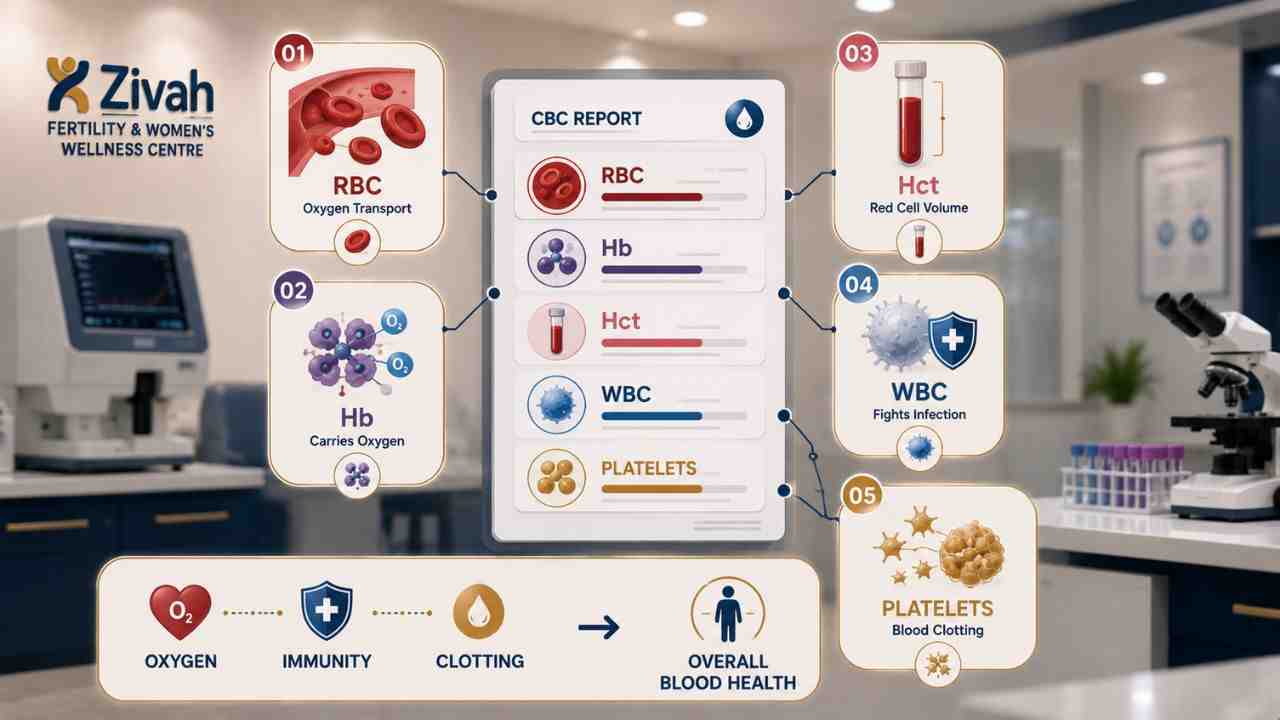
This CBC blood test looks at the amount, size, and cell types in your blood from a single sample. It looks at the red cells that carry oxygen, the white cells that fight infection, the platelets that help your blood clot and your haemoglobin level.
On this page, you’ll learn what a CBC measures, why it’s arranged, if you need to fast, and how to interpret your results, with and without a differential. It’s a very complete picture from a very simple test.
What Is a Complete Blood Count (CBC)?
The full form of CBC is Complete Blood Count; it's a normal blood test. You may also see it called a full blood count, or, across India, a complete blood picture (CBP). Whatever it's called, it does the same: it counts and measures the main types of cells in your blood from one tiny blood sample.
A CBC, in simple terms, provides your doctor with a brief, overall view of your blood health. It is used to check for common disorders such as anaemia (not enough red cells), infection (indicated by white cells) and clotting problems (platelets), which explains why it is one of the most commonly ordered tests of all.
What Does a CBC Measure?
The CBC tests for three types of blood cells and two essential measures of your red blood cells. Your red blood cells deliver oxygen, your white blood cells fight infection, and your platelets help your blood clot. It also measures your haemoglobin and hematocrit levels, which show how well you can carry oxygen.
What a Complete Blood Count Measures
| Blood Component |
What It Does |
What It Screens For |
|---|---|---|
| Red blood cells (RBC) |
Carry oxygen around the body |
Anaemia, dehydration |
| Haemoglobin (Hb) |
Oxygen-carrying protein in red cells |
Anaemia, oxygen capacity |
| Haematocrit (Hct) |
Share of blood made up of red cells |
Anaemia, dehydration |
| White blood cells (WBC) |
Fight infection and disease |
Infection, inflammation |
| Platelets |
Help blood clot |
Bleeding or clotting issues |
RBC Indices: Red Blood Cell Metrics Explained
A CBC doesn’t just count your red blood cells, it describes them. Not only how many. These descriptions, called RBC indices, tell your doctor about the size and quality of each cell. You will see four of these on a report. MCV is the average size of your red cells. MCH and MCHC tell us how much haemoglobin is in each cell, i.e., how much oxygen-carrying protein it contains.
And RDW ( red cell distribution width ) gives you a sense of how much your cells vary in size from each other. On their own, they sound technical, but together they offer something useful: they help pin down the nature of a problem, particularly when it comes to anaemia.
Classifying Anaemia: Microcytic vs Macrocytic
This is where the MCV earns its keep. If red cells are smaller than normal (an MCV of less than roughly 80 fL) this is called microcytic anaemia and most typically reflects iron deficiency.
When they are larger than normal (an MCV over about 100 fL), it is macrocytic anaemia, which can signal a vitamin B12 or folate deficit. In the case of a normal MCV with increased RDW, this could be an early hint that more than one insufficiency is present.
CBC vs CBC with Differential: What's the Difference?
You may see a CBC organised in two ways, and the difference is simple. A basic CBC will tell you the total white blood cell count. A CBC with differential takes it a step further and divides that total down into the five main types of white cell, showing you how much of each you’ve got.
What’s the difference? The total tells you if your white-cell count is high or low; the difference tells you which cells are driving the change, and that often provides a clue to the cause.
For routine checks, the doctor can order the basic test, adding the differential when an infection, allergy or specific white-cell issue calls for a closer examination.
What Does a CBC with Differential Show?
A differential shows you the balance of your five types of white-blood cells: neutrophils, lymphocytes, monocytes, eosinophils and basophils. They each have a particular job. So a change in any of them can indicate a different direction. An increase in neutrophils with a bacterial illness, for example, or in eosinophils with an allergy.
Automated vs Manual Differential (When a Smear Is Reviewed)
Most differentials today are done by machine: an auto-diff, where the analyser counts cells automatically. It is rapid and accurate for typical samples. But if the auto-differential flags something odd, a pathologist will come in and look at a manual blood smear under the microscope, verifying the finding by eye before it goes out.
The Five White Blood Cell Types (CBC Differential)
| White Cell Type |
Primary Role |
What a Change May Suggest |
|---|---|---|
| Neutrophils |
First responders to infection |
Bacterial or fungal infection |
| Lymphocytes |
Fight viruses, build immunity |
Viral infection |
| Monocytes |
Clear debris, alert the immune system |
Chronic infection, inflammation |
| Eosinophils |
Tackle parasites and allergens |
Allergy, parasitic infection |
| Basophils |
Release histamine in allergic reactions |
Allergic response |
Why Is a CBC Test Done?
It is ordered for three general reasons. The first thing you can do is examine your general health, a CBC blood test is a regular part of many check-up routines. The second is to look at symptoms, helping a doctor figure out what’s behind things like fatigue, a fever or unknown bruising.
The third way is to check for an existing condition or to look at how a treatment is affecting your blood. This is why the CBC test is so often used; it is so flexible. It can identify an issue early, direct toward the next test, or validate that everything is running as it should from a single sample.
What Is a CBC Blood Test Used For? Common Diagnostic Triggers
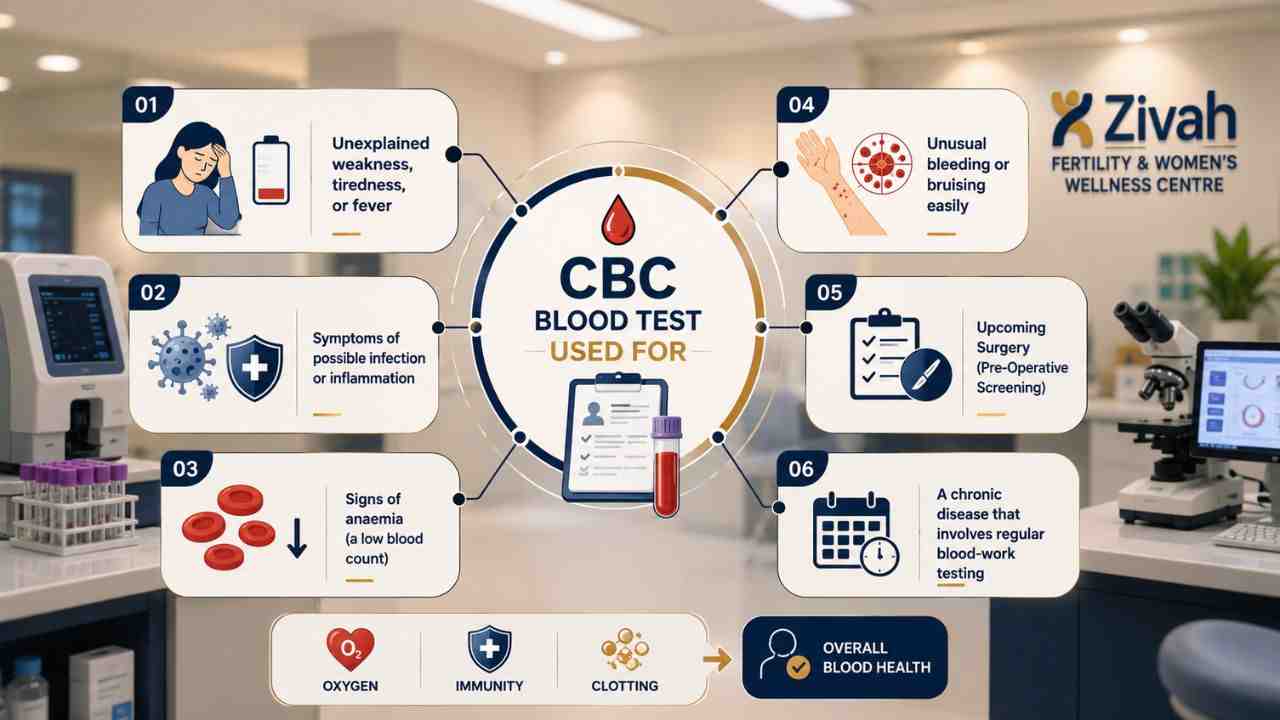
A doctor may request a CBC test if you have some of the most common purposes of the CBC test:
- Unexplained weakness, tiredness, or fever
- Symptoms of possible infection or inflammation
- Signs of anaemia (a low blood count)
- Unusual bleeding or bruising easily
- Upcoming Surgery (Pre-Operative Screening)
- A chronic disease that involves regular blood-work testing
CBC in Pregnancy: Haemoglobin & Platelet Count Monitoring
There is a reason a CBC is a routine part of prenatal care. It screens for anaemia, which is common when the blood volume increases, so a low haemoglobin level in pregnancy can be detected and treated early. It also looks at platelet count in pregnancy, and a dropping amount can be a sign of pre-eclampsia, which is important to know.
When a CBC Test Is Recommended
| When a CBC Test Is Recommended |
What's Being Checked |
CBC's Role |
|---|---|---|
| Routine health check |
General blood health |
Baseline screening |
| Unexplained symptoms |
Fatigue, fever, weakness |
Helps find the cause |
| Suspected infection |
White blood cell levels |
Flags infection/inflammation |
| Suspected anaemia |
Red cells and haemoglobin |
Confirms and grades anaemia |
| Pre-operative screening |
Clotting and cell counts |
Checks fitness for surgery |
| Pregnancy / chronic condition |
Anaemia, platelets, stability |
Ongoing monitoring |
How Is a CBC Test Done?
A CBC test is quick and straightforward. A healthcare professional takes out a small blood sample from your arm's vein, usually at the bend of the elbow, and collects it into a special purple-top EDTA tube, the additive that keeps the sample fresh for cell counting.
That sample then goes to an automated analyser that counts and sizes the cells. If anything appears weird, a pathologist will have a look at it. The blood sample itself takes less than five minutes, and results are usually available in a few hours to a day, depending on the facility.
Do You Need to Fast for a CBC?
A common question is: Do you have to fast for a CBC test? For a CBC by itself, no. You don't need to fast for a CBC. You can eat and drink as usual before the test. The only exception is if your CBC comes combined with other tests that require it, such as a blood glucose or lipid profile. If so, just follow the fasting guidelines that come with those tests.
Is a CBC Test Safe? Risks & Why a Sample Is Sometimes Redrawn
A CBC blood test is very safe; it's a normal blood draw, with little more than moderate pain or a small bruise at the site of the needle. From time to time, you may be asked to give a repeat sample.
This is typically no reflection on your health. It happens if the sample haemolyses (the cells burst during a difficult draw) or if it clots because it wasn't mixed properly with EDTA. A new sample guarantees only an accurate result.
Understanding Your CBC Test Results
When your CBC results come in, each value is shown with a reference range, the range of numbers considered normal. The key is to realise that these ranges aren't set in stone: they vary by lab, your age, your sex and if you are pregnant. Therefore, a number is only significant if you read it according to the range shown on your report.
In short, to read your CBC report, look at each result and see how it compares to the reference range given on the report. Note any values marked "H" (high) or "L" (low) and discuss any flagged values with your doctor. A result just beyond the range isn't necessarily an issue, it depends on the situation.
Normal CBC Values vs Pregnancy Reference Shifts
Normal CBC results for most adults are within conventional bands for white cells, red cells, haemoglobin, haematocrit and platelets. The significant exception is pregnancy. Normal haemoglobin during pregnancy is lower than the regular adult figure. With increased blood volume, blood naturally thins. If you are pregnant, do not compare your result to normal adult ranges or worry unnecessarily.
CBC Values: What Each Means & Typical Reference Ranges
| Test (Acronym) |
What It Measures |
Typical Adult Range | Pregnancy Note |
|---|---|---|---|
| WBC |
White blood cells - infection defence |
4.0–11.0 × 10⁹/L | Rises mildly; up to ~15 near term |
| RBC |
Red blood cells - oxygen carriers |
4.0–5.5 × 10¹²/L | Falls slightly (haemodilution) |
| Hb |
Haemoglobin - oxygen-carrying protein |
12–16 g/dL (women) | ≥11 (1st/3rd tri), ≥10.5 (2nd tri) |
| Hct |
Haematocrit - share that is red cells |
36–46% | Falls with haemodilution |
| MCV |
Average red cell size |
80–100 fL | Largely unchanged |
| MCH / MCHC |
Haemoglobin per red cell |
- | Largely unchanged |
| RDW |
Variation in red cell size |
11.5–14.5% | May rise with deficiency |
| Platelets |
Clotting cells |
150–400 × 10⁹/L | May fall mildly in late pregnancy |
| MPV |
Average platelet size7–11 f |
7–11 fL | Largely unchanged |
What Do Abnormal CBC Results Mean & What Happens Next?
First, an abnormal CBC test does not necessarily suggest there is a problem. There are lots of ordinary things that nudge the numbers, what you ate, how hydrated you are, activity you did recently, a menstrual period, or a medicine you take can all shift a value out of range without any underlying sickness.
What the result does is provide your doctor a lead worth following up on. Your doctor doesn't look at an abnormal CBC result in a vacuum; rather, they consider it in conjunction with your symptoms and history, and a number just outside the range of normal is often nothing to act on. The more evident the result is off, the more it points you to what cell line to look at and what to check next.
High & Low Red Cells, White Cells & Platelets
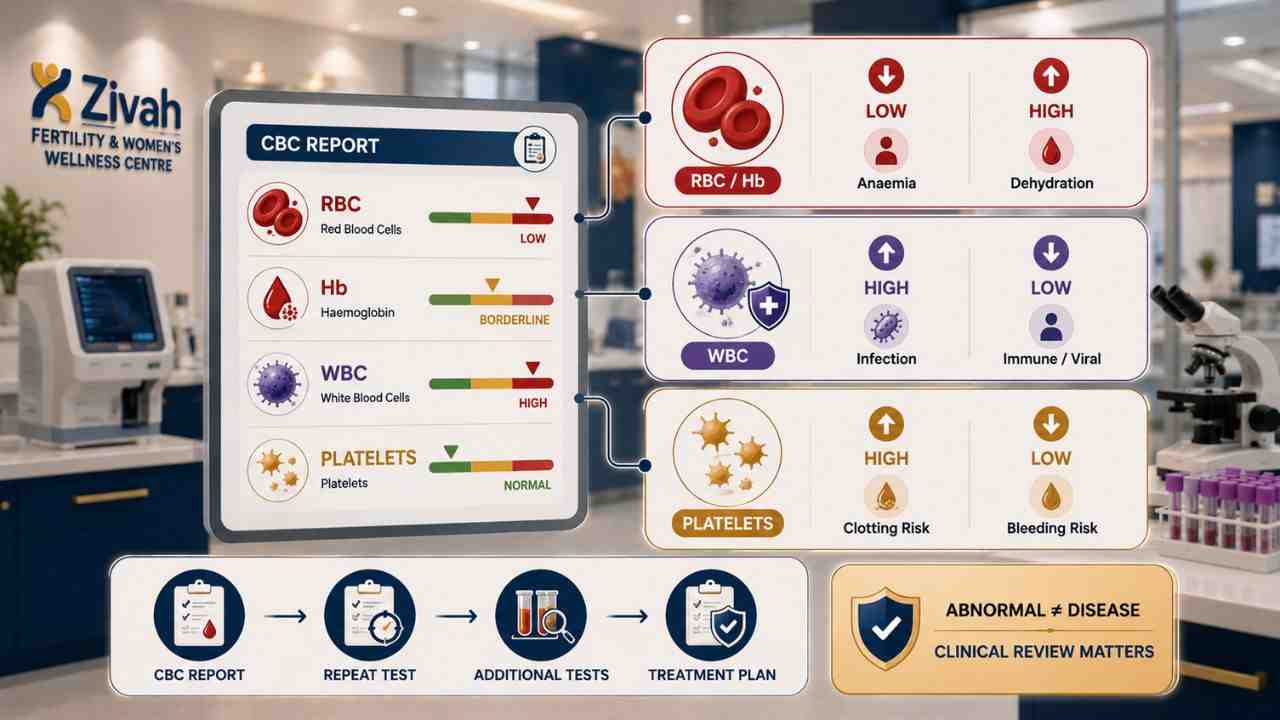
Abnormal values often fall into three classes. A common manifestation of anaemia is a low red-cell count or low haemoglobin. Leukocytosis (high white-cell count) usually indicates infection, while a low count may be associated with bone marrow, the immune system, or medication. And with platelets, a high count (thrombocytosis) or a low count (thrombocytopenia) is related to how easily your blood clots.
Reflex & Follow-Up Tests After an Abnormal CBC
What happens next depends on the findings. Sometimes it's just a repeat CBC, sometimes reflex testing. If you develop anaemia, a reticulocyte count is often the next step to see whether your bone marrow is producing enough new red cells and to differentiate a production problem from blood loss or cell destruction.
Depending on the image, peripheral smear, iron or vitamin investigations, or haematologist referral may ensue. Many mild abnormalities are just monitored.
Abnormal CBC Results & Possible Causes
| Finding |
Medical TerMedical Termm |
Possible Causes |
|---|---|---|
| Low RBC / haemoglobin |
Anaemia |
Iron/B12 deficiency, blood loss, chronic illness |
| High RBC / haemoglobin |
Erythrocytosis |
Dehydration, low oxygen, polycythaemia |
| High white cell count |
Leukocytosis |
Infection, inflammation, stress response |
| Low white cell count |
Leukopenia |
Viral illness, medication, marrow issues |
| High platelet count |
Thrombocytosis |
Infection, inflammation, iron deficiency |
| Low platelet count |
Thrombocytosis |
Immune causes, certain medications, pregnancy |
Why Choose Zivah for Your CBC Blood Test?
When you need a CBC test near you, the most important thing is accuracy, and the accuracy of a CBC blood test depends on the lab that runs it. Your sample is processed at Zivah in an accredited laboratory using automated analysers, with anything requiring closer inspection reviewed by a pathologist.
Equally essential, your results are compared to correct, pregnancy-aware reference ranges, so a pregnant patient’s report is interpreted properly, not against typical adult values. Results are available quickly and explained well, and, if necessary, follow-up is handled under one roof. A carefully planned method produces reliable results.
Zivah is a diagnostic lab focused on quality. We combine automated analysis with physician monitoring and quality-controlled reference ranges. We also offer rapid turnaround so you’re not waiting on results.