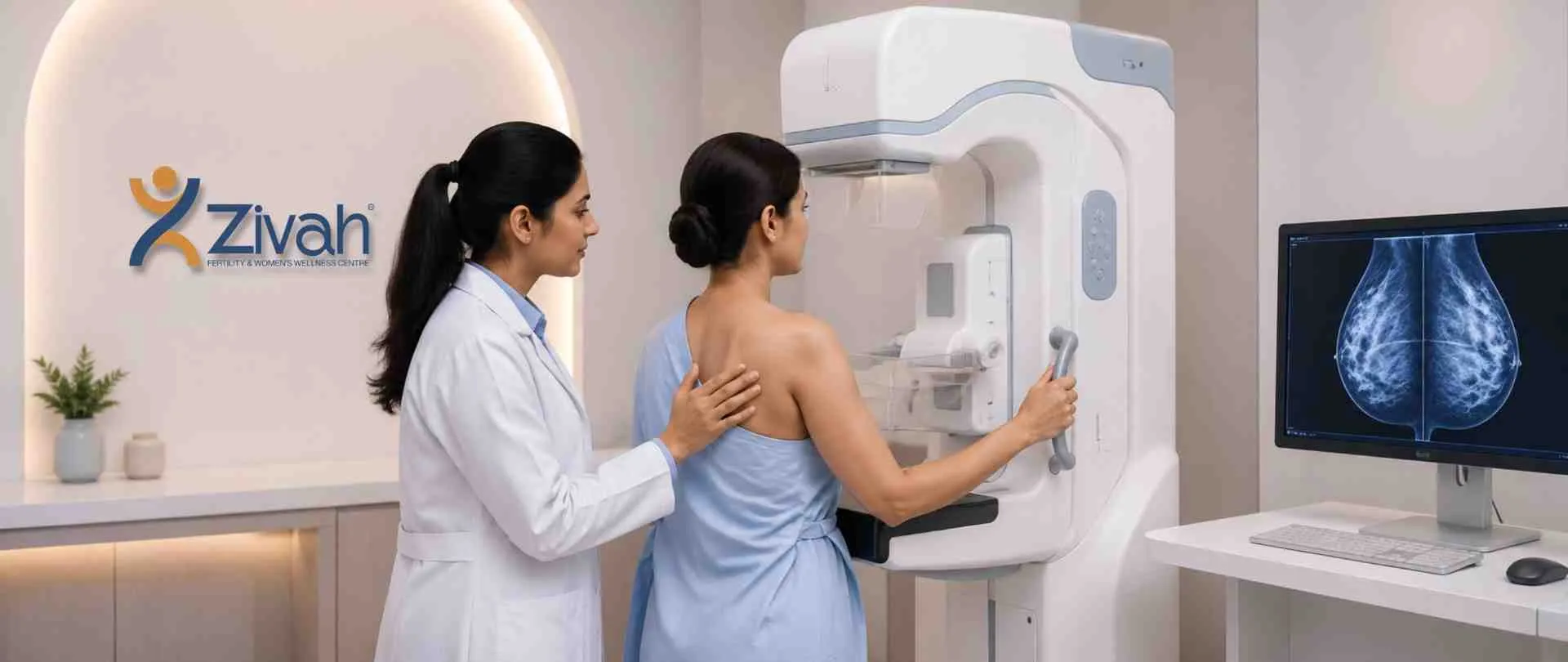

At Zivah, a bilateral breast mammography test, which checks both breasts in one sitting, is performed. It helps find changes early, often before you can feel them. So what is a bilateral breast mammogram used for? It is a low-dose X-ray that gives clear pictures of each breast. It can spot tiny calcium small mark or small lumps that a self-check or a normal scan may miss.
This mammogram test is for women due for a routine breast screening, anyone who has felt a lump or noticed a change, and those asked to have a check before further care. Whether this is your first scan or a regular one, you are in caring, experienced hands here. A specialist reviews your images and guides you on what comes next, including whether anything needs a closer look. Here is what your mammogram at Zivah covers, and how to know when it is time to book.
What Does a Bilateral Mammogram at Zivah Include?
At Zivah, your bilateral mammogram is a comprehensive breast check performed in a single visit. So what is included in a bilateral mammogram? Both breasts are imaged and compared side by side, using a low-dose X-ray, which means very little radiation. Two views are taken of each breast, so more tissue is seen, and fewer changes are missed.
Most of all, this breast mammogram test is built to catch changes early, picking up tiny calcium specks or small lumps before they can be felt. And you are never left to read the result alone. A specialist reviews your mammography scan and guides you on what comes next.
| What You Get |
What It Means for You |
|---|---|
| Both Breasts, One Sitting |
Both breasts are imaged and compared during the same appointment |
| Low-Dose X-ray |
A safe scan that uses a very small amount of radiation |
| Two Views per Breast |
Top-down and angled images provide a more complete view of the breast tissue |
| Early-Change Detection |
Helps detect tiny calcium deposits (calcifications) or lumps before they can be felt |
| Radiologist Review |
Images are interpreted by a specialist, with clear guidance on any next steps if needed |
Should You Have a 2D or 3D Mammogram?
A 2D mammogram (digital mammography) takes a few flat images of each breast, while a 3D mammography scan, or tomosynthesis, builds thin slices that separate overlapping tissue. When tissue is hard to read, the 3D scan often gives a better picture. It's not up to you to decide. At Zivah, we first look at the type of breasts you have and then match you with the scan that gives us the best picture.
Mammogram or Breast Ultrasound: Which Do You Need?
A mammogram and an ultrasound of the breast are not the same thing. A mammogram, which uses low-dose X-rays, is the best way to find tiny calcium spots that an ultrasound might miss. An ultrasound of the breast uses sound waves to get a better picture of tissue that is firmer and thicker. For many women, they work together, and we'll tell you which test or pair fits your breasts best.
What Can a Bilateral Mammogram Reveal?
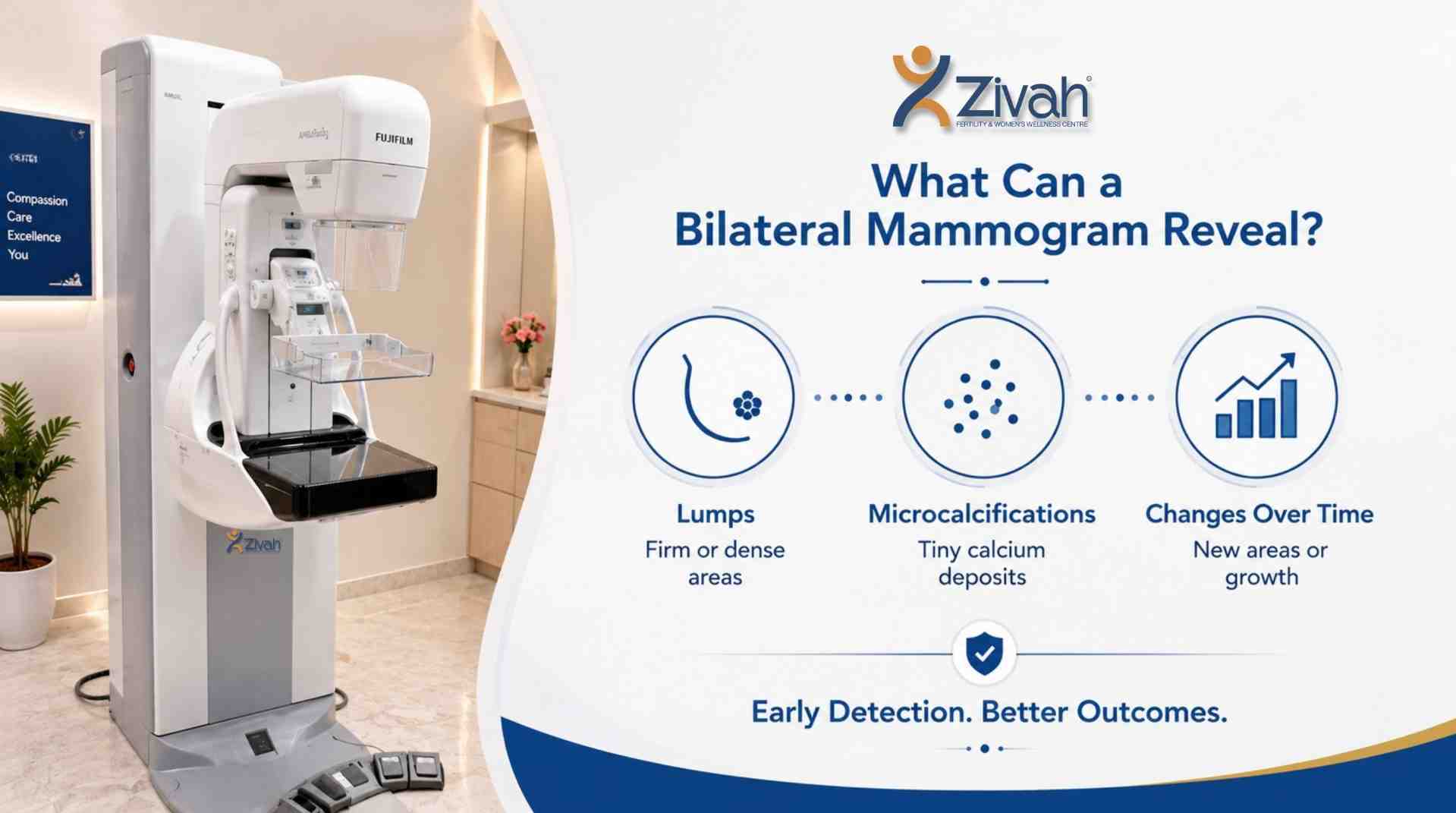
A bilateral mammogram is a key part of breast cancer screening, and it shows us more than most women expect. So what does a mammogram show? In a single scan, it can pick up:
- Lumps or masses: a firm or dense area in the breast tissue.
- Microcalcifications: Very small calcium deposits that may be an early sign.
- Changes over time: Compared with your older scans, new areas have grown.
This is also how a mammogram can detect breast cancer early, flagging change long before it can be felt, with each finding pointing us to the right next step.
One thing matters here. A mammogram reads microcalcifications very well, but dense glandular tissue shows up white on an X-ray, the same shade as a small mass. So, in dense breasts, a small change can go unnoticed. This is exactly why we often add a breast ultrasound when there is dense tissue, so nothing is missed.
| What We Look At |
What the Scan Shows |
How Zivah Helps |
|---|---|---|
| Masses |
Lumps or dense areas |
Reviews and guides next steps |
| Microcalcifications |
Tiny calcium deposits |
Identifies changes early |
| Breast Density |
Amount of dense tissue |
Advises if ultrasound is needed |
| Changes Over Time |
New findings since earlier scans |
Compares with previous mammograms |
| Both Sides |
Differences between breasts |
Assesses both breasts together |
What Does a Lump or Finding on a Mammogram Mean?
Finding something on a mammogram does not always mean that there is cancer. In fact, most of the time, they are harmless. There is nothing wrong with an area if the radiologist flags it. They just want to take a better look. What comes next, like an ultrasound, an extra view, or a short follow-up, is based on the scan itself. If your report says something was found, it's just a second look that was done carefully. It's not a diagnosis.
When Should You Start, and How Often?
There is no single answer that fits every woman; the right breast screening age depends on your own risk. For most women at average risk, mammograms start around age 40 and are repeated every 1 to 2 years. But at what age should you start mammograms in India? Often a little earlier, as breast cancer here tends to appear at a younger age.
Your history can shift that timeline. A family history or a BRCA gene (BReast CAncer gene) change usually means starting screening sooner and screening more often, and dense breasts or a past finding may call for closer monitoring. And if you ever notice a symptom, a lump or a change in shape, you should not wait for a screening age. That is a different scan, done to look into a specific concern.
| Your Situation |
When to Start |
How Often |
|---|---|---|
| Average Risk |
Around age 40 |
Every 1–2 years |
| Family History / BRCA Gene |
Earlier, often in your 30s |
Yearly, sometimes with MRI |
| Dense Breasts |
As advised by your specialist |
Mammogram, often with ultrasound |
| Previous Finding or Treatment |
As advised by your specialist |
More frequent follow-up |
| Any Age with Symptoms |
Immediately |
Diagnostic scan as needed |
Why Does the Timing in Your Cycle Matter?
The week after your period ends is the best time for a mammogram, since your breast tissue will be least tender. So can you get a mammogram while you're on your period? Most of the time, it's better to wait a few days because the breasts may feel sore. A window with less noise also shows a better picture. When you book, we help you pick the best day.
Who Should Book a Bilateral Mammogram at Zivah?
Who should get a mammogram, and when should they get one? An MRI of both breasts is recommended at Zivah for three types of women:
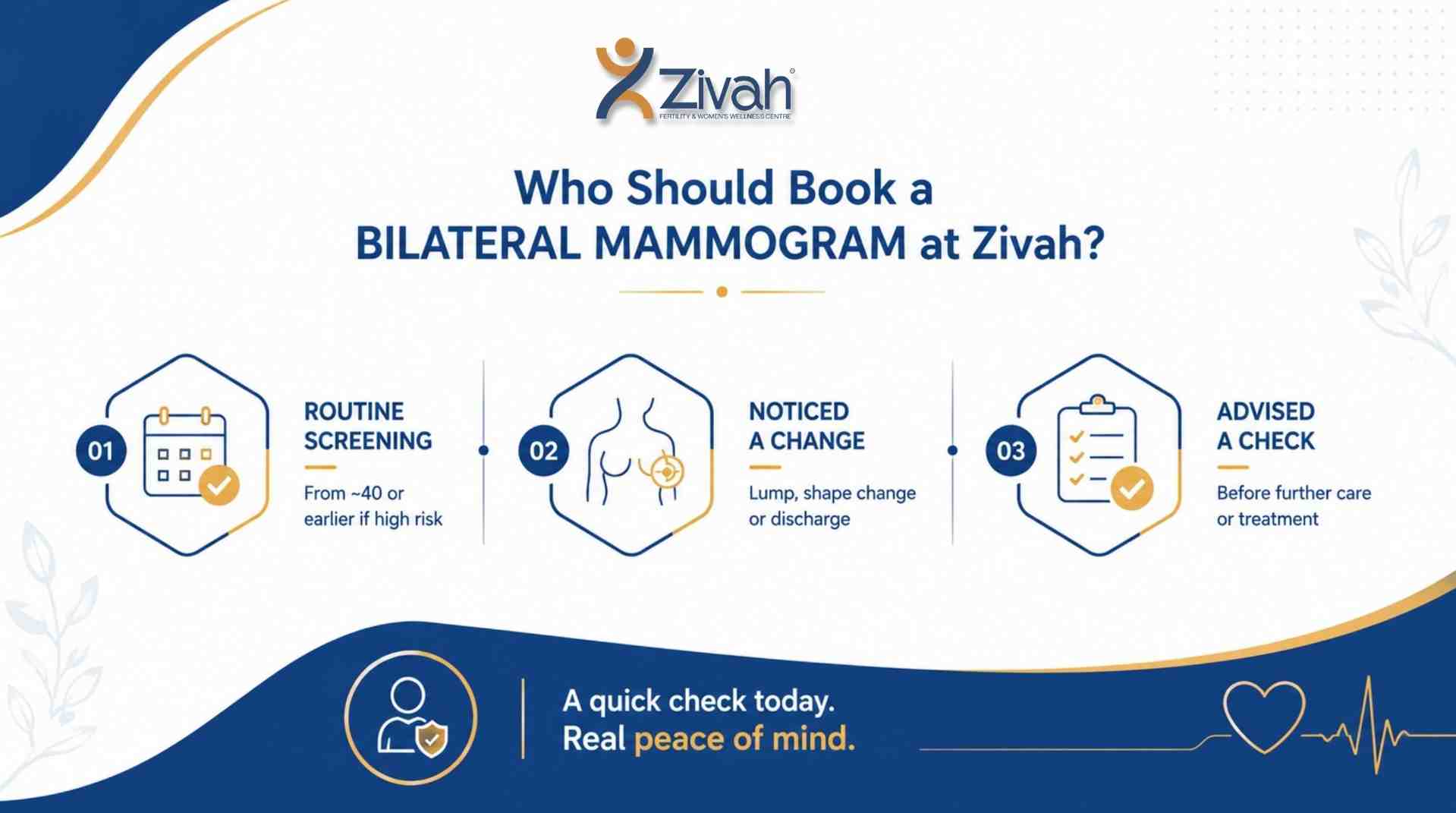
- Due for routine screening: usually from around 40, or earlier if your risk is higher.
- Noticed a change: a new lump, a shift in shape, or nipple discharge.
- Advised a check: before further care or treatment.
This is the scan for you if you are of screening age or if something feels off. At Zivah, our breast screening service has a specialist who will review your images and ensure you know what to do next. So, no matter the result, getting a quick check today will give you real peace of mind.
Do You Need a Mammogram with Dense Breasts or a Family History?
A mammogram scan is most important for women who are more likely to get breast cancer. At Zivah, the first step is to quickly identify changes. Regular screening can help find any changes in your breasts while they are still small and easy to treat if breast cancer runs in your family.
Care should also be taken with dense breasts because thick tissue can hide a finding on an X-ray. Your doctor may suggest an additional ultrasound in addition to your scan. If any of these sound like you, you should definitely get a mammogram.
What Happens During a Bilateral Mammogram?
Knowing what to expect during a mammogram takes most of the worry out of it. When you arrive, you undress from the waist up, and a technician helps rest one breast at a time on the machine. So, how is a mammogram done? A second plate is pressed down for a few seconds to spread the tissue and capture a clear image, with two views of each side: one from the top and one from the angle. How long does a mammogram take? From start to finish, about 15 to 20 minutes, with the pressure lasting only seconds. Then you are free to go.
Does a Mammogram Hurt, and How Do You Prepare?
There is no long-term pain from the process, which lasts only seconds during a bilateral mammogram. So it does not hurt, as many women fear. It's normal to feel a little sore around your period, which is why the week after is easier. To get ready, don't use deodorant, powder, or sunscreen that day, as they will show up in the picture. We'll tell you about anything else when you book.
Your Report and What a Recall Means
A professional radiologist reads your mammogram results; you are not given a sheet of numbers that you have to figure out on your own. For how long do mammogram results take to come back? Most of the time, you'll get your report within a few days, and someone will explain what it means. The study uses a standard scale, BI-RADS, with scores ranging from 0 to 5. What does a BI-RADS number mean? It's just a shorthand way for the doctor to rate how clear or alert a result is and point out the right next step.
| BI-RADS Score |
What It Means |
Typical Next Step |
|---|---|---|
| 0 |
More images needed |
Extra mammogram views or ultrasound |
| 1 | Normal result |
Continue routine screening |
| 2 | Benign (non-cancerous) finding |
Continue routine screening |
| 3 | Probably benign |
Follow-up scan in about 6 months |
| 4 | Suspicious finding |
Biopsy usually recommended |
| 5 | Strongly suggests cancer |
Biopsy and specialist review |
Note: In dense breast tissue, a mammogram can miss some changes, so your specialist may advise an additional ultrasound. A clear scan lowers concern but does not rule everything out.
Why Were You Called Back After Your Mammogram?
A mammogram recall just means the doctor needs additional images or an ultrasound to see breast tissue that is overlapping more clearly. A lot of women come in and ask this question, and the honest answer is reassuring: being called back does not mean you have cancer. The outcome of most recalls is a simple "all clear." A return is just a closer look, not a diagnosis. We work quickly, so you never have to wait and worry.
Why Choose Zivah for Your Bilateral Mammogram?
It's not just the scan that makes a mammogram clinic good; it's also how well the results are read and described. You get these at Zivah:

- Skilled reading: Radiologists with extensive expertise review your scans.
- A result you understand: told to you, not given as a report for you to figure out on your own.
- Both 2D and 3D: the right scan for your breast type to get the best picture.
- A plan, not just a finding: Your answer was directly linked to clear next steps.
- Care in one place: As part of your overall women's health care, your mammogram is important.
That joined-up care is what makes Zivah a trusted breast screening centre for women who want a careful, clear answer, not a loose end.
Who Carries Out Your Scan and Reads It?
A trained tech does your mammogram, and a specialist radiologist reads it on modern mammography tools right here in the office. They are not sent off to be read somewhere else, so you don't have to wait around and wonder when or by whom your scan is being looked at. This is the doctor who reads your mammogram report and decides what to do next. From the time of your scan until you get your result, this doctor has real knowledge close at hand.
Book Your Bilateral Mammogram at Zivah
Booking your bilateral mammogram at Zivah is simple, and it may be one of the most important checks you do for yourself this year. A few minutes today can catch a change early, while it is small and most treatable, and give you real peace of mind, whatever the result. Whether this is your first scan or a routine repeat, our team is here to make the whole visit easy, from picking the right day to talking you through your result. Reach out to book your mammogram, and take that simple step for your long-term health.