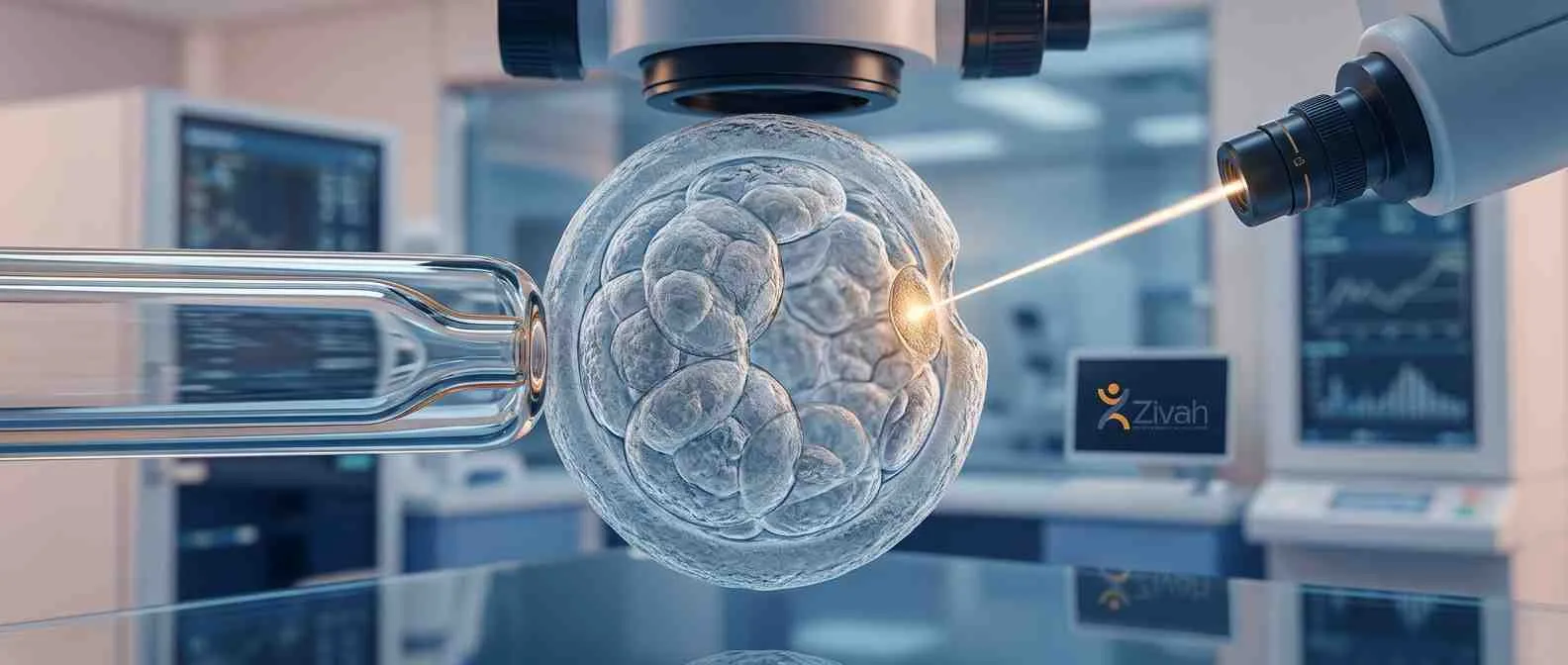
Laser assisted hatching is a rapid, exact lab process used in IVF to help an embryo implant. Each embryo is protected by a thin outer shell and must break free, or "hatch," before it can implant in the womb. With laser-assisted hatching, a gentle laser is used to create a small opening in the shell, giving the embryo a little help hatching and implanting.
The reality is that not every IVF patient requires aided hatching. It really helps certain people, like those using frozen embryos or with a thicker shell around their embryo, but it doesn’t benefit others much. The key is knowing if it's correct for your scenario.
At Zivah Fertility, we don’t support laser hatching as an add-on, only when it has a real chance of improving your odds. Below we describe what it is, who it helps, how it works and what to expect.
What Is Laser Assisted Hatching in IVF?
It’s a lab method used in IVF in which an embryologist uses a small laser to create a tiny hole in the embryo’s outer shell. The idea is simple: make that shell a little softer or more open, and the embryo can "hatch" and attach itself to the womb more easily. Laser-assisted hatching occurs in the lab during the IVF journey, immediately before the embryo is transferred. It doesn't change the embryo itself, it just provides a helpful hand in the one moment that usually determines if an embryo implants or not.
Understanding the Zona Pellucida and Embryo Hatching
Each embryo is surrounded by a thin protective shell called the zona pellucida. It’s like the shell of an egg; it protects the embryo while it grows in those early days. But you can’t keep that shell on forever. The embryo has to break free of it before it can implant, a natural action known as embryo hatching. It cannot reach the lining of the womb, the endometrium, and start a pregnancy until it has come out of the shell. No matter how healthy it is, if it can't hatch, it can't implant.
Why Do Some Embryos Fail to Hatch Naturally?
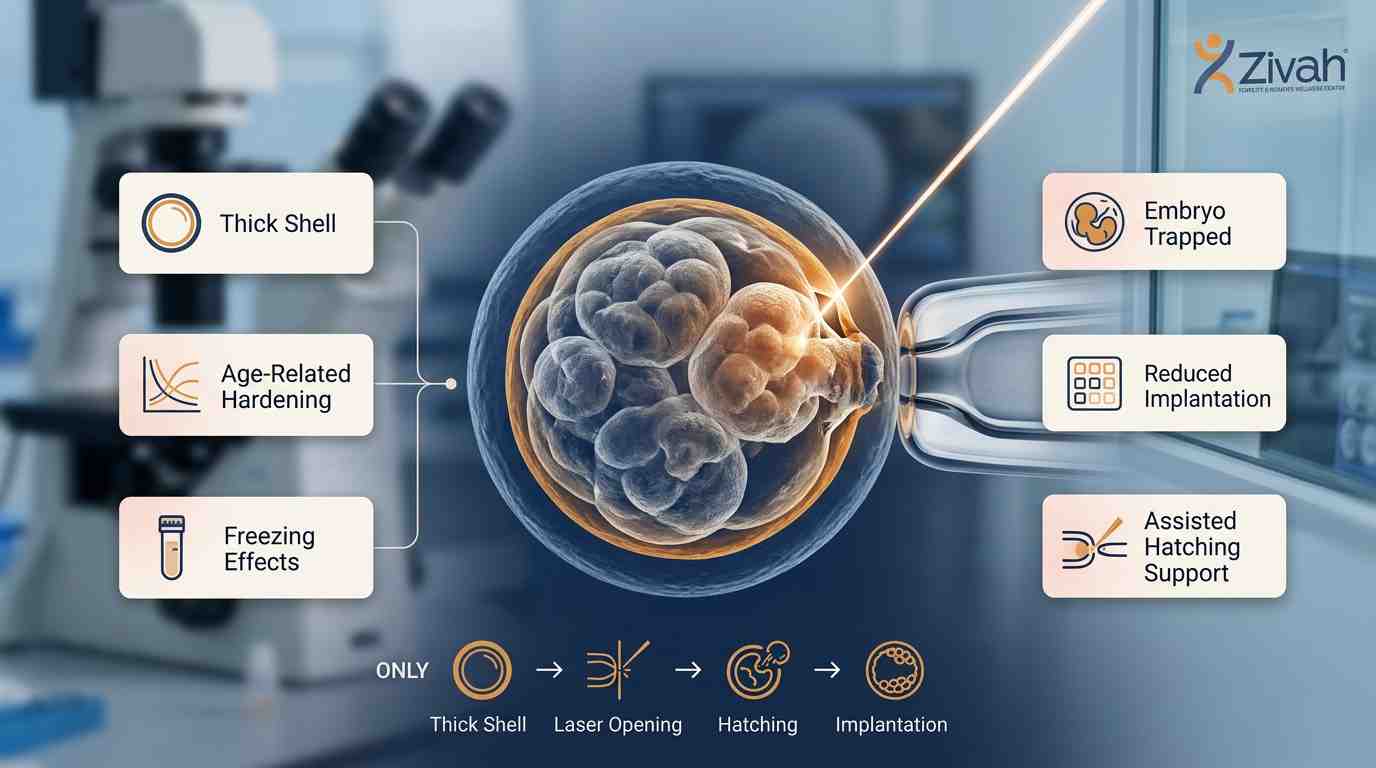
The shell can sometimes make hatching tougher than it needs to be. The common explanations are:
- A naturally thick zona - Some embryos have a tougher shell
- Age - a woman gets older, the shell gets harder
- Freezing and thawing - the cryopreservation might strengthen the shell in the process
If the shell is too hard or too thick, even a healthy embryo can get caught inside and fail to implant. And that is the same problem that laser-assisted hatching addresses.
Does Laser Assisted Hatching Actually Work? What the Evidence Says
Let’s be honest about this, because this is the question that matters most: can assisted hatching increase the success of IVF? In fact, most IVF patients don’t have enough information to go on, large, high-quality studies haven’t shown that laser assisted hatching increases the likelihood of a baby in general. This is why it is viewed as an add-on rather than a normal element of every cycle.
But “not for everyone” is not the same as “doesn’t work”. The evidence does suggest an important advantage for certain persons, particularly people using frozen embryos, or those whose embryos have a thicker, tougher shell.
Laser hatching can really improve the chances of implantation for them because it fixes the specific defect that stops their embryos from progressing. So the actual question isn't "does it work?", it's "does it work for me?" The success rate of assisted hatching in different groups of patients is:
| Patient Group |
Evidence of Benefit |
|---|---|
| Frozen/thawed embryo transfer |
Strongest, freezing hardens the shell |
| Thick or hardened zona pellucida |
Supported |
| Women over 35–38 |
Possible |
| Repeated implantation failure |
Possible |
| Young, good-prognosis, first IVF |
No clear benefit |
So exactly which patients gain the most? Let's learn who laser-aided hatching is really useful for.
Who Should Consider Laser Assisted Hatching?
As we saw, it’s not for everyone, but for the right person, it can really make a difference. Put simply, laser hatching is useful when anything is making natural hatching more difficult than it should be. If that’s you, it’s a discussion worth having. If not, you probably don’t need it.
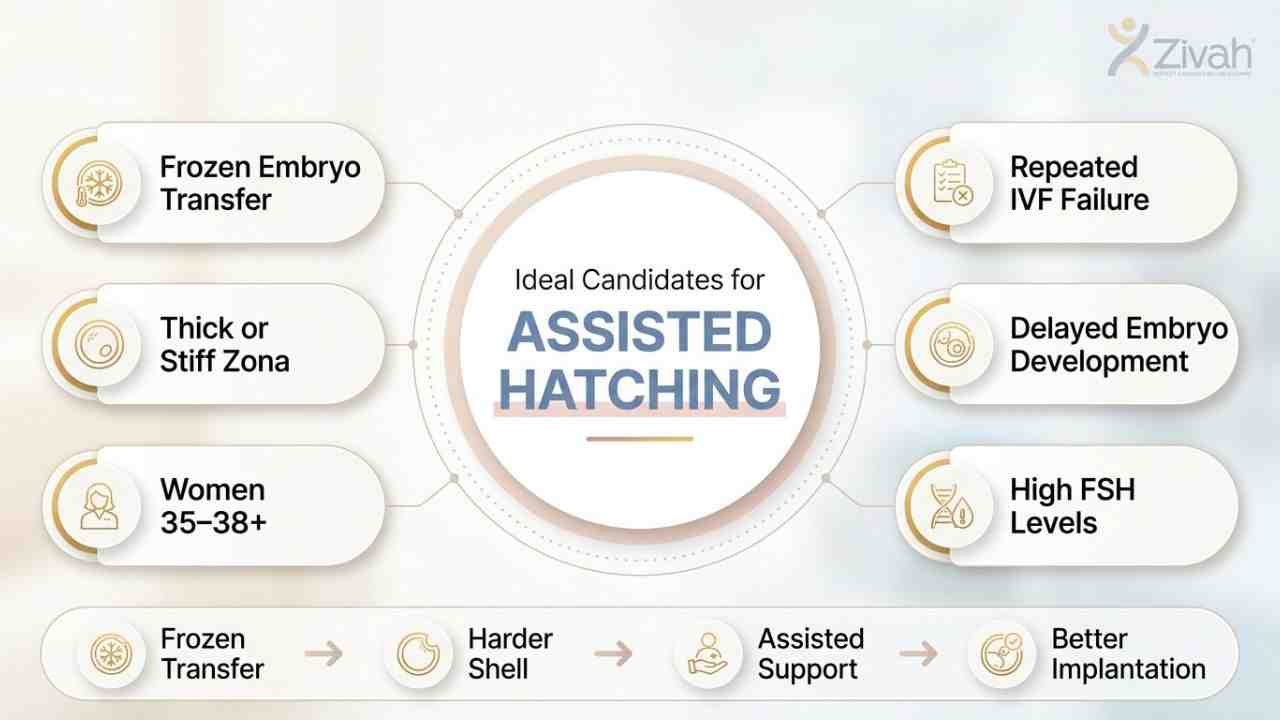
Ideal Candidates for Assisted Hatching
Think you’d be a good fit? Usually, assisted hatching is recommended when:
- Frozen embryo transfers – freezing can harden the shell, thus this is where it is most helpful
- Embryos with a thick or stiff zona - a naturally hard shell, make it more difficult to hatch
- Women above 35-38 - Assisted hatching for older women can help, as the shell starts to stiffen with age
- Repeated IVF or implantation failure - when good embryos repeatedly fail to implant, hatching may be the hidden problem
- Poor or delayed embryo development – embryos that may need a little aid along the way
- High FSH levels – often connected to harder embryo shells
When Laser Assisted Hatching Is Not Recommended
But when does it not add up? Actually, in many cases. If you’re young, on your first IVF cycle, and have a favourable prognosis, laser hatching is usually not necessary; your embryos will likely hatch just fine without it. The same is true for hatchling embryos, or those with a thin, soft shell. If this is the case, adding the operation will not increase your odds; an honest clinic will not propose it.
How Laser Assisted Hatching Is Performed at Zivah: Step-by-Step
That’s exactly what assisted hatching is all about, and the good news is, you won’t have to do or feel anything. This is a laser-assisted hatching process performed exclusively in the lab on the embryo by Zivah's embryology team. You won't feel any pain, because it happens to the embryo before it is ever put inside you. The whole process takes seconds.
Step 1: Embryo Preparation and Timing
It’s all about timing. Assisted hatching is performed at the appropriate embryo stage, day 5 for some fresh cycles or immediately after warming for a frozen blastocyst. The embryologist removes the dish from the incubator and selects the ready-to-hatch embryos, always under the tightly regulated lab environment.
Step 2: Laser Application on the Zona Pellucida
This is the core of the procedure. Under a high-magnification micromanipulation microscope, the embryologist focuses a focused laser at the embryo’s shell, the zona pellucida, but at a spot well removed from the embryo’s own cells. A few exact pulses, generally 3 to 5, thin or open the shell. The laser heat is well controlled and never affects the embryo itself; the cells are perfectly safe.
Step 3: Return to Incubator and Embryo Transfer
Then the shell is carefully opened, and the embryo is returned to the incubator to continue developing. When the time comes, it's moved to the uterus, where that small opening can now help the embryo to hatch and implant in the lining of the womb.
Thinning vs Drilling: The Two LAH Methods
You may hear about two methods for doing this.
- Thinning lightly wears away the outer shell.
- Drilling punches a small hole right through the shell.
So which one is better? What we find interesting is that, in comparing the two, there really is no difference in pregnancy outcomes. So, it is a matter of the embryologist deciding what is best for each embryo, not which procedure is "best " overall.
Why Laser Assisted Hatching Works Best with Frozen Embryos
This is one scenario where assisted hatching for frozen embryo transfer really deserves its place. Patients who use frozen embryos are most likely to benefit from laser hatching. And there’s a reason for it.
Embryos may be slightly hardened by freezing and thawing. So even a good-quality, healthy embryo may have trouble hatching on its own after thawing. This is exactly the gap that laser hatching frozen embryos is intended to bridge, which is why the best evidence for aided hatching is in FET cycles, not fresh ones.
Why Frozen Embryos Often Benefit Most
Here's the science in plain terms. With freezing and thawing, even with modern vitrification, frozen embryo zona hardening can happen. That is, the shell is stiffer than it would be naturally. The stiffer the shell, the harder it is to break out. To avoid this, the embryologist performs laser hatching immediately after warming, while the blastocyst is still compacted and easiest to work with.
That little opening, well-timed, offers a far better chance for the thawed embryo to hatch and implant after transfer. If you are thinking of a frozen embryo transfer, assisted hatching often makes the most sense.
Laser Assisted Hatching vs Embryo Biopsy: What's the Difference?
These two are commonly confused, and it’s simple to see why. Both are done in the lab, on the embryo, using a precision laser. But they do quite different jobs. The difference between assisted hatching and embryo biopsy: Hatching assists the embryo to implant, whereas biopsy tests the embryo’s genetics.
| Procedure |
Purpose |
|---|---|
| Laser Assisted Hatching |
Opens the embryo's shell to help it hatch and implant |
| Embryo Biopsy |
Removes cells for genetic testing (PGT) |
So you need both? Often, yes, because one enables the other. Laser assisted hatching is done before an embryo biopsy, creating a small opening in the embryo's outer shell through which the cells are removed for testing. That same opening then helps the embryo implant after transfer.
Risks and Safety of Laser Assisted Hatching
Is laser assisted hatching safe? Yes, very much so under skilled hands. The laser is quite precise, the treatment takes seconds, and embryo survival rates are around 100%. Assisted hatching is unlikely to harm the embryo when performed by an experienced embryologist, as the laser is targeted well away from the embryo's cells and the heat is closely controlled. But like any treatment, there are a handful of honest risks you should know about.
Common Risks and the Twinning Consideration
The two biggest things to look out for are:
- Embryo damage - very rare, and almost always linked to poor technique. This is exactly why the lab's skill matters so much.
- Identical (monozygotic) twins - there may be a small rise in monozygotic twinning following assisted hatching. This is no small thing, as twins are more risky for both the mother and the babies.
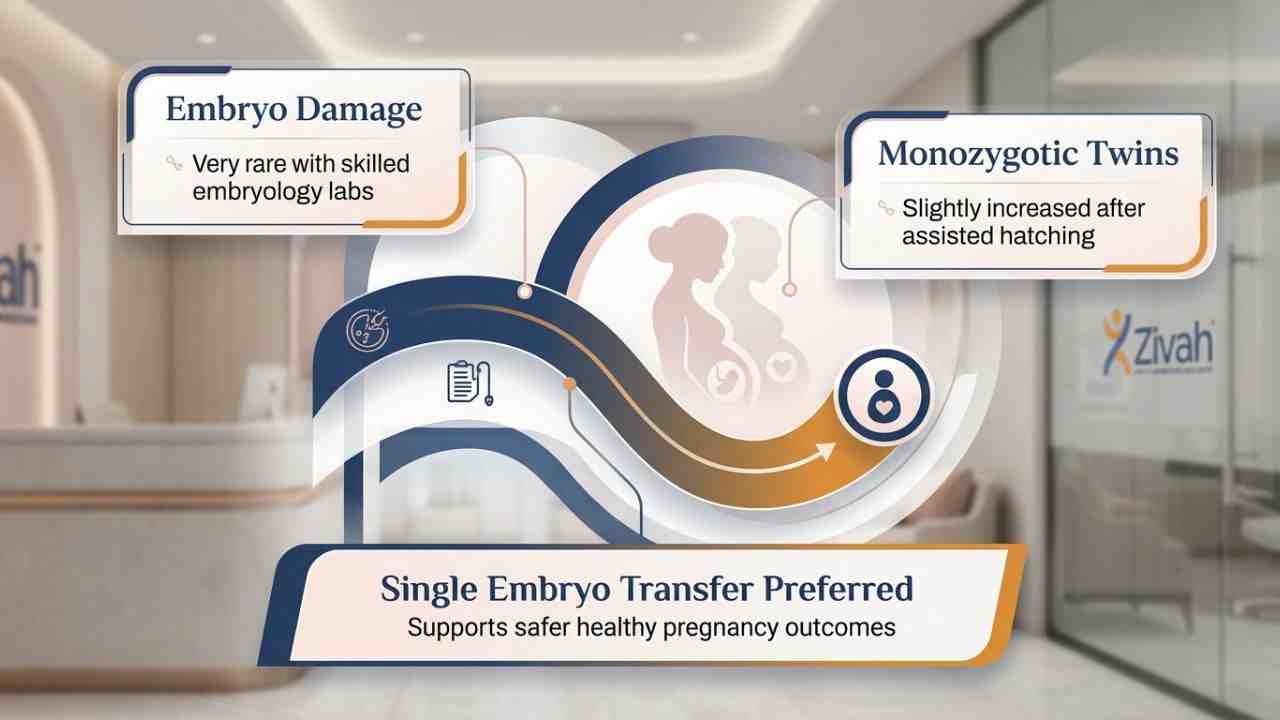
That twinning issue is why, after laser hatching, most clinics, including Zivah, prefer to transfer only one embryo. It gives the best possibility of a healthy, single pregnancy.
Laser Assisted Hatching Cost in India
There is no fixed cost for laser-aided hatching in India, and the rationale is simple: it's an add-on to your IVF cycle, not a treatment you arrange on its own. So, how much does assisted hatching cost? Well, it depends on a few factors, notably whether it is included in your IVF package and which clinic you go to.
| Cost Factor |
What It Affects |
|---|---|
| IVF bundling |
Whether LAH is included or added separately |
| Clinic and lab |
Technology and expertise affect pricing |
| Whether it's indicated |
Recommended only when it benefits your case |
Here's where Zivah differs: Laser hatching is only beneficial for some patients, and we propose it carefully. Never as a default upsell. You won't pay for an add-on that won't increase your chances. You can find out your actual aided hatching cost with IVF after the quick consultation. We'll give you a clear, honest breakdown based on your situation.
Why Choose Zivah for Laser Assisted Hatching
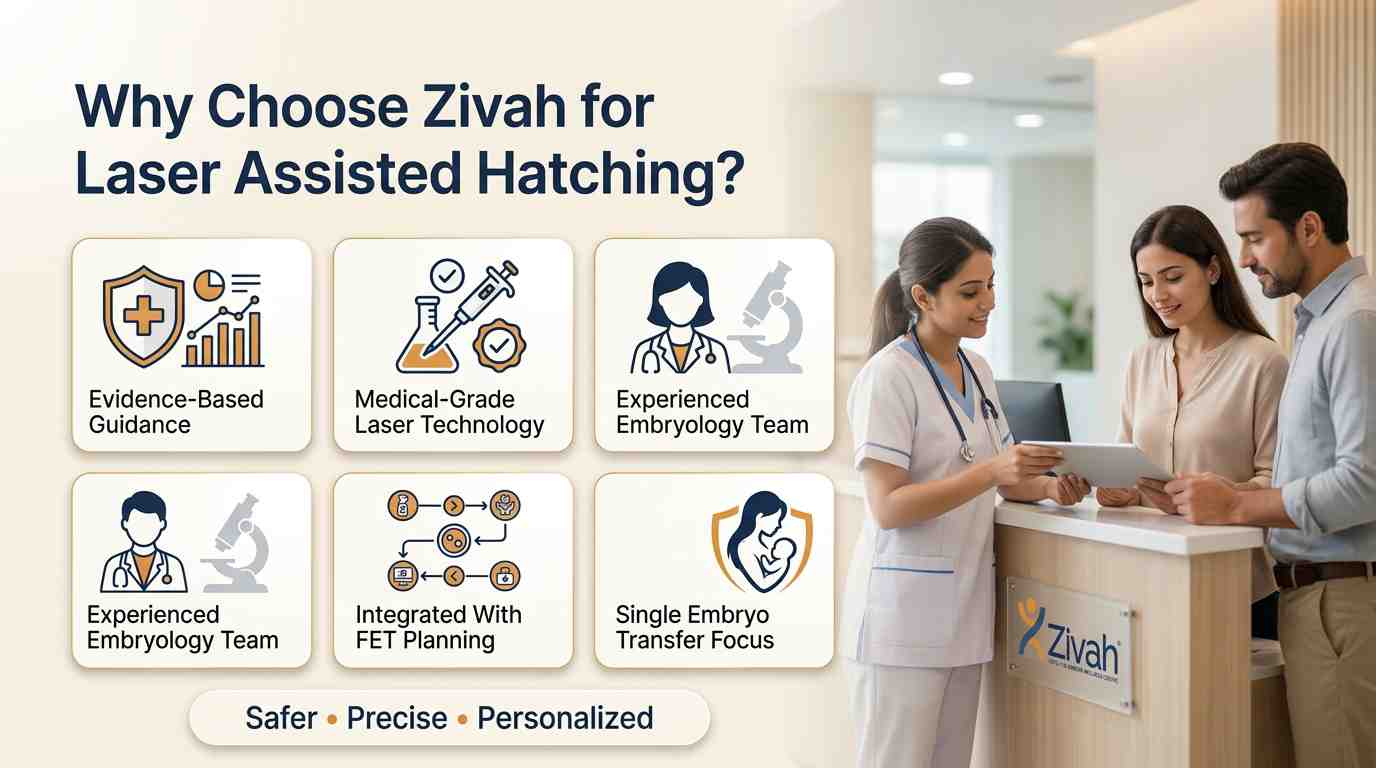
Laser-assisted hatching is not a treatment that the correct clinic offers to everyone; the right clinic knows when it helps. This honesty is what makes Zivah a trusted laser-assisted hatching clinic:
- Trustworthy, evidence-based guidance - We propose hatching only where it is really likely to assist, not as a routine upsell
- Precision medical-grade laser - Soft, fast and accurate with minimal touching of your embryo
- Experienced embryologists - skilled hands matter most in a procedure measured in seconds and microns
- Built into your FET plan - we smoothly integrate hatching with frozen embryo transfers where it matters most
- Single-embryo-transfer safety - we want a healthy, single pregnancy, and we carefully manage the risk of twinning
Your Next Step
Laser-assisted hatching is not a magical fix for every IVF cycle, but for the appropriate patient, it can be the modest targeted nudge that helps an embryo implant . The difference is two things: a good lab and an honest staff, only recommending it when it really helps. That’s precisely what we do. See if laser-assisted hatching is appropriate for you.
Book a consultation with Zivah Fertility.