How Many Embryos Are Needed for IVF Success?
Often, one high-quality blastocyst is enough. Learn how embryo grading, Day 5 blastocysts, PGT-A and single embryo transfer shape IVF success rates at Zivah.
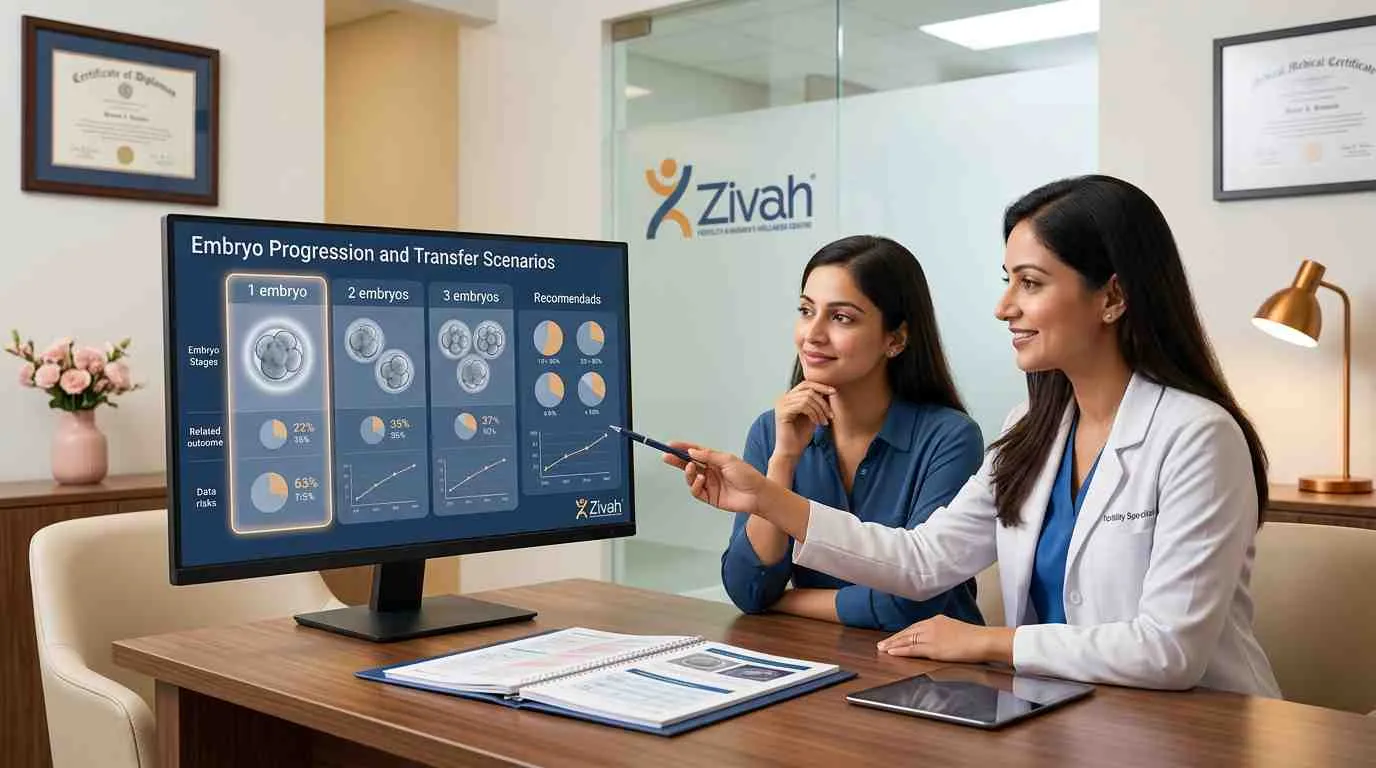
If you are going through IVF, the one question that keeps coming back to your mind is: how many embryos are needed for IVF success? It’s completely normal to feel anxious about this. You are not alone.
The truth is, there is no set answer for how many embryos you will need for IVF. It depends on your age, embryo quality, the type of transfer and several other factors that your doctor will look at closely.
In this guide, we will walk you through everything, from how embryos are graded and how many are typically created in one IVF cycle to how many should be transferred, what the IVF success rates by age actually look like, and when PGT-A testing helps. By the end, you will have a clear picture, not just the numbers, but what those numbers mean for your journey.
What Is an IVF Embryo and Why Does Quality Matter More Than Quantity?
But first, the basics. What actually is an IVF embryo? Basically, when sperm meets egg, you get an embryo. IVF is when your eggs are taken from your ovaries and mixed with sperm in the lab. An embryo is a fertilised egg that is beginning to develop.
Over the next 5 to 6 days, these embryos grow and develop. The ones that survive and reach a stage called the blastocyst stage are considered your strongest candidates for transfer.
Here is the key thing most people do not realise: it is not about how many embryos you start with. It is about how many are of good enough quality to transfer. A single high-quality blastocyst can achieve pregnancy. Five poor-quality embryos may not. That is why your fertility doctor focuses on embryo quality, not just count.
Day 3 vs Day 5 Embryos: Which One Has a Better Chance of IVF Success?
Your embryo can be transferred on Day 3 or Day 5 after fertilisation. Most clinics today prefer Day 5, also called the blastocyst stage, and here is why it matters for your IVF success rate. By day 5, the embryos have already passed the most important stage of early development.
They are more mature, more evolved and more likely to implant effectively. Day 3 embryos are younger and can still be transferred, although there is a slightly higher uncertainty about their future development.
| Feature |
Day 3 Embryo |
Day 5 Embryo (Blastocyst) |
|---|---|---|
| Stage of development |
8-cell stage |
100–200 cells, fully formed |
| Success rate |
30–40% |
45–65% |
| Who uses it |
Fewer embryos available |
Most IVF patients today |
| PGT-A testing |
testingNot possible at this stage |
Can be done for chromosome testing |
Now that you understand the difference between Day 3 and Day 5 embryos, the next natural question is, how do doctors decide which embryo is good enough to transfer? That is where embryo grading comes in.
How Are IVF Embryos Graded? Understanding Embryo Quality Before Transfer
While your embryos are in the lab, the embryologist maintains a close eye on them and gives each one a grade based on two things: appearance and how well it is growing. This is called embryo grading in IVF and is very important; it helps to determine which embryo to transfer first.
So no, the best embryo is not selected randomly. They are hand-selected. The grading technique used by most clinics for blastocysts (embryos at roughly days 5 to 6) is called Gardner grading. It considers three things:
- Expansion - size of the blastocyst and stage of development
- Inner cell mass (ICM) - the cells that will become the infant
- Trophectoderm (TE) - cells that develop into the placenta
Each section is given a score, and together they make up your embryo's grade. 4AA or 5AA graded embryo is exceptional, 3BB embryo is still good. Even an embryo of BB grade can lead to a successful pregnancy reassuringly. Here's a simple tutorial to help you understand what your embryo grade means:
| Grade |
Quality |
What it means for transfer |
|---|---|---|
| 4AA / 5AA |
Excellent |
Fully expanded with a strong cell mass, first priority for transfer |
| 3BB / 4BB |
Good |
Well-developed with good implantation potential, a very good candidate |
| 3BC / 3CB |
Fair |
Slightly lower cell mass or trophectoderm quality, can be transferred, but with a lower success rate |
Now you know what makes a good embryo. But the next big question is, in one IVF cycle, how many embryos do patients typically end up with? Let us look at the realistic numbers.
How Many Embryos Are Typically Created in One IVF Cycle?
This is where many patients feel let down, and we want you to be prepared. Not all eggs retrieved will fertilise. Not all fertilised eggs will become embryos. And not all embryos will survive to the blastocyst stage. This is not a failure; it is nature being selective. Here is what typically happens during one IVF cycle:
Out of 10 to 15 eggs retrieved, usually 70 to 80% fertilise, giving you around 7 to 12 fertilised eggs. Of those, only 40 to 60% will grow into blastocysts by Day 5, leaving you with 3 to 7. Of those blastocysts, 1 to 3 are typically grade A or B quality, the ones suitable for transfer.
These numbers change with age. The older you are, the fewer viable embryos per IVF cycle you may get. But do not let this discourage you. Many patients across India have gone on to have successful pregnancies with just one good-quality blastocyst. The table below gives you a realistic picture by age group:
| Age Group |
Eggs Retrieved |
Blastocysts |
Good-Quality Embryos |
|---|---|---|---|
| Under 35 |
12–15 |
5–8 |
2–4 |
| 35 - 40 |
8–12 |
2–5 |
1–3 |
| Over 40 |
5–8 |
1–3 |
0–1 |
As we discussed earlier, not all embryos will make it. But the ones that do reach the blastocyst stage, now the real question begins: how many should actually go back into your uterus?
How Many Embryos Should You Transfer? The SET vs DET Decision
This is one of the most important decisions in your IVF journey, and it should always be made with your doctor, not on theories or what worked for someone else. There are two options: Single Embryo Transfer (SET) or Double Embryo Transfer (DET).
What Is Single Embryo Transfer (SET) and Is It Really Enough?
SET means transferring just one embryo. And yes, one good embryo is often enough. If your embryo is a grade AA blastocyst, the chances of pregnancy from a single embryo transfer are 50 to 65%, especially if you are under 35. This is why most top fertility clinics in India and in Hyderabad now recommend SET as the first approach.
Transferring just one embryo also significantly lowers the possibility of twins or triplets, which can result in high-risk pregnancies, premature birth and problems for both mother and baby.
When Is Double Embryo Transfer (DET) Recommended?
If you’re over 38, have had several failed cycles, have lower grade embryos or if your embryos haven’t been tested for chromosomal problems, DET can be considered. DET could boost your overall chance of pregnancy, but it also doubles your chance of having twins.
Your fertility doctor will consider this and recommend what is best for your body and your condition. Here’s a short side by side comparison to help you comprehend the difference:
| Factor |
SET (Single Embryo Transfer) |
DET (Double Embryo Transfer) |
|---|---|---|
| Embryos transferred |
1 |
2 |
| Success rate (per transfer) |
45–65% (AA/AB grade) |
55–70% (both transferred) |
| Risk of twins |
Less than 1% |
Up to 30% |
| Best for |
Under 37, good-grade embryos |
Over 38, fair-grade embryos, or multiple failures |
Now that you know about SET and DET, the next thing that must be on your mind is, what are the real possibilities of success? Let’s discuss about IVF success rates by age.
IVF Success Rates by Age: What Do the Numbers Really Mean for You?
Success rates in IVF are measured as the percentage of transfer cycles that result in a live birth. And these numbers change quite significantly with age. The younger you are, the better your egg quality. Better egg quality means better embryos. Better embryos mean a higher IVF success rate. It all connects.
IVF Success Rate by Age Group: Realistic Expectations
- Under 35: Live birth rate of 40-50% per fresh cycle. With a frozen blastocyst, success rates can be 55-65%.
- 35 - 37 years: Around 35-42% per cycle. Still good results with quality embryos.
- 38 - 40 years: About 20-30% / cycle. Testing embryos for PGT-A can help enhance results.
- Over 40 years: 10-15% per cycle with own eggs. Using donor eggs can bring success rates back up to 45-55%.
Remember: these are average numbers. Your specific results depend on your diagnosis, your clinic, your embryologist's experience, and your overall health.
At Zivah Clinic, our team takes a highly personalised approach to maximise your chances in every single cycle.
| Age Group |
Fresh Cycle Success Rate |
Frozen Blastocyst Transfer |
|---|---|---|
| Under 35 |
40-50% |
55-65% |
| 35-37 years |
35-42% |
45-55% |
| 38-40 years |
20-30% |
30-40% |
| Over 40 |
10-15% |
15-25% (donor eggs: 45-55%) |
Now that you understand what affects your success rates, there is one more tool that can significantly change the game for some patients: PGT-A testing.
Should You Do PGT-A Testing on Your Embryos Before Transfer?
PGT-A means Preimplantation Genetic Testing for Aneuploidies. In simple terms, it is a test performed on your embryos in the laboratory, before transfer, to see whether they contain the correct number of chromosomes.An embryo with too many or too few chromosomes is called aneuploid. The issue? These embryos may appear normal under the microscope, but are less likely to implant and are more likely to miscarry.
That’s where PGT-A testing comes in. By transferring only euploid (chromosomally normal) embryos, success rates improve, and the chance of miscarriage is lower.We highly recommend PGT-A if you:
- Are over 38
- Have had two or more unsuccessful IVF cycles
- History of recurrent miscarriages
- Have a family history of a genetic condition
But it’s not for all, because it:
- Adds to the total cost
- Requires a tiny biopsy of the embryo
- May mean fewer embryos available for transfer
Your fertility doctor can tell you whether this is the right approach for you. So far, we have talked about embryos, the number, quality, and when to transfer. But here’s the wider picture: embryos are part of the jigsaw. Let’s get to the other aspects, which are equally important.
Beyond Embryos: Other Factors That Can Make or Break Your IVF Success
Even if you have a great embryo, there are other factors in your body that are just as important in IVF success. Here is what you need to know about:
1. Is Your Uterine Lining Thick Enough for Embryo Implantation?
The uterine lining (endometrium) must be 7 to 8 mm thick and well supplied with blood for the embryo to effectively implant. If your lining is too thin, your doctor may delay the transfer and work on improving it first with hormonal support.
2. How Does Your Age and Egg Quality Affect the Number of Good Embryos?
As we mentioned at the start of this guide, age plays a very significant role in IVF. As women age, egg quality declines. This means fewer eggs will fertilise properly, and fewer embryos will reach the blastocyst stage with the right chromosome count.
This is not a reason to leave hope, but it is important to know this so that you can plan accordingly. You have to start IVF earlier; banking embryos over multiple cycles, or considering donor eggs when advised, can all be part of a smart strategy.
3. Can Your Lifestyle and Health Conditions Affect How Many Embryos Succeed?
Yes, a lot. Uncontrolled diabetes, thyroid issues, PCOS, endometriosis or fibroids can all affect implantation and embryo survival. Other things may also decrease your chances. For example, smoking, being underweight or overweight, and high stress levels.
At Zivah Clinic, we do a full pre-IVF health assessment before you even begin stimulation. Our goal is to make sure your body is in the best possible state to receive your embryo, because a good embryo in an unprepared uterus may not implant.
Understanding all these factors leads naturally to a question many patients whisper but rarely ask aloud: what happens if I only have one or two embryos?
What If You Only Have One or Two Embryos? Is Hope Still There?
Yes, of course. One or two embryos do not mean your IVF journey is over. Many patients had successful pregnancies and healthy babies with one frozen blastocyst transfer. What counts is the quality of the embryo, the health of your uterine lining and the skill of your fertility experts.
If a transfer does not succeed the first time, it does not mean your embryo was bad. Sometimes, the timing, your lining, or stress factors can play a role. A second transfer may work perfectly. And if you have no remaining embryos, another stimulation cycle can be planned.
In some cases, combining multiple cycles for embryo banking before doing a transfer is a smart approach, especially for patients over 38. At Zivah Clinic, we believe every patient deserves a personalised plan, not a one-size-fits-all approach. We will talk you through your numbers, your options, and help you make informed decisions at every step.
Final Thoughts: Quality Over Quantity
If there is one thing we want you to take away from this guide, it is this: when it comes to IVF, quality always wins over quantity. Throughout this guide, we covered how embryos are made, graded, and transferred. We looked at why Day 5 blastocysts give better results, how embryo grading works, what a typical cycle produces by age, and when to use SET versus DET.
We also walked through IVF success rates by age, the role of PGT-A testing, and how factors beyond the embryo, your uterine lining, age, and health shape your outcome. There is no single number of embryos that guarantees IVF success. But there is a clear principle: one right embryo, at the right time, in the right uterus, is what creates life.
At Zivah Clinic, our fertility specialists take the time to understand your unique biology, test results, history, and goals. Whether this is your first IVF cycle or you've had setbacks before, we're here to give you the best possible chance.
Want to understand your embryo journey better? Book your free appointment today with the IVF team at Zivah Clinic.
Frequently asked
01 How many embryos are needed for IVF success?
02 What is the success rate of IVF with one embryo?
03 How many embryos are good for IVF?
04 How many embryos should I transfer during IVF?
05 Is a Day 5 embryo better than a Day 3 embryo for IVF?
06 What happens if none of my eggs fertilise during IVF?
07 Can I freeze my remaining embryos after IVF transfer?
08 Does PGT-A testing improve IVF success rates?
09 What is the IVF success rate in India for patients over 40?
10 Can a low-grade embryo still result in a healthy baby?