
What Causes IVF Failure? Real Reasons and How to Improve Success Rates
Wondering why IVF fails? Discover the real causes of IVF failure, the signs, and proven ways to improve your success rate after a failed cycle.

You took the test and one line ruined it all. If you’re here, an IVF failure is undoubtedly still new, and the cruellest question is circling: why does IVF fail when we did everything right? You’re not the reason it happened, and you’re not the only one asking.
This guide answers honestly. Real reasons why IVF fails, how often failed IVF cycles occur, signs that follow, and the Medical plans that improve your next attempt. What most people don’t hear is that a failed IVF cycle is rarely random. There is nearly always a reason, and once named, many may be fixed. Even a perfect-looking embryo might not implant. But what is the real failure rate of IVF? The honest numbers matter more than you realise.
How IVF Works: A Quick Refresher Before We Talk About Failure
Before we go into the reasons IVF fails, it's helpful to understand how a cycle truly works, as every IVF failure goes back to one particular step.Think of an IVF treatment cycle as five steps, and each one is a place where things might go right or wrong.
First, ovarian stimulation, medication that stimulates the ovaries to grow multiple eggs. Then, egg retrieval, where those eggs are collected. The embryo will then form over the next few days as it grows. Finally, embryo transfer occurs when an embryo is transferred into the uterus for implantation. Most IVF treatment issues occur at one of these five points. Knowing the map helps a whole lot to follow the reasons ahead.
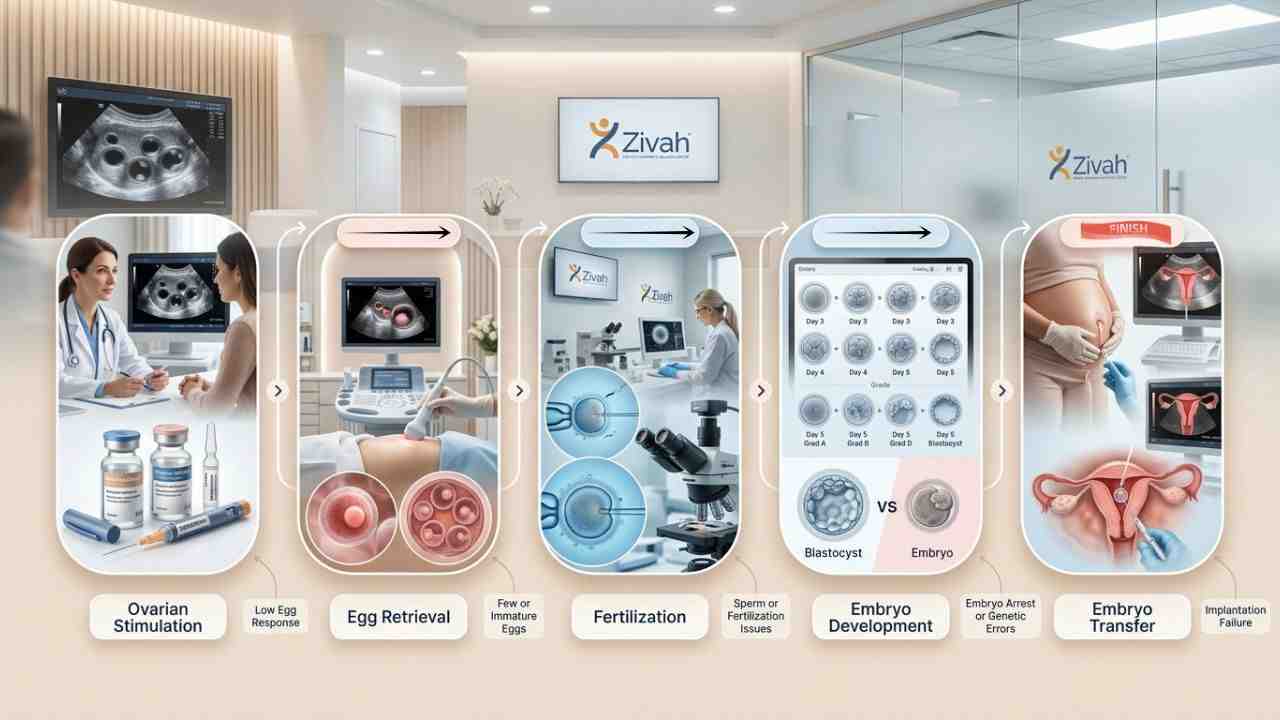
The 5 IVF Stages & Where Failure Can Occur
| IVF Stage |
What Happens |
Where It Can Fail |
|---|---|---|
| Ovarian stimulation |
Medicines prompt the ovaries to grow multiple eggs |
Poor ovarian response, too few eggs |
| Egg retrieval |
Mature eggs are collected from the ovaries |
Few or immature eggs retrieved |
| Fertilisation |
Egg and sperm combine in the lab (IVF or ICSI) |
Failed fertilisation, sperm DNA issues |
| Embryo development |
Embryos grow toward the blastocyst stage |
Embryo arrest, poor grade, chromosomal errors |
| Embryo transfer |
A healthy embryo is placed in the uterus |
Implantation failure |
If all the stages can go smoothly, and a cycle can still fail, how often does it happen? Let's see the actual deal.
How Often Does IVF Fail? (Real Success Rates by Age)
More often than doctors like to say. For women under 35, a single IVF cycle works about 40–50% of the time. As women get older, their IVF success rate goes down. It's not rare or unusual for a cycle to fail; it's just how fertility treatment works. Just seeing that number can hurt.
But think about this for a moment: if even the best odds are around half, then your failed IVF cycle wasn't your fault. It was just numbers doing what they do best. This is where age comes in. Age is the single most important factor that affects IVF success rates. This is because both the number and quality of eggs decrease with age. So can age lower IVF success rates? Yes, slowly until you're 35, then more quickly until you're in your late 30s or early 40s.
IVF Success Rate by Age
| Age Group |
Success Rate Per Cycle |
What It Means for You |
|---|---|---|
| Under 35 |
40–50% |
Highest odds, but a failed cycle is still common |
| 35–37 |
30–40% |
Gradual decline begins |
| 38–40 |
20–30% |
Egg quality becomes the main driver |
| Over 40 |
10–20% |
Cumulative cycles or donor eggs often discussed |
The most important thing is that those are per-cycle chances. If you stack two or three rounds, the overall success rate goes up a lot. Just because one round failed doesn't mean something is wrong. Numbers show that this does happen, but they don't explain why yours did. Let's answer that.
Why Does IVF Fail? The Real Reasons Explained
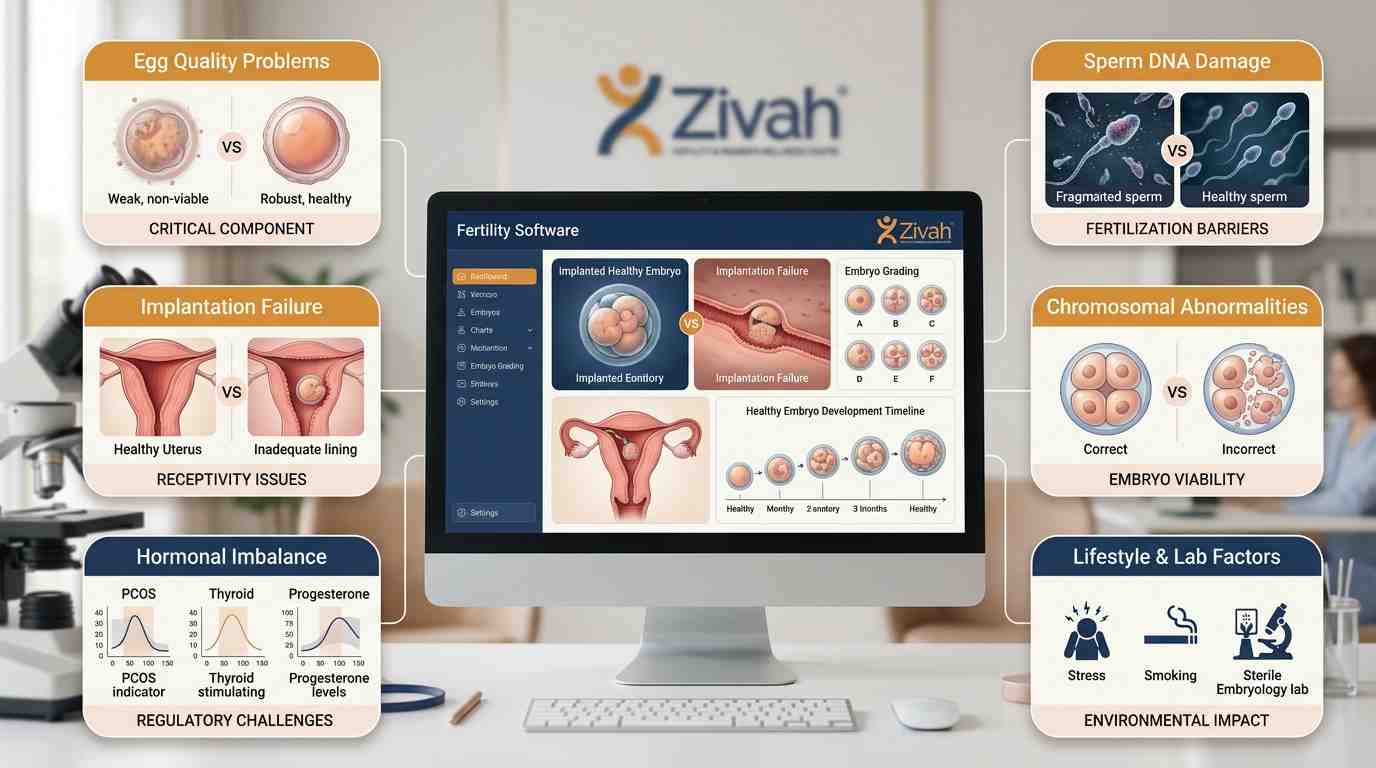
So, what truly causes IVF to fail? When couples ask why failed IVF happens to them specifically, the answer is almost always one of a few named things: the egg, the sperm, the embryo, the uterus, your hormones, or the time. Remember the five steps we talked about before? Any of them can break the cycle. But most of the time, "we don't know" is not the answer. Start with the most usual reason why IVF fails and go through the others one by one.
1. IVF Failure Due to Poor Egg Quality
This is where it starts for most couples. Poor egg quality is the most common reason IVF fails, and it also comes with two things: How many eggs you have and how healthy they are are the two most important things. Both decline with age; that's just how things are, not a sign of weakness. More chromosomal mistakes occur in older eggs, which means they might not fertilise, stop growing, or fail to implant even after a perfect transfer.
So how does egg quality affect IVF success? Really, because a strong embryo can only grow from a healthy egg. The egg is only part of the story, though. Your partner is the other half.
2. When Sperm Is the Hidden Problem (Even With a 'Normal' Report)
This is a heartbreaking circumstance. Semen analysis was normal, yet the IVF cycle failed. How could his semen analysis be normal, yet IVF failed? A standard test looks at count, shape and movement. What it often misses is sperm DNA fragmentation, unseen damage inside the sperm that can quietly delay embryo development.
So certainly, even if the report seems okay, poor sperm quality can cause IVF to fail. Often, the remedy is easy: a DNA fragmentation test to discover it and ICSI to inject a single healthy sperm directly into the egg. More about that later.
3. Embryo & Implantation Failure
This is the one that bothers couples the most. The embryo was graded well. The transfer was straightforward. And yet nothing. So why do good embryos fail to implant? More often, the embryo is not the answer. It’s the uterus in which it was asked to grow. For an embryo implantation, the uterine lining must be thick enough, healthy enough and timed just so.
A thin lining doesn’t give you enough to hold on to. Polyps, fibroids, or scar tissue might block attachment. So certainly, endometriosis can cause IVF failure since it can inflame the environment. Timing is critical, too, as the embryo and lining need to be in sync in a small “implantation window.”
Sometimes the immune system itself prevents the embryo from settling. The bottom line: unsuccessful embryo transfers are rarely just bad luck, and almost every reason why can be tested for and often fixed by a specialist.
Uterine & Implantation Factors and Their Effect on IVF
| Uterine / Implantation Factor |
Effect on IVF |
|---|---|
| Thin endometrial lining |
Too little support for the embryo to attach |
| Fibroids (inside the cavity) |
Physically interfere with attachment |
| Polyps or scar tissue |
Disrupt the implantation surface |
| Endometriosis / adenomyosis |
Inflammation lowers receptivity |
| Mistimed implantation window |
Embryo and lining fall out of sync |
| Immune or clotting factors |
Body may block a healthy embryo from settling |
Why Does Frozen Embryo Transfer Fail?
Frozen transfers (FET) also come with risks. Most of the time, it’s the preparation, not the embryo. The lining wasn’t built up quite right, the progesterone timing was just a little off, or the embryo didn’t survive the thaw completely. Even one day off the implantation window, and a healthy frozen embryo can still fail. So, a fertilised egg cannot implant? Yes, sometimes.
4. Chromosomal Abnormalities & Genetic Factors
Here's the hidden reason many "perfect embryo" failures happen: chromosomal abnormalities. An embryo can seem perfect yet have the wrong number of chromosomes, and when it does, the body normally won't allow it to implant. Like egg quality, this probability of mistakes increases with age. No one's fault, that's just how human reproduction works even without IVF. The good news is that these embryos can be identified. PGT-A testing screens embryos before transfer, so chromosomally normal embryos are selected first.
5. Hormonal Imbalances: PCOS, Thyroid & Progesterone
Your hormones set everything up. Many common diseases impact the outcome of fertility treatment. A slow or hyperactive thyroid could delay implantation. PCOS affects egg quality and ovulation; thus, may PCOS affect embryo implantation? It can do so by disrupting the hormonal balance on which the embryo depends. Low progesterone might leave the lining underprepared. The good news is that most of these are fixable, generally with medication, before the next transfer.
6. Lifestyle, Lab & Timing Factors
Finally, the little things on the edges, little in themselves, but they build up. On your side: Smoking, drinking and weight all affect egg, sperm and implantation health. From the clinic's side: lab conditions, embryologist skill, and transfer accuracy, true IVF risk factors that have nothing to do with you.
Many of them are adjustable, which marks the next leg of your journey. So now you've seen the usual suspects. One of them, stress, is blamed considerably more than it should be. Let's separate myth from medicine.
Stress, Lifestyle & IVF: What Actually Matters
If you’ve been repeating the loop over and over, wondering if you were too worried or too anxious, please don’t. It’s the heaviest weight couples carry after a failed IVF cycle, and it’s largely unnecessary. Stress and everyday habits affect your well-being, but they are rarely the decisive factor. What really matters for IVF success is largely biological, and much of that is within reach.
Can Stress Really Cause IVF Failure?
There is no solid evidence that stress alone leads to a cycle failure. The IVF failure was not because you felt worried throughout treatment, therefore you may let the self-blame go. Stress may destroy your sleep and your resiliency, and that alone is reason enough to take it seriously.
And as we showed with hormonal issues earlier, diseases like PCOS or thyroid instability matter significantly more, and those are controllable. Can you feel when a cycle is quietly failing? What the signs truly mean. Many couples look at their bodies for hints.
What are the signs of a failed embryo transfer?
To be honest, there are no reliable ones. You are seeing cramping, spotting, or the absence of signs, which can happen whether or not the cycle worked. Only a blood test for beta-hCG, done around 10-14 days following transfer, will tell you for sure. If you are in the two-week wait, you know the routine: every ache is examined, every symptom is checked out. It's tiring, yet perfectly human.
But the early symptoms of a failed embryo transfer are most similar to a successful transfer, as the progesterone sustaining your cycle is similar to early pregnancy and PMS signs. Sore breasts, cramps, spotting, they can imply anything, or nothing at all. Only the lab can give an honest response.

Common Post-Transfer Signs vs What They Actually Mean
| What You Notice |
What It Actually Means |
|---|---|
| Mild cramping |
Unreliable, mimics PMS and progesterone |
| Spotting |
Can happen in both success and failure |
| No symptoms at all |
Not a sign of failure |
| Negative home test (day 10–14) |
Confirm with a beta-hCG blood test before concluding |
A low or rising hCG level can signal that the embryo didn't fully implant, though one figure rarely tells the whole story. The patterns differ from person to person, so let your clinic read the trend before you conclude anything. A negative result is heartbreaking. But it is data, too. But the difficult question is: why THIS time, when nothing looked wrong?
Repeated IVF Failure & Recurrent Implantation Failure (RIF)
If you are here after a second or third try, you deserve a straight answer. Recurrent implantation failure (RIF) occurs when doctors transfer multiple excellent embryos, but none of them implant. What is recurrent implantation failure in IVF? In simple terms, it’s repeated IVF failure despite embryos that should have worked.
The shift that matters is this. "Bad luck" is fair after a cycle or two of failure, but usually, after numerous failures, it is not so. And it is good news. Repeated IVF failure means there is a particular, findable cause, not a limitless chance.
The secret? It is often missed in routine testing. If you have asked yourself what went wrong in your failed IVF, the answer is frequently outside of a standard workup: uterine inflammation, immunological reactions, clotting difficulties, or an implantation window that was not timed properly. That’s what a new test is looking for. For reasons why IVF would not work, over and over again? There is nearly always an answer worth pursuing.
Can IVF Fail With Healthy or PGT-Tested Embryos?
Yes, even those who have genetic testing. A PGT-tested embryo is one with normal chromosomes, but it doesn’t mean the uterus, timing or immunological environment will play ball. So, yes, IVF failure with PGT-tested embryos does happen. And, as we saw with implantation earlier, even a perfect embryo needs the right spot and the appropriate time. Your decent embryos fail, the hunt just shifts from embryo to environment, limiting the question, not ending it.
What Tests Are Done After Repeated IVF Failure?
Think of it as a strategy, not a death sentence. Your initial cycle didn’t screen for these, but a specialist will probe further. They’ll examine your uterine cavity, your implantation window, and your immunological and clotting elements that a standard workup never considers.
Diagnostic Tests After Repeated IVF Failure & What Each Reveals
| Test |
What It Reveals |
|---|---|
| Hysteroscopy |
Polyps, scar tissue, or chronic endometritis |
| ERA / receptivity test |
Whether your implantation window is correctly timed |
| Immune & thrombophilia panel |
Immune or clotting barriers to implantation |
| Sperm DNA fragmentation (repeat) |
Hidden male-factor damage missed earlier |
| Karyotyping (both partners) |
Inherited chromosomal issues |
Yes, autoimmune problems can impact IVF outcomes, hence the importance of these panels. Each test below takes an unanswered “why” and turns it into a fixable answer.
What to Do After a Failed IVF Cycle
Let yourself grieve first. A failed IVF cycle is a significant loss; take the time you need. What to do after a failed IVF: a plan of action, not a spiral, when you are ready:
- Book a follow-up consultation - review exactly what happened.
- Ask about targeted testing - what the initial round overlooked.
- Allow recovery time - let your body and mind reset.
- Go back to the protocol - if IVF fails, the next cycle should be smarter, not a duplicate.
And how many failed IVF cycles are normal? More than you think. Many couples need two or three rounds, and so one failure is no reason to give up. You have to wait, which is personal, and the first cycle is usually testing.
So why does IVF fail the first time? It usually tells your team how your body responds, so the next round can be adjusted for you. You're not back at the beginning; you're starting over with information you didn't have before. Knowing what went wrong is only half the win. The other half is the half you can actually influence, and that half increases your odds next time.
How to Improve IVF Success Rates After a Failed Cycle
This is where you grab the steering wheel back. A failed cycle is not the end. It's data, and that data is the exact way you improve your IVF success rates next time.The biggest advances come from precision, not trying again. So, how do you increase the chances of a successful IVF? Customising the treatment to your body's actual response, improving egg and sperm health, correcting any uterine or timing abnormalities, and selecting the strongest embryo. The levers your specialist chooses are the ones that fit your story; not all will be required.

1. Personalised Protocols, Medications & Embryo Selection
And this is where the real work is done: accuracy, not repetition. Depending on what your last cycle showed, your team might be:
- Customise your medication: adjust stimulation and add the right progesterone and luteal support, the meds that improve IVF implantation.
- Timing is everything: a frozen embryo transfer guided by your ERA to your implantation window.
- Make better choices: PGT-A to choose chromosomally normal embryos or ICSI if sperm quality is an issue.
Together, they are among the best techniques to improve embryo implantation, tiny modifications that make for a totally different cycle.
2. Lifestyle, Diet & Foods That Support IVF Success
You can't control the lab, but you can set the stage. Real lifestyle modifications that actually improve IVF success: a nutritious diet of antioxidants, folate, omega-3s, a healthy weight, reduced smoking and drinking, and protected sleep.
No one food guarantees a result, but a well-supported body gives every other lever a better opportunity to work. Most of these levers are ones you can't pull by yourself, and that's the purpose. The next move is rarely striving harder; it's being looked at more closely.
When Should You See a Fertility Specialist?
Sometimes the most intelligent thing to do is not another cycle, it's fresh eyes. If you see any of these, get a specialist review:
- Repeated failures - two or more unsuccessful cycles.If you're over 35, egg quality and timing are most critical.
- A diagnosed condition - like PCOS or endometriosis.
- Recurrent pregnancy loss – losses that demand further examination.
The most advantage you can get is through a comprehensive review. It converts "why would IVF not work for us?" into a practical, practical issue and guides your fertility treatment after a failed IVF based on genuine data, not guesswork.
This is exactly where the Zivah Fertility experts can help, taking a complete examination of your history and helping you through your repeated IVF failure treatment options, one straightforward step at a time.
Failure identified is a failure that can be repaired. Let's bring this home and leave you with a clearer path than when you arrived.
Conclusion
If there is one thing to take away, it is this: IVF failure nearly always has a nameable explanation: the egg, the sperm, the embryo, the uterus, your hormones, or timing. As we've gone through, it's almost never because of something you did wrong. Your failed IVF cycle was biology, not blame. And that is what gives one hope for the next step.
Understanding the last cycle is the start of the next one, and that's where your power is. Targeted testing and a personalised strategy based on your actual results can make a huge difference in your odds. So, back to the question you started with.
Why does IVF fail? Now you have real answers, not guesses. A failed cycle isn't the end of your story. It's a challenge. Many couples go on to succeed with the correct care and a clear plan. You haven't gone back to the start. You're on better ground. Take the next step with Zivah Fertility.
Frequently asked
01 Can IVF fail with healthy embryos?
02 Can stress affect IVF success?
03 How many IVF cycles do most couples need?
04 What foods improve IVF success rates?
05 Can poor sperm quality cause IVF failure?
06 Can endometriosis cause IVF failure?
07 Why does IVF fail the first time?
08 Can autoimmune disorders affect IVF success?
09 Is IUI failure the same as IVF failure?
10 How long should couples wait after a failed IVF cycle?