
At Zivah Fertility, couples counselling gives you and your partner a private, unhurried space to talk through the emotional side of trying to conceive, including the worry, the waiting, and the things that feel hard to say out loud. So what is fertility couples counselling? It is supportive, confidential guidance for two people navigating fertility together, led by a counsellor who understands this particular kind of hope and strain.
On this page, we explain how couples counselling at Zivah works, who it helps most, and how to book when you're ready. Wherever you are in your journey, our team is here to listen.
Why Does Fertility Treatment Put Pressure on a Relationship?
Being a parent can put even the strongest relationships to the test. Some tests- time, closeness, and quiet disappointment can change the way two people feel about each other over the course of months.
Many couples are surprised by how heavy it feels. It's normal to feel this way when you're going through a tough time, and it doesn't mean there's something wrong with your relationship. Putting a name to the stress is the first step toward easing it.
Here are some of the most common ways that partners experience pregnancy stress.
| Common Strain |
How It Feels for Couples |
How Zivah Helps You |
|---|---|---|
| Communication Breakdown |
Conversations turn into arguments or silence |
We guide calmer, more honest conversations |
| Blame or Guilt |
One partner feels responsible |
We help you face the journey as a team |
| Loss of Intimacy |
Sex becomes clinical and scheduled |
We help rebuild closeness beyond treatment |
| Different Coping Styles |
One wants to talk while the other withdraws |
We help you understand and bridge coping differences |
| Decision Fatigue |
Too many treatment choices feel overwhelming |
We help you make decisions together |
All of these problems don't mean that your relationship is ending. They just mean that you are carrying something heavy, and a little help can make all the difference in how you do it.
Does Infertility Affect Men and Women Differently?
Most of the time, yes. A lot of women carry the weight of their monthly appointments, procedures, and hopes, while a lot of men feel like they have to be strong and not say much because they are scared but don't know how to show it. There is no right or wrong way to deal with things, and neither person is failing the other.
Zivah's couples counselling gives each of you a chance to be honest about your own problems. This way, the gap that can form between two people who handle things differently can be bridged.
Can the Stress of Treatment Affect Our Relationship and Its Outcomes?
Don't worry that your feelings are making it impossible for you to get pregnant. Stress alone doesn't usually do that. Treatment can make it hard to sleep, stay close, and have energy for each other and the choices that lie ahead. Taking care of your mental health not only makes your relationship feel stronger, but it also helps you both be more resilient as you go through each stage of care.
What Happens During Couples Counselling for Fertility?
If you have never spoken to a counsellor before, it is natural to wonder what a session actually involves. At Zivah, there is no script and nothing you must say. A trained fertility counsellor leads sessions in a calm, confidential setting, and the time is yours to use however you need. Most couples find that a typical session makes room for a few different things:
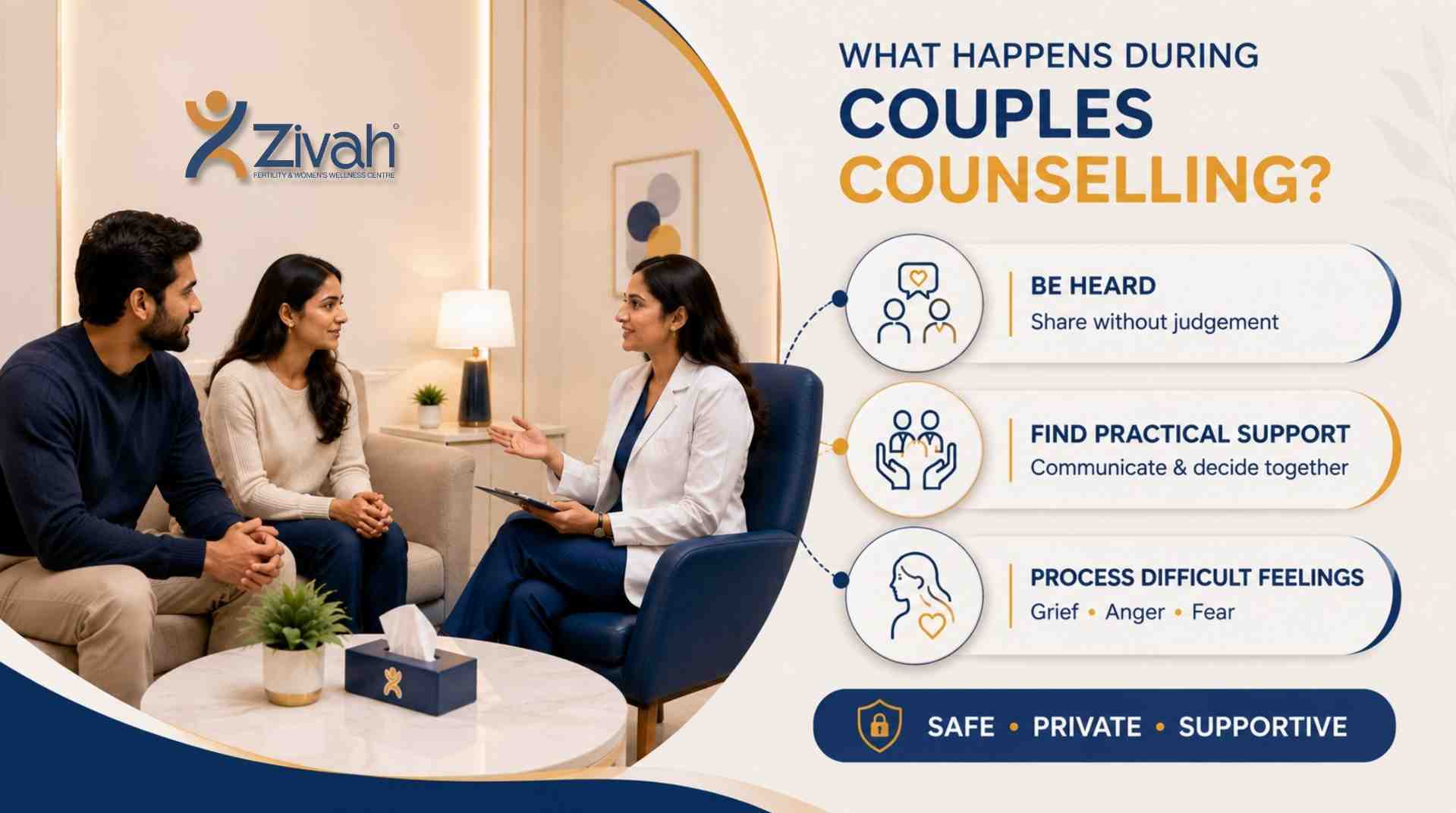
- A chance to be heard: You can all share how you're really coping without being interrupted or judged.
- Help in the real world: reliable ways to talk, make choices, and get through the tough spots together.
- Room for the difficult feelings: Grief, anger, or fear should be able to express themselves in a safe place so that they don't have to carry them around in quiet.
Is fertility counselling the same as ordinary couples therapy? Not quite. Fertility counselling is based on the experience of trying to conceive, so your counsellor already knows what it's like to wait two weeks, be disappointed when the test comes back negative, and feel stressed out in a relationship. You don't have to start from scratch to explain that world to your counsellor.
To help you understand better, here is what a session usually includes:
| Session Focus |
What You Explore Together |
Who It Suits |
|---|---|---|
| Emotional Check-In |
How each of you is coping |
Couples at any stage |
| Communication Support |
Talking without blame or withdrawal |
Couples feeling distant |
| Treatment Decisions |
Weighing IVF, donor, or surrogacy options |
Couples facing difficult choices |
| Grief and Loss |
Processing failed cycles or miscarriage |
Couples coping with setbacks |
| Rebuilding Intimacy |
Reconnecting beyond timed conception |
Couples feeling intimacy has become clinical |
There is no one way that every couple should use their sessions, and that's fine. Your counsellor goes at your pace and time, or any time that works for both of you.
How Long Is Each Counselling Session?
Most sessions run for around 45 to 60 minutes and are arranged at times that work with your treatment and your working lives. You're not rushed, and you don't have to commit to a certain number of sessions. Some couples feel supported after just a few, while others would rather have ongoing support over a longer period of treatment. The pace must be right for you.
Do We Have to Attend Together Every Time?
Not at all. A lot of couples go together, but you can always have a session by yourself if one of you needs some space. You may travel together for most of your journey and separately when you feel you need some space. Your counsellor will help you make the best choice for both of you.
What Types of Fertility Counselling Do We Offer at Zivah?
Not every couple needs the same kind of support, because no two people arrive at counselling carrying quite the same thing. Some come to cope with the day-to-day strain of treatment, others to think through a big decision before they take it, and some to work through a loss that still feels raw.
At Zivah, we offer a few different types of fertility counselling so the support you receive genuinely matches where you are and what you are facing.
| Counselling Type |
What It Covers |
When It Helps |
|---|---|---|
| Support Counselling |
Coping with the emotional strain of treatment |
At any stage of your journey |
| Implications Counselling |
Understanding donor, surrogacy, or genetic choices |
Before third-party fertility treatment |
| Therapeutic Counselling |
Working through grief, loss, or anxiety |
After setbacks or pregnancy loss |
| Decision Counselling |
Deciding whether and how to continue treatment |
At crossroads in your fertility journey |
What is the difference between support and implications counselling? Support counselling helps you deal with how treatment makes you feel, while effects counselling helps you think about a choice before you make it. Support counselling helps with the everyday stress and weight of the journey, like waiting and worrying. On the other hand, implications counselling is a more focused conversation for couples who are thinking about whether to use a donor or a surrogate.
What Is Support Counselling?
For most couples, this is where counselling begins. Support counselling is not about fixing anything; it is about having somewhere steady to bring the feelings that treatment stirs up, week after week.
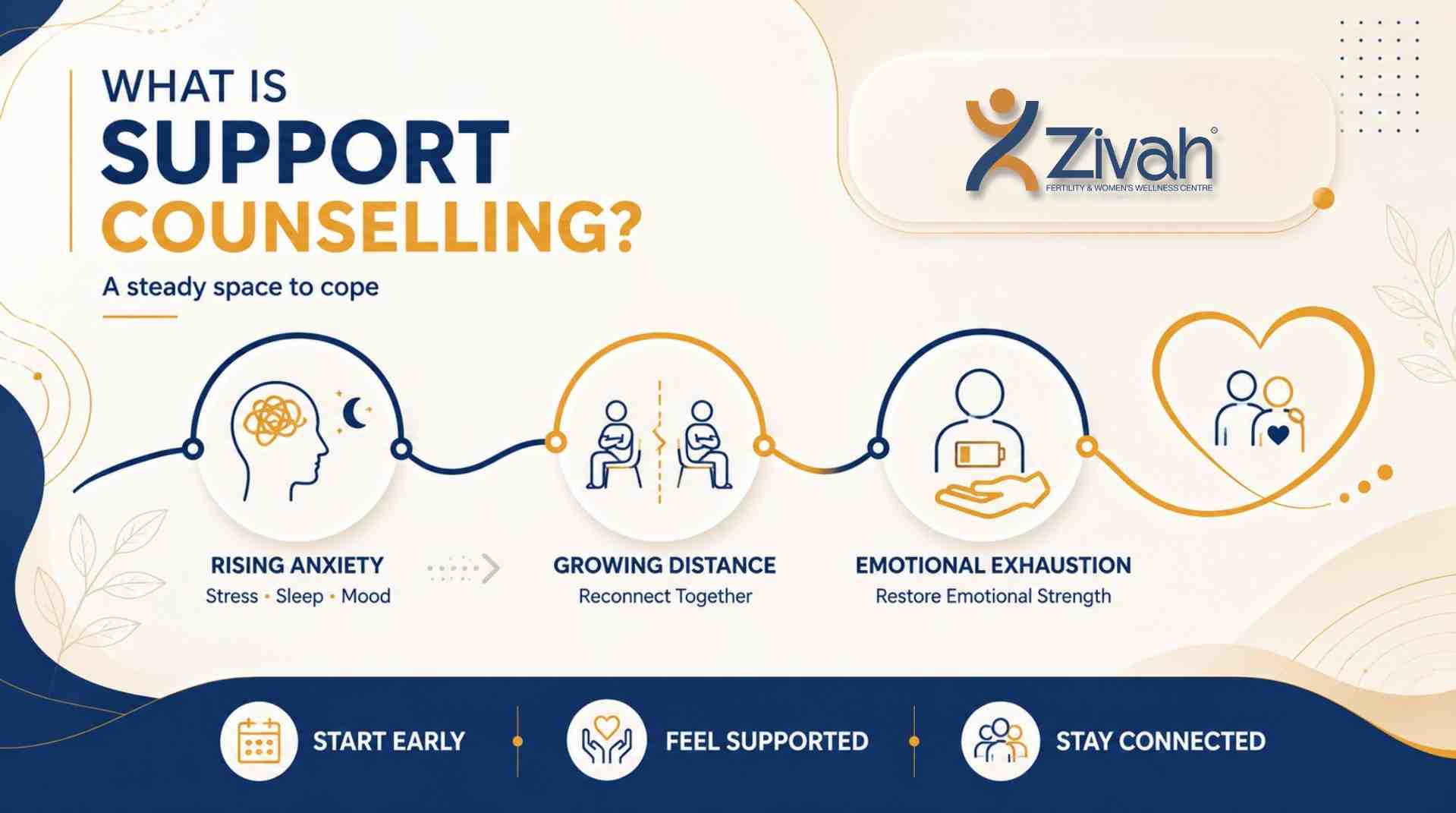
Couples often turn to it when they notice things like:
- Rising anxiety: the waiting and the results start to affect sleep, mood, or daily calm.
- Growing distance: you are coping in different ways and feeling less connected because of it.
- Emotional exhaustion: the effort of staying hopeful is beginning to wear you both down.
When should we start support counselling? Whenever it would be helpful, which is usually before the couple plans. You don't have to fight to start; many people find that starting early keeps small strains from getting worse.
What Is Implications Counselling?
There are times when you need more help than usual on your path to fertility. If you are thinking about whether to use a donor or a surrogate, implications counselling can help you think it through with a partner. Being led to a choice is not the point.
The point is to understand what each road means to both of you so that the choice you make is one you are both comfortable with, made together rather than alone.
Which Couples Should Consider Fertility Counselling?
It is important to make it clear that counselling is not just for couples who are having a hard time. Is counselling only for couples in crisis? Not at all. Most couples who come to us can handle things, but they're having a harder time than they expected. If treatment has begun to change how you talk, sleep, or feel about each other, that is reason enough to consider support.
Couples Facing Repeated IVF Cycles or Setbacks
Few things test a couple like trying again after a cycle has not worked. A failed transfer or the loss of a pregnancy can leave you both drained and unsure how to comfort each other. Counselling at Zivah gives you space to grieve, steady yourselves, and find your footing again together.
Couples Facing Donor or Surrogacy Emotions
Choosing a donor or surrogacy journey can stir feelings and catch you by surprise, even when you feel sure of the decision. Questions of identity and connection can sit quietly underneath, and counselling gives you both a place to bring them, so you step forward feeling ready.
If you are wondering whether now is the right time to reach out, it helps to check in on how the two of you are doing. Couples often find counselling worthwhile when:
- You feel like patients, not partners; you're not as close as you used to be.
- You're sad but don't know how to express it; a loss sits between you.
- You can't agree on what to do next; the decisions are too big for you to make on your own.
- You worry all the time now; anxiety is guiding your days.
Any one of these is reason enough to talk to someone. Here are the signs that couples counselling could help you.
| You May Benefit If… |
What You Might Notice |
How Zivah Supports You |
|---|---|---|
| Treatment Feels Isolating |
You cope alone instead of together |
We help you reconnect as a team |
| Decisions Feel Too Big |
You disagree about the next steps |
We guide calmer, shared decisions |
| Loss Feels Unspoken |
Grief goes unacknowledged |
We help you process loss with care |
| Intimacy Has Faded |
Emotional or physical closeness feels lost |
We support you in rebuilding your bond |
| Anxiety Is Constant |
Worry disrupts your daily life |
We provide practical coping tools and support |
If even one sign feels familiar, that is enough, and our counsellors are ready to help.
Who Should Book Couples Counselling at Zivah?
Couples counselling at Zivah suits partners at any point in the fertility journey, from your very first questions to advanced treatment and beyond. Can we book counselling without starting treatment? Yes, absolutely. You do not need to be in active treatment or even certain about your next step to talk to a counsellor. Many couples come while they are still deciding, simply because facing it together feels easier with support.
Couples at Any Stage of Treatment
Wherever you are, counselling meets you there. What makes this support different at Zivah is that our counsellors work closely with our fertility team, so your emotional care and medical care stay joined up, and you never feel passed between strangers. The reassurance you need at the very start is not the same as the strength you need years in, and your counsellor adjusts to that as you go.
No matter where you find yourselves right now, the kind of support that helps shifts as you move through each stage. Here is how counselling at Zivah supports you along the way.
| Stage of Journey |
Emotional Needs |
How Zivah Helps You |
|---|---|---|
| Just Beginning |
Clarity and reassurance |
We explain, listen, and support you |
| During Active Treatment |
Coping and communication |
We support you through each treatment cycle |
| After a Setback |
Grief and recovery |
We help you process, heal, and regroup |
| Considering Donor or Surrogacy |
Reflection and readiness |
We guide important decisions with care |
| Building Your Family |
Confidence and hope |
We support you through your next chapter |
Wherever this table finds you, that stage is reason enough to reach out. Our counsellors are here whenever you feel ready to begin. And if you are already in treatment, you may be wondering how counselling sits beside the clinical side of your care, which is exactly where we turn next.
Can We Have Counselling During IVF Treatment?
Yes, and for many couples this is when it helps most. Counselling at Zivah runs alongside your treatment, never in place of it, so you are supported at the very moments the clinical side feels most demanding.
Couples often carry a quiet worry here, though, so let us answer it plainly. Will our counsellor talk to our fertility doctor, or stay separate? What you share in counselling stays strictly between you and your counsellor; it is not reported back into your medical notes. Your emotional care and clinical care move in parallel, working together toward your wellbeing, while the privacy of the counselling room is always protected.
That reassurance matters most in the moments treatment asks the most of you. Here is where counselling tends to help alongside each kind of care.
| Your Treatment |
Where Counselling Helps |
How Zivah Supports You |
|---|---|---|
| IVF Cycles |
Managing the two-week wait and treatment results |
We support you through each stage |
| Donor Egg or Sperm IVF |
Processing emotions around donor conception |
We guide these conversations with care |
| Surrogacy Programme |
Preparing emotionally for the journey |
We provide support throughout the process |
| After Pregnancy Loss |
Coping with grief and deciding next steps |
We help you heal at your own pace |
Whichever path you are on, the support runs steadily beside it, so you never carry the emotional weight alone. You can read more on our IVF, donor, and surrogacy pages.
How to Book Couples Counselling at Zivah Fertility
Taking the first step is simpler than you might expect. So how do we get started with couples counselling? You reach out to our team, tell us a little about what you are going through, and we do the rest, matching you with a fertility counsellor suited to your situation and arranging a time that works for both of you. There is no long process to navigate and nothing you need to prepare beforehand.
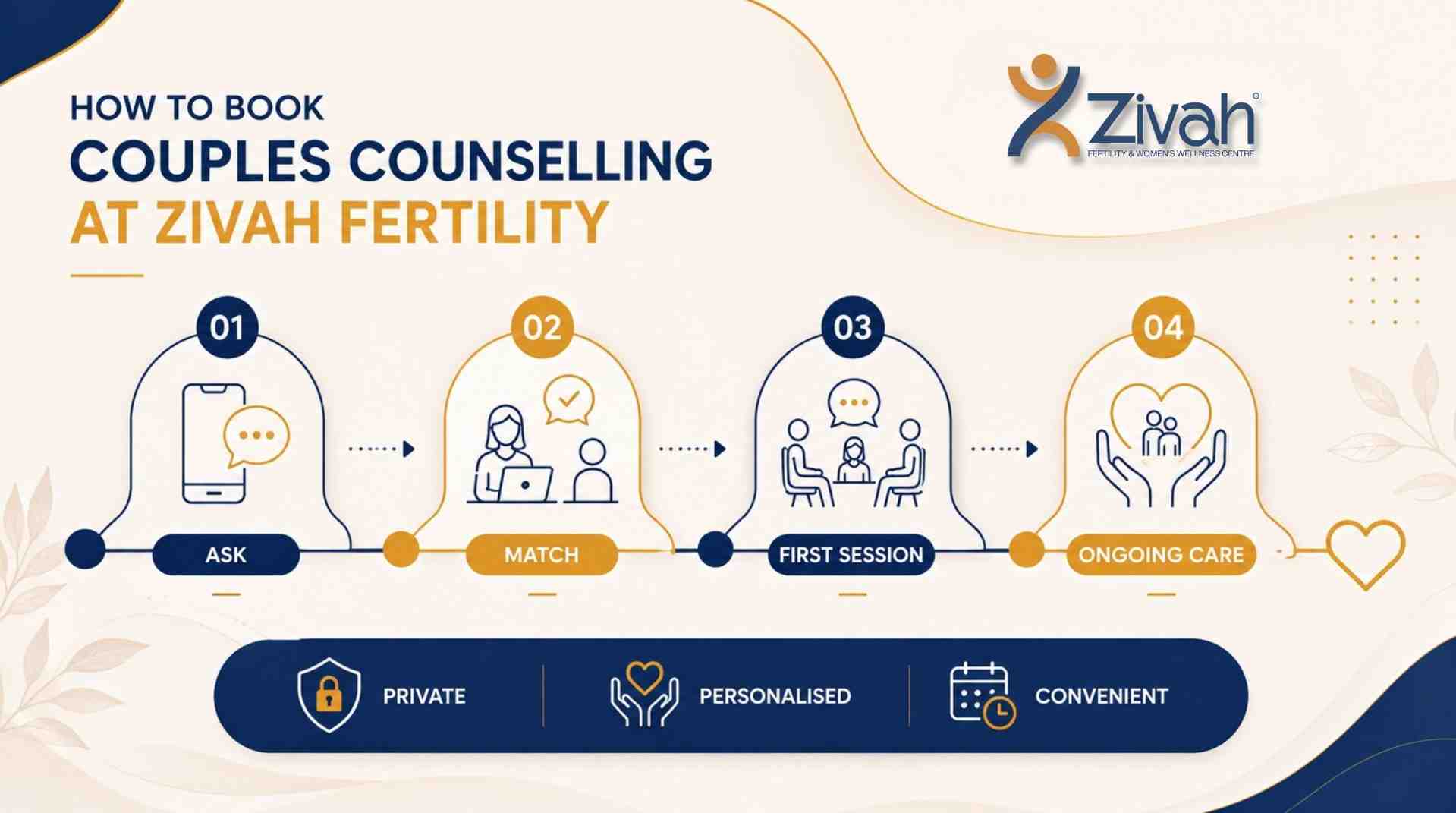
Here’s how it works, step by step:
- Ask: Reach out to our team and let them know what you need.
- Match: We’ll connect you with a fertility counsellor and find a time that works for both of you.
- First session: The first time you meet with your counsellor, you both come as you are, with nothing planned.
- Ongoing care: You continue as needed, attending appointments together or alone.
From your very first message to your first session, everything is arranged with care and kept completely private, so the only thing you need to bring is yourselves.
Conclusion
It can be one of the hardest things for two people to go through together, but you don't have to carry it alone. When you and your partner go to Zivah Fertility for couples counselling, you and your partner can be heard, understand each other better, and feel encouraged as you go through each stage instead of alone. Our counsellors are here to walk with you both whenever you're ready.