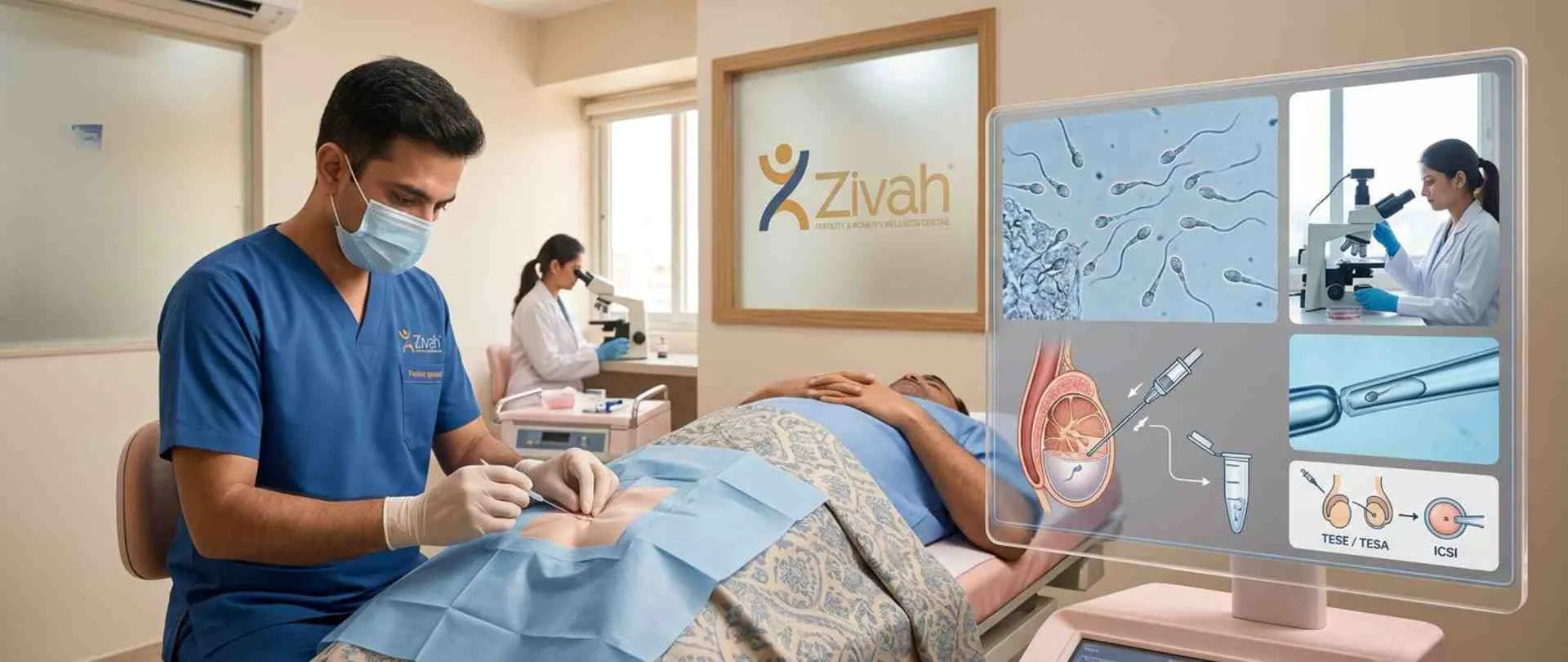

A diagnosis of azoospermia may seem like the end of the road, but it isn't. If you don't have sperm in your semen, it doesn't indicate you don't have sperm in your body. In most situations, sperm are still being made inside the testes, but they are not making it into the ejaculate. This is where TESA treatment comes in.
Testicular sperm aspiration is a quick, minimally invasive sperm retrieval method in which sperm is extracted straight from the testicular tissue using a small needle, no surgery, no stitches, same day discharge. TESA for azoospermia is often the initial step towards parenthood with IVF-ICSI for men with obstructive or some non-obstructive azoospermia.
Zivah Fertility performs the TESA procedure under short general anaesthesia by trained andrologists, and the sperm retrieval rates are among the highest in the region.
What Is TESA and How It Works
Testicular sperm aspiration is a sperm retrieval process where a doctor uses a fine needle to draw sperm directly from your testicular tissue. It skips the standard path totally.
Here's the short anatomical part. Inside your testes, there are tiny, coiled structures called seminiferous tubules, and that is where sperm is made. Under normal circumstances, the sperm will move through the epididymis, then the vas deferens, and then mix with semen after ejaculation. If there is a blockage somewhere in that pipeline or the sperm count is too low to make it through, none makes it into the semen sample.
That's the problem TESA overcomes by going straight to the source. Instead of waiting for sperm to come out, the needle gathers aspirated sperm right from the testicular tubules where they are being created.
TESA Full Form and Medical Meaning
In medical terms, the full form of TESA is Testicular Sperm Aspiration, a common medical acronym known globally. The meaning of TESA is simple: collecting, or pulling out, sperm from the testes with a needle. It’s the most common method when sperm is present in the testicles but can’t find its way into the ejaculate on its own.
Understanding Azoospermia: The Diagnosis Behind TESA
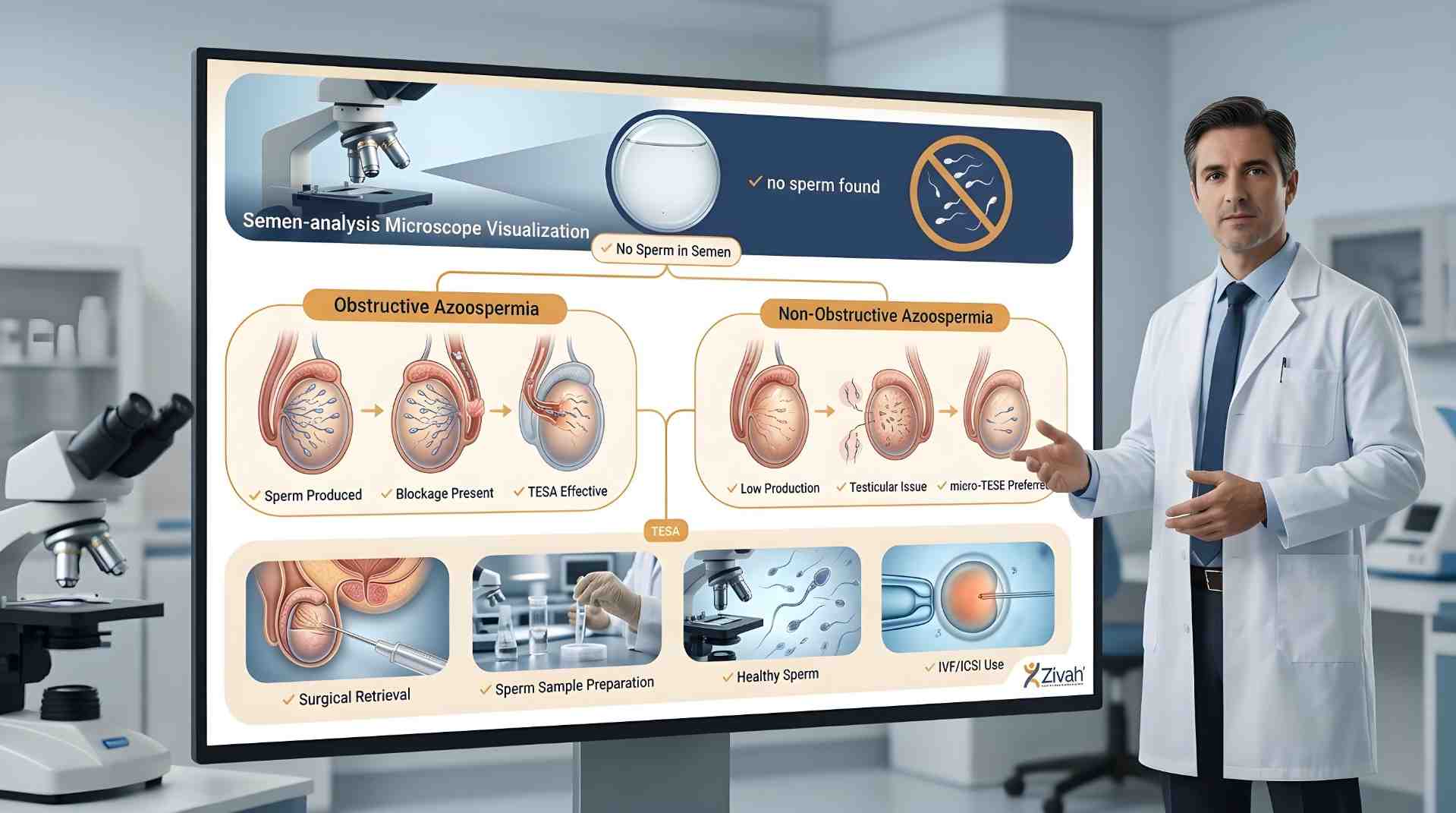
Azoospermia means no sperm in semen, meaning there are zero sperm cells found in your ejaculate under a microscope. It sounds like it's final, but it's not. Azoospermia is not infertility. Most men with this diagnosis are still producing sperm within the testes; it’s simply not making it into the semen. That is why azoospermic patients can have biological children with the use of sperm retrieval procedures like TESA and then IVF-ICSI. But there are two sorts of azoospermia, and the difference determines your whole azoospermia therapy pathway.
1. Obstructive Azoospermia: Sperm Is Made But Blocked
In obstructive azoospermia, sperm production is normal; the pipeline is blocked. Common causes: blockage after vasectomy, CBAVD ( congenital absence of vas deferens ), blockage of the epididymis due to scarring from infection, or blockage of the vas deferens due to previous surgery. Since there is sperm, TESA retrieval success is 95-100%.
2. Non-Obstructive Azoospermia: Production Problem
Non-obstructive azoospermia (NOA) is a difficulty with sperm production, meaning the testes are not producing enough sperm, or production is focal. Causes include Klinefelter azoospermia (XXY), Y-chromosome microdeletion, intrinsic testicular failure, hormonal imbalance, prior chemotherapy or radiation, and undescended testes. For NOA, micro-TESE is generally favoured over normal TESA.
Azoospermia Decision Matrix
| Diagnosis Type |
Most Likely Cause |
Recommended Retrieval Method |
|---|---|---|
| Post-Vasectomy |
Mechanical blockage |
TESA or PESA |
| CBAVD (Congenital Absence of Vas Deferens) |
Genetic (CFTR mutation) |
TESA or MESA |
| Post-Infection Scarring |
Acquired blockage |
TESA or PESA |
| Klinefelter Syndrome |
Genetic (XXY karyotype) |
Micro-TESE preferred |
| Y-Chromosome Microdeletion |
Genetic deletion (AZF region) |
Micro-TESE preferred |
| Idiopathic Non-Obstructive Azoospermia |
Unknown / multifactorial |
Micro-TESE preferred |
When Doctors Recommend TESA
The short answer is: When sperm are in the testes but can't go into the ejaculate normally. The reasons for getting TESA are cases of blocked, bypassed or blocked sperm passage, not where sperm production has failed.
1. After Vasectomy or Failed Vasectomy Reversal
The most common reason for sperm retrieval after vasectomy is. Sperm production is still normal, but delivery is blocked. TESA after vasectomy is a minimally invasive and often a better alternative than a second vasectomy reversal procedure, especially when reversal has already failed, or the couple prefers to proceed straight to IVF-ICSI.
2. Other Obstructive Causes and Ejaculation Disorders
TESA can also be used to treat blocked sperm ducts in a couple of other situations:
- CBAVD (congenital absence of the vas deferens)
- The scar tissue from epididymitis, STIs, or TB after infection
- Ejaculatory duct obstruction or damage from hernia/scrotal surgery
- TESA for retrograde ejaculation, anejaculation or spinal cord injury
- Ejaculation problems with nerves and diabetes
- Severe oligozoospermia when the ejaculate has near-zero sperm
- Sperm preservation before chemotherapy or radiation when ejaculation is not possible or semen quality is inadequate
- Use non-obstructive azoospermia cases as a first-line attempt
PESA may be suitable for some obstructive cases; however, Micro-TESE is still the best approach for most NOA conditions.
TESA Procedure Step by Step: What Happens During Testicular Sperm Aspiration
Wondering what happens during TESA? Here’s how the testicular sperm aspiration procedure looks from your point of view – from pre-tests to discharge on the same day. How does the TESA procedure work? Simpler than most men think and quicker.
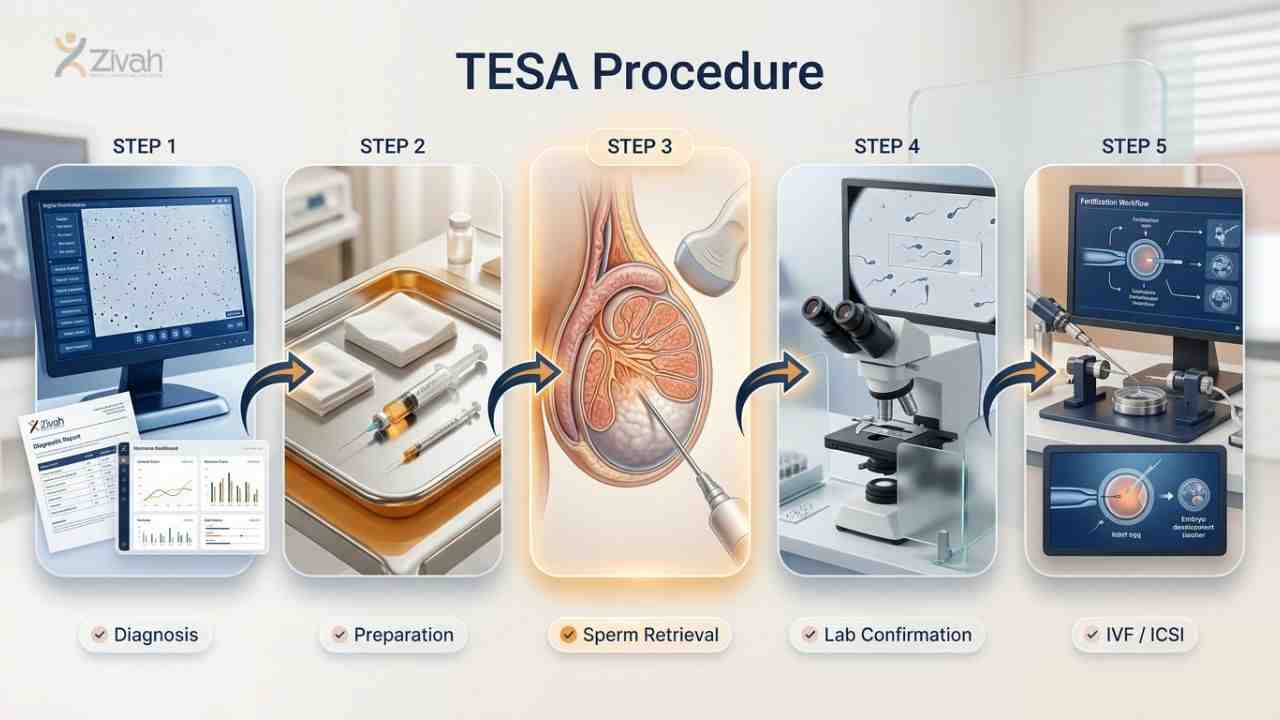
Step 1: Pre-Procedure Tests and Evaluation
The diagnostic basis that verified your azoospermia was a repeat semen study (often combined with sperm DNA fragmentation testing). Your andrologist will perform a few TESA pre-tests before the TESA to ensure a safe retrieval.
| Test |
What It Reveals |
|---|---|
| Semen analysis |
Confirms azoospermia (no sperm in ejaculate) |
| Hormonal profile (FSH, LH, testosterone) |
Shows whether sperm production is intact |
| Scrotal ultrasound |
Maps testicular anatomy and blockages |
| Genetic testing (karyotype, Y-microdeletion) |
Screens non-obstructive cases |
| CFTR mutation test |
Checks for CBAVD-linked mutations |
Step 2: Arrival, Preparation, and Anesthesia
You check in, and change. Is TESA done under anaesthesia? Yes, local anaesthesia or OT under short anaesthesia with spermatic cord block is standard (general only with another treatment). Numbing takes 5-10 minutes, and the area is completely numb before any needle is inserted. You are awake but do not feel any acute symptoms.
Step 3: Sperm Aspiration from the Testicle
This is the main step: how sperm is collected in TESA. A fine 21-23 gauge needle is passed through the scrotal skin into the testis, and gentle suction is used to aspirate small samples. Your surgeon may take a few samples to get the greatest number of sperm. Most men report pressure or little pulling, not severe pain. The needle aspiration lasts 10-20 minutes.
Step 4: Real-Time Lab Confirmation
The moment of truth. While still on the table, the aspirate goes directly to the embryologist next door in the lab for microscope analysis. If viable sperm are detected, the process is complete. If not, the surgeon takes a sample from another place or advises Micro-TESE, so you leave with an answer.
Step 5: Sample Preparation, Coordination, and Same-Day Discharge
When the eggs are extracted from your partner in the room next door, the embryologist removes a viable sperm under high magnification, in perfect sync with the other team, in a new cycle. Otherwise, we freeze sperm for future use. You have a little break and go home that day. So you get sperm. Then what? This is where ICSI comes in.
TESA + ICSI: The Combined Pathway (and Sperm Freezing)
So they've retrieved the sperm, now what? Here’s the thing: many men don’t realise that TESA is only half the trip. Step one is retrieving sperm, step two is fertilising your partner's egg. And you can't make that second step in the usual way. That's why. Sperm taken straight from the testicles are generally immature. They lack the natural motility necessary to pass through an egg independently, which rules out IUI and standard TESA IVF. This is why specifically surgically extracted sperm needs to be combined with ICSI Treatment, whereby a single healthy sperm is injected straight into the egg. TESA + ICSI path, step by step:
- TESA - sperm taken directly from the testicle tissue
- Sample prep - embryologist pulls out the healthiest viable sperm
- ICSI - sperm is put directly into each developing egg
- Embryo transfer - Fertilised embryos are grown and then transferred to the uterus
On timing: TESA can be done the same day as your partner’s egg retrieval (a fresh cycle), or in advance with the sperm frozen, which leads us to the next topic.
Sperm Freezing After TESA
Do you have to repeat this surgery if the first cycle fails? Not usually. Any additional sperm collected during TESA can be frozen and kept for future use, and that single point saves a lot of men from a second operation.
Can I use TESA frozen sperm later? YES, Frozen TESA sperm as successful as fresh in ICSI cycles.
- With sperm cryopreservation, TESA allows for several IVF attempts with a single retrieval.
- 5+ years storage, renewable: standard at Zivah
- Peace of mind – back up sperm for repeat cycles or future children.
How Successful Is TESA? Understanding Sperm Retrieval Rates
When people ask about the TESA success rate, they are typically confusing three different numbers. It helps to separate them. There’s the sperm retrieval rate (did we find sperm?), the ICSI fertilisation rate (did the sperm fertilise the egg?) and the IVF pregnancy rate every cycle (which also depends on your partner). Each one monitors a different stage, so a high retrieval rate doesn’t immediately signify pregnancy, and a lower one doesn’t mean the end of the road.
Sperm Retrieval Rate by Type of Azoospermia
Here’s the real deal: most clinics don’t tell you, how effectively TESA works for azoospermia is almost completely dependent on your diagnosis. The results of sperm retrieval are good for blockages and poorer for production difficulties.
| Diagnosis Type |
Sperm Retrieval Rate |
|---|---|
| Post-Vasectomy |
95–100% |
| Obstructive Azoospermia |
90–100% |
| Ejaculation Disorders |
85–95% |
| Non-Obstructive Azoospermia |
15–45% (Micro-TESE may improve this) |
What If No Sperm Is Found During TESA?
It’s the question every man fears, so let’s answer it honestly. Does sperm retrieval fail ever? Yes, particularly in the non-obstructive situations. But it’s unusual. And it’s considered. If no sperm are detected, the next steps may involve Micro-TESE (a more extensive microscopic search), [donor sperm IVF], or other possibilities for fatherhood. A failing TESA is not the end; it is a redirect.
TESA vs PESA vs TESE vs Micro-TESE: Choosing the Right Method
You’ve probably heard various treatment names being thrown around – and wondered which one is right for you. Good news: most of the time you don’t have to choose! Your diagnosis will tell. But knowing TESA vs TESE, TESA vs PESA, and Micro-TESE vs TESA can help you go into that conversation knowledgeable and not overwhelmed.
How TESA Compares to Other Sperm Retrieval Methods
Think of these four techniques as a ladder of increasing invasiveness, suited to the difficulty of finding the sperm. TESA is a thin needle that pulls out sperm from the testes themselves - rapid, minimal, great for obstructive instances. PESA is similarly gentle but instead removes sperm from the epididymis, which is better for epididymal obstructions and CBAVD.
Methods increase if a needle just won’t cut it. TESE is an open biopsy when a tiny portion of testicular tissue is removed and is utilized in unsuccessful TESA or mixed situations. Micro-TESE is the most advanced. A surgeon uses a microscope to search for the rare pockets of sperm production, and it’s the best sperm retrieval method for a non-obstructive kind of azoospermia, including Klinefelter syndrome.
| Parameter |
TESA |
PESA |
TESE |
Micro-TESE |
|---|---|---|---|---|
| Site of Retrieval |
Testis (needle) |
Epididymis (needle) |
Testis (open biopsy) |
Testis (microscope-guided) |
| Best For |
Obstructive azoospermia, post-vasectomy |
Epididymal blockage, CBAVD |
Failed TESA, mixed cases |
Non-obstructive azoospermia, Klinefelter |
| Anesthesia |
Local |
Local / Short General |
Local or sedation |
General |
| Procedure Duration |
15–30 min |
15–30 min |
30–45 min |
2–4 hours |
| Sperm Yield |
Small |
Small |
Moderate |
Largest possible |
| Recovery Time |
24–48 hours |
24–48 hours |
3–5 days | 5–7 days |
| Success Rate |
90–100% obstructive |
80–100% obstructive |
60–90% |
43–63% non-obstructive |
Quick decision guide:
- Obstructive azoospermia or after vasectomy? Usually TESA or PESA is all that is needed
- Failed a prior TESA or mixed picture? TESE is the next level up for
- Non-obstructive azoospermia (Klinefelter, Y-microdeletion)? Micro-TESE has the best chance of discovering sperm
TESA Recovery Time: What Your Week Really Looks Like
Most men are surprised by how quick TESA recovery is because there’s not really a wound, just a little needle entry point. This is exactly what you can expect.
First 48 Hours and Returning to Normal Life
It is typical for the scrotum to be uncomfortable, have some bruising and a little swelling. Use an ice pack for 15 minutes at a time during the first 24 hours. Take OTC pain treatment. Wear a scrotal support brace or tight cotton underwear for 48-72 hours.
| Timeline |
Do |
Avoid |
|---|---|---|
| First 24 hrs |
Ice in 15-min intervals, rest |
Hot baths, saunas, pools (48 hrs) |
| 24–48 hrs |
Return to desk work |
Heavy lifting |
| 5–7 days |
Resume gym and heavy lifting |
Overexertion |
| 7–10 days |
Resume sexual activity |
Rushing back too soon |
Does TESA Affect Testosterone or Hormonal Health?
Does sperm retrieval affect testosterone? A typical concern. Rarely with Tesa. TESA is minimally invasive, and so the hormonal effects are rare and usually transient. Larger or recurrent procedures, especially Micro-TESE, carry a slightly increased risk of a short-term testosterone decrease. Most men return to baseline in 3-6 months (check with a test at 3 months).
Risks, Safety & Long-Term Effects of TESA
Is TESA safe? Yes, for the vast majority of guys. It’s as minimally invasive as surgery can get, but you deserve the whole story before you sign up. These are the true TESA risks, how common they really are, and what they mean in the long term.
Common Side Effects and Rare Complications
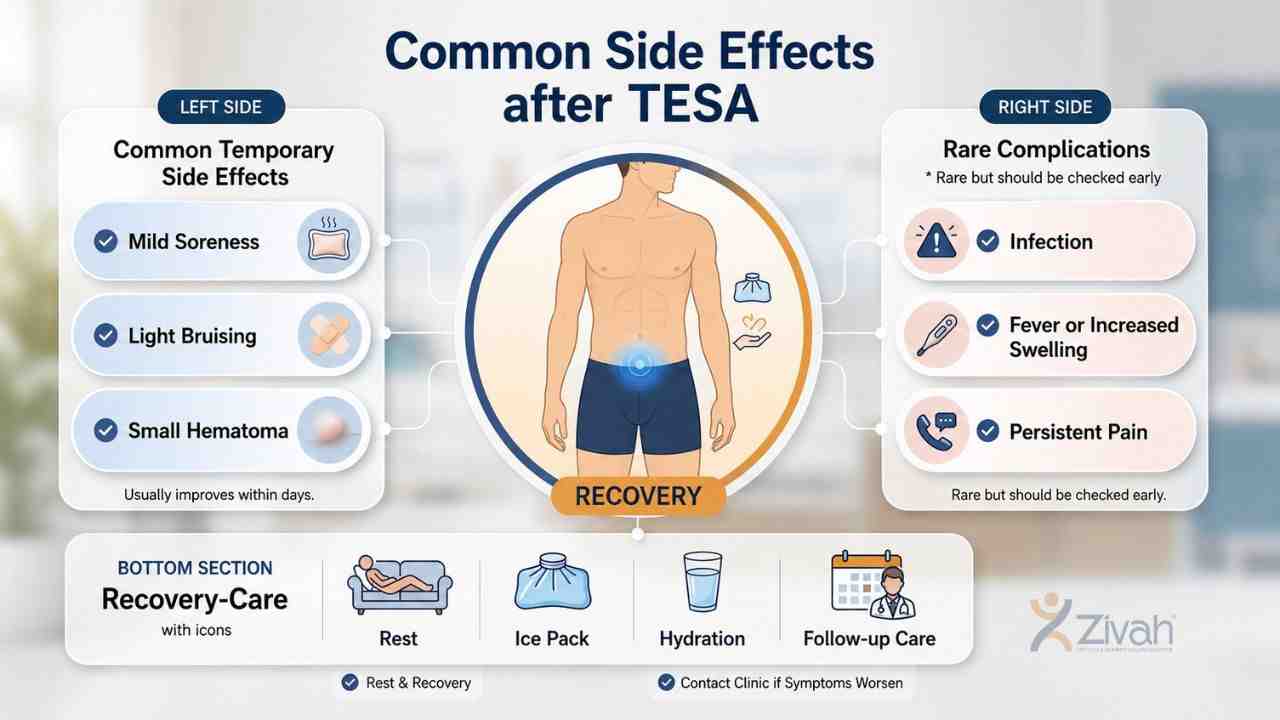
Most TESA side effects are mild and temporary.
- Mild scrotal soreness – frequent, settles within days
- Light bruising - normal, will go away
- Small hematoma (blood accumulation) - rare, about 1–5%
- Infection - uncommon, less than 1%
- Testicular tissue damage - very rare
Call your doctor if you notice worsening pain, spreading swelling, fever, or a hematoma that keeps getting bigger; these are signs to check early.
Are Repeat TESA Procedures Safe?
Can repeated TESA procedures affect fertility? Usually, no, TESA can be repeated safely with a 3–6 month delay between tries to allow the testicular tissue to recover. The risk of cumulative damage is particularly low for TESA (and higher for repeat Micro-TESE). The best strategy to avoid a second surgery? Additional sperm frozen from your first cycle, one retrieval, several IVF tries.
Why Choose Zivah for TESA
Where you get your TESA done matters more than most men understand, since the retrieval is only as excellent as the lab that validates the sperm and the team that makes it into an embryo. That’s where Zivah is built differently.
- Andrology specialists collaborating with reproductive endocrinologists - Your retrieval is scheduled by male-fertility specialists, not transferred.
- On-site embryology staff for immediate sperm confirmation - get your answer while you are still on the table, not days after.
- Co-ordinated TESA + ICSI scheduling – one cycle, instead of two separate visits.
- On-site cryopreservation – more sperm are preserved on the same day, thus one retrieval can cover future efforts.
- Hormone monitoring before and after - an honest consultation that does the “what if no sperm is found” talk, not just easy tasks.
An azoospermia diagnosis can seem like a closed door, but for most guys, it’s just another path to fatherhood. The sperm could already be there, waiting to be detected. All too often, it’s the right team, the appropriate lab, and one carefully planned procedure that stands between you and your child.
Book a private TESA appointment with Zivah’s andrology specialists today, and let’s see what’s possible.