

Amniocentesis is prenatal testing that will provide you with clear information regarding your baby's health. During the test, a small amount of amniotic fluid, the fluid that surrounds your baby, is measured and tested for genetic and chromosomal problems.
Because the fluid contains your own cells, this amniotic fluid test can confirm a diagnosis, not just predict a risk. That is what makes it unique. Screening tests, such as NIPT, tell you the probability of a problem, whereas a prenatal diagnostic test, such as amniocentesis, tells you for sure.
On this page, what the test involves, why and when it's performed, risks, and what the results indicate If a screening test gives you a "maybe", the next step to a clear answer is frequently amniocentesis in pregnancy.
What Is Amniocentesis (Amniotic Fluid Test)?
It’s a prenatal test that checks a little sample of fluid around your baby.An ultrasound is used to help a thin needle through the abdomen to bring out a small amount of amniotic fluid that includes your baby’s cells, which can be checked for genetic and chromosomal problems.
The simplest amniocentesis definition is that it is a diagnostic test that offers a definitive, proven answer, not an estimate. That’s what is most important to know about how it’s used during pregnancy.
Diagnostic vs Screening: Confirmed Answers vs Risk Estimates
This is the most significant difference of all. A screening test like NIPT or the First Trimester Screening gives you a possibility that your baby has a certain issue. This is useful, but it can’t provide certainty.
A diagnostic test, such as amniocentesis, is more definitive, confirming the presence or absence of a disease. So if a screening test has highlighted a higher risk, this is often the test that settles the matter.
What the Amniotic Fluid Reveals About Your Baby
Your baby’s fluid is more than just a protection. It contains fetal cells, small cells that your baby naturally sheds, and those cells include a full copy of your kid’s DNA.
The genetic test performed on amniotic fluid looks for any alterations in those chromosomes in the lab. (Find out more about amniotic fluid and how it develops in our amniocentesis guide.) This is the difference between screening and diagnostic tests.
Screening vs Diagnostic Tests in Pregnancy
| Feature |
Screening (NIPT, NT) |
Diagnostic (Amniocentesis) |
|---|---|---|
| What it tells you |
Risk/likelihood |
Confirmed yes/no |
| Risk to pregnancy |
None |
Very small |
| Accuracy |
Estimates probability |
99% |
Why Amniocentesis Is Done: Reasons and Indications
Amniocentesis is not a standard test for every pregnancy; it is offered when there is a specific cause to take a closer look. Understanding why amniocentesis is done usually comes down to one thing: to confirm or rule out a problem when anything previously has created a question.
Usually, that 'something' is the outcome of a screening. Amniocentesis can provide a definitive answer if a screening test such as NIPT or the nuchal translucency scan shows that the chance of a problem is increased.
Amniocentesis is also offered to women who are of advanced maternal age, have a family history of a genetic problem, or have an abnormal ultrasound.
Genetic and Chromosomal Conditions It Can Detect
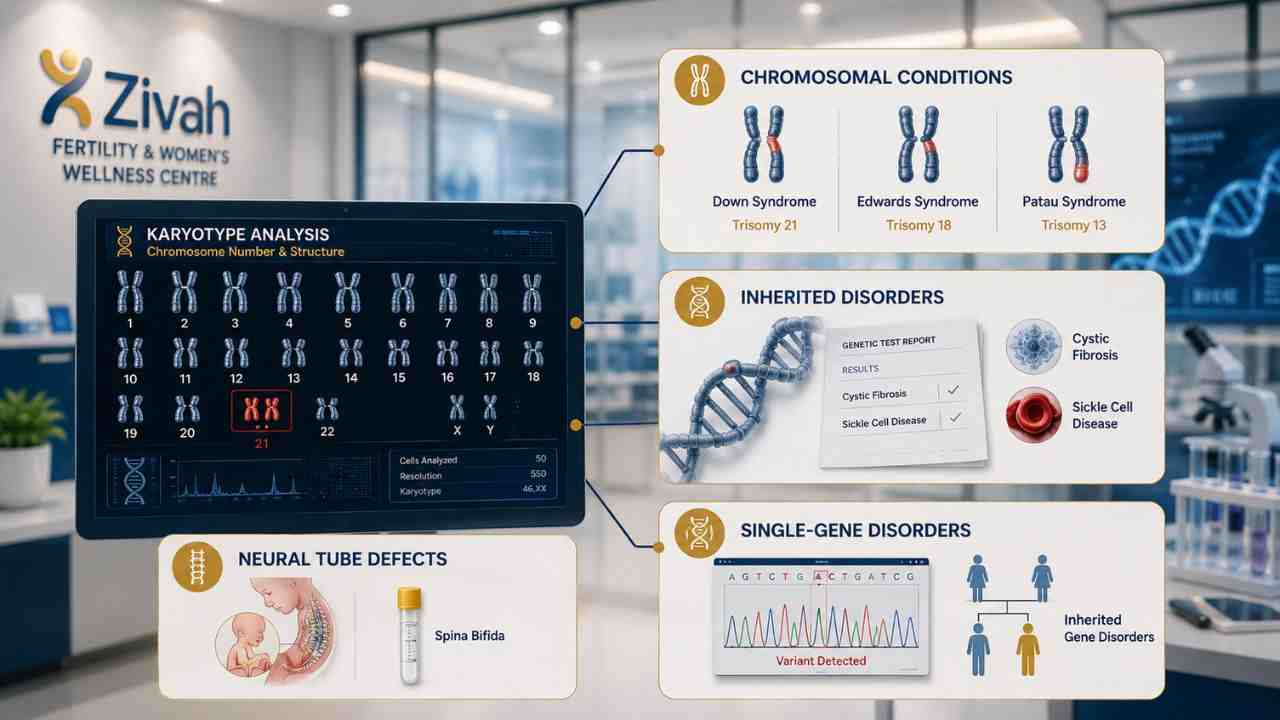
So what does an amniocentesis test for? This genetic amniocentesis test can identify several diseases by looking at your baby’s chromosomes, including:
- Down’s syndrome (and other chromosomal disorders such as Edwards’ and Patau’s syndromes)
- Cystic fibrosis and sickle cell disease
- Neural tube congenital disabilities, like spina bifida
- Some single-gene disorders are inherited
A karyotype, or whole chromosomal check, examines the number and shape of all the chromosomes.
Who Might Be Offered the Test, and Why It's Your Choice
If you are 35 or over, have had a positive screening test, a genetic disorder, had a previous pregnancy affected, or a scan has identified an issue that needs further investigation, you can be offered amniocentesis.
Something to keep in mind: this test is always available and never required. Your choice whether or not to have it, alongside your doctor, and whether you want a genetic counsellor.
When Is Amniocentesis Done? Timing in Pregnancy
Timing is important in this test. Amniocentesis is normally performed between 15 and 20 weeks of pregnancy, during the second trimester, which is the most informative and safest period. In some cases, it is done later in the pregnancy for other purposes, such as testing a baby's lung maturity before an early delivery, or testing for an infection.
But the mid-pregnancy window is the standard for genetic and chromosomal testing. Your specialist will talk to you about when amniocentesis can be done in your individual pregnancy, depending on your situation.
Why the 15-20 Week Window Is Safest
There's a good rationale for that week for amniocentesis. By 15 weeks, there is enough amniotic fluid surrounding your baby to sample securely and more room between the needle and the baby.
Usually, the surgery is not done before 15 weeks, because the risk of problems is higher. If you need to know earlier, there is another test called CVS (chorionic villus sampling) that can be done as early as 10 to 13 weeks instead.
How Amniocentesis Is Performed: The Procedure
If you are worried about the test, it often helps to know exactly how amniocentesis is done. It's a short, ultrasound-guided procedure via the abdomen, done by a fetal-medicine specialist. The total session takes about 15 to 30 minutes, but the sample itself only takes a minute or two.
Before the Test: Preparation, Referral and Form F
First, a little preparation. Before the procedure, you need to have your referring doctor's prescription and completed Form F. This is a legal requirement in India under the PCPNDT Act, and our team will guide you through this. Other than that, preparation is simple:
- Sign the consent form once your specialist explains the procedure
- Get an ultrasound so your specialist can place the baby and placenta
- List any medications you take, particularly blood thinners
Once everything is ready, the test can start.
During the Test: Ultrasound Guidance and Sampling
Here's what happens during an amniocentesis procedure. You lie down and get your abdomen cleansed with an antiseptic. Under continuous ultrasound guidance, your specialist will insert a fine (20-22 gauge) needle through the abdomen and withdraw roughly 20ml of fluid.
If you have an anterior placenta (the placenta sitting at the front), it is easily mapped on the scan and the path can be modified safely. You may experience some pinching or minor cramps. They listen to your baby's heartbeat right away.
After the Test: Recovery and Rh Protection
Recovery is generally easy. We'll watch you for a bit, but most ladies go home after about 24 hours and don't do much physical activity. If you are Rh-negative, you will get an Anti-D injection within 72 hours to protect future pregnancies. Contact us if you have bleeding, fluid leakage, fever or severe cramps.
Your Amniocentesis Appointment: Step by Step
| Stage |
What Happens |
Time |
|---|---|---|
| Before |
Referral + Form F, ultrasound, consent |
10 min |
| During |
Needle sample taken; heartbeat checked |
1–2 min sampling |
| After |
Monitored; Anti-D if Rh-negative; rest 24h |
Same day |
Risks, Safety and Benefits of Amniocentesis
Because amniocentesis involves a needle, it's natural to ask is amniocentesis safe, and the honest answer is that it's very safe in experienced hands, though, like any invasive test, it carries a small risk. If you understand both sides, it helps you make the decision that's right for you. The risk people are most afraid of is miscarriage.
Understanding the Miscarriage Risk in Context
The risk of miscarriage with amniocentesis is very low in expert hands, about 0.1% to 0.3%. The vast majority of women have no problems whatsoever. The experience of the individual doing the test is very different from that in a specialist institution where the risk is low. It's a real risk to be aware of, not an excuse to panic.

Other Possible Complications and How They're Managed
In addition to miscarriage, most other problems of amniocentesis are moderate and infrequent:
- Cramping or minor bleeding - typical in the hours thereafter, but usually settles soon
- An unusual leak of amniotic fluid - usually shuts itself up
- Infection - highly rare, antiseptic procedures in place
- Rh sensitisation - Anti-D injection will prevent this if you are Rh-negative
All of these are uncommon or quickly treated. That's part of why the test is regarded as safe with expert hands.
The Benefits of Amniocentesis: Why the Test Can Be Worth It
The benefits of amniocentesis are equally important to consider:
- Near-definitive answers - about 99 per cent accurate, significantly more certain than screening
- Informed decisions - Clear results help you and your specialist prepare ahead
- Peace of mind - For many parents, knowing offers true confidence
It is advisable to look at the benefits and cons side by side to determine what is suitable for you.
Amniocentesis Results: Accuracy and Timing
You will not be left to interpret your results yourself when they are in. Your expert will always explain your amniocentesis test results, and, where helpful, a genetic counsellor, putting them into the context of your pregnancy and what they mean for you.The good news is that amniocentesis is quite accurate. It is one of the most reliable tests available during pregnancy, with an accuracy of about 99%.
How Long Results Take: Rapid Tests vs Full Karyotype
The most common question from parents is how long amniocentesis results take, and the answer depends on the type of test:
- Rapid test (FISH/QF-PCR) – detects the most frequent conditions, results in 1-3 days
- Full karyotype – a full view of all of the chromosomes, usually 2 to 3 weeks
- Microarray – identifies minor genomic alterations, usually within 1 to 3 weeks
The full karyotype takes a while to get, since the cells have to develop in the lab before we can look at them.
Reading Normal vs Abnormal Findings
A normal (or negative) result means no sign of the conditions tested for, which is encouraging, although no test can rule out every possibility. An abnormal (or positive) result suggests that a condition has been detected with a high probability.
Amniocentesis is so accurate that a false result is rare, but knowing what any finding means is where a [genetic counsellor] is a real assistance, leading you through your options with care.
Amniocentesis Result Types and Timing
| Test Type |
What It Checks |
Result Time |
|---|---|---|
| Rapid test (FISH/QF-PCR) |
Common conditions (Down, Edwards, Patau) |
1–3 days |
| Full karyotype |
Full chromosome set |
2–3 weeks |
| Microarray |
Smaller genetic changes |
1–3 weeks |
Amniocentesis vs Other Prenatal Tests (NIPT, CVS)
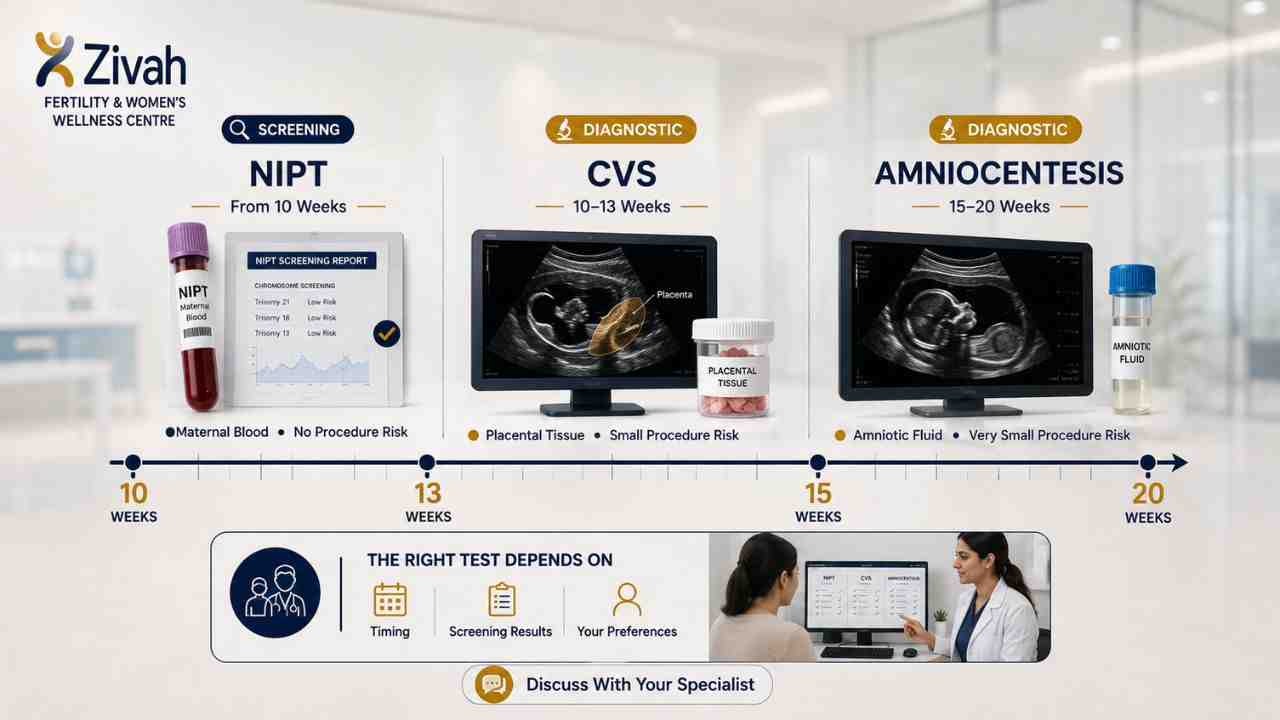
Amniocentesis is one of several types of prenatal testing, and it’s good to know how it compares against the rest. The three you're most likely to hear about are NIPT, CVS and amniocentesis, and although they sound similar, they do quite different roles.
The key difference is in screening and diagnosis. NIPT is a screening test, a simple blood test that carries no harm to the pregnancy and checks for the possibility of a disease occurring.
CVS (chorionic villus sampling) and amniocentesis are both diagnostic tests, i.e. they confirm an answer, but differ in timing and in how the sample is collected.
Choosing the Right Test for Your Situation
When it comes to NIPT vs amniocentesis or amniocentesis vs CVS, which one is right? It all depends on where you are in your pregnancy, your screening results and your own preferences:
- NIPT allows early screening without danger
- CVS provides a diagnostic answer earlier, 10–13 weeks
- From 15-20 weeks, amniocentesis provides a diagnostic answer with a very modest risk
There is no one "best" test, only the one that works for you. The best approach is to talk with your specialist, who will direct you to the right NIPT or CVS test for you.
Comparing Diagnostic and Screening Tests
| Feature |
NIPT |
CVS |
Amniocentesis |
|---|---|---|---|
| Type |
Screening |
Diagnostic |
Diagnostic |
| Timing |
From 10 wks |
10–13 wks |
15–20 wks |
| Sample |
Maternal blood |
Placental tissue |
Amniotic fluid |
| Risk |
None |
Slightly higher |
Very small |
How Amniocentesis Works at Zivah
This kind of test is as much about how you are taken care of as the procedure itself. At Zivah, your amniocentesis is done by a fetal-medicine specialist whose experience keeps the little danger at its lowest, and whose calm, methodical manner is there to steady you through it.
And all the stuff around the test is taken care of for you, too: your referral and Form F, your Anti-D protection if you're Rh-negative, the lab route that gets your findings back swiftly.
Expert Hands, Counselling and a Clear Results Pathway
You are all the way backed up. Before that, a specialist and genetic counsellor assist you in determining if the test is the best one for you. The same staff will then discuss the results of your amniocentesis and tell you what happens next. We discuss costs during your appointment based on what you truly need.
And this test is for diagnosis only, as per the PCPNDT Act, Zivah never determines or discloses your baby's sex. A straightforward solution. In compassionate hands. Book your consultation with Zivah now.