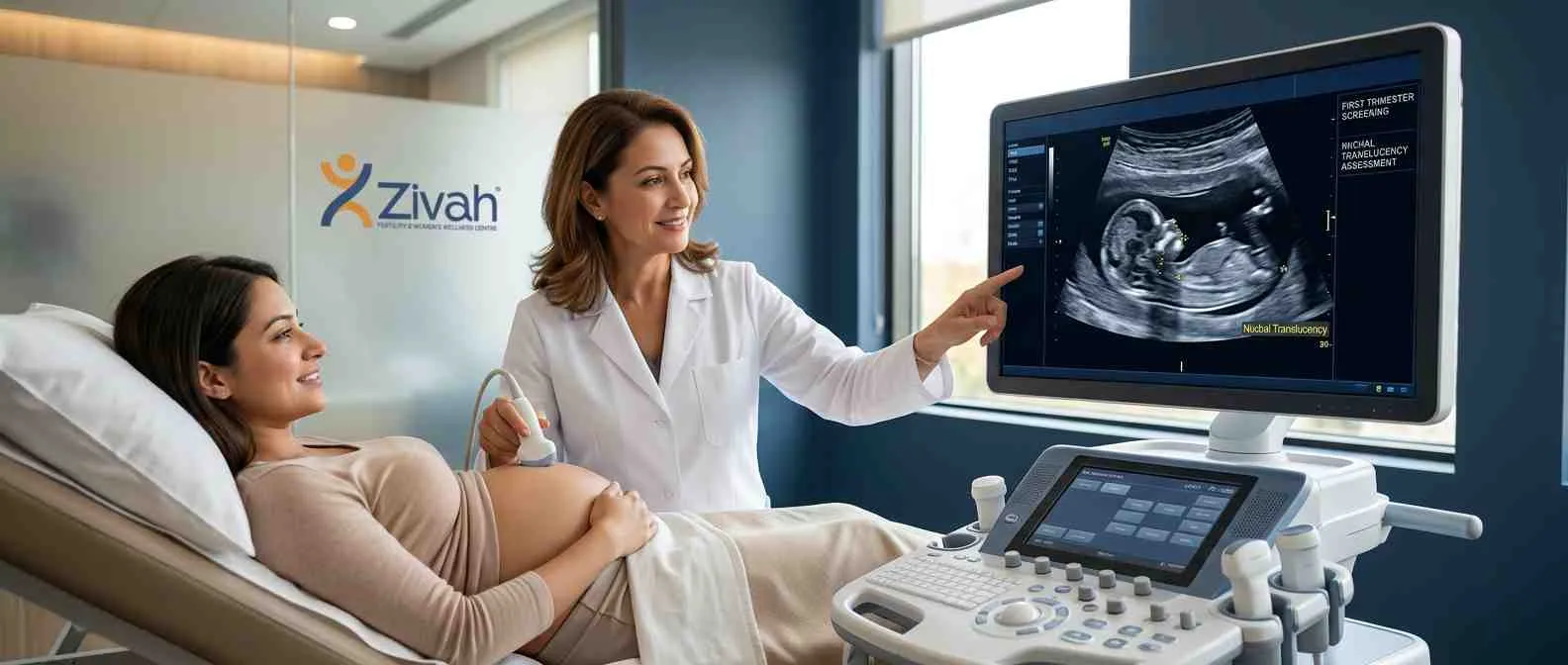
First-trimester screening is a simple, optional test that can be done early in pregnancy to determine your baby’s risk for specific chromosomal abnormalities, such as Down syndrome. It combines an ultrasound scan (the NT scan) with a blood test for the mother. It is usually done between weeks 11 and 14.
In this page, we’ll explain all you need to know about the first-trimester test, including what it’s looking for, when it’s done, what your results actually mean, how accurate it is and whether it’s safe for you and your baby.
One thing to know right away: This is a screening test that suggests risk, not a diagnosis, so it can never confirm a problem on its own. At Zivah, we support you every step of the way with personal care, clear explanations and expertise when you need it.
What Is First Trimester Screening?
First-trimester screening is a screening test performed during early pregnancy for all women at their prenatal visit, generally between 11 and 14 weeks. It combines an ultrasound scan and a simple blood test from the mother to calculate your baby’s risk of certain genetic disorders, such as Down syndrome.
The essential word here is believe. This is a risk assessment; it gives you the probability of a condition, but cannot confirm it. It is offered to all pregnant women as part of common antenatal screening; it’s fully voluntary and entirely your choice.
Screening vs Diagnosis: What the Test Actually Tells You
Worth being explicit about what this test does and does not do:
- It measures risk, so it gives you an opportunity, not a yes or no.
- It doesn't diagnose. That can only be done by confirming testing.
- It suggests the next steps and whether further testing could help.
So aneuploidy screening is: checking the chance of having an extra or missing chromosome. It’s a first mild step, never the final word, as a prenatal risk assessment.
Why First Trimester Screening Is Offered
So why is screening in the first trimester important? It gives you early information, when you have the greatest time to make calm, informed choices. This first-trimester prenatal genetic screen gives you an earlier overview of your baby’s health, and helps you decide what to do next, if anything.
What Does First Trimester Screening Detect?
Basically, it only evaluates your baby’s chances for a handful of chromosomal abnormalities, the most common of which is Down syndrome. It’s worth noting that it’s a sign of danger, not a diagnosis, but an early understanding of risk gives you time and common sense.
Down Syndrome & Trisomy 18/13 Risk
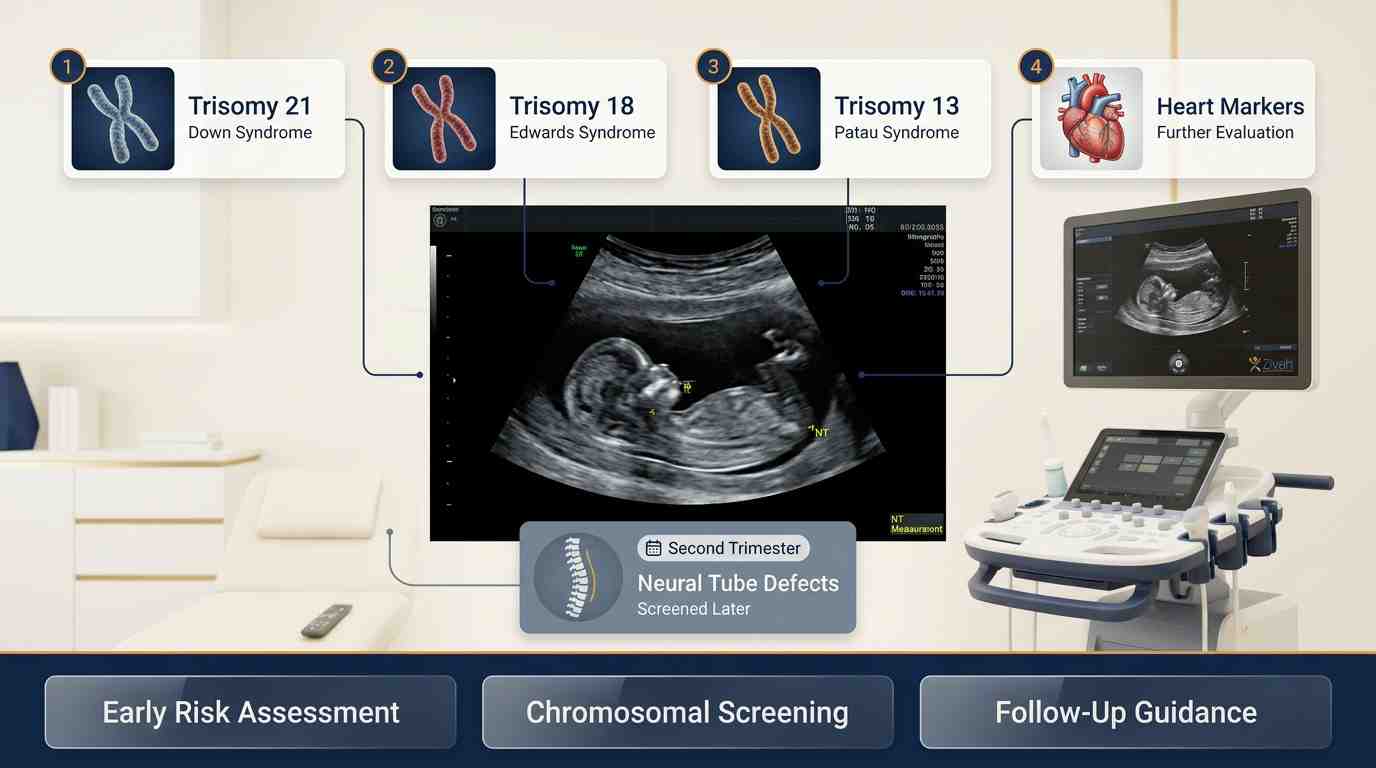
The primary focus is Down syndrome screening during pregnancy, also known as trisomy 21, a genetic condition caused by an extra chromosome 21.
The same test also covers trisomy screening for trisomy 13 (Patau syndrome) and trisomy 18 (Edwards syndrome), two other chromosomal conditions. Additionally, the NT scan can detect markers associated with some heart abnormalities, which are then identified for further examination.
What It Does NOT Detect
One thing that can be confusing is that first-trimester screening does not find every condition. It doesn't detect neural tube problems such as spina bifida, this is looked at later, during second-trimester screening. So this fetal abnormality test is great for chromosomal risk, but it is just one part of your entire prenatal care, not a thorough check of your baby’s health.
What First Trimester Screening Covers
| Condition |
What It Is |
Screened in 1st Trimester? |
|---|---|---|
| Down syndrome (Trisomy 21) |
Extra chromosome 21 |
Yes, main focus |
| Trisomy 18 (Edwards) |
Extra chromosome 18 |
Yes |
| Trisomy 13 (Patau) |
Extra chromosome 13 |
Yes, in combined screening |
| Certain heart defects |
Linked to increased NT measurement |
Flagged for further scans |
| Neural tube defects (spina bifida) |
Spinal/brain development defect |
No, screened later (2nd trimester) |
When Is First Trimester Screening Done?
Timing is one of the most important variables in this test. First trimester screening is performed between weeks 11 and 14 of pregnancy, a limited window where the results are most reliable. Booking during this window provides the clearest, most accurate picture of your baby’s risk.
The 11-14 Week Window
So when is the best time for first trimester screening? Sweet spot is 11 to 14 weeks. Here's the timing at a glance:
- NT scan – between 11 and 14 weeks when the fluid behind your baby’s neck can be correctly measured
- Blood Test (PAPP-A and hCG) – same 11-14 week timeframe
- Too early (before 11 weeks) – NT scan cannot be correctly measured
- Too late (beyond 14 weeks) – the nuchal fluid will not be accurately measured/visualised
Why Accurate Dating Matters
It is important to know exactly where you are in the process. So when should the first trimester blood test be done? But only if your pregnancy is exactly dated, generally by an early ultrasound.
Because if your dates are wrong, the findings can be skewed, which is why prenatal screening before 13 weeks is scheduled carefully. Book early for faster results, allowing you more time to think carefully about your alternatives.
What's Included: NT Scan + Combined Blood Test
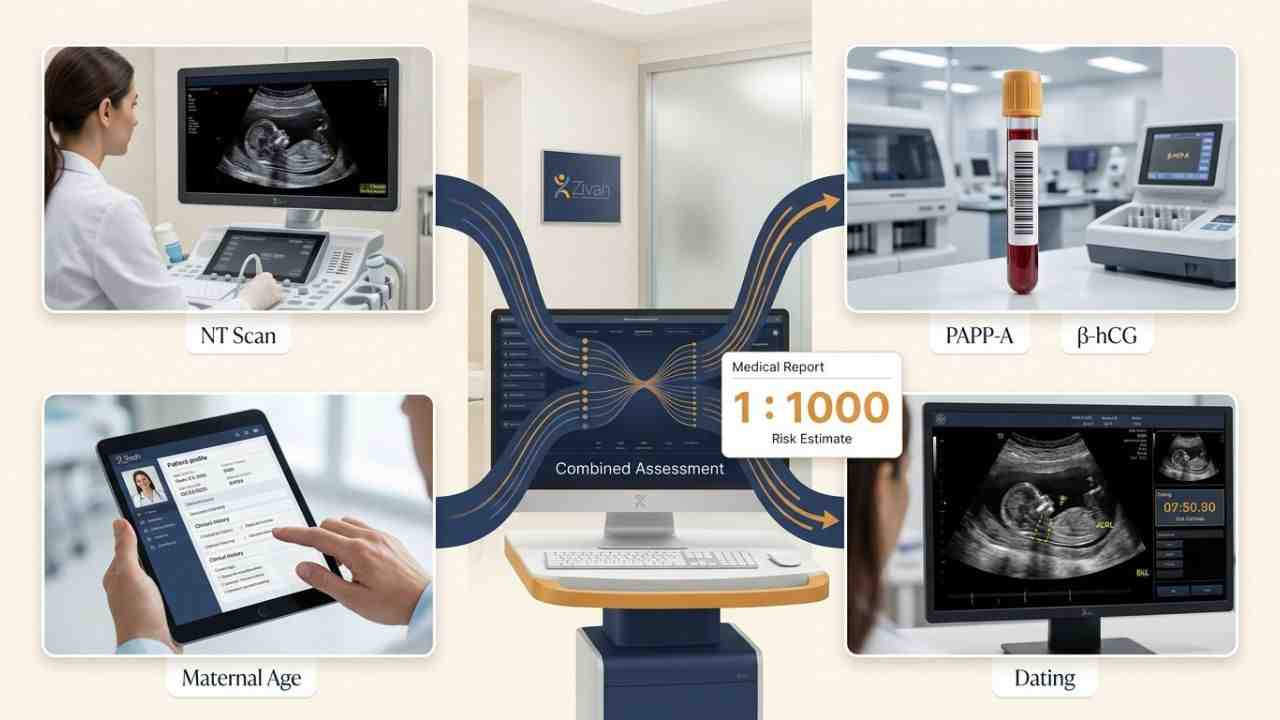
So what does first-trimester screening include? It combines two basic components, an ultrasound and a blood test, into one result. This is why it is called the first trimester combined screening. Individual tests are less effective, but together they give a much clearer idea of your baby's risk.
1. The Nuchal Translucency (NT) Scan
First, the nuchal translucency scan, sometimes just called the NT scan. So what is a nuchal translucency scan then? It’s an ultrasound that measures the amount of fluid at the back of your baby’s neck. Some fluid is quite normal. But a larger-than-normal measurement may suggest an increased risk of a chromosomal issue, which is why this scan is so important.
2. The Maternal Blood Test (PAPP-A & hCG)
The second phase is a simple maternal blood check. Just one stick from your arm. This first-trimester blood test checks two pregnancy markers: PAPP-A (a protein) and beta-hCG (a hormone). If these levels are outside the normal range, it may show a higher risk and is useful information to add to the scan results.
How the Combined Result Is Calculated
Here’s where it all comes together. The combined first trimester screening test combines your NT scan, both blood markers, your age and your pregnancy dating into a single risk assessment, for example, 1 in 1,000. A single clear number is so much more reliable than any single test.
What's Included in First Trimester Combined Screening?
| Component | What It Measures | How It's Done |
|---|---|---|
| NT ultrasound scan | Fluid at the back of the baby's neck | Abdominal or transvaginal ultrasound |
| PAPP-A (blood) | Pregnancy-associated plasma protein-A | Simple maternal blood draw |
| Beta-hCG (blood) | Pregnancy hormone level | Same blood sample |
| Maternal age & dating | Factored into the risk calculation | From your records & scan |
| Combined result | Overall risk estimate (e.g. 1 in 1,000) | Algorithm combines all inputs |
What Your First Trimester Screening Results Actually Mean
Your first trimester screening blood test results won’t state “yes” or “no.” Instead, they offer a risk estimate, a number that tells you the chance of a condition. The most important thing to understand is that screening is about risk, not diagnosis.
What 'Low Risk' and 'High Risk' Mean
Results often fall into one of two categories: low risk or high risk. So what does a normal first trimester test result mean? A “low risk” (or screen-negative) result says there’s a lesser chance of a condition, comforting, yes, but not a sure thing. The phrase “high risk” can sound alarming.
But the important thing to know is that it doesn't mean your baby has an issue. The low-risk meaning in aneuploidy screening is only a lesser chance; high risk suggests a further check may help.
Understanding Risk Ratios (e.g. 1 in 1,000)
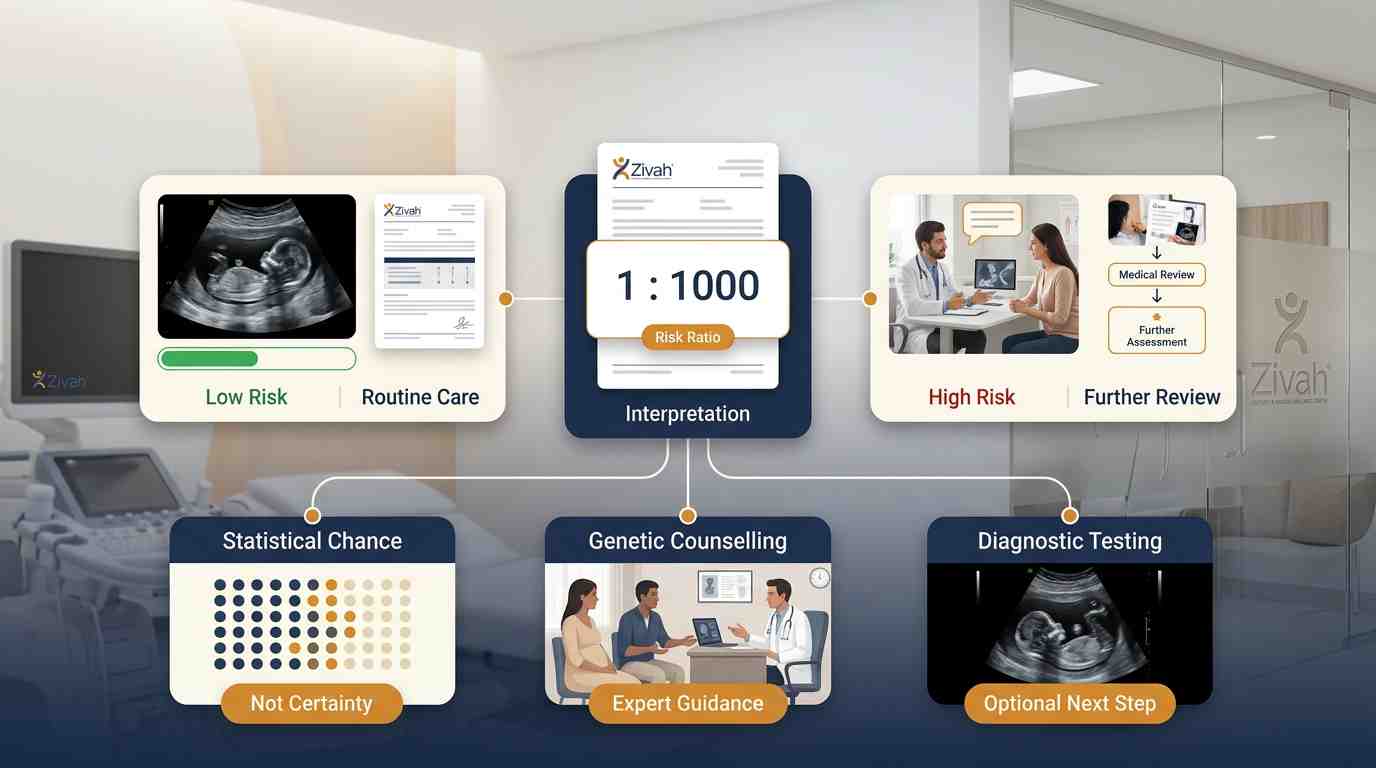
So how are first-trimester screening results understood? They are in a ratio of like 1 in 1,000. In other words, of every 1,000 babies with the identical result, about one would have the disease and 999 would not. From this perspective, many “high-risk” numbers are significantly less frightening than they first appear.
(Note: risk for neural tube abnormalities, such as the “1 in 5,000 ONTD” number, is from later second-trimester screening, not this test.)
If Your Result Is High Risk: Next Steps & Counselling
A high-risk result just suggests the next step is a calm, lengthy talk with a Zivah Fetal medicine expert to explore confirmatory testing possibilities. You are never left to face a number on your own, a counsellor will explain what it means, and any additional testing is entirely your option.
Understanding Your Screening Results
| Result Type |
What It Means |
Next Step |
|---|---|---|
| Low risk (screen negative) |
Lower chance, but not a guarantee |
Routine antenatal care continues |
| High risk (screen positive) |
Higher chance, NOT a diagnosis |
Genetic counselling + optional diagnostic test |
| False positive (~5%) |
Screen positive but baby is healthy |
Diagnostic test confirms |
| Risk ratio (e.g. 1 in 1,000) |
Statistical chance, not certainty |
Discuss with a Zivah counsellor |
How Accurate Is First Trimester Screening?
It's a fair thing to ask, and the results are reassuringly good. So how accurate is first trimester screening? If done at the correct time, it catches the majority of Down syndrome cases, but it's still a screening test, so a tiny number of false positives is part of the picture.
Detection Rate & False-Positive Rate
ACOG states that when the first-trimester combination screening test is done between 11-14 weeks, it identifies 82% to 87% of cases with trisomy 21, also known as Down syndrome, and has a false-positive rate of about 5%. Some of the larger studies have claimed detection rates as high as 90% at the same false-positive rate.
In simple terms, the test covers most cases; the first-trimester screening is effective and accurate, but a positive screen is not a diagnosis. And that's why there are follow-up tests. There is also a more advanced test called NIPT (cell-free DNA testing).
Combined First Trimester Screening vs NIPT (cfDNA)
| Factor |
Combined First Trimester Screening |
NIPT / cfDNA (Alternative Tier) |
|---|---|---|
| What it is |
NT scan + PAPP-A/hCG blood test |
Blood test analysing fetal DNA |
| Down syndrome detection |
Around 82–90% |
Around 99% |
| Invasive |
No |
No |
| Still a screening test |
Yes, estimates risk |
Yes, estimates risk, not diagnosis |
| Typical use |
Routine first-line screening |
Advanced option / higher-risk pregnancies |
It is a blood test that examines the fragments of your baby's DNA. It detects over 99% of Down syndrome with fewer false positives.In pregnancies with higher risks, NIPT is usually the option. But this is just a screening test and doesn't provide a diagnosis. Combined first-trimester screening is still the trusted first choice for most women.
Who Should Have It & Is It Safe?
The two most typical searches are who the first trimester screening is for and whether it is safe. The simple answer to both is that it is provided to all pregnant women and is perfectly safe for you and your baby.
Who Is Offered First Trimester Screening?
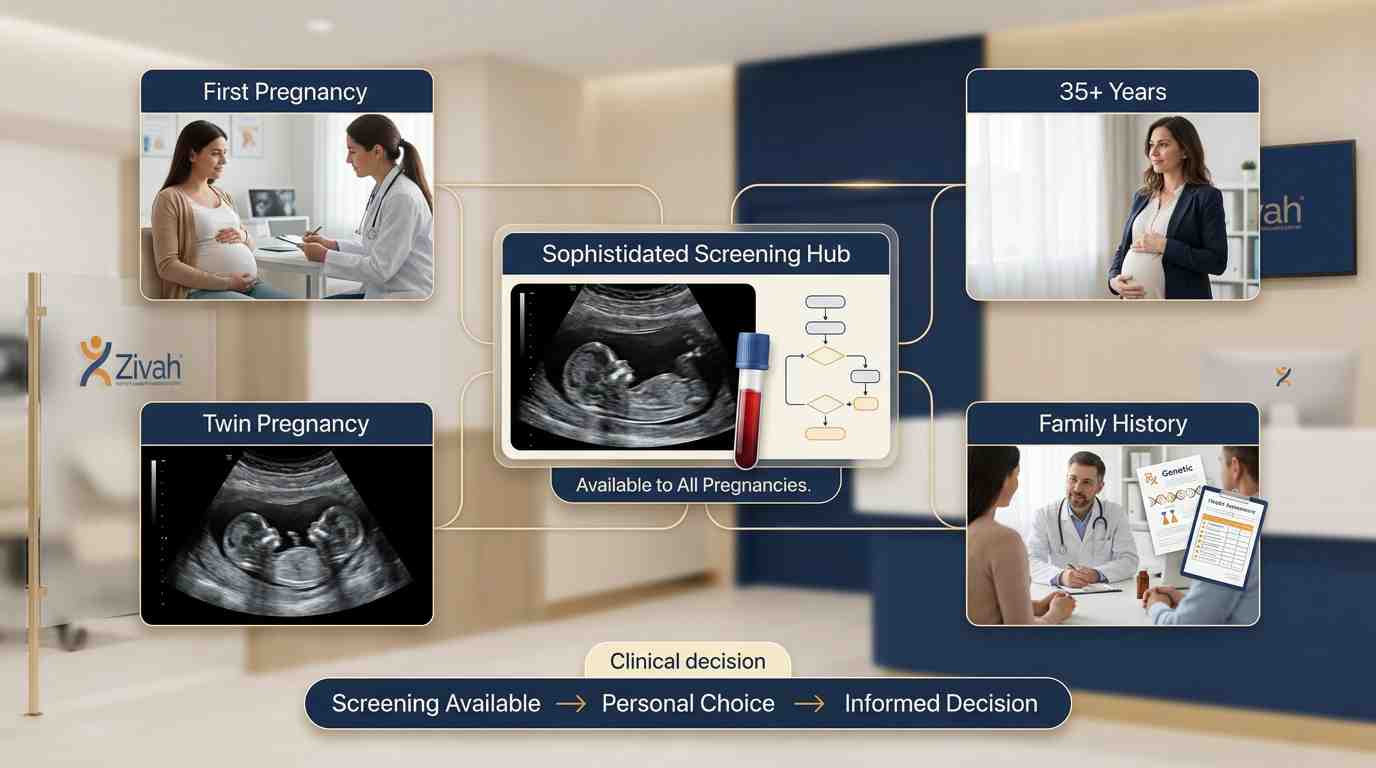
First-trimester screening is available to all pregnant women as part of standard antenatal care, not just for higher-risk pregnancies. You can have it or not; it’s entirely up to you. So is first trimester screening needed? It’s optional, not compulsory. It’s worth thinking about, especially if you are:
- A first-time mother looking for comfort in early pregnancy
- Over 35 when the chromosomal risk is slightly increased naturally
- Expecting twins where screening is still possible (limited)
- Concerned about the family history of chromosomal problems
So, in short, should every pregnant woman have first-trimester screening? No, but it’s available to everyone who wants it.
Is It Safe? (And Screening in Twins)
Yes, first trimester screening is quite safe for mom and baby. It's nothing but an ultrasound and a simple blood sample, with no known risks beyond a bit of pain from the needle. Can you do first-trimester screening for twins? Yes, but it's a little less accurate with twin pregnancies. Screening is not routinely offered for triplets or more; your specialist will tell you what is best for you.
Screening vs Diagnostic Tests (CVS & Amniocentesis)
It's useful to understand that screening and diagnostic testing do two separate things. Screening gives you an estimate of risk; it gives you the possibility of a condition. Diagnostic tests like CVS (chorionic villus sampling) and amniocentesis go a step further and provide you with a definitive answer.
When Diagnostic Testing Is Offered
So when would you need a diagnostic test? Only if your screening result is high risk or if you just want to get one. These first-trimester prenatal diagnostic tests are quite invasive and carry a minor risk of miscarriage; hence, they are never the first step.
What you have to remember is that a diagnostic test always begins with a calm talk with detailed genetic counseling. You’re never on your own with this decision: your Zivah team walks you through everything, and it’s your call.
| Feature |
Screening (1st Trimester) |
Diagnostic (CVS / Amnio) |
|---|---|---|
| Purpose |
Estimates risk |
Confirms a diagnosis |
| Invasive |
No |
Yes |
| Risk to pregnancy |
None known |
Small miscarriage risk |
| When offered |
Routinely, 11–14 weeks |
After high-risk screen + counselling |
| Result |
Risk ratio |
Definitive answer |
First Trimester Screening at Zivah
Your pregnancy deserves a clinic that combines clinical quality with warm and considerate care, and that’s exactly what Zivah does. Zivah is one of the best clinics for first-trimester screening, trusted by many, providing everything you need under one roof.
Your first-trimester prenatal treatment is accurate, caring, and supportive every step of the way, with our accredited laboratory, certified sonographers for NT measurement, and in-house genetic counsellors. And under India's PCPNDT Act, our screening never reveals the baby's sex; your test is just about your baby's health.
Cost & Booking Your Screening
Wondering about the cost of first-trimester screening in India? The Zivah prenatal screening bundle is clear and open; however, the exact price depends on which tests are included. The best next step for a tailored quote is a quick conversation with our team.
Booking early is important because the 11 to 14-week timeframe goes by fast. So if you’re starting on your path, contact us immediately and let Zivah help you take the next step with clarity, confidence and complete care.