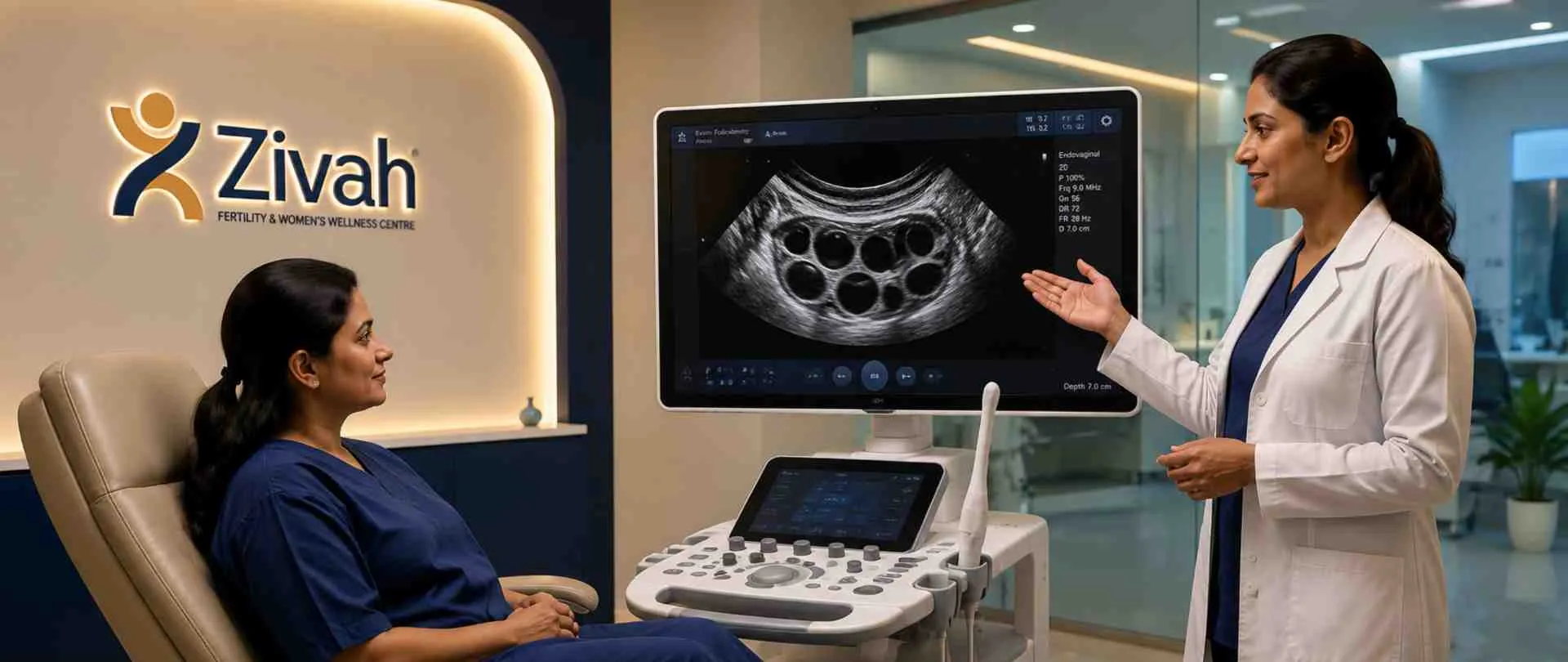
Folliculometry is a quick and painless way to find out when you ovulate and how long it will take to get pregnant. Zivah Fertility offers it. With a transvaginal ultrasound, our doctors can keep an eye on your follicles throughout the cycle and tell you exactly when to try to get pregnant or when to keep going with treatment.
It is a very important part of the fertility care we offer, whether you are trying to get pregnant on your own or getting ready for IUI or IVF. Here is how the scan works and what it can tell you.
What Is Folliculometry (TVS / Follicular Study)?
Folliculometry, also called a follicular study, is a gentle series of transvaginal scans (TVS) that follow your follicles (the tiny sacs in your ovaries that each hold an egg) as they grow through your cycle. Rather than one quick look, it watches your body's own rhythm unfold, day by day. At Zivah Fertility, we use it to see how your follicles are maturing and to find the days when you are most likely to conceive, so you never have to guess at the timing on your own.
Is a folliculometry test the same as a normal ultrasound? No, it's not the same as a normal ultrasound; a normal scan shows only one image at a time. But folliculometry tracks your follicles over time using many scans. This way, we can see the changes as they happen and give you exact advice rather than guessing.
How Does Folliculometry Track Ovulation?
Your follicles grow a little more each day until one takes the lead and grows, ready to release its egg. With folliculometry, we measure growth scan by scan, watch the leading (dominant) follicle reach its full size, and check that the lining of your womb is getting ready to do so with it. When that follicle releases its egg, we can confirm ovulation has taken place. It is a calm, clear way to see your fertile window rather than hope you have caught it.
Here is what each scan looks at, and why it matters for you.
| What the Scan Checks |
Why It Matters for You |
|---|---|
| Follicle Number & Growth |
Shows how many follicles are developing and how they are growing |
| Dominant Follicle Size |
Helps predict the timing of ovulation |
| Endometrial (Uterine Lining) Thickness |
Assesses whether the lining is ready for implantation |
| Ovulation Confirmation |
Confirms whether the egg has been released |
| Ovarian Response |
Monitors how the ovaries respond in a natural or stimulated cycle |
Knowing your follicles are being followed this gently and this closely, the next thing to ask is whether a follicular study is the right step for you.
Do You Need a Follicular Study?
If you've been trying to get pregnant and haven't been able to, or if your periods are irregular, folliculometry can help you understand what's happening. Many women don't know if or when they are ovulating, making it hard to know when the right time is. A follicular study gives us a clear picture of what your ovaries are up to this cycle, which is a quiet but clear answer.
There are a few common signs that follicle tracking could help you:
- Your periods come and go, are unexpected, or sometimes don't come at all.
- You have been trying to conceive for a while now, and you can't seem to figure out why it's not happening.
- You think you might not be ovulating or are only ovulating some cycles.
- You were told you have PCOS or PMOS, which are both hormonal imbalances that make it hard to ovulate.
Can folliculometry help if your periods are irregular? Yes, and this is often where it helps most. When your cycle is hard to predict, ovulation kits and calendar counting tend to fall short. Following your follicles directly lets us find your fertile window even when your dates keep shifting, so you are no longer guessing month after month. If any of this feels familiar, the next step is simply knowing whether a follicular study is right for you.
Who Should Book Folliculometry at Zivah?
Folliculometry suits women at many different stages, whether you are just beginning to try or already planning treatment. At Zivah Fertility, we often recommend a follicular study for:
- Women with PCOS or PMOS who need to keep a close eye on their ovulation.
- Pairs who are trying to get pregnant naturally and want help with their timing.
- Women getting ready for IUI, where the scan helps them get everything just right.
- Women whose periods aren't regular and want a better idea of when they ovulate.
Wherever you are on this path, folliculometry gives you and your specialist a real starting point. Next, let us walk you through how the scan itself is done.
How Is a Folliculometry Scan Done?
A folliculometry scan is quick and gentle. Each visit involves a transvaginal scan (TVS) where a slim, smooth probe is placed just inside the vagina to provide a close, clear view of your ovaries and womb lining. Because it sits so near, we can measure even the smallest follicles accurately. Each scan takes only a few minutes.
Instead of a single visit, folliculometry uses multiple short scans to track your cycle. The first scan is a baseline, and the rest are scheduled for the days when your follicles grow fastest.
Does a transvaginal folliculometry scan hurt? No, it should not hurt. Most women feel only a little pressure, much like a routine internal examination, and it is over within minutes. Here is how a typical tracking cycle unfolds.
| Cycle Day (Typical) |
What Happens at This Stage |
Approx. Follicle Size |
|---|---|---|
| Day 2–3 (Baseline) |
Ovaries and uterine lining are assessed |
2–9 mm |
| Day 9–10 |
Growing follicles are measured and the dominant follicle is identified |
10–14 mm |
| Day 11–13 |
Dominant follicle is monitored as it matures |
15–20 mm |
| Around Ovulation |
Mature follicle is ready to release the egg |
18–24 mm |
| After Ovulation |
Egg release is confirmed |
Follicle collapses |
A little preparation helps each scan go smoothly.
How to Prepare for Your Folliculometry Scan
Preparing is simple. Usually, you need to have an empty bladder for a transvaginal scan, so go to the bathroom right before your appointment. Wear something comfortable and bring any notes or scans from the past that will help us track your progress on the day your doctor told you to come in for your cycle. A lot of women want to know how exact folliculometry really is once their scans take place.
How Accurate Is Folliculometry for Timing Ovulation?
Folliculometry is one of the most accurate ways to find out when you ovulate because it lets you track your body directly rather than just relying on dates or hormone levels to estimate. Since we can see your cells move in real time, we can be sure which stage your cycle is in and set your dates accordingly. There are a few reasons it helps so much:
- It keeps track of your follicles as they grow, cycle by cycle, not just guessing how much they are growing.
- It tells you when you're most likely to get pregnant, even if your periods aren't regular.
- It tells you for sure if ovulation has happened, not just that it might have.
- Since it doesn't use radiation, it's safe to repeat every cycle.
Is folliculometry better than an ovulation kit? In most cases, yes. A home kit only detects a hormone surge in your urine and cannot tell you whether an egg was actually released. Folliculometry shows us the follicle itself growing and releasing, which is far more precise, especially if your cycle is unpredictable.
Still, it helps to know what the scan can and cannot do, so your expectations stay clear from the start.
| Folliculometry Can |
Folliculometry Cannot |
|---|---|
| Track follicle growth throughout the cycle |
Confirm egg quality or fertilisation |
| Identify your fertile window |
Diagnose infertility on its own |
| Confirm whether ovulation has occurred |
Guarantee pregnancy |
| Assess endometrial thickness |
Replace hormone or blood tests |
Knowing how closely it can follow your cycle, the next thing to plan is how often you will need to be scanned.
How Often Will You Need Scanning Through the Cycle?
A lot of women don't need a scan every day, just a few tests during a cycle. A baseline scan is usually the first one. The next few are usually spaced out to align with the days when your follicles grow fastest. We call it "serial folliculometry" because the exact number depends on your cycle. It's not a set plan, but a series of scans done at the right times.
The timing depends on how fast your follicles grow. In the beginning, they are small, often less than 10 mm across. We keep a closer eye on the main follicle as it grows past 15 mm. When it reaches about 18–24 mm, it is fully grown, and ovulation is likely to occur without delay. Plus, we make sure the lining of your stomach is at least 8 mm thick; it should be thick enough to support a baby.
Do you need scans every day near ovulation? No, rarely daily. As your follicle nears maturity, we may scan every day or two to catch the right moment, but most of your cycle only needs occasional checks.
| Your Concern |
How Zivah Helps You |
|---|---|
| Unsure When You Ovulate |
We monitor follicles to identify your fertile window |
| Irregular or Unpredictable Periods |
We tailor scan timing to your cycle |
| Trying to Conceive Naturally |
We guide intercourse timing based on follicle growth |
| Planning IUI or IVF |
We monitor follicles to time treatment accurately |
| Concerned About Ovarian Response |
We assess follicle growth and endometrial development |
Life does not always run to schedule, so it helps to know what happens if a scan is missed.
What Happens If a Scan Is Missed or Delayed?
If you miss a scan or are late for it, don't worry. Missing one visit shouldn't affect your tracking, but it could make the timing slightly less accurate. Let us know as soon as you can, and we'll move your next scan to ensure it shows where your follicles are. Now, let's look at how folliculometry can help with an IUI or IVF cycle.
Folliculometry in Your IUI or IVF Cycle
If you are going to be having fertility treatment, then follicle measurement is even more important. These cycles involve using medication to gently stimulate your ovaries, and we keep a close eye on your follicles to see how they respond, whether you are preparing for customised IUI cycle methods or advanced IVF treatments at Zivah Fertility.
In an IUI cycle, we watch a small number of follicles and time everything around the day one is ready. In IVF, several follicles grow together, so we scan more often to monitor them all before your eggs are collected.
How is folliculometry different in an IVF cycle? In IVF, we keep an eye on more than one follicle at the same time. We do a lot more scans, so we know how big they are and how your lining is, so we get the eggs at the right time. This is because several mature simultaneously when stimulated.
| Cycle Type |
What Is Monitored |
Scan Frequency |
|---|---|---|
| Natural Cycle |
Dominant follicle and uterine lining |
A few scans, as advised by your specialist |
| IUI Cycle Follicle |
Response to stimulation |
Serial scans to time the trigger injection |
| IVF Cycle |
Multiple follicles and endometrial lining |
Frequent scans throughout ovarian stimulation |
Timing matters most with your trigger, so here is how that works.
Timing Your Trigger Shot with Folliculometry
The injection that helps your egg take the last step toward escaping is called a trigger shot. With foliculometry, we know exactly when to give it to you, once your follicle is the right size, which is usually at least 18 mm. Get your egg picked up or let go at the best time for it. Now, let's look at why women pick Zivah to track their follicles.
Why Choose Zivah for Follicle Tracking?
Choosing where to track your cycle matters, because good timing rests on careful, experienced eyes. Here is what your follicle tracking at Zivah Fertility gives you:
- A team of experts who carefully look over your scans and explain each step in language you can understand.
- Planned scans based on your cycle instead of a set pattern, so that your care is always right for you.
- There is a full fertility service under one roof, so your care stays linked no matter where your tracking takes you, from natural timing to IUI or IVF.
It is this quiet, joined-up attention that helps you feel guided rather than rushed at every visit.
Book Your Folliculometry Scan Near You
Are you ready to start? This is how easy it is to book your folliculometry scan at Zivah Fertility. With our locations, you can find follicle tracking close to you without having to drive far. Come in on the day your doctor tells you to cycle, and we'll take care of the rest. We'll plan each scan around your body so that your schedule is respected from the very first visit.