

A diagnostic hysteroscopy is a simple, reassuring approach to look inside your uterus and see exactly what is happening. Whether your doctor is looking into irregular bleeding or checking your womb before an IVF cycle, this careful hysteroscopy procedure provides clear, real-time answers, no cuts and no stitches.
Your specialist can check straight into your uterus with a narrow, lighted camera called a hysteroscope to see if there is anything that may be affecting your fertility and whether it is a healthy location for a pregnancy to begin.
This section describes what a hysteroscopy test can find, how a hysteroscopy is done and what to expect following recovery. Consider the peace of mind and clarity a simple day-care check may bring.
What Is Diagnostic Hysteroscopy?
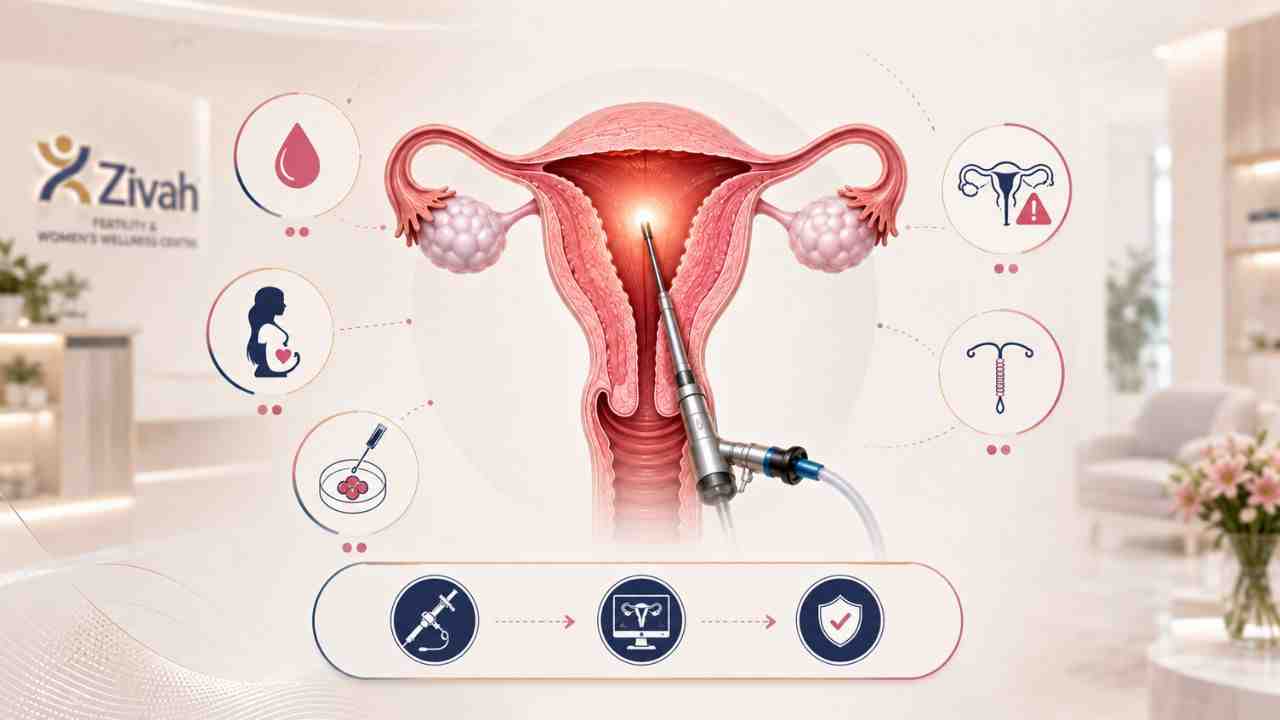
A diagnostic hysteroscopy is simply a good look into your uterus. Your doctor may use a thin, lit camera called a hysteroscope. It is sometimes called a uterine scope or womb camera.
It is passed in through the cervix. No cuts, nothing to heal on your tum. It is a hysteroscopy test, and it is entirely diagnostic; the idea is to look and identify, not to treat. It can be surgical if your specialist sees something like a polyp, which may be removed during the same session.
Diagnostic vs Operative Hysteroscopy
Understanding the difference between diagnostic and operative hysteroscopy is easy. In diagnostic hysteroscopy, the problem is examined and diagnosed; in operative hysteroscopy, it is treated by removing a polyp, fibroid, or adhesion. Both use the same camera; the operative adds fine surgical tools.
| Feature |
Diagnostic |
Operative |
|---|---|---|
| Purpose |
Inspect & identify |
Treat the finding |
| Instruments |
Camera only |
Camera + surgical tools |
| Duration |
~10–20 min |
~20–45 min |
| Recovery |
Hours–1 day |
A few days |
Diagnostic Hysteroscopy vs HSG and Laparoscopy
Curious about HSG or hysteroscopy? Hysteroscopy allows you to see inside the uterus directly and in real time. This is more accurate than HSG (hysterosalpingography) for identifying problems with the cavities. Laparoscopy is another thing altogether that examines the outside of the womb; therefore, the two usually work together.
Why Is Diagnostic Hysteroscopy Done?
In short, it is the best technique to look at your uterus from the inside. Many uterine issues have no clear symptoms. They are only discovered with a physical examination by a clinician. And that's exactly where a diagnostic hysteroscopy can be so helpful in finding those hidden issues that scans and other testing can easily overlook.
Your doctor might recommend a diagnostic hysteroscopy to:
- Investigate abnormal bleeding, strong, irregular, between cycles or after menopause
- Consider problems with fertility as an infertility workup
- Hysteroscopy before IVF cycle
- Identify a cause of recurrent implantation failure or recurrent miscarriage
- Find a displaced IUD (coil)
- Look closer, when a scan says check something
Whatever the surgery, the purpose is the same: to look carefully at your uterus and to find any problem at an early stage, when it is easy to treat. Finding out the cause sooner often means faster, more effective next measures for your fertility or your symptoms.
Who Should, and Shouldn't Have Diagnostic Hysteroscopy
Diagnostic hysteroscopy is a reasonable option for most women requiring uterine cavity evaluation. It's normally not done if you're pregnant or have an active pelvic infection. Your specialist will always consider your history and present health first, so it is only recommended when it is correct and safe for you.
What Can Diagnostic Hysteroscopy Detect?
The main advantage of this test is what it can tell us. A diagnostic hysteroscopy gives a direct view of the uterine cavity and can find issues that are not frequently seen on scans, many of which can be silently affecting fertility. Here’s a quick overview of the most common findings.
Common Uterine Findings on Diagnostic Hysteroscopy
| Finding |
What It Is |
Effect on Fertility |
|---|---|---|
| Endometrial polyp |
Soft lining outgrowth |
Disrupts implantation |
| Submucosal fibroid |
Fibroid in the cavity |
Distorts the cavity |
| Adhesions (Asherman's) |
Scar tissue bands |
Lowers receptivity |
| Uterine septum |
Congenital cavity divide |
Linked to miscarriage |
A little more detail on what each of these means:
- Endometrial polyps - soft growths from the lining of the uterus. Hysteroscopy is one of the best ways to detect polyps that can interfere with embryo implantation.
- Submucosal fibroids - fibroids that develop into the cavity. Hysteroscopy is important in detecting fibroids as they can alter the shape of the womb and make it more difficult to conceive.
- Intrauterine adhesions (Asherman’s syndrome) - bands of scar tissue, often from a previous operation, that can limit the receptivity of the lining.
- Uterine septum - a congenital ring of tissue that divides the cavity and is associated with recurrent miscarriage.
- Endometrial TB - a major cause of infertility in India, as it can scar and weaken the lining.
The camera may provide a clear image of the uterine cavity, and your doctor can also perform an endometrial examination and take a targeted sample of any worrisome spot, if necessary. Treatment, if indicated, is discussed on our surgical hysteroscopy page.
Diagnostic Hysteroscopy for Fertility & Before IVF at Zivah
The uterus is the place where everything has to fall into place when you're trying to get pregnant, yet it's typically the part that standard testing doesn't really check out. Diagnostic hysteroscopy for infertility has thus become an important step.
Many conditions of the uterus that can impair fertility will not be seen on a routine ultrasound. Actually, a significant proportion of women with repeated IVF failure are found to have cavity anomalies, which, when corrected, can raise the odds of conception significantly. That is why a diagnostic hysteroscopy is so commonly indicated as part of the baseline infertility work-up before IVF.
This is especially true if you have had a failed IVF cycle, implantation failure or recurrent miscarriage, conditions where an occult reason is more likely. At Zivah, we are diagnosis-led and fertility-focused. We will utilise a hysteroscopy to give each embryo the greatest possible chance to make sure your uterus is ready before treatment starts. If any of this rings a bell, it's worth looking into early.
How Is Diagnostic Hysteroscopy Performed?
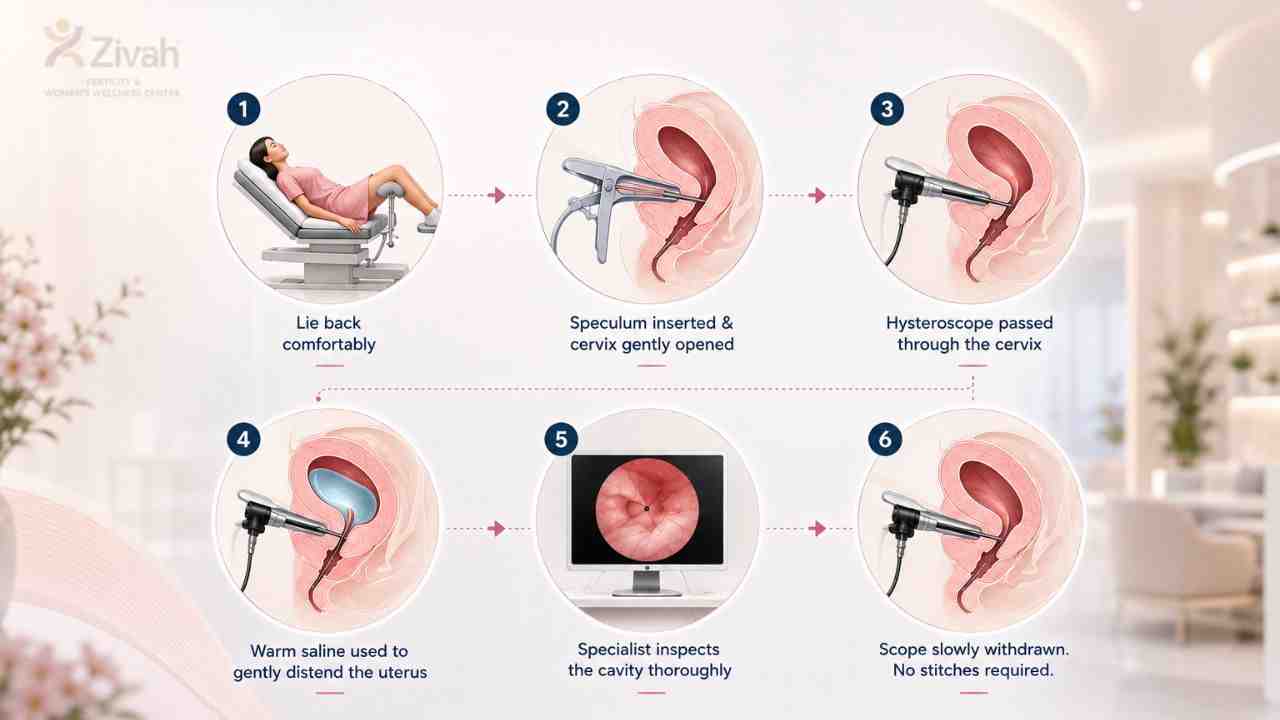
Knowing how a diagnostic hysteroscopy is done makes the whole matter feel considerably less stressful. It’s a brief, gentle operation with no cuts. Here’s how the hysteroscopy procedure goes, step by step: You lie back comfortably with your legs supported.
A little speculum is inserted (like a smear test), and the cervix is gently opened if necessary. The hysteroscope is then softly passed through the cervix, and a small amount of warm saline is used to gently distend the uterus to give a clear look. Your specialist inspects the cavity thoroughly, then slowly withdraws the scope. No stitches required.
1. Preparation for Diagnostic Hysteroscopy
It goes well with a little preparation. The ideal time for a hysteroscopy is usually in the first part of your cycle, immediately after your period finishes, when the lining is thin and easier to view, it’s not usually performed when you’re on your period.
If you are undergoing sedation or general anaesthesia, you will need to fast beforehand. Tell your doctor about any blood thinners or supplements you take. Bring someone to drive you home.
2. Anaesthesia & Duration
When it comes to anaesthesia for hysteroscopy, you have options. Often, a brief diagnostic check is carried out with local anaesthesia or even without anaesthetic at all. Sedation or general anaesthesia is used if you’d like to be sleepy or unconscious, or if several operations are combined.
Are you anaesthetised for hysteroscopy? Only if you have a general anaesthetic. How long does a hysteroscopy take? A diagnostic one normally lasts only 10 to 20 minutes.
Anaesthesia Options for Diagnostic Hysteroscopy
| Type |
What It Means |
When It's Used |
|---|---|---|
| None / local |
Awake, small area numbed |
Quick office diagnostic |
| Sedation |
Relaxed, drowsy |
Mild anxiety / discomfort |
| General |
Fully asleep |
Combined or complex cases |
After the Procedure: Results & Next Steps
Your doctor can typically discuss your diagnostic hysteroscopy results on the same day, as the camera shows everything live. If the cavity is normal, that is reassuring, and you can go ahead. If something is identified, the next steps are easy, your doctor will explain them, which may include treatment via surgical hysteroscopy. Then, a bit later, any biopsy results.
Diagnostic Hysteroscopy Recovery & Aftercare
The good news about hysteroscopy recovery is that it is usually rapid and easy. Most women return to normal within a day or two with only minimal after-effects. Here’s what to expect, and some aftercare to help things settle.
Recovery Time & Period After Hysteroscopy
For a hysteroscopy done just to diagnose a problem, recuperation time is usually only 24 to 48 hours. It’s common to experience a few days of cramping and light spotting, nothing that a bit of relaxation and paracetamol won’t allow to settle.
Your period normally returns in your next cycle after a hysteroscopy, so your first period afterwards may feel a little unusual, but it eventually settles. If you are trying for a baby, pregnancy or fertility treatment can typically restart after a few weeks.
Diagnostic Hysteroscopy Recovery Timeline
| Timeframe |
What to Expect |
Notes |
|---|---|---|
| Immediately after |
Mild cramps, light spotting |
Rest 1–2 hrs, then home |
| First 24–48 hrs |
Resume light activity |
Paracetamol for cramps |
| 1–2 weeks |
Full recovery |
Avoid sex, tampons, swimming |
| Next cycle |
Period returns |
Fertility care can resume |
Side Effects & What to Avoid
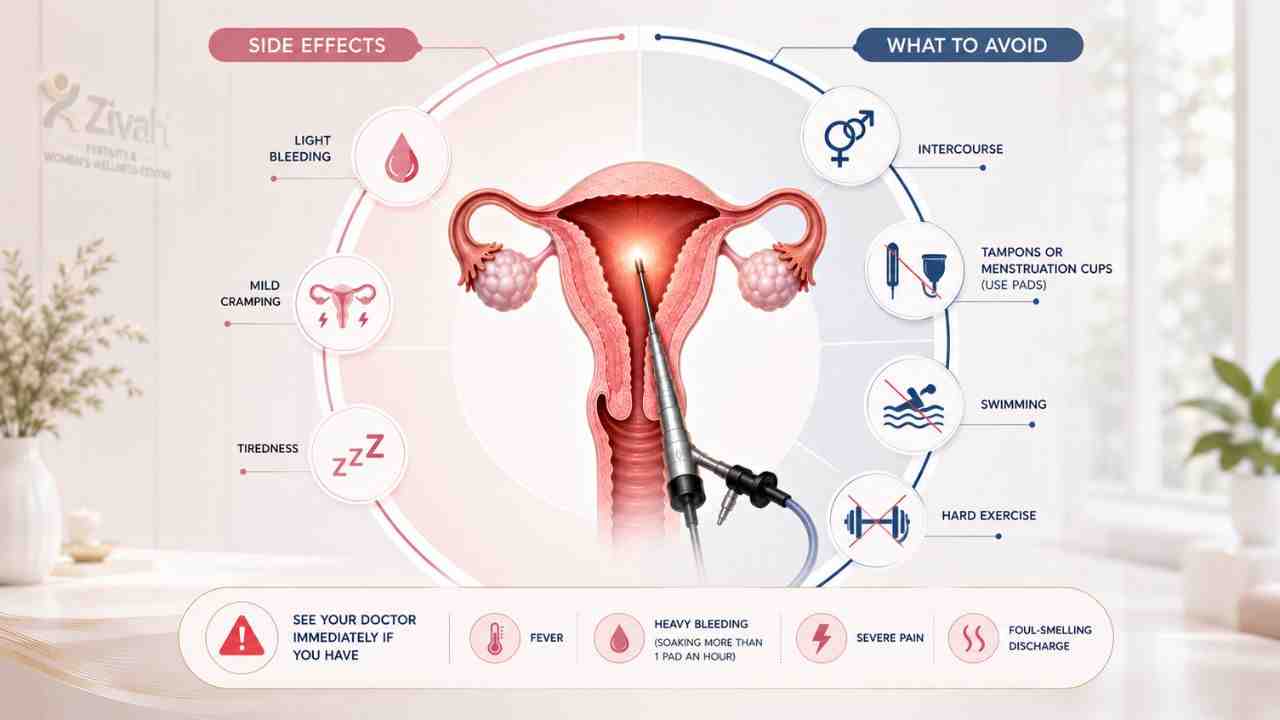
The negative effects of hysteroscopy can be moderate and short-lived, with little bleeding, slight cramping and a little weariness. Best avoided for about 1 to 2 weeks:
- Intercourse: this is the main reason there is no sex straight after hysteroscopy, as resting reduces infection risk until the lining recovers
- Tampons or menstruation cups (use pads)
- Swimming and hard exercise
Light bleeding is the most common type of bleeding following hysteroscopy. See your doctor immediately if you develop fever, heavy bleeding ( through more than one pad an hour), severe pain or a foul-smelling discharge.
Diagnostic Hysteroscopy Cost & Safety
Curious about how much a hysteroscopy costs? The diagnostic hysteroscopy cost is not fixed but depends on several factors, such as your city and type of hospital, the type of anaesthesia you choose, whether a biopsy is performed and whether the procedure remains diagnostic or becomes operative.
To get a clear personal number, it is best to contact Zivah’s billing section for a clear written estimate.There is little to fear about safety. A diagnostic hysteroscopy is very safe and has complications in far under 1% of cases, a low overall risk.
So is diagnostic hysteroscopy painful? Usually just minimally; the side effects are restricted to short-lived cramping or light spotting, and the whole operation is a straightforward day-care procedure.
Diagnostic Hysteroscopy at Zivah
Where you get your diagnostic hysteroscopy is important; the hysteroscopy test at Zivah focuses on accuracy, comfort and your fertility goals.
- Accuracy of Day-Care Diagnosis: A direct, real-time image of your uterine cavity, clear answers, in one short visit.
- Fertility & Pre-IVF Focus: We use diagnostic hysteroscopy in fertility, to assess your uterus prior to IVF and following failed cycles.
- Experienced Team for Hysteroscopy: A safe, low-discomfort technique by qualified specialists in a properly equipped clinic.
If your doctor has recommended this test, or you simply want clear answers regarding your uterus, book a hysteroscopy consultation at Zivah. One short visit can deliver true peace of mind.