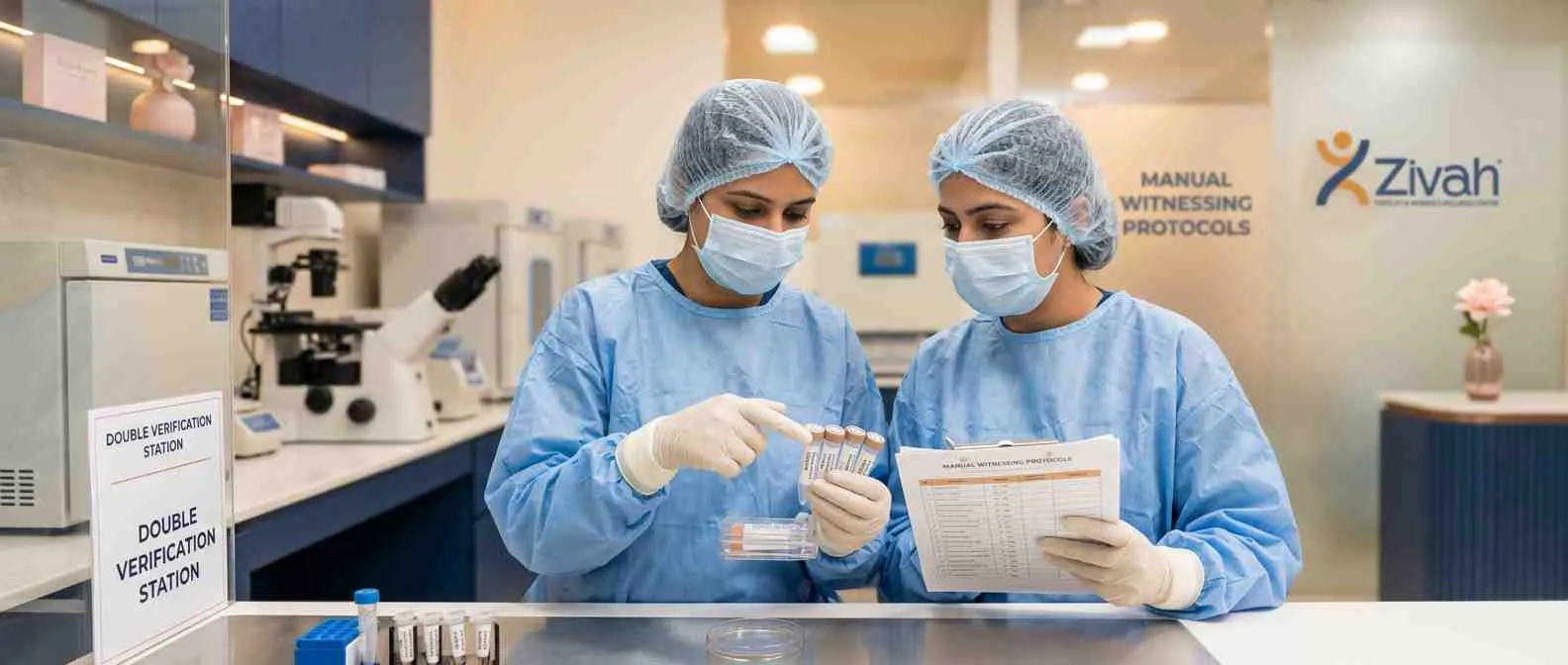
An IVF witnessing system is the safety measure that makes sure your eggs, sperm and embryos are properly matched to you throughout your treatment. It’s the quiet, ongoing check in the background that keeps your samples exactly where they belong, and gives you complete peace of mind.
This page explains what a witnessing system in IVF is, why it is important and how Zivah protects your samples with a careful manual double witnessing process. At Zivah, all the key steps from egg retrieval to embryo transfer are verified and recorded separately by two skilled embryologists, thus nothing is ever left to chance.
Note: Zivah uses a manual double-witnessing protocol, not an electronic or RFID technology. Every examination is performed by two qualified embryologists and documented in writing at every stage, offering you correct human verification and a complete, permanent record of your samples.
What Is an IVF Witnessing System?
The IVF witnessing system is a safeguard that a fertility lab uses to confirm your identification, and to make sure your eggs, sperm and embryos are properly matched to you at each phase. In an IVF cycle, many changes are made to tiny samples, and this system ensures the right samples are always with the right patient. It’s like a complete, regular identity check that protects your treatment from start to finish.
How a Witnessing System Keeps Samples Matched
This is about fertility sample verification at its core, making sure that every dish, tube and label is the right patient before anything is used. Your samples are reviewed and rechecked at every stage of the fertility lab sample-matching process as they move through the lab. No assumptions are made, and no steps are skipped.
What Is Manual Witnessing in IVF?
Manual witnessing simply means that each stage is independently observed by a second trained embryologist rather than by a single individual working alone. Your identification and labels are confirmed by 2 sets of trained eyes together, and the check is recorded.
Manual witnessing in IVF is a worldwide standard for lab safety that has been relied upon for a long time, and it’s just what Zivah does with its thorough double-witnessing procedure.
Why IVF Witnessing Is Essential for Patient Safety
In one cycle of IVF, your samples are managed several times, and every time they are moved, labelled, or mixed, their identity must be flawless. That's why witnessing is important in embryology labs: it ensures every sample remains properly matched throughout treatment. Mix-ups in IVF are very uncommon. Witnesses exist to keep that risk as near to zero as possible, serving as the quality-control backbone of a safe, well-run lab.
The Critical Points Where Identity Must Be Confirmed
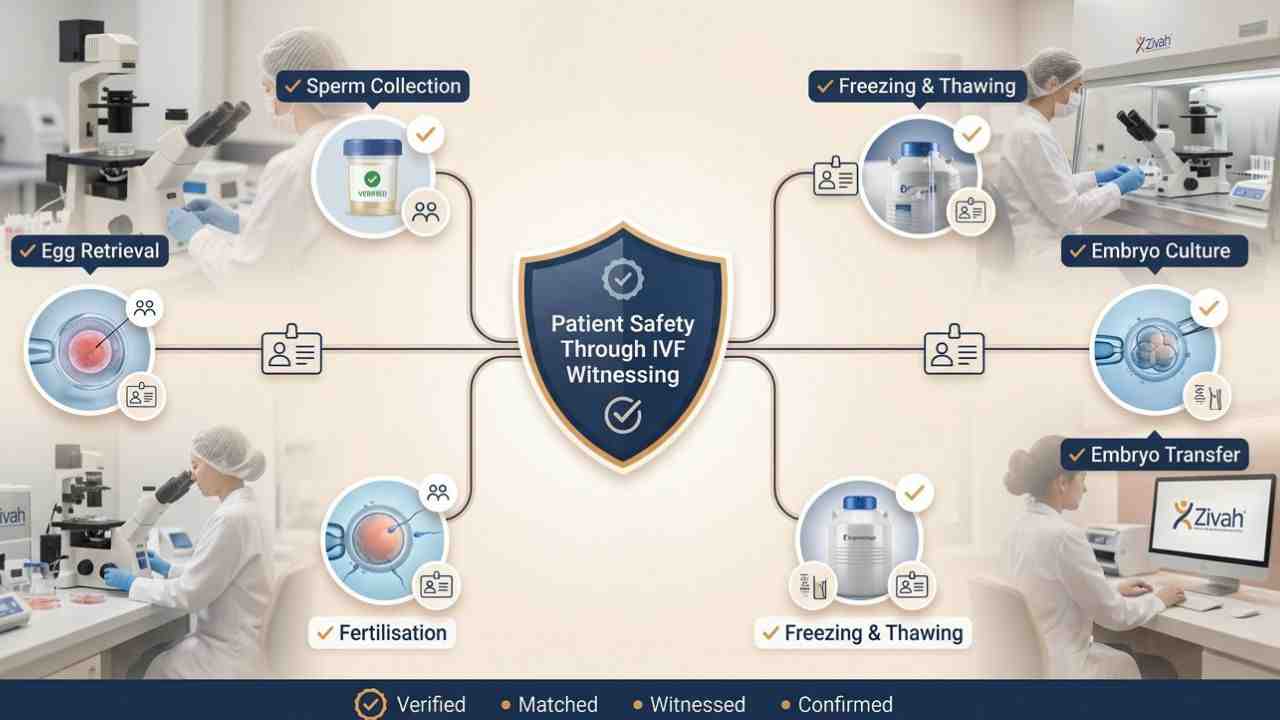
There are many points throughout the IVF cycle at which identity needs to be properly verified. In the lab, embryos and sperm are accepted by comparing them to your records at each of these handover points:
- Egg Retrieval – your eggs are labelled and matched to you
- Sperm collection – the sample is confirmed to be from the correct partner or donor
- Fertilisation -The correct egg and sperm are checked before they are combined
- Embryo culture - dish labels are reviewed every time they are touched
- Freezing & thawing - samples are confirmed before and after storage
- Embryo transfer – a final identity check before putting the embryo in
Each one of these processes is carefully witnessed by a sample taker, so nothing gets forwarded without confirmation.
How Witnessing Prevents Sample Mix-Ups
So, how do fertility clinics avoid sample mix-ups? Not on an individual basis, but by confirming identity at each level. Each stage is checked before the next begins, which is how witnessing systems prevent embryo mix-ups. It’s a basic idea, consistent practice: check, confirm, record, and go on.
Zivah's Manual Double-Witnessing Protocol Explained
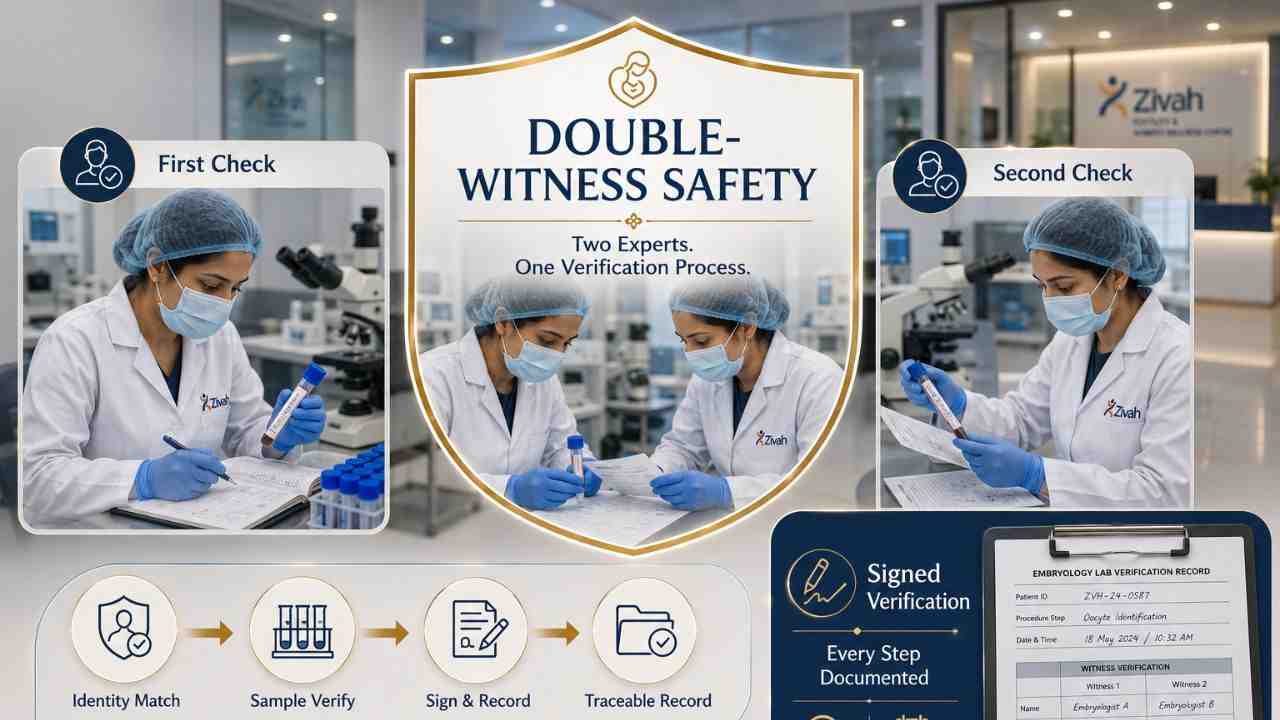
A simple but important rule guides our lab safety: no important step is ever taken by itself. The Zivah procedure uses a double-witnessing method in which two qualified embryologists work together to validate and record every key event in your treatment.
This isn't a quick look or an assignment. At each stage of your cycle, you follow a scheduled, written protocol that gives you both human responsibility and a full written record.
How Zivah's Two-Person Witness Check Works
Zivah has two individuals checking each witness, not one. So that first embryologist does a step. The second embryologist takes the sample and validates that the sample and identity labels match your records before any more steps are taken.
This manual witness check during IVF treatment is done at every important step in the process. You need two trained specialists to agree; one overlooks, can't slip by, and the second person is there specifically to catch what one person could miss.
Trained Embryologists & Signed Verification
Only qualified embryologists who know exactly what they are observing witness in our embryology lab. And all the checks are signed. Both witnesses time-stamp the step as part of our embryology lab ID checks so that there is always a clear and traceable record of who identified what and when. That trail of writing is the basis of meticulous checking into lasting accountability.
Inside Zivah's Manual Double-Witnessing Protocol
| Protocol Element |
How Zivah Applies It |
|---|---|
| Two-person check |
A second embryologist independently verifies identity and labels |
| Identity matching |
Patient details cross-checked against every dish, tube, and form |
| Signed record |
Both witnesses sign and timestamp each verified step |
| Single-patient rule |
Only one patient's samples are handled in the work area at a time |
| Every critical step |
Checks repeated from egg retrieval through to embryo transfer |
How Zivah Witnesses Every Step, Egg Retrieval to Transfer
Your samples are examined at every key point of your IVF cycle, not just once at the start. This is the IVF witnessing process, step-by-step, so you can see exactly where and how your eggs, sperm and embryos are confirmed along the journey.
Step 1: Witnessing at Egg Retrieval & Sperm Collection
The very first checks are done when your samples are taken. Once your eggs are removed, they are labelled and matched to you, and a confirmation is also carried out on your partner’s or donor’s sample. So, how can you confirm sperm samples in an IVF treatment? Careful tracking of sperm samples, the sample is matched to the appropriate patient and defined before anything moves ahead.
Step 2: Witnessing at Fertilisation & Embryo Culture
Then comes the biggest match of all. Both the egg and the sperm are proven to be yours individually before they are combined. So what witness checks happen during fertilisation? Two embryologists confirm that the egg and sperm are the correct ones before they are mixed. Then you identify the embryos during IVF by rechecking the dish labels every time they are handled in culture.
Step 3: Witnessing at Freezing & Embryo Transfer
If embryos are frozen, they are checked before and after storage, so nothing is mismatched during freezing or thawing. And the last, important moment? The witness is confirmed before embryo transfer. A last two-person identity check just before your embryo is inserted makes sure it’s you. Frozen embryos are examined in the same way before transfer.
What Happens If a Witness Check Doesn't Match?
This is where witnessing makes its help. If a check fails, the step fails immediately; no further steps are taken until the difference is fixed. This “stop and resolve” requirement is exactly how witness checking increases IVF safety: no sample is ever changed while any uncertainty exists.
Witness Checks at Each IVF Stage
| IVF Stage |
Witness Check Performed |
Recorded? |
|---|---|---|
| Egg retrieval |
Patient identity confirmed against collection dish labels |
Yes, signed by both |
| Sperm collection |
Sample matched to the correct patient/partner or donor |
Yes, signed by both |
| Fertilisation (IVF/ICSI) |
Correct egg and sperm confirmed before joining |
Yes, signed by both |
| Embryo culture |
Dish labels re-verified at each handling |
Yes, logged each time |
| Freezing / thawing |
Samples checked before and after cryopreservation |
Yes, signed by both |
| Embryo transfer |
Final identity check before the embryo enters the patient |
Yes, signed by both |
Manual vs Electronic Witnessing: An Honest Comparison
People ask me often how a manual witnessing system in the IVF lab compares to an electronic one. The answer is simple: it is not the technology that protects patients, but how disciplined and well-documented the checking is. That truth is what Zivah structures its entire system around.
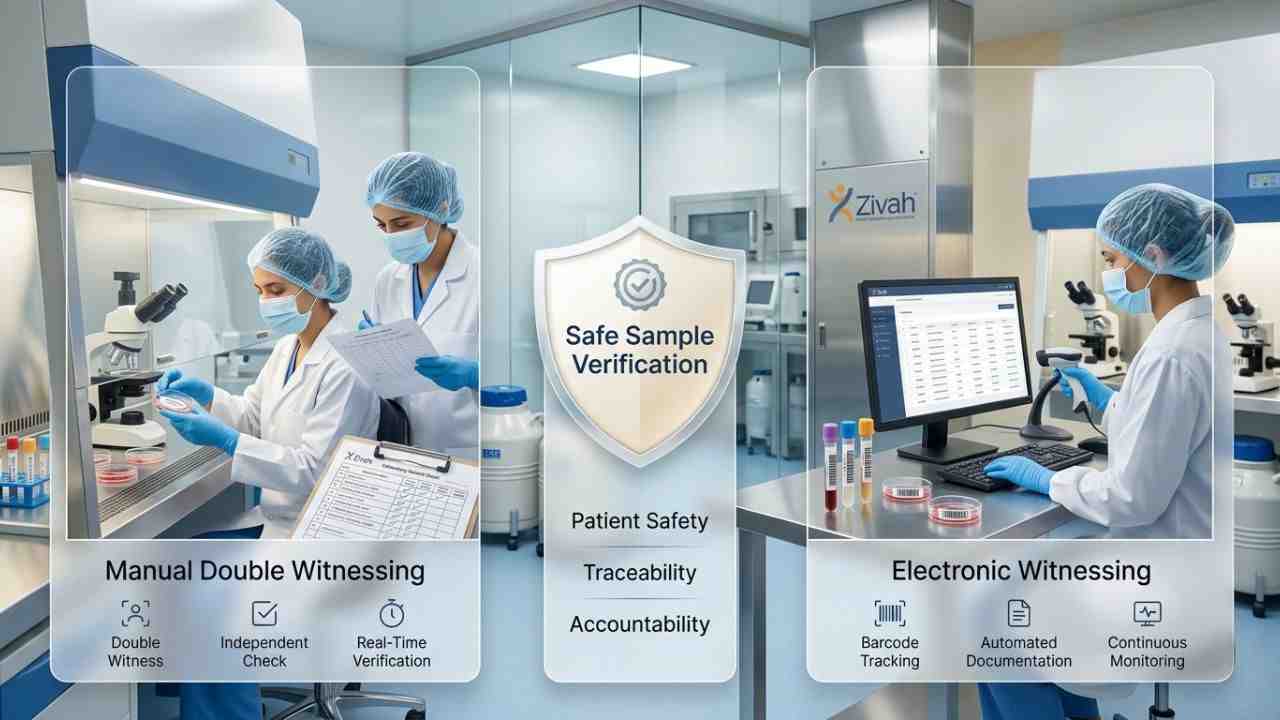
The Known Limits of Manual Checking and How Zivah Prevents Them
Let's have it. In theory, there are three ways manual checking might go wrong: a step is missed, a check is put on autopilot, or it is recorded after the fact rather than in the moment.
Zivah's multi-layered, manual double-witnessing architecture is chosen specifically because it designs out each of these dangers. Since of our one patient rule, only your samples are in the work area, you have nothing to mix up. An independent second embryologist breaks any autopilot, because it takes two people to agree actively.
And signing at the very moment of each step makes every check right away and documented. This is how witness checking is done manually in truly accountable fertility facilities.
Where Electronic Systems Differ
A real strength of an embryo identification system using barcodes or RFID is its continuous, automatic background monitoring. Instead, Zivah incorporates direct, unautomated human responsibility into its laboratory culture, with qualified personnel actively confirming and recording every step.
We share the same goal with our witnessing procedures: full documentation behind each check for safe, accurate, traceable care.
Manual vs Electronic Witnessing
| Factor |
Manual Double Witnessing |
Electronic Witnessing |
|---|---|---|
| Verification |
Two embryologists independently confirm each step |
Software/RFID confirms automatically |
| Accountability |
Direct human sign-off at each step |
System log; less direct human ownership |
| Records |
Complete signed written documentation |
Digital audit trail |
| Continuous monitoring |
At defined check points |
Continuous (electronic's genuine edge) |
| Cost & accessibility |
Lower cost, widely available |
Higher setup and maintenance cost |
| Safeguard against autopilot |
Independent second person breaks routine |
Automated alerts on mismatch |
Records & Chain of Custody: Your Complete Paper Trail
Every check Zivah does is documented, and that documentation is one of the most reassuring parts of our protocol. That means your treatment isn’t just visible in the moment, it’s documented, traceable and reviewable from start to finish.
How Zivah Documents Every Witness Check
Any verification is written down as it occurs. As part of our IVF sample tracking systems, each check captures:
- Who both performed and watched the step (both were embryologists)
- What was verified: your identity and sample labels
- When it took place, with a timestamp
- The signatures of both witnesses confirm that the match is correct
This is also how our patient ID system remains waterproof; your information is linked to every dish, tube and form throughout your cycle.
An Unbroken Chain of Custody, Retrieval to Transfer
What is the chain of custody in fertility labs? A continuous, recorded trail that shows your samples were matched appropriately at every step. Our chain of custody is unbroken from egg retrieval all the way through to embryo transfer, no gaps, no missed stages. These records provide real transparency and allow our staff to analyse each cycle for quality assurance.
Why Witnessing Builds Trust and How Zivah Delivers It
A well-witnessed lab is, simply put, a safe lab. With every sample being checked and recorded at every stage, IVF patient safety becomes more than a promise; it becomes visible on the records.
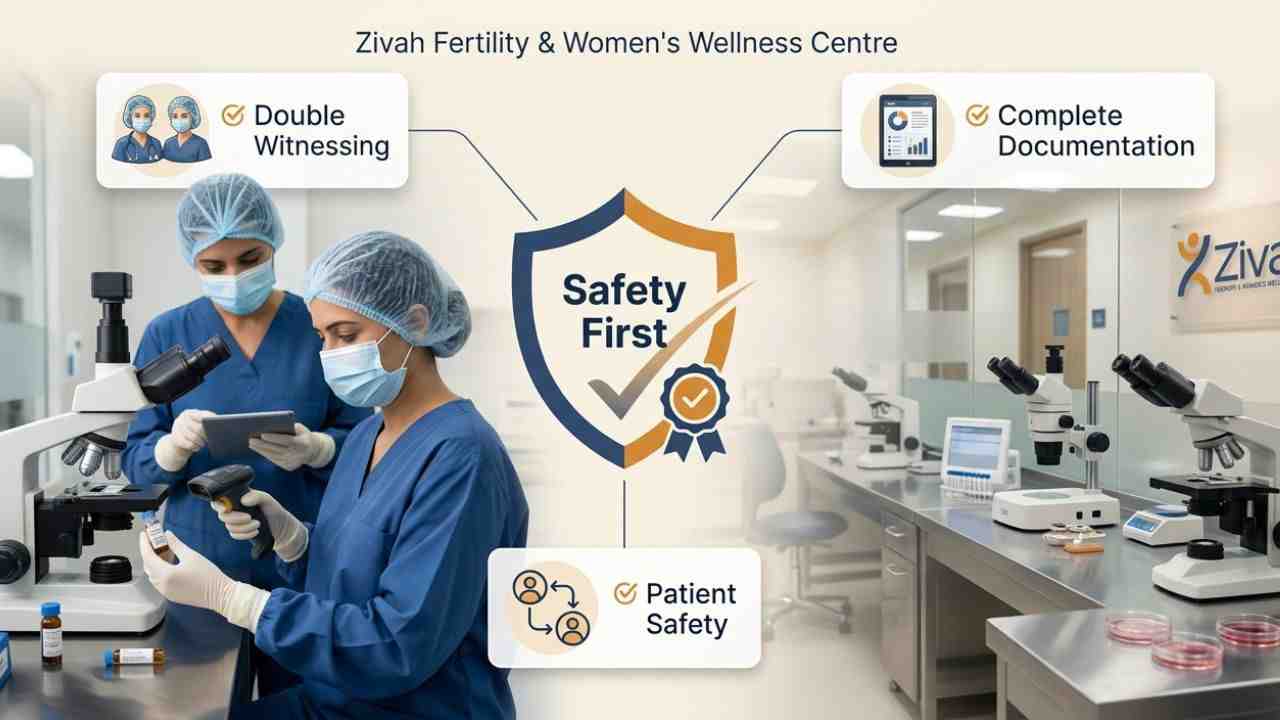
Confidence for Patients, Embryologists & the Clinic
For you, peace of mind is real: your samples are a match and are documented from start to finish. This is why patient identification is so important in fertility treatment; it protects the integrity of your whole cycle. And for our team, embryo witnessing for patient safety provides obvious accountability and confidence as well.
Our embryologists follow safety standards and take every step knowing that every check is shared, recorded, and not carried out alone.
Zivah's Safety-First Lab Standard
At Zivah, manual double witnessing and thorough documentation are not optional add-ons; they're an intentional safety-first norm. Our experienced embryologists witness each and every phase of each cycle under our fertility clinic's witnessing process, backed up by thorough records and strong quality assurance in the fertility lab.
If you're curious about how your samples are protected, our experts can guide you through Zivah's witness system and lab safety processes. Just ask at your consultation.