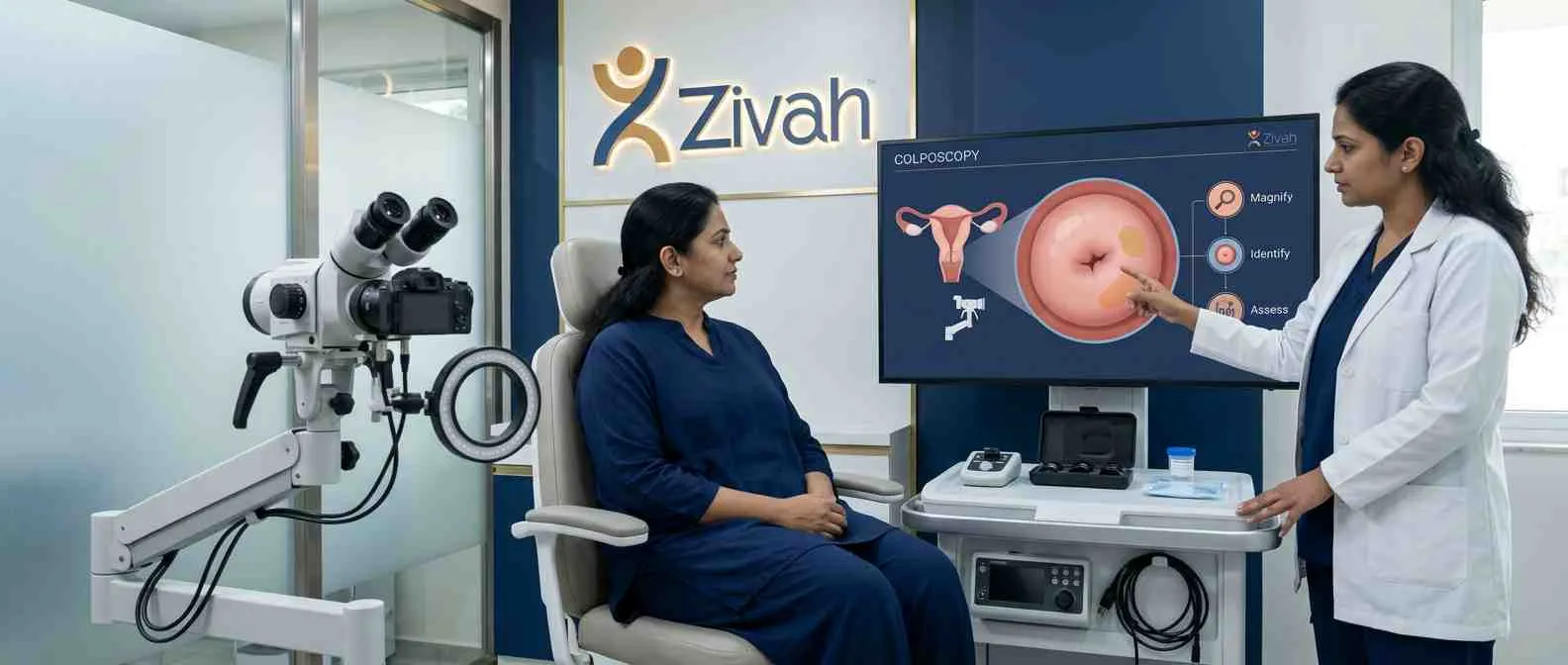

If you’ve been referred for a colposcopy after a positive HPV test or abnormal Pap smear results, breathe. Referrals Are Not Diagnoses. That only means anything showed up in your screening that has to be looked at more closely.
Colposcopy examines your cervix under magnification. A colposcope is a lit tool that acts like a pair of binoculars, and it never enters your body. Like a Pap test, except the speculum goes in.
This page explains why you have been referred, what to do and avoid beforehand, what the process feels like, what your findings mean, and how it impacts fertility. Most of the dread here comes from not knowing. Let’s solve it.
What Is a Colposcopy? Cervical Examination Explained
Colposcopy is a visual assessment of the cervix (and commonly the vagina and vulva as well). This is a diagnostic process, not a treatment; a closer look at cells that a screening test cannot determine from a distance. And the thing no one really knows is the instrument stays outside your body. No, just the speculum goes in, just like a Pap test.
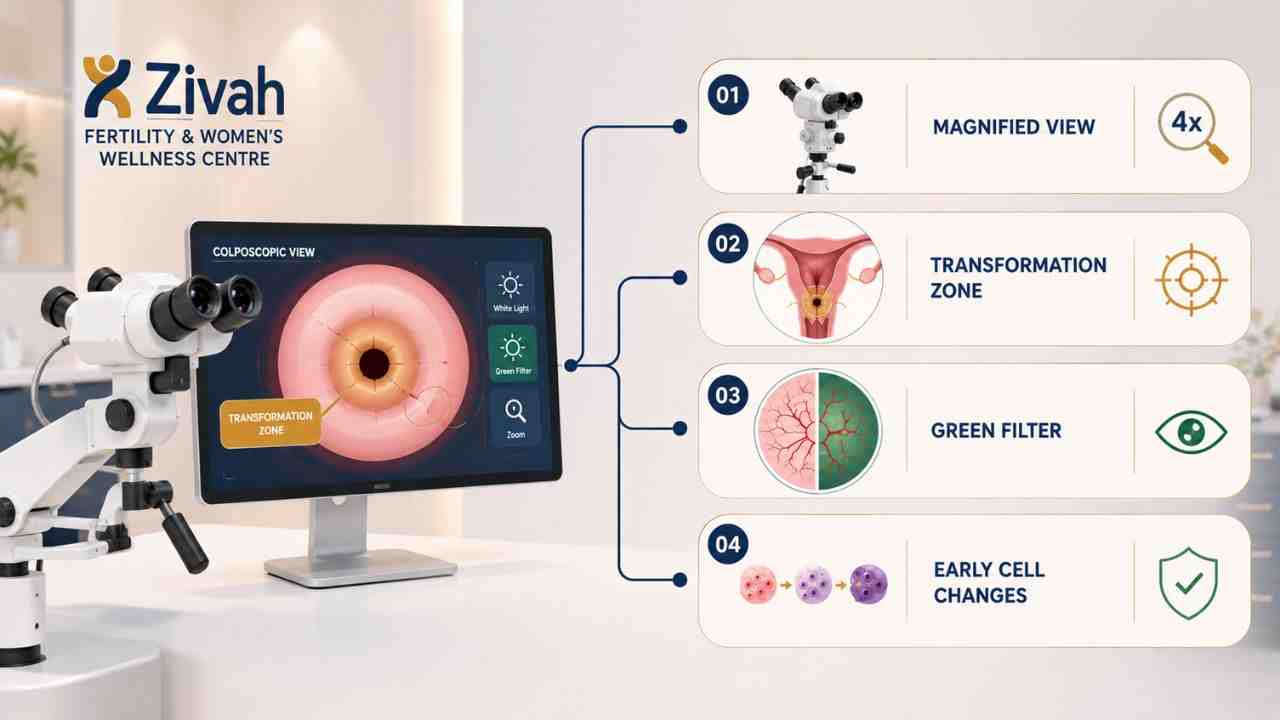
How the Colposcope Magnifies the Cervix
The colposcope is a stand with a lit microscope. Your gynaecologist examines it through a microscope, magnifying the cervix several times over from a distance.
A green filter shows the patterns of blood vessels that are unseen under white light. Most abnormal cell changes begin in one place, the transformation zone; therefore, the emphasis is directed there.
Does Being Referred for Colposcopy Mean I Have Cancer?
Referral is not a diagnosis. Your cervical screening caught up anything that requires a deeper look; that’s all. Most of what a colposcopy detects is precancerous change, cells that have started to change but are not cancer, and generally get better on their own. Yes, it can find cervical cancer. But discovering adjustments immediately is how cervical cancer gets prevented.
Why Colposcopy Is Advised: Abnormal Pap Smear and HPV Results
Cervical screening is quite excellent at detecting changes. It can’t tell you what’s changed, or by how much. That’s a colposcopy, which is why it’s the routine follow-up when a screening test comes back unreliable.
Colposcopy After an Abnormal Pap Smear or Positive HPV Test
Not all abnormal Pap smears come here. Low-grade changes (ASCUS or LSIL) generally go away by themselves, and may only need to be retested in a year. High-grade findings are processed differently. HSIL or ASC-H means there are abnormal cells on the cervix that are severe enough to need to see a doctor right away for a colposcopy.
This is where HPV comes in. Most infections go by without doing any harm, but it is the high-risk ones that count, HPV 16 and 18 above all. A positive high-risk HPV result, especially if you have abnormal cells, means you’ll likely need a colposcopy. Your doctor will let you know if you need to be retested initially only for HPV.
Other Reasons for Colposcopy: Bleeding, Discharge and a Suspicious Cervix
Screening isn’t the only way. Even if the Pap smear results are normal, a colposcopy may be recommended if you have bleeding after sex, have unexplained vaginal bleeding, chronic discharge or vulvar irritation, or if the cervix seems abnormal on inspection.
Why You Were Referred: Screening Result
| Screening Result |
What It Suggests |
Usual Next Step |
|---|---|---|
| Normal Pap + HPV negative |
No changes detected |
Routine screening at the usual interval |
| ASCUS + HPV negative |
Borderline cells, low risk |
Repeat testing, usually in a year |
| LSIL or ASCUS + HPV positive |
Low-grade changes with high-risk virus |
Colposcopy advised |
| HSIL or ASC-H |
High-grade changes possible |
Colposcopy without delay |
| HPV 16 or 18 positive |
Highest-risk strains detected |
Colposcopy, even if cells look mild |
| Suspicious-looking cervix |
Visible abnormality on exam |
Colposcopy regardless of Pap result |
Before Your Colposcopy: What to Do and What to Avoid
There is not much to do to prepare for colposcopy, and almost all of it is designed to do one thing: maintain your cervix in clear view. Any blood, creams, or recent friction on the tissue make the test harder to read.
Colposcopy Preparation: Timing, Sex and Tampons
Your time: Menstrual blood covers the cervix, which makes heavy bleeding delayed. But don't cancel automatically; light spotting is usually workable. Call the clinic, describe what you're seeing, and let them decide.
The 48-hour rule: Do not have sex, use tampons, douche, or use creams or pessaries. Keep the vagina free for about two days before. That is not random. All of these can affect the surface of the cervical tissue, and that may affect what your gynaecologist sees and what a biopsy shows.
What to Bring on the Day of Colposcopy
Ask your doctor about taking a mild painkiller beforehand; many women find it takes the edge off any cramping, especially if a biopsy is expected. If pregnancy is a possibility, a test is usually performed upon arrival. You will be asked to sign a consent form before you start, and it is typical to have minor bleeding or discharge afterwards, so bring a sanitary pad.
How a Colposcopy Is Performed at Zivah: Step by Step
Colposcopy is not performed in an operating theatre but in a consultation room. It normally takes 10 - 20 minutes, and you go directly home afterwards: no anaesthetic, no hospitalisation, no recovery unit.
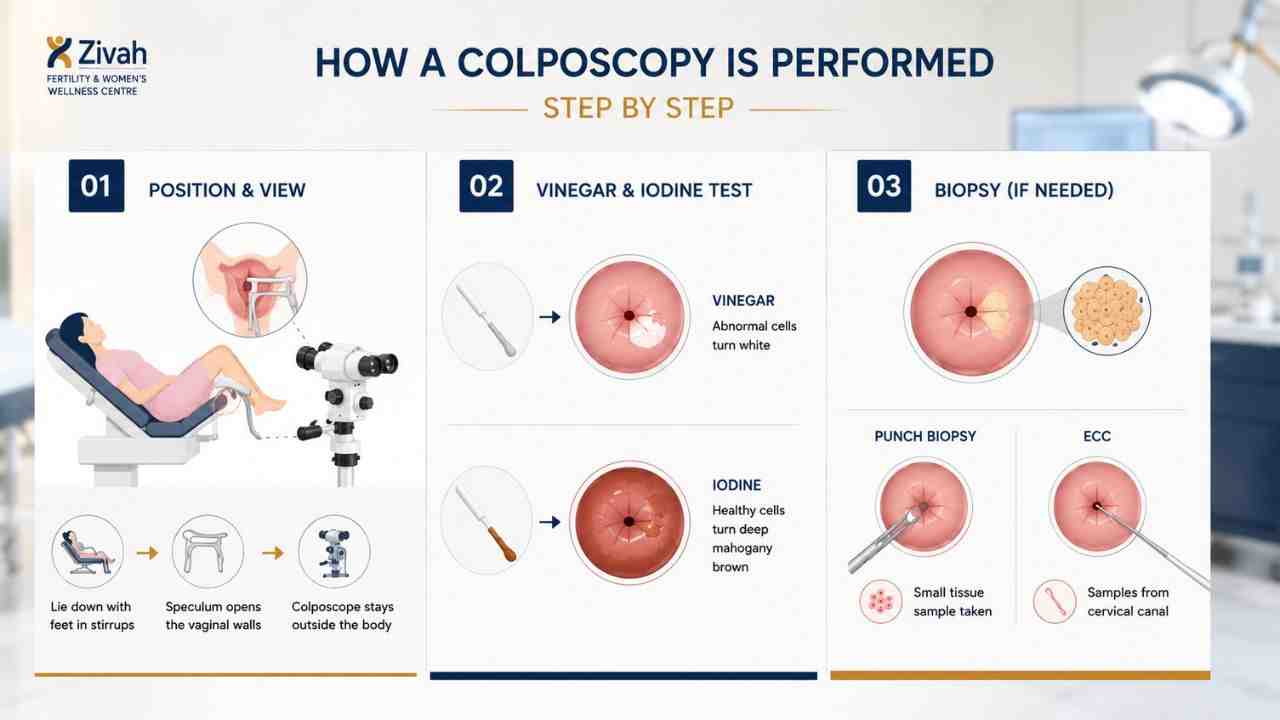
Step 1: Position, Speculum and the Colposcope
You lie down with your feet in stirrups, the same way you do for a Pap test. A speculum is inserted carefully to open the vaginal walls and allow for visualisation of the cervix. Next, the colposcope is placed a few inches away from you, never within you.
Step 2: The Vinegar Test and Iodine Stain
A moderate solution of vinegar, acetic acid, is swiped on the cervix. Abnormal cells become white in response, providing a contrast to the healthy tissue. That will sting a little.
A short burn is common, happens in seconds, and catches most women unaware since no one tells them. This may be followed by an iodine stain. Healthy cells are full of glycogen and devour it, becoming a deep mahogany colour.
Step 3: If a Biopsy Is Taken - Punch Biopsy and ECC
The abnormal cells have little glycogen and stay a pale mustard-yellow, and that contrast makes them apparent. If an abnormal region is seen, a little sample of tissue is extracted. A punch biopsy is rapid, with a small sample of a few millimetres: a small punch, then a cramp. An endocervical curettage (ECC) with a thin curette may also be used to sample the cervical canal. Then a solution is used to halt any bleeding.
Colposcopy Step by Step: What Happens and What You'll Feel
| Step |
What Happens |
What You'll Feel |
|---|---|---|
| Positioning |
You lie back, feet in supports |
Nothing, as for a Pap test |
| Speculum |
Inserted to open the vaginal walls |
Pressure, mild discomfort |
| Colposcope |
Positioned outside; cervix magnified |
Nothing at all |
| Vinegar (acetic acid) |
Applied by swab; abnormal cells turn white |
A brief sting or tingle |
| Iodine stain |
Healthy cells turn brown; abnormal stay pale |
Little to nothing |
| Punch biopsy |
Small tissue sample taken |
A sharp pinch, then cramping |
| ECC |
Cervical canal gently sampled |
Cramping, like a strong period pain |
| Sealing solution |
Applied to stop bleeding |
Nothing |
Does a Colposcopy Hurt? Pain and Anaesthesia Options
Let's be honest, because vague reassurance helps nobody. The exam itself is not painful. The speculum is pressure and a little pain; that's it. The vinegar solution hurts for a moment, then goes away.
If a cervical biopsy is taken, that's the portion you'll feel a sharp, rapid squeeze, settling into cramping like a heavy menstruation. It's over in seconds. But it's nothing, and you should know that going in.
Pain Relief and Local Anaesthetic Options
Here's something most women don't expect: the cervix contains extremely few pain-sensing nerve terminals. This means that an anaesthetic injection into it might be more unpleasant than the little punch biopsy.
This is why most colposcopy biopsies are taken without local anaesthesia, not to save time, but because it really does save you the worst of two feelings.
Treatments like LEEP involve removing more tissue and are more commonly performed under local anaesthetic. Sometimes a numbing spray. And always pain alleviation. You're entitled to ask before you start.
After Your Colposcopy: Recovery, Discharge and Aftercare
It ultimately comes down to one thing: was a biopsy taken?If it wasn't, you're out. Drive yourself home, go back to work, just keep going. You may have a little spotting for a day or two; that's all.If you have a biopsy, take it easy for a few days.
Colposcopy Aftercare: Bleeding, Cramping and Discharge
And this is normal. This is what is truly happening :
- The dark discharge: This is not told to women, and it sends individuals to emergency departments who don't need to go. Iron salts are put on your cervix in a paste to stop the biopsy site bleeding. It washes out over the following few days, dark brown or black, occasionally grainy, often described as similar to coffee grounds. It's not blood. This is not tissue. It is the paste lifting as it should.
- Some bleeding: It should last a few days. Don't use a tampon; use a pad.
- Muscle spasms: It's like period discomfort, but it goes away soon. Usually, a simple painkiller is enough.
Colposcopy Recovery: When You Can Resume Normal Activity
Most women return to work immediately. This is not an operation, and you may take yourself home. For roughly a week following a biopsy, or for as long as your gynaecologist advises:
- No intercourse
- No tampons, pads only
- No Bathing
- Take it easy with hard exercise
It's a brief window and provides the cervix a clean chance to repair.
Colposcopy Results Explained: Normal, CIN 1, CIN 2 and CIN 3
Colposcopy biopsy results are often available in 1-2 weeks. If you had a biopsy, the waiting is usually worse than the procedure itself. Ask before you leave when and how you'll get your findings, letter, phone call or appointment. Knowing what to expect takes away some of the pain of the wait.
Normal Colposcopy Results and Routine Follow-Up
If the test is normal, it means no abnormal cells were seen. Nothing has to be treated.You'll return to normal cervical screening at your gynaecologist's recommended interval, which could be a bit sooner than usual if HPV was discovered, to keep an eye on things.
Understanding CIN 1, CIN 2 and CIN 3
If the report states CIN, read this first: CIN is not cancer. This term refers to cervical intraepithelial neoplasia, which involves abnormal cells on the surface layer of the cervix. And the number informs you how deep the alteration goes.
- CIN 1 - minimal change. It's often self-limiting and is often watched with recurrent testing rather than treated.
- CIN 2 - modest change. Usually treated but occasionally carefully observed in younger women.
- CIN 3 - high-grade. Treated, since if left alone there is a serious risk of becoming cancer over the years.
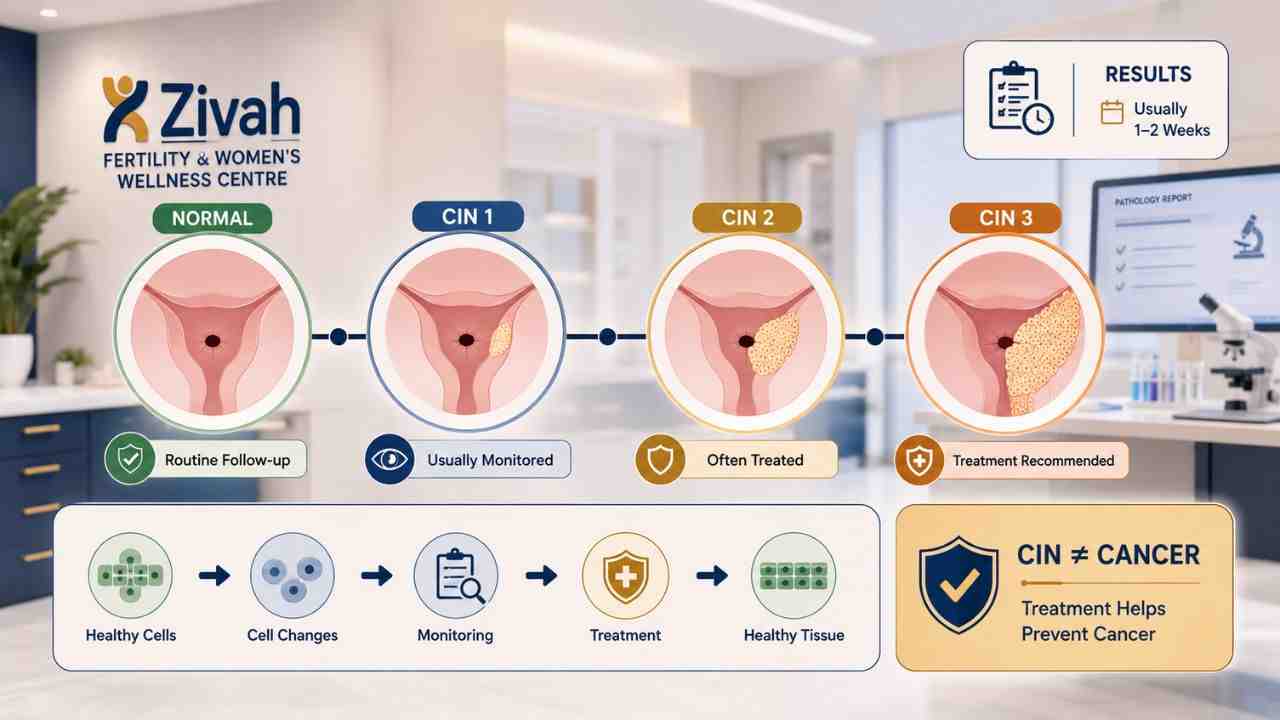
The important thing to remember is that treatment of CIN 2 or CIN 3 is not cancer treatment. It removes cells before they become cancer. That's the screen operating exactly as planned, which is why you were sent.
Colposcopy Treatment, Fertility and Pregnancy: What Happens Next
A colposcopy is a diagnostic test, not a treatment. Its role is to determine exactly what is there, and then what happens next is a whole distinct choice. Sometimes that choice is to take out abnormal cells. But often it is only to observe and then repeat the test. Many adjustments need no action at all.
Does Colposcopy Affect Fertility or Pregnancy?
Fertility: No. Cervical biopsy through colposcopy does not lead to infertility. The samples collected are small, the cervix heals, and your ability to get pregnant is not affected. Treatment techniques are another thing; see below.
Pregnancy: Colposcopy is safe in pregnancy and occasionally needed. Two things change. There is a somewhat increased risk of bleeding, and an endocervical curettage is never performed. If abnormal cells are detected, treatment is generally delayed until after your baby is born, with close observation in the meantime.
Treatment for Cervical Dysplasia: Removing Abnormal Cells or Monitoring Them
Not all abnormal results require treatment. Mild changes (CIN 1) typically resolve on their own and are commonly followed with repeat testing.
Remove higher grade adjustments. And here's the fertility caveat, honestly. LEEP and cone biopsy remove more cervical tissue than a biopsy does. This will not have a significant impact on conceiving for most women, but it is a topic worth having with your gynaecologist, particularly if you are planning a pregnancy.
Treatment Options: LEEP vs Cryotherapy vs Cone Biopsy
| Treatment |
How It Works |
Typically Used For |
Recovery |
|---|---|---|---|
| LEEP |
A fine heated wire loop removes the abnormal area |
CIN 2 and CIN 3 |
Discharge and light bleeding for 2–3 weeks |
| Cryotherapy |
Abnormal cells are frozen off |
Smaller, low-grade lesions |
Watery discharge for a few weeks |
| Cone biopsy |
A cone of tissue is removed surgically |
Larger or deeper changes; when more tissue is needed |
Longer; usually done under anaesthesia |
Is a Colposcopy Safe? Risks and Side Effects
Yes. Colposcopy is a common, low-risk check performed in a consultation room, with no anaesthetic and no hospitalisation. Serious problems are genuinely uncommon. That said, a biopsy involves taking genuine tissue, however little. So it's good to understand what's usual afterwards, what's not, and when to pick up the phone.
Colposcopy Side Effects, Rare Complications and Why Your Colposcopist Matters
Common side effects are moderate and short-lived: light bleeding, period-like cramps and black discharge if a biopsy was performed. All settle after a few days.
Serious problems are uncommon: excessive bleeding, infection at the biopsy site, or continued pelvic discomfort. All are curable. Some women report burning when they pass pee; comment on this, since it may need testing.
One thing to understand: colposcopy is very operator-dependent. What is found and what is missed is largely a matter of the experience of the person behind the colposcope. It's not a test where the machine performs the job. It's an art. That's reason enough to inquire who's doing yours.
Why Choose Zivah for Your Colposcopy
Colposcopy is a skill, before it is a procedure. The correctness of the result depends on the person doing it, which makes where you go and who you see a decision worth making carefully. That's where we get serious at Zivah.

Experienced Colposcopists, Same-Visit Biopsy and What It Costs
We do colposcopy routinely, and if we find a suspicious region, we do a biopsy at the same time no second appointment, no second wait. There is no single price.
It depends on whether a biopsy is needed, how many samples are collected, and the pathology that follows. Get an exact quotation and check your insurance cover with our staff. Make an appointment if anything has been detected during your cervical screening.
A colposcopy is not a diagnostic. It's a more detailed examination, and most of what it finds is curable or goes away on its own. The examination is brief, conducted in a consultation room, over in twenty minutes. Here is an answer, a name for what is there, and a strategy. The good news is catching changes early. That's the point.