10 Essential Health Checkups Every Woman Needs at Different Ages
Know which health checkups you need in your 20s, 30s, 40s and beyond. A clear, age-wise guide to the 10 tests that matter most for women at every stage of life.
Some days the list gets too long. Work, home, someone who needs you the moment you sit down. And somewhere near the bottom sits the appointment you keep meaning to book for yourself.
Women's health checkups aren't a one-size-fits-all list you finish once. What your body needs in your twenties is not what it will ask for in your forties. Regular women's health screening is less about catching something frightening and more about knowing your own baseline, so you notice early when something shifts.
At Zivah, we meet women like this every week. They feel well and want to understand their health a little better. Here are the essential health checkups every woman needs, decade by decade, so you can see where you are right now.
Why Your Health Checkups Change With Your Age
Most women's health checkups are written as a one-size-fits-all list. But a woman of twenty-four and a woman of forty-eight are not looking for the same things, and treating them the same way misses what matters at each stage.
Why do women need different health tests at different ages?
Your body is not the same at thirty-five as it was at twenty-two, and it should not be tested as though it were. In your twenties, your bones are still storing strength you will draw on later. By your forties, that store has stopped growing. Routine health checkups for women follow that same rhythm, testing what is happening now.
Does every woman need the same tests? No. Your age, your cycle, your family history and your plans for children all shape what belongs on your list.
How do hormonal changes affect what you should be screening for?
The hormones change almost everything. During your reproductive years, estrogen keeps your bones and heart healthy. When it drops in your forties, you need to pay more attention to both of them. Your thyroid can change your periods even if you don't notice. In your thirties, your body's sensitivity to insulin often drops. That is why preventive health checkups work best when they are based on your decade, not a list of decades.
| Life Stage | What Your Body Is Doing | What to Watch For |
|---|---|---|
| 20s | Building peak bone mass, cycles settling | Iron, thyroid, cycle irregularity |
| 30s | Peak fertility years, rising stress load | Hormones, blood sugar, reproductive health |
| 40s | Perimenopause begins, metabolism shifts | Breast health, cholesterol, bone strength |
| 50s and beyond | Post-menopausal changes | Bone density, heart health, cancer screening |
Notice that nothing on that table appears suddenly. Checking your thyroid at 24 is the same as when you're 40. There are not four different health plans here. Every decade builds on the last. To begin, you need to know what decade you are in. Most women start with what they notice first: how much energy they actually have.
Complete Blood Count and Iron: Start This in Your 20s
You lose blood every month. Not many of us think about how much that steady loss adds up to over time. Your blood carries oxygen to every muscle and every thought, and when it carries less, you feel it long before anything shows up as a problem. This is where many health checks for 20-something women begin.
What does a complete blood count actually check in women?
A complete blood count looks at your red cells, white cells and platelets in one small sample. Your haemoglobin shows how well oxygen is reaching your body. Your platelets show how your blood clots, which matters if your periods are heavy. Your specialist may also check your iron levels and ferritin (your stored iron), because the two tell different stories.
Can low iron be the reason you feel tired all the time?
Very often, yes. Why does tiredness so often start with your blood? Because low haemoglobin means less oxygen reaching your muscles and brain, and your body responds by slowing you down. Anaemia in women builds slowly enough that many of us adjust to it.
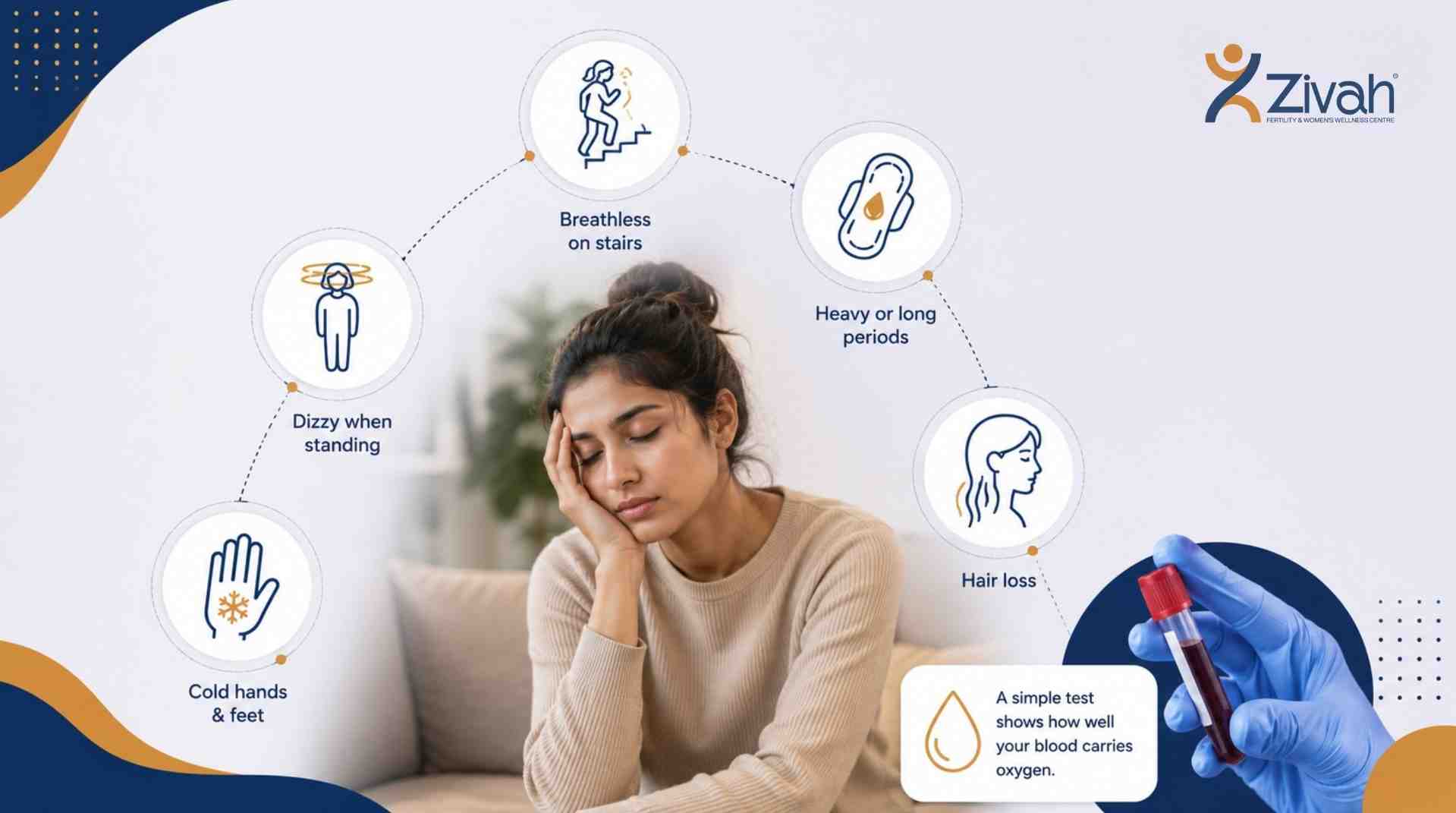
A few signs worth mentioning at your next visit:
- Having trouble breathing on stairs that you used to handle easily.
- Periods that last more than a week or are heavy.
- Loss of hair for no clear reason.
- Feet and hands are cold.
- Feeling dizzy when standing.
None alone means something is wrong. Together, they are worth a simple test. Once you know how well your blood carries oxygen, the next question is what sets the pace at which your body burns it.
Thyroid Testing: Why It Matters From Your 20s Onwards
Your thyroid sets the speed at which your whole body runs. It decides how warm you feel, how quickly you feel tired, how steady your weight sits and how regularly your cycle arrives.
When that speed drifts even slightly, the signs rarely arrive together. You feel cold in a room where nobody else does. Your periods come a few days late, then a week late. You put it down to stress, and often it is. But sometimes it is a small gland doing its job a little too slowly.
How do you know if your thyroid is affecting your periods?
Most women don't think the link is this close. Thyroid hormones help control ovulation hormones, so when one shifts, the other usually does too. You should talk about heavier bleeding, longer breaks between cycles, or cycles you used to predict but now can't. Can a thyroid problem change your mood and your cycle at once? Yes, because the same hormones that set your metabolic pace also influence sleep, concentration and how easily you feel low.
That's why thyroid and hormone tests for women are often read together. A simple TSH test is the first thing your doctor will do. If that test shows more tests are needed, they will do them. Your thyroid sets the pace for your body. As you get older, the next thing you should pay attention to is what your cells do with food every day.
Blood Sugar and HbA1c: A Priority From Your 30s
You know that heavy feeling after lunch. Your eyes get tired. Your thinking slows down. Most of us call it a long day.
Sometimes it is. But sometimes your body is having a harder time using the sugar from your food properly. Doctors call this insulin resistance. It often starts in your thirties, and it starts quietly. That is why blood sugar is one of the main health tests women should get after 30.
When should a woman start checking her blood sugar levels?
More quickly than you think. How early is too early to check your blood sugar? That doesn't exist. If you're in your early 30s and get a normal number, it's still helpful because it gives you something to compare later.
Some women need to start earlier. Tell them if you have PCOS, if diabetes runs in your family, or if your blood sugar was high while you were pregnant. From there, your expert will guide you.
What is the difference between fasting sugar and HbA1c?
A fasting sugar test shows what your sugar is doing today, after a night without food. HbA1c shows your average over the last three months.
Both are helpful, and they work best together. Your morning reading can look fine while your three-month average has been slowly rising. A blood sugar test for women usually includes both, so nothing is missed.
| Test | What It Tells You | How Often (guide only) |
|---|---|---|
| Complete blood count | Anaemia, infection, overall health | As advised at your routine visit |
| Thyroid profile | Metabolism, cycle regularity | As your specialist suggests |
| HbA1c or fasting sugar | Blood sugar across three months | Interval guided by your risk profile |
| Lipid profile | Cholesterol and heart risk | Frequency confirmed by your doctor |
| Vitamin D and B12 | Bone, nerve and energy health | On specialist advice |
You may notice the timings above are left open. That is on purpose. No one schedule suits every woman.
The table shows how much these tests belong together. Your energy, your cycles and your sugar levels are all part of the same picture. Most of them can be done from one sample, in one visit. Your specialist will tell you which ones you need this year, and which ones can wait.
How your body uses fuel is one half of the story. How that fuel travels through your heart is the other half.
Blood Pressure and Cholesterol: From Your 30s Into Your 40s
Heart trouble is still thought of as something that happens to men. It is not.
For most of your reproductive years, oestrogen gives your heart and blood vessels a quiet layer of protection. As you move through your forties and that oestrogen begins to fall, that protection softens. This is why a blood pressure check for women matters more with each passing decade, not less.
Why is heart health so often missed in women's routine checkups?
Partly because we are looking for the wrong signs. Why do heart symptoms look different in women? Because women more often feel tiredness, breathlessness, jaw or back discomfort, and nausea, rather than the chest pain everyone expects. These feel like ordinary tiredness, so they get brushed aside.
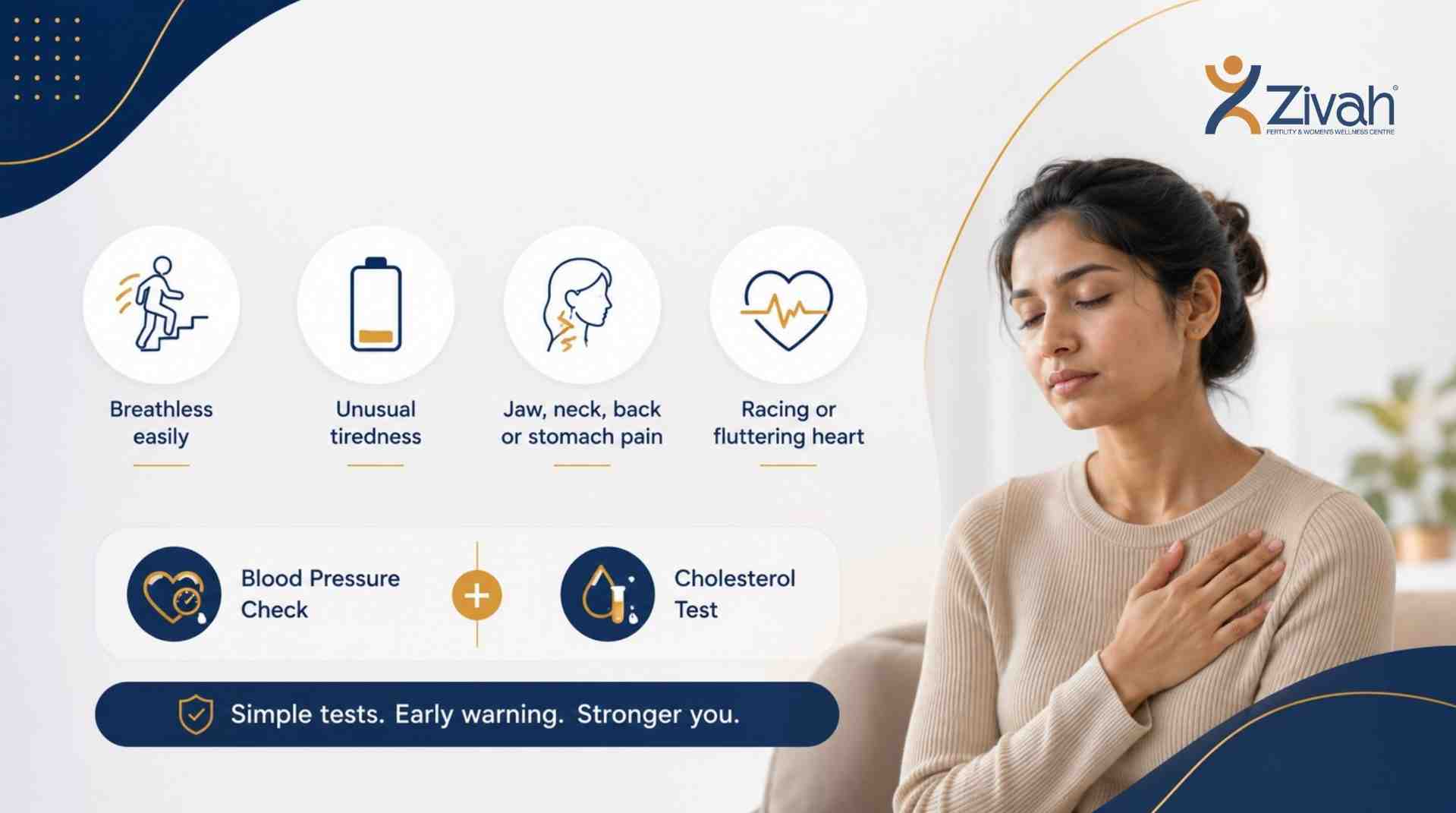
Some things are worth mentioning at your next visit, even if they seem small:
- Getting out of breath while doing something you used to do without any trouble.
- Strange tiredness that doesn't go away with rest.
- Having pain in your jaw, neck, back, or upper stomach.
- Having a racing or fluttering heart for no clear reason.
The good news is that these two tests are simple. A blood pressure check takes a minute. A cholesterol test, usually done as a lipid profile, comes from the same blood sample as your other tests. Together they form the backbone of any preventive health checkup, and both give you plenty of warning while there is still time to act.
Your heart moves everything around your body. Next comes the part of you that your cycles depend on.
Pelvic Exam and Ultrasound: Through Your Reproductive Years
There are parts of your body you cannot feel from the outside. Your uterus, your ovaries, the lining that builds and sheds each month. They do a great deal of work, and they do it out of sight.
A pelvic examination and an ultrasound scan are how your specialist looks in on them. It takes a few minutes, and for most women it is far less uncomfortable than they expect.
What can a pelvic ultrasound tell you about your reproductive health?
Quite a lot, and quickly. A pelvic ultrasound shows the size and shape of your uterus, the thickness of your lining, and how your ovaries look. It can pick up fibroids, cysts, or the pattern of many small follicles that often points to PCOS.
What can a scan show that symptoms alone cannot? It shows things that have not started causing trouble yet. A small fibroid may sit quietly for years. A cyst may come and go without you ever knowing. Seeing them early means you and your doctor can monitor them instead of reacting later.
Do you need a pelvic scan if your periods are regular?
Not always, and this is worth saying plainly. Regular periods are a good sign, and many women go years without needing a scan.
But regular periods do not rule everything out. Fibroids often cause no change at all in your cycle. Endometriosis can bring pain with perfectly normal timing. If you are planning a pregnancy, or if something has changed in how your periods feel, a reproductive health check is worth asking about. Most women have this done as part of a routine well-woman check-up rather than as a separate visit.
A scan shows your doctor the shape of things. Some changes, though, are far too small to see, and those need a different kind of look.
Cervical Screening: From Your 20s Through Your 50s
This is the test that women put off the most. The test itself isn't the only thing that makes people think of it as uncomfortable and awkward.
A pap smear takes a couple of minutes. Your doctor collects a few cells from your cervix, and those cells are checked under a microscope. That is the whole of it. It's one of the few screenings in medicine that can find a problem years before it becomes one.
How often should you get a pap smear test done?
That depends on you, and your specialist will set the interval. Your age, your last result, and whether you have had HPV testing all shape how often you need to come back. Do you still need screening if you feel completely well? Yes, and this is the part that matters most. Cervical changes cause no symptoms at all in their early years. No pain, no bleeding, nothing you would notice. Feeling well doesn't mean nothing is happening. It simply means nothing has grown far enough to be felt yet.
Do you need HPV testing along with a Pap smear?
Often, yes, and the two answer different questions. Here is what each one looks for:
- A Pap smear looks at your cells and asks whether any of them have started to change.
- An HPV test looks for the virus that causes most of those changes in the first place.
- Together they tell your doctor both what is happening now and what your risk looks like ahead.
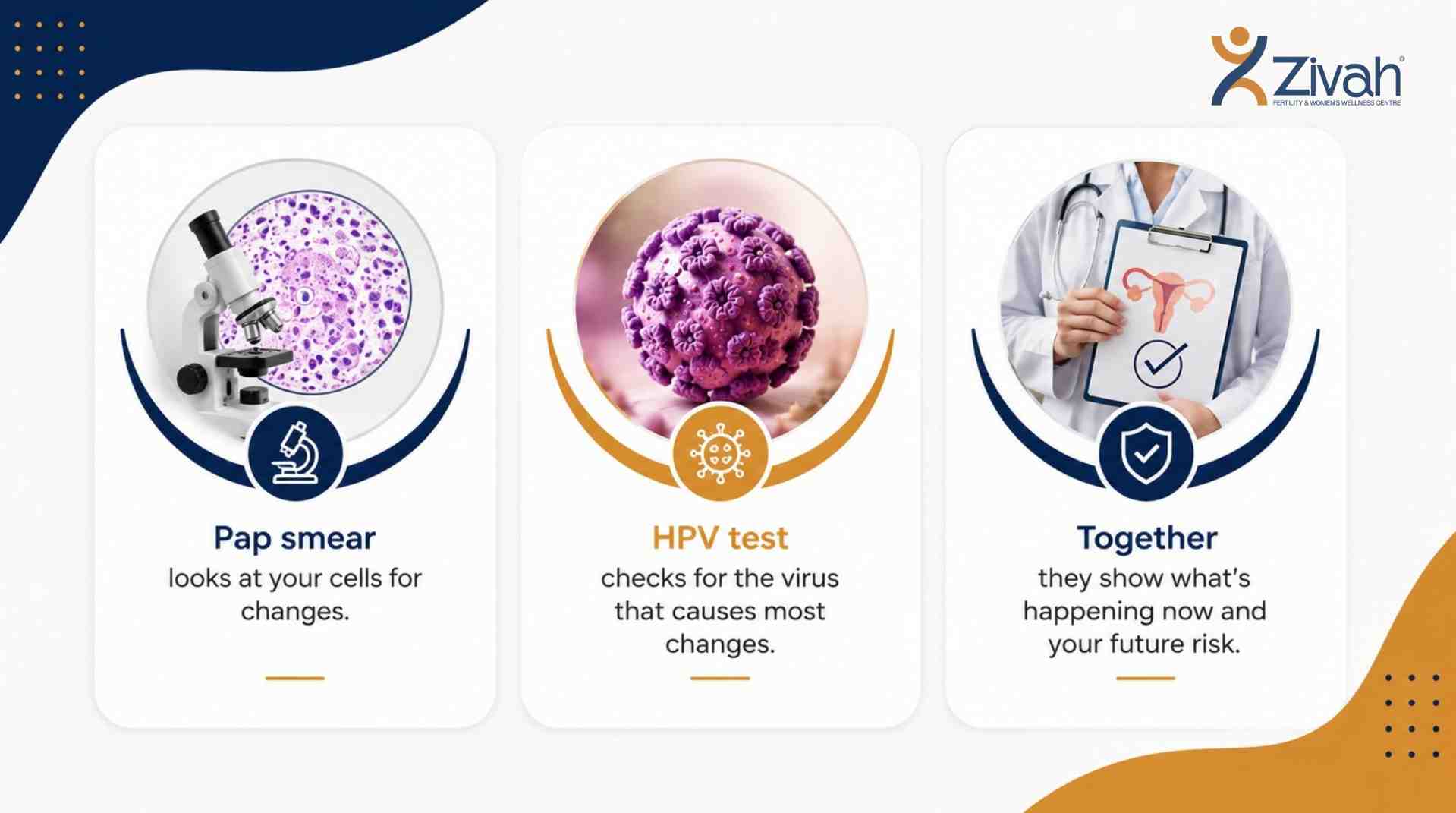
Most guidance on cervical screening and HPV testing now leans towards using both, though pap smear and mammography guidelines for women vary by age and by country. Your specialist will tell you what suits your stage
| Age Band | Screening to Discuss | Why It Matters Now |
|---|---|---|
| 20s | Cervical screening, thyroid, iron | Early baseline, cycle health |
| 30s | Above, plus reproductive health review | Fertility planning years |
| 40s | Above, plus breast screening and lipid profile | Perimenopausal shifts begin |
| 50s and beyond | Above, plus bone density and colorectal check | Post-menopausal risk changes |
Notice that each row keeps everything from the row above it. Nothing gets dropped as you get older. You simply add.
This is what makes women's health screening feel manageable. You are not starting fresh every decade. You are adding one or two new things to a list you already know. And nothing here is fixed. Your own list will depend on your history and what your specialist thinks is right for you, so treat this as a starting point for that conversation.
That screening happens in a clinic room. The next one starts with your own hands.
Breast Screening: What Changes After 40
Most breast changes women find, they find themselves. In the shower, getting dressed, without looking for anything in particular. You do not need a technique or a schedule for this.
You simply need to know how your own breasts usually feel, so that you notice when something is different. That familiarity is the first layer of breast screening, and it costs you nothing.
At what age should women start breast screening?
Being aware of your own body starts in your twenties. Formal imaging usually starts later.
Your specialist will suggest when, depending on your history. If breast or ovarian cancer runs in your family, you may be advised to begin earlier than most. This is one of the main health screenings for women over 40, though the exact starting age is a conversation to have with your doctor rather than a fixed rule.
What breast changes should you always get checked?
Anything that is new for you, and anything that stays. Most of these turn out to be harmless, so please do not carry the worry alone while you wait and see.
Worth mentioning at your next visit:
- A bump or thick spot you haven't felt before.
- A change in one breast's shape or size.
- Skin that has lines, bumps, or red spots.
- If your nipple has turned inward or if you didn't expect it to do so.
- Pain in one place that doesn't go away when you move.
When does an ultrasound suit you better than a mammogram? Usually when your breast tissue is denser, which is common in younger women and in many Indian women at any age. Dense tissue shows up bright on a mammogram, and so do the things doctors are looking for, which makes them harder to separate. A breast ultrasound handles dense tissue more easily. After menopause, when tissue softens, mammography often becomes the clearer choice. Many women end up having both, and your specialist will explain which one suits you now.
Your breasts are soft tissue. The frame that carries you all day needs checking too.
Bone Density: Why Your 40s and 50s Matter
Most of your bones were built long before you thought about them. Through your twenties, your body stored bone like you might put money aside without noticing. By your early thirties, that's the time to save it and stop doing any damage to it. From then on, you are drawing from what you already have.
Why does bone loss speed up for women after menopause?
Oestrogen is the reason. It helps your body hold on to bone, and when it falls after menopause, that hold weakens. Can you lose bone strength without feeling anything at all? Yes, and this is why it gets missed. Thinning bone causes no pain until something breaks. A wrist after a small fall, sometimes a rib. That is often the first anyone knows. So health checkups after menopause include bone health, even when you feel perfectly strong.
Who should consider a bone density scan?
Your specialist will advise you. A few things bring it up sooner: a parent who broke a hip, a slim build, early menopause, or a history of low vitamin D.
The test is a DEXA scan. You lie still on a table for a few minutes while a low-dose scanner passes over your hip and spine. Nothing hurts. Many women have a bone density test after 50, alongside their other checks. Since vitamin D deficiency is common in India, even in sunny cities, your doctor may check that too.
| Area | Simple Daily Support | What It Improves |
|---|---|---|
| Iron and energy | Iron-rich meals with vitamin C | Steadier haemoglobin |
| Thyroid balance | Sleep rhythm, stress care | More stable TSH readings |
| Blood sugar | Movement after meals, more fibre | Gentler HbA1c |
| Bone strength | Weight-bearing walks, sunlight | Better bone density scores |
| Heart health | Less salt, more whole foods | Healthier lipid profile |
None of these is dramatic, and that is the point. Your reports are not a verdict on you. They reflect months of small, ordinary choices, which means they can move. A daily walk changes your bone scores. Ten minutes of morning sun helps your vitamin D. Pick what feels easiest. Those are the years after your hormones fall. Now back to the years before.
Hormone and Fertility Review: Your 20s Through Your 30s
Many women wait until they are trying for a baby before asking about their fertility. By then, information that would have helped years earlier arrives late. Does a fertility check mean you are trying right now? Not at all. It means you would like to know where you stand, whatever you decide later.
What hormone tests help you understand your fertility health?
A few simple ones tell your doctor most of what they need. AMH gives a sense of your ovarian reserve, meaning roughly how many eggs you have left. FSH and LH show how your cycle is driven each month. Thyroid and prolactin matter too, since both can affect ovulation.
Together, these hormone tests build a picture. Read alone, any one can mislead you.
Can you check your fertility before you are ready to conceive?
Yes, and many women do. Knowing early gives you time, which is the one thing fertility care cannot create later. If your numbers are reassuring, you can move forward with one less worry. If something needs attention, you have found it while choices are still open. At Zivah, this is one of our calmest conversations, because nothing has to be decided that day.
Hormones can be measured. The weight you carry alongside them can't be measured.
Emotional Health: At Every Age, Not Just the Hard Ones
Nine checkups here can be measured. This one can't be measured, and it is the one most women skip. You do not have to be struggling to ask support for emotional health care .
How are stress and hormonal health connected in women?
More closely than most of us realise. Long stress raises cortisol, and cortisol interferes with the hormones that run your cycle. Periods get late, or heavier, or stop. How does long-term stress show up in your test results? In small ways across several reports at once. Slightly raised sugar. A thyroid reading that has drifted. Any one looks minor. Together they point back to the same source.
So women's mental health screening belongs in a checkup list, not outside it. Counselling is a health decision, like any test here. That is all ten. Now let us make them workable.
Putting Your Ten Checkups Into a Simple Plan
Ten tests read as a lot. In practice, most women are not doing ten separate things. What if the whole list feels like too much at once? Start with one appointment, not ten. A single well-woman check-up covers much of this list, because most blood tests come from one sample.
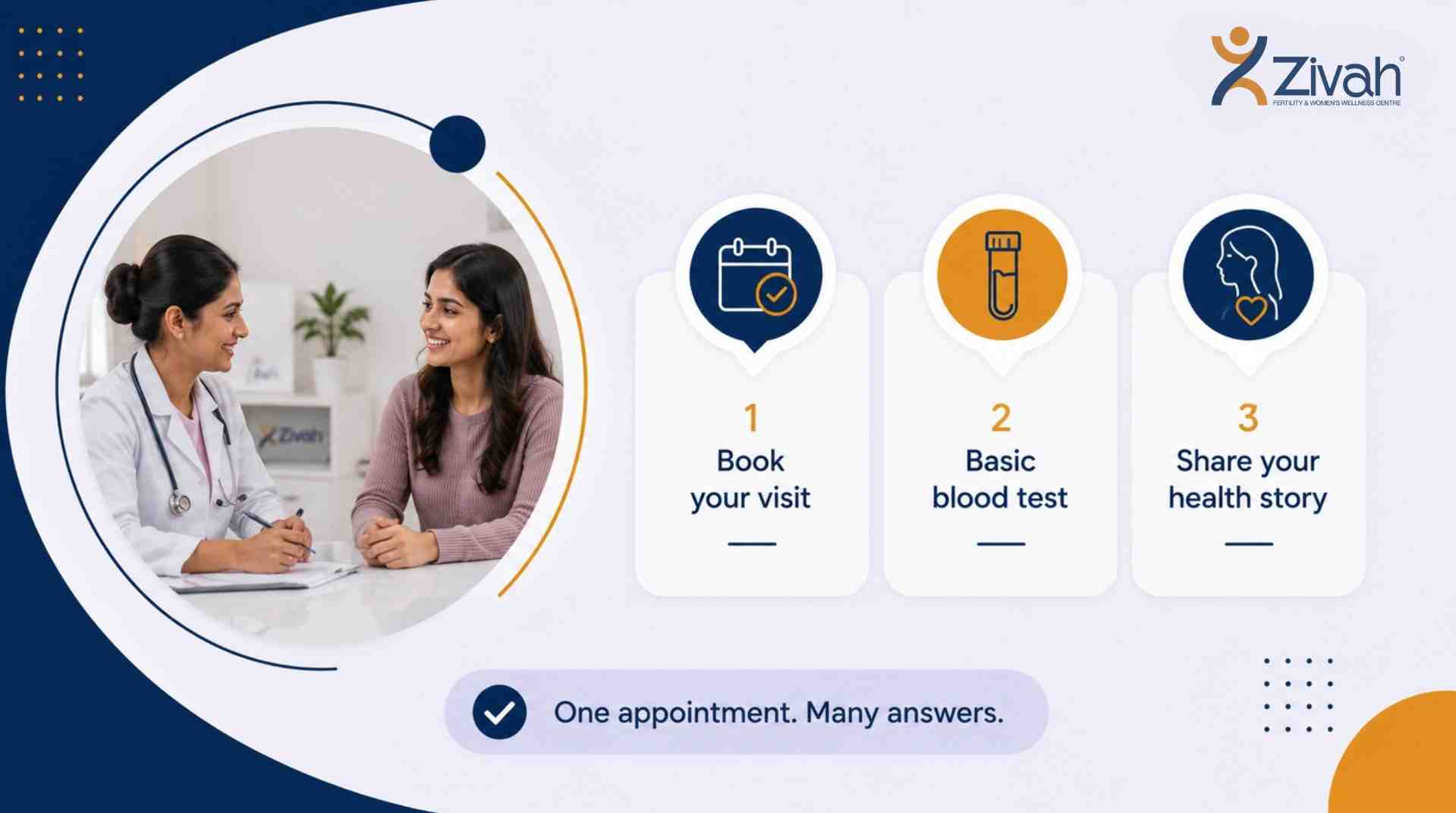
If you have never had a check-up, begin here:
- Book a general review with your gynaecologist.
- Ask for a basic blood panel.
- Mention your cycle, your energy and your family history.
That is the answer to which health tests a woman should get every year. There is no fixed list. There is your list.
| When | What to Book | Who to Speak To |
|---|---|---|
| Starting out | Basic blood panel and general review | Your gynaecologist |
| At every routine visit | Blood pressure, weight, cycle review | Your treating specialist |
| As advised | Screening suited to your age and history | Specialist-guided |
| If something feels off | A prompt review, without waiting | Book directly, do not delay |
The last row matters most. Everything above it can follow a schedule. That one cannot. If something has changed and it is not settling, do not wait for your next routine visit. None of this needs to happen this month. It needs to start.
Talking to a Specialist About Your Checkups
You do not need to arrive with a plan. That is what the appointment is for.
Bring what you have noticed. Your energy, your cycle, anything that has changed. Your specialist will work out the rest and tell you which tests you need now and which can wait.
Every checkup in this article is available at Zivah. Blood work, scans, screenings, hormone and fertility review, and support when you need someone to talk to. It means you are not sent from one place to another with a list in your hand. Most of it happens in one visit, with a doctor who knows your history.
If it has been a while since your last annual health checkup, this is a good place to start. Health checkups for women work best when they're part of your year, not something you put off.
Call us or book a visit, and we will take it from there.
Frequently asked
01 At what age should a woman start regular health checkups?
02 How often should I get a full health checkup?
03 Do I need checkups if I feel completely healthy?
04 Which health tests matter most before planning a pregnancy?
05 Can I get all these tests done in one visit?
06 Do health checkups change after menopause?
07 Should I fast before a women's health checkup?
08 Are these checkups different if I have PCOS or irregular periods?
09 Can I bring my previous reports to my appointment?
10 PCPNDT Act disclaimer