
What Does Your Vaginal Discharge Say About Your Health? Types, Colors and Causes
aginal discharge colour, texture and timing all mean something. Learn what is normal, what is not, and when to see a doctor. Clear guidance from Zivah Fertility

You may have noticed a change in your vaginal discharge and felt a small worry settle in. Many women carry that question for weeks without asking anyone.
Please know this. Your body makes discharge every day for a reason. It keeps you clean, carries away what it no longer needs, and maintains your body's natural balance. Most of the time, what you see is completely normal.
Sometimes, it is your body asking you to pay attention. Here you will learn the types, the colours, the causes, and when it is worth speaking to a doctor. Let us begin with what your discharge is telling you.
What Does Vaginal Discharge Say About Your Health?
Your vaginal discharge is a fluid your body makes every day. It comes from your cervix (the neck of your womb) and the walls of your vagina, and it has a quiet job to do. It carries away old cells, keeps the tissue comfortable, and keeps good bacteria in balance so infection has a harder time taking hold.
When it stays steady, your body is telling you things are working well. When it shifts, it is worth listening.
Wondering how much vaginal discharge is normal for you? No single amount fits every woman. Specialists look at your own pattern rather than a fixed number, because what is normal for you may be very different from what is normal for your closest friend.
What Is Healthy Vaginal Discharge Supposed to Look Like?
Healthy vaginal discharge is usually very clear or milky white. It may feel thin and slippery on some days, thicker and creamier on others. It shouldn't itch, burn, or smell strong.
The amount changes across your month too. You may see more in the middle of your cycle and less just before your period. This is why your own baseline matters more than any chart.
Once you know your usual, you will notice a real change far sooner than any guide could tell you. And the first change most women notice is the colour.
What Does Each Vaginal Discharge Colour Mean?
Colour is almost always the first thing you notice. You see something on your underwear or on the tissue, and before you have thought it through, a question has already formed.
It helps to know that vaginal discharge colour is only one signal. On its own, a shade tells you very little. What sits beside it matters as much: the texture, the smell, any itching, and where you are in your month.
So read colour as a starting point, not a verdict. A shade that worries you one week may be completely ordinary the next, simply because your hormones have moved on.
What Colour Vaginal Discharge Is Normal?
For most women, clear and white discharge is normal. Clear tends to appear around the middle of your cycle. White, in a creamy or milky form, shows up through much of the rest of the month.
The table below sets out vaginal discharge colour and meaning in one place, so you have something simple to return to whenever you need it.
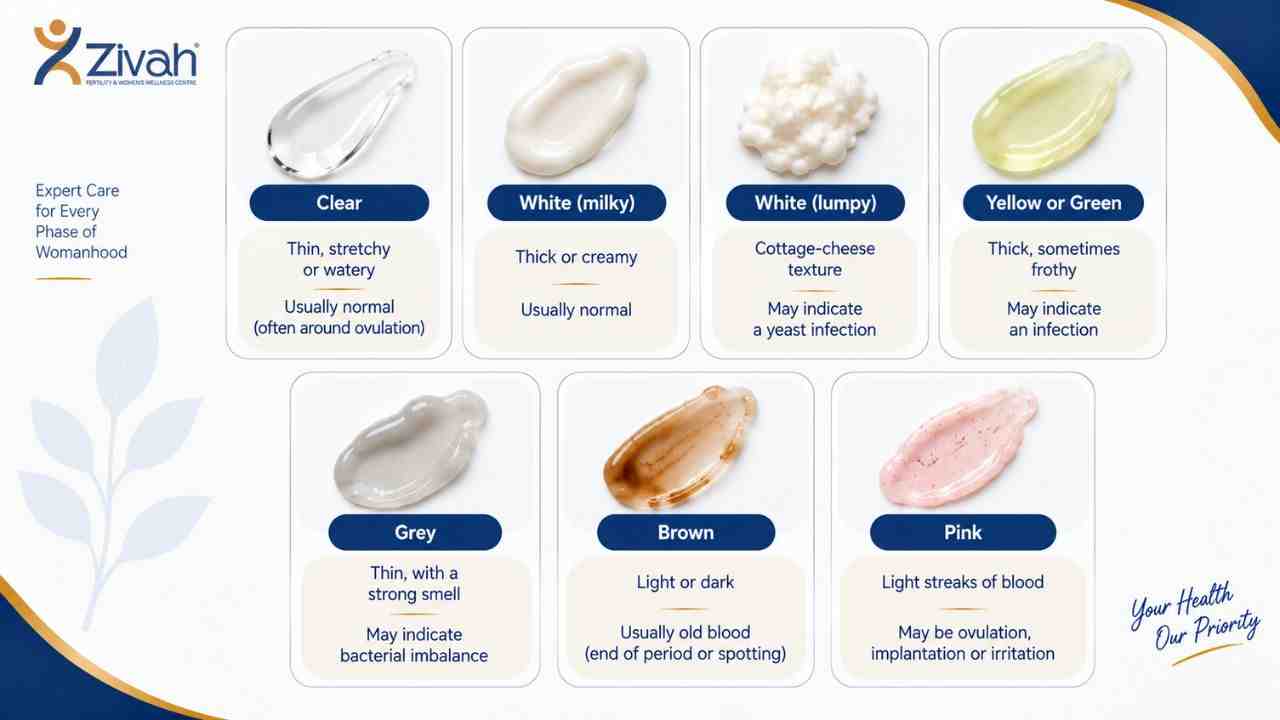
| Colour | What It Usually Looks Like | What It May Mean | How Zivah Helps You |
|---|---|---|---|
| Clear | Thin, stretchy or watery | Normal, often around ovulation | Track your cycle pattern |
| White (milky) | Thick or creamy | Usually normal | Check for infection |
| White (lumpy) | Cottage-cheese texture | Possible yeast overgrowth | Test and treat the cause |
| Yellow or green | Thick, sometimes frothy | Possible infection | Screen and start treatment |
| Grey | Thin, with a strong smell | Bacterial imbalance | Find the cause and treat it |
| Brown | Old blood, light or dark | Usually end of a period or spotting | Scan if it keeps returning |
| Pink | Light streaks of blood | Ovulation, implantation or irritation | Check your hormone picture |
Each of these colours has a story behind it, and the sections ahead walk through them one by one. Let us begin with the shade you are most likely to see, and the one that raises the most questions.
What Causes White Vaginal Discharge?
White discharge is the type most women notice, and in most cases, nothing is wrong. It is simply cervical mucus (fluid made by the neck of your womb) doing its daily work.
In this case, hormones are the main cause of vaginal discharge. Every month, your estrogen level goes up and down, and your body responds by making more or less fluid. When you ovulate and the days that follow, you may see a creamy white discharge because progesterone makes it thicker. You might see more again when you are first pregnant, when hormones are high and stay high.
So white vaginal discharge is usually a sign your cycle is moving as it should.
When Is White Vaginal Discharge a Concern?
The difference is in the texture and what comes with it. It's normal to feel creamy and smooth. It's not thick and hard, like cottage cheese. Most of the time, that change is caused by too much yeast and not a change in hormones.
Watch for burning, itching, or pain along with it. Discharge by itself doesn't usually disturb or irritate you. Your body is trying to tell you that it needs help when it hurts. If that sounds like you, it's better to get checked out than to wait it out.
Much of this comes down to timing, so let us look at how your discharge moves across your cycle.
How Does Vaginal Discharge Change During Your Menstrual Cycle?
Your discharge isn't the same every day, and it never was meant to be. As the month goes on, your hormones cause it to rise and fall in a rhythm. When you get used to that rhythm, the changes in your vaginal discharge during your menstrual cycle ( periods) will no longer seem random.
Is Vaginal Discharge Before a Period Normal?
Yes, and it is one of the most common things women ask about. A lot of progesterone is in your body in the days before your period. Sometimes, your discharge gets creamier and thicker, and you may not notice as much of it as you did in the middle of the month. Some women don't even notice it.
If you have vaginal discharge before your period, this is just your cycle ending. There is no reason to be worried unless it itches, smells bad, or makes you feel bad.
What Does Vaginal Discharge After a Period Look Like?
Straight after bleeding stops, you may see a brown tinge for a day or two. That is old blood clearing out, not fresh bleeding. Then come the drier days. Many women notice very little discharge at all in this stretch, and that is completely normal. As oestrogen begins to rise again, vaginal discharge after period returns slowly, turning creamy and white before it builds toward your fertile days.
Here is how the whole month tends to look, stage by stage, so that you can place yourself on it.
| Cycle Stage | Usual Texture | Usual Colour | What It Tells You |
|---|---|---|---|
| Just after period | Sticky or dry | Brown fading to clear | Old blood clearing out |
| Before ovulation | Creamy | White or cloudy | Hormones building |
| Around ovulation | Stretchy, slippery | Clear | Fertile window |
| After ovulation | Thick | White | Progesterone rising |
| Before period | Creamy, less in amount | White | Cycle winding down |
Read across that table and one row stands out from the rest. The middle of your cycle brings the biggest change of all, and it is the one worth understanding closely.
Vaginal Discharge and Ovulation: What Changes and Why
More changes happen in the middle of your cycle than at any other time. The amount goes up and the texture changes, typically enough for you to notice without trying to find it. When you look at ovulation and vaginal discharge together, you can tell what time of the month it is.
Why Does Vaginal Discharge Change During Ovulation?
Estrogen levels rise as pregnancy gets closer. Your body releases a clear, stretchy fluid that many women describe as raw egg white. If you hold it between your two fingers, it stretches instead of breaking.
There is a purpose behind it. That texture opens a path for sperm to travel through and keeps them alive far longer than they would survive otherwise.
Then comes the shift. Vaginal discharge after ovulation turns thicker and whiter as progesterone rises, and there is less of it. Many women feel dry within a day or two. That is your fertile window closing.
These are the signs worth watching, and what each one means.
| Sign You Notice | What It Feels Like | What It May Signal | How Zivah Helps You |
|---|---|---|---|
| Stretchy, clear fluid | Like raw egg white | Peak fertile days | Time your cycle with you |
| Slippery, wet feeling | Comfortable, slippery | Fertile window open | Track ovulation with scans |
| Sudden dryness after | Thicker, less fluid | Ovulation has passed | Confirm your cycle pattern |
| Light pink streak | Very light spotting | Ovulation bleeding | Check your hormone balance |
Everything so far has been your body working as it should. But sometimes a change fits none of these patterns, and knowing the difference is what matters most.
What Are the Signs of Abnormal Vaginal Discharge?
No universal chart tells you what is wrong. What matters far more is what has changed for you. If your discharge has looked one way for years and now looks different, that shift is worth noticing, even if it seems ordinary to someone else.
Not sure whether your discharge counts as abnormal? First look at the change from what you're used to, then at what's next to it. A discharge by itself doesn't always tell the whole story. Discharge with pain almost always does.
These are the vaginal discharge symptoms worth watching :
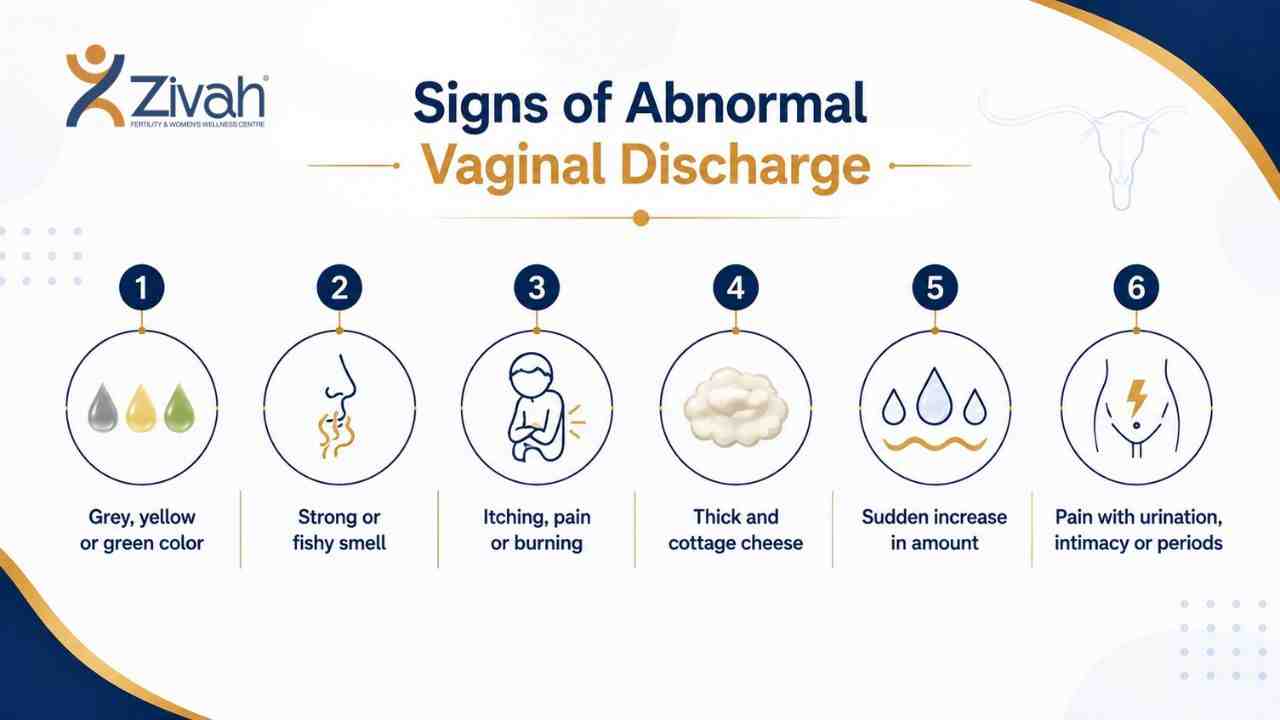
- A shade of grey, yellow, or green.
- A strong or fishy smell.Itching, pain, or burning.
- Feels thick and hard, like cottage cheese.
- A quick rise in the amount that doesn't go away.
- Pain when going to the bathroom or during intimacy.
- Bleeding during periods along with the discharge.
Seeing one of these does not mean something serious is happening. Most causes of abnormal vaginal discharge are common and treatable. What they do mean is that guessing is no longer useful.
The sections ahead explain what each colour may indicate. Let us start with the shades that carry a trace of blood, because those worry women most.
What Do Brown and Pink Vaginal Discharge Mean?
Of all the colours, these are the ones that stop women in their tracks. Any hint of blood feels serious, and the mind moves fast. So let us slow it down. Vaginal discharge with blood in it is common, and in most cases the reason is ordinary.
What Does Brown Vaginal Discharge Mean?
Brown is almost always old blood. Blood darkens as it takes longer to leave the body, so brown vaginal discharge usually means something that happened days ago is only clearing now. You'll most often see it at the tail end of a period. It can also appear as light spotting mid-cycle, or in very early pregnancy. It needs checking when it keeps returning cycle after cycle, lasts well beyond your period, or comes with pain.
What Does Pink Vaginal Discharge Mean?
Pink is fresh blood, but only a trace of it, mixed into your usual discharge. Spots of ovulation, a small drop in hormones in the middle of your cycle, are the most common cause. Pink vaginal discharge can also happen after implantation in early pregnancy or just because the cervix is sore from being intimate.
Hormonal shifts explain most of it. What matters is whether it settles on its own or keeps coming back.
Here is a simple way to tell the difference between watching and acting.
| What You See | Common Reason | Usually Settles? | When to Get It Checked |
|---|---|---|---|
| Brown at end of period | Old blood clearing | Yes, within days | If it lasts beyond a week |
| Brown between periods | Spotting or hormonal shift | Often | If it repeats each cycle |
| Pink around mid-cycle | Ovulation spotting | Yes | If it comes with pain |
| Pink after intimacy | Irritation of the cervix | Often | If it happens repeatedly |
| Heavy bleeding with discharge | Needs assessment | No | Book a check without delay |
Blood is not the only signal worth reading. Some colours point to something your body cannot clear on its own, and those deserve a closer look.
When Is Vaginal Discharge a Sign of Infection?
Infections of this kind are common. They happen to women who are careful, clean, and doing everything right, because the balance inside your body is delicate and easy to tip. There is nothing here to feel ashamed of. Almost all of it treats quickly once someone looks properly.
What Does Grey Vaginal Discharge Indicate?
Grey vaginal discharge usually points to a bacterial imbalance (bacterial vaginosis). The good bacteria that normally keep things steady have been outnumbered.
It tends to look thin and watery rather than creamy, and it often has a strong, fishy smell that becomes more noticeable after intimacy. Vaginal discharge with odour like this rarely clears on its own and responds well to simple treatment.
What Causes Yellow or Green Vaginal Discharge?
Pale yellow with nothing else alongside it can be harmless. Green almost never is. Look at the texture. Thick or frothy discharge in these shades usually points to an infection, often with burning, soreness, or discomfort when passing urine. This one needs testing, not waiting.
What Does Thick or Cottage-Cheese-Like Vaginal Discharge Mean?
This is the classic sign of a yeast overgrowth (candida). The texture is unmistakable: thick and lumpy rather than smooth. Vaginal discharge with itching is the usual companion, along with soreness. It is one of the most common conditions women face, and one of the quickest to settle. None of this needs to be worked out from a screen. A short visit can tell you exactly what is happening.
When Should You See a Gynaecologist for Abnormal Vaginal Discharge?
Most women wait longer than they need to. The discomfort becomes familiar, the days pass, and the visit keeps moving down the list.
Book when the change has lasted more than a few days, when there is itching, burning, or a strong smell, when bleeding appears between periods, or when something feels different from your own normal and will not settle. You do not need to be certain something is wrong before you come. That is what the visit is for.
What Happens During a Gynaecology Visit for Discharge?
Less than you are imagining. It starts with a conversation. Your doctor at Zivah asks what you have noticed, when it began, and where you are in your cycle. That alone often narrows things considerably. An examination follows, brief and straightforward. If a swab is needed, it takes seconds.
Should your symptoms point toward something hormonal or toward bleeding, a scan may be added. Most women leave with an answer the same day, or within a short wait for lab results. Here is what that looks like depending on what brought you in.

| Your Concern | What We Look At | What We May Do | How Zivah Helps You |
|---|---|---|---|
| Change in colour | Your cycle and history | Simple swab test | Find the exact cause |
| Strong smell | Balance of bacteria | Lab testing | Treat it fully, not partly |
| Itching or burning | Skin and tissue health | Examination | Settle the discomfort |
| Bleeding with discharge | Hormones and womb lining | Scan if needed | Check the whole picture |
| Trying to conceive | Cycle and fertile window | Ovulation tracking | Plan your next steps with you |
Between visits, the everyday care you give your body does more than you might think.
How Can You Keep Vaginal Discharge Healthy Every Day?
The best care here is the simplest. Pick cotton underwear that lets air pass through, and don't sit in wet or sweaty clothes. Instead, change out of them. Use plain water to wash the outside. Your body cleans itself, and douching or scented washes throw off the balance that they are supposed to keep.
That is genuinely most of it. Try to remember that healthy vaginal discharge is not a problem to manage. It is your body doing its job well, quietly and daily, without needing your help. What matters is knowing your own pattern. Once you do, a real change will stand out to you long before it would to anyone else. And when something does feel different, you do not have to sit with the question.
The team at Zivah Fertility is here for exactly that, whether it turns out to be nothing at all or something worth treating. Your body has been telling you what it needs. Listening to it is the whole of it.
Frequently asked
01 What does vaginal discharge say about your health?
02 What colour vaginal discharge is normal?
03 How much vaginal discharge is normal?
04 What causes white vaginal discharge?
05 Is vaginal discharge before a period normal?
06 What does brown vaginal discharge mean?
07 Why does vaginal discharge change during ovulation?
08 What does grey vaginal discharge indicate?
09 Is vaginal discharge with blood normal?
10 When should you see a gynaecologist for abnormal vaginal discharge?