

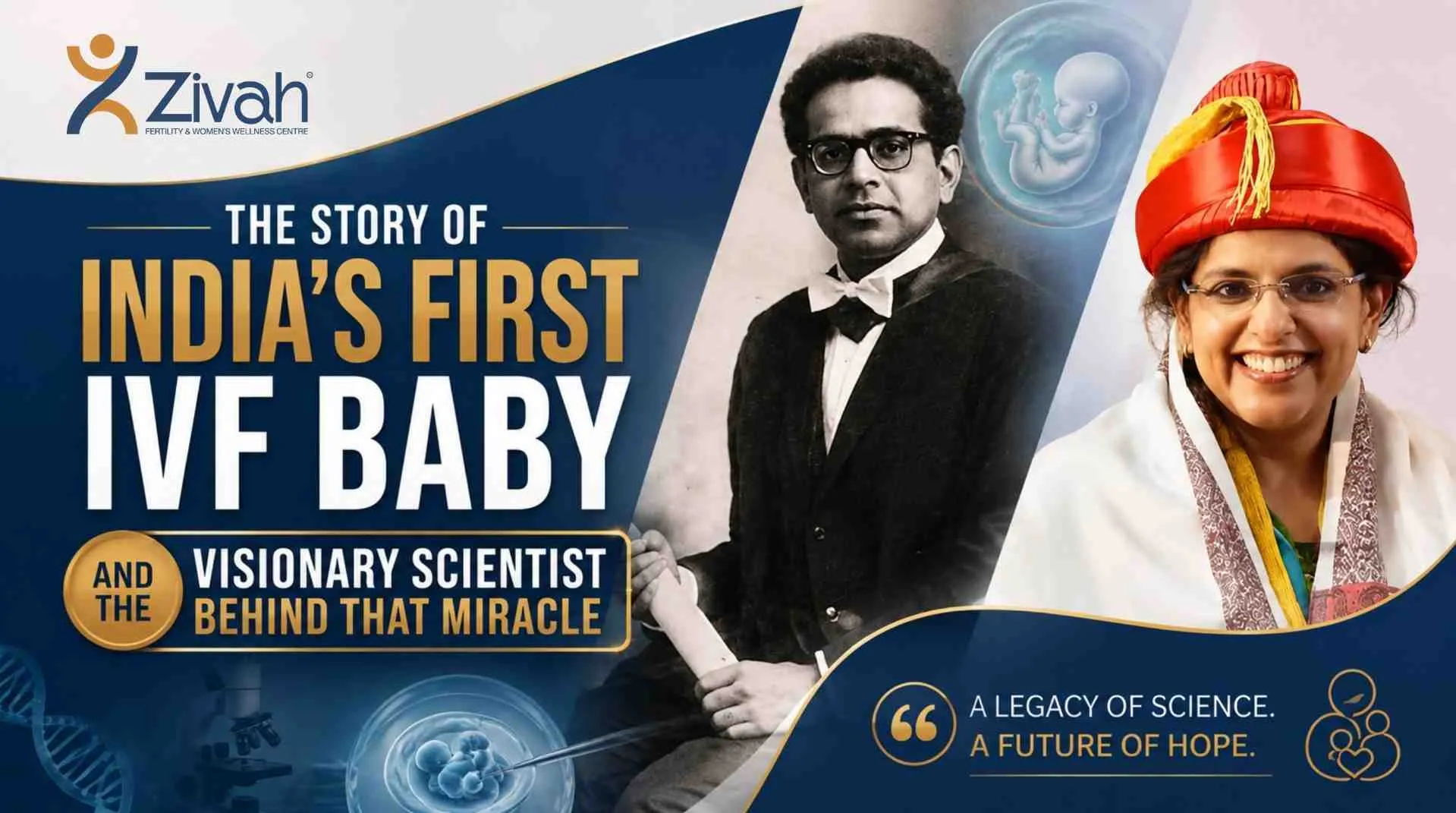
In India today, IVF is spoken about openly. Couples look it up, they search on Google, ask questions, and walk into clinics without fear. What most people do not know is the name of the first child born with IVF.
Her name is Durga. She was born on 3 October 1978 in Kolkata, and she is India's first IVF baby. The doctor behind her birth was Dr Subhas Mukhopadhyay, who worked with almost nothing and achieved what the world was still learning to do. His work was not celebrated. It was questioned, dismissed, and set aside.
This is the story of the first test tube baby in India, the science that brought her here, and the price her doctor paid for it. It begins with a couple in Kolkata who agreed to something no one had tried here before.
Who Is Durga, India's First IVF Baby?
Durga is the name Dr Subhas Mukhopadhyay gave to the child born from his work in Kolkata in 1978. Her parents had waited years for a child, and when they came to him, they agreed to something no Indian couple had tried before. They asked for one thing in return: their daughter's identity would stay private.
So the story travelled without her in it. People heard a baby had been born through a new method in Kolkata, but never knew her name or saw her face. She grew up like any other girl in her city, and was told the truth about her own birth only as an adult.
Many readers want to know if her identity was ever proven beyond a reasonable doubt. The record shows that it was, when she spoke out in public decades later. Only then did the first test tube baby in India become a person rather than a claim.
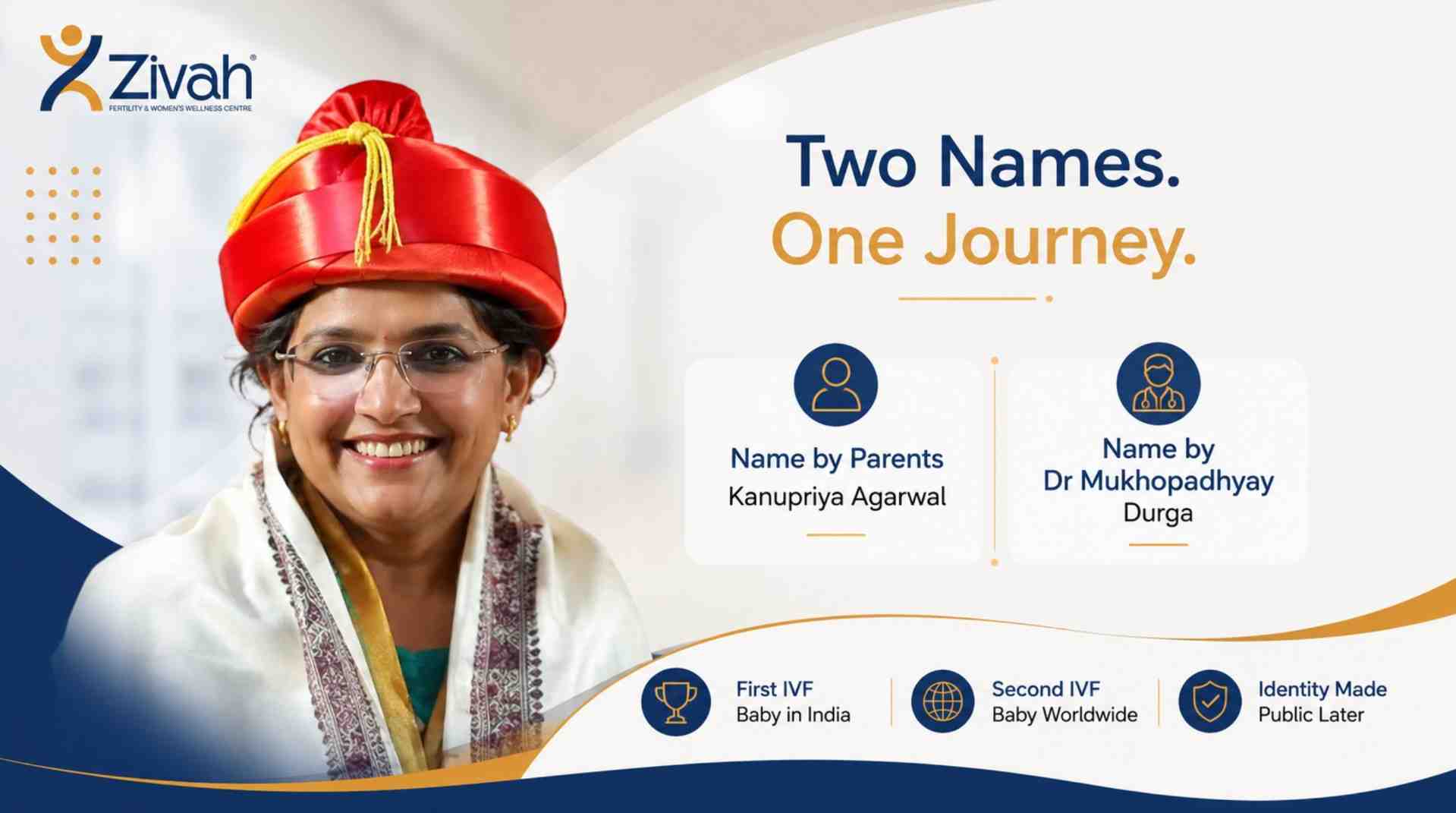
Why Does Durga Have Two Names?
Her parents named her Kanupriya Agarwal. Dr Mukhopadhyay called her Durga because she arrived in the festival month. Both names are correct, which is why searches return one or the other.
| Detail |
Record |
|---|---|
| Name Given by Parents |
Kanupriya Agarwal |
| Name Given by Dr Mukhopadhyay |
Durga |
| Parents |
A Kolkata couple, identity kept private |
| Doctor |
Dr Subhas Mukhopadhyay |
| Position in India |
First IVF baby |
| Position Worldwide |
Second IVF baby |
| Identity Made Public |
Decades later, by her own choice |
She was not only India's first. She was the second child anywhere born this way, and the gap between her and the first was smaller than most expect.
How Soon After the World's First Test Tube Baby Was Durga Born?
Louise Brown was born in England on 25 July 1978. Durga was born in Kolkata on 3 October 1978. Count the days between those two dates, and you get seventy.
That number is worth sitting with. The two teams had no contact with each other. They shared no method, no notes, and no equipment. What they had were completely different resources.
Patrick Steptoe and Robert Edwards had worked toward that birth for more than a decade with institutional backing and a proper laboratory behind them. Dr Subhas Mukhopadhyay worked from a rented flat with borrowed instruments and a refrigerator that was used for daily purposes but not for medical use. Seventy days separated their results.
| Detail | Louise Brown |
Durga (Kanupriya Agarwal) |
|---|---|---|
| Date of Birth |
25 July 1978 |
3 October 1978 |
| Gap |
---- | 70 days later |
| Country |
England |
India |
| Doctors |
Patrick Steptoe, Robert Edwards |
Dr Subhas Mukhopadhyay |
| Embryo Transferred |
Fresh |
Frozen for 53 days |
| Reception at the Time |
Global celebration |
Official rejection |
| Later Recognition |
Nobel Prize, 2010 |
Posthumous recognition from 1997 |
The last two rows are where the two stories separate. One birth was celebrated across the world and eventually recognised with a Nobel Prize. The other made India's first IVF baby the world's second test tube baby, and brought her doctor nothing but questions. The science does not explain that difference. It is explained by what happened to the man behind it.
Who Was the Scientist Behind Durga's Birth?
Dr Subhas Mukhopadhyay was born in 1931 in Hazaribagh. He earned two doctorates, one in reproductive physiology from Calcutta University and a second in reproductive endocrinology from Edinburgh, then joined NRS Medical College in Kolkata.
That second degree matters. Only then did the first test-tube baby in India become a person rather than a claim. He knew more about the biological side of getting pregnant than almost any other doctor in India at the time.
People often ask how a doctor with no funding managed what well-resourced teams abroad were still struggling with, and the answer is that he worked around his teaching hours, in a rented flat, with instruments he arranged himself. There was no grant and no laboratory. The man who delivered India's first IVF baby had no official backing of any kind.
Who Else Worked on India's First IVF Birth?
He did not work alone. The work was divided between three men, each handling the part he knew best:
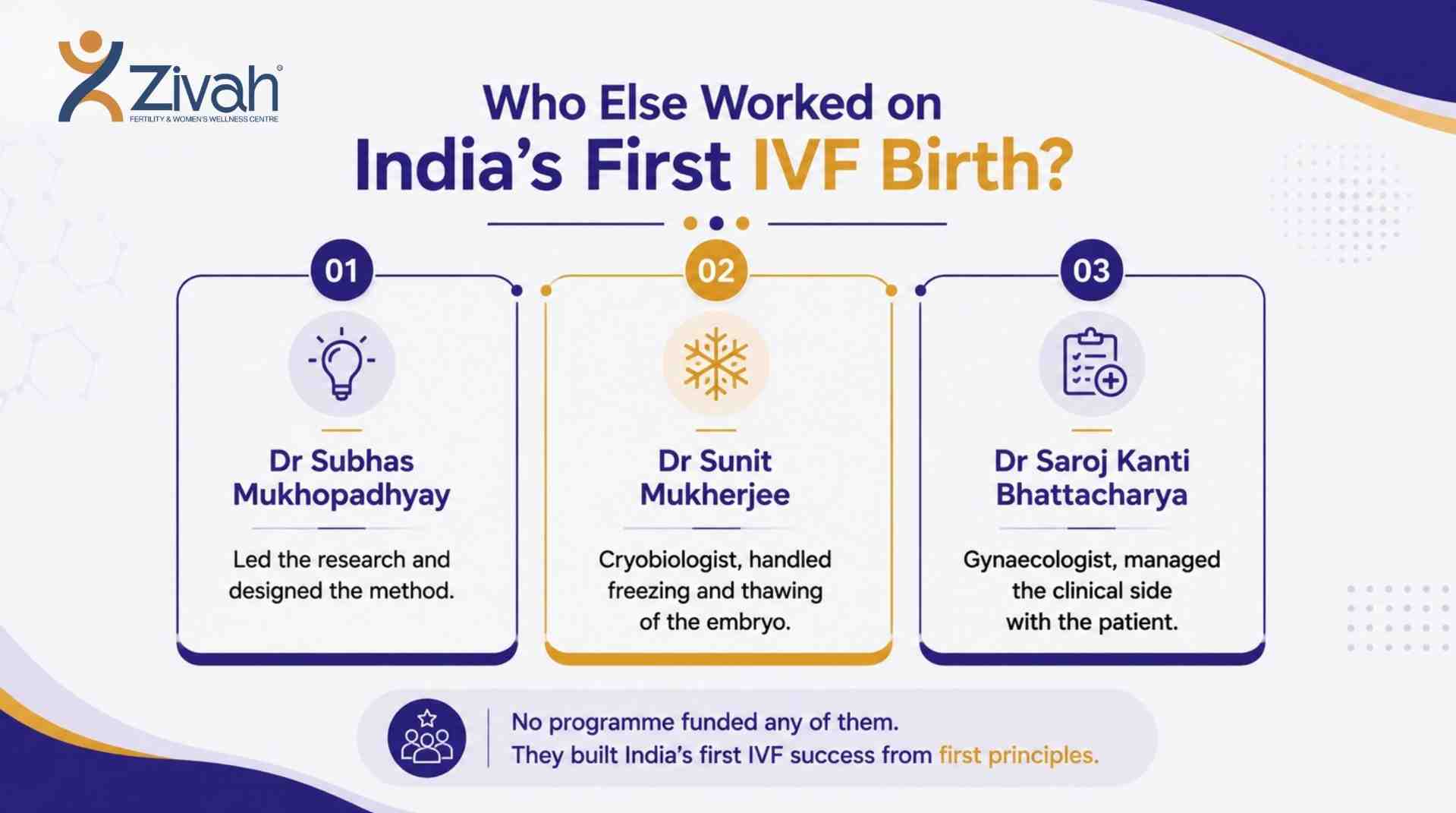
- Dr Subhas Mukhopadhyay: led the research and designed the method.
- Dr Sunit Mukherjee: a cryobiologist, handled the freezing and thawing of the embryo.
- Dr Saroj Kanti Bhattacharya: a gynaecologist, managed the clinical side with the patient.
No programme funded any of them. Almost everything they achieved was worked out from first principles, because there was nobody in the country to ask.
What Did Dr Mukhopadhyay Do to Make Durga's Birth Possible?
The steps he followed are ones you would recognise in any fertility clinic today. He gave the mother hormone injections so her ovaries produced more than one egg (ovarian stimulation), collected those eggs, fertilised them outside the body, and watched the embryo begin to grow.
What happened next was different. Instead of transferring the embryo straight away, he froze it for fifty-three days before placing it back. Nobody else in the world was doing that in 1978.
Fertility specialists who later reviewed his notes pointed out that several of his methods were ahead of what any funded programme in the world was using at the time.
Which of His Methods Were Ahead of Their Time?
Three choices stand out against what was standard practice in 1978:
- Ovarian stimulation using human menopausal gonadotropin, before stimulated cycles became routine.
- Egg retrieval through a transvaginal route, years before it replaced laparoscopy as standard.
- Embryo freezing and thawing before transfer, six years ahead of the world's first recognised frozen-embryo birth.
None of this was borrowed. He had no access to the teams working abroad, so each of these was worked out on his own.
| Technique |
Mukhopadhyay, 1978 |
When the World Adopted It |
|---|---|---|
| Ovarian Stimulation |
hMG protocol |
Widespread through the 1980s |
| Egg Retrieval |
Transvaginal, via colpotomy |
Standard from the late 1980s |
| Embryo Freezing |
Frozen for 53 days before transfer |
First recognised frozen-embryo birth, 1984 |
| Laboratory |
Improvised, domestic refrigerator |
Purpose-built embryology units |
Read that last row again. The freezing that made Durga's birth possible was done in a household refrigerator. Work of this standard should have brought him recognition. It brought him the opposite.
Why Was the Man Behind India's First IVF Baby Rejected?
In 2010, Robert Edwards received the Nobel Prize for the work that produced Louise Brown. Dr Subhas Mukhopadhyay had been dead for twenty-nine years by then.
The difference came down to how each claim was assessed. Weeks after Durga was born, an enquiry committee was set up in West Bengal to examine his work. In 1978, there was no established process anywhere in India for reviewing a claim like this, and no group of specialists to draw on.
Who Sat on the Committee That Judged His Work?
The committee was made up of accomplished scientists and doctors, but their fields explain the outcome:
- A physiologist.
- A gynaecologist.
- A physicist.
- A neurologist.
- No embryologist and no reproductive endocrinologist
Reproductive medicine was a new field in 1978, and the committee assessed his claim with the expertise available to it.
His work was not accepted. He was not permitted to present his findings in Japan, which closed off the route that might have put his results on record abroad. He was later moved into ophthalmology, and when he died on 19 June 1981, the review he had asked for had still not taken place.
What changed the record was not a decision taken in his lifetime, but a scientist who went back to his notes long after he was gone.
When Did India Finally Accept Durga as Its First IVF Baby?
The correction came from an unexpected direction. Dr T C Anand Kumar had himself led a team that produced an IVF birth in India, and in the 1990s he went back to Mukhopadhyay's surviving notes to examine them properly.
That second degree matters. Only then did the first test-tube baby in India become a person rather than a claim. He said it in public and kept saying it. A man who had his own claim to history chose to give credit to someone who was no longer alive to receive it.
The record moved after that. ICMR formally acknowledged the contribution, and Mukhopadhyay's name entered the Dictionary of Medical Biography as the doctor behind India's first IVF baby. Much of what is known about his work today comes from these three sources: his surviving records, Anand Kumar's review, and the ICMR acknowledgement.
| Year |
Event |
|---|---|
| 3 October 1978 |
Durga born in Kolkata |
| 1978 |
State committee rejects the work |
| 1981 |
Dr Mukhopadhyay dies |
| 1997 |
Dr T. C. Anand Kumar reviews records and credits him |
| 2005 |
ICMR formally acknowledges the contribution |
| 2000s |
Durga confirms her identity publicly |
Sixteen years between his death and the review. Twenty-four between Durga's birth and the formal acknowledgement. The history of IVF in India was written correctly in the end, but not while the man who made it happen was alive to read it. The last row of that table belongs to her, and it is the only part of this story she had any say in.
What Has Durga Said About Being India's First IVF Baby?
She has spoken publicly only a few times, and always on her own terms. What comes through in those appearances is not pride in being first. It is respect for the doctor who was never thanked. She has used the attention she receives to point it somewhere else, toward the man whose name was missing from the record for most of her life.
She has built an ordinary professional life away from the story, and she has never traded on it. That restraint is worth noting in a story where almost everyone else eventually got their say.
Did Durga Know She Was India's First IVF Baby?
Anyone tracing this story usually reaches the same question about whether she knew from childhood, and by her own account she did not. Her parents kept it from her, exactly as they had planned in 1978. She grew up without knowing, and was told only as an adult. By then Dr Mukhopadhyay had been dead for years, and she had never met the man who made her birth possible.
What Has Changed in IVF Since Durga Was Born?
The basic idea has not changed. Eggs are collected, fertilised outside the body, and an embryo is placed back. What has changed is everything around those steps.
In 1978, the process was watched by hand and judged by eye. Today every stage is monitored and recorded, embryos are assessed against agreed standards, and freezing has moved from a domestic refrigerator to vitrification. There is also law now. The ART Regulation Act 2021 sets out how clinics must operate and what patients are entitled to know.
What Does an IVF Cycle Involve Today?
If you are considering IVF treatment in India today, this is broadly what a cycle looks like:
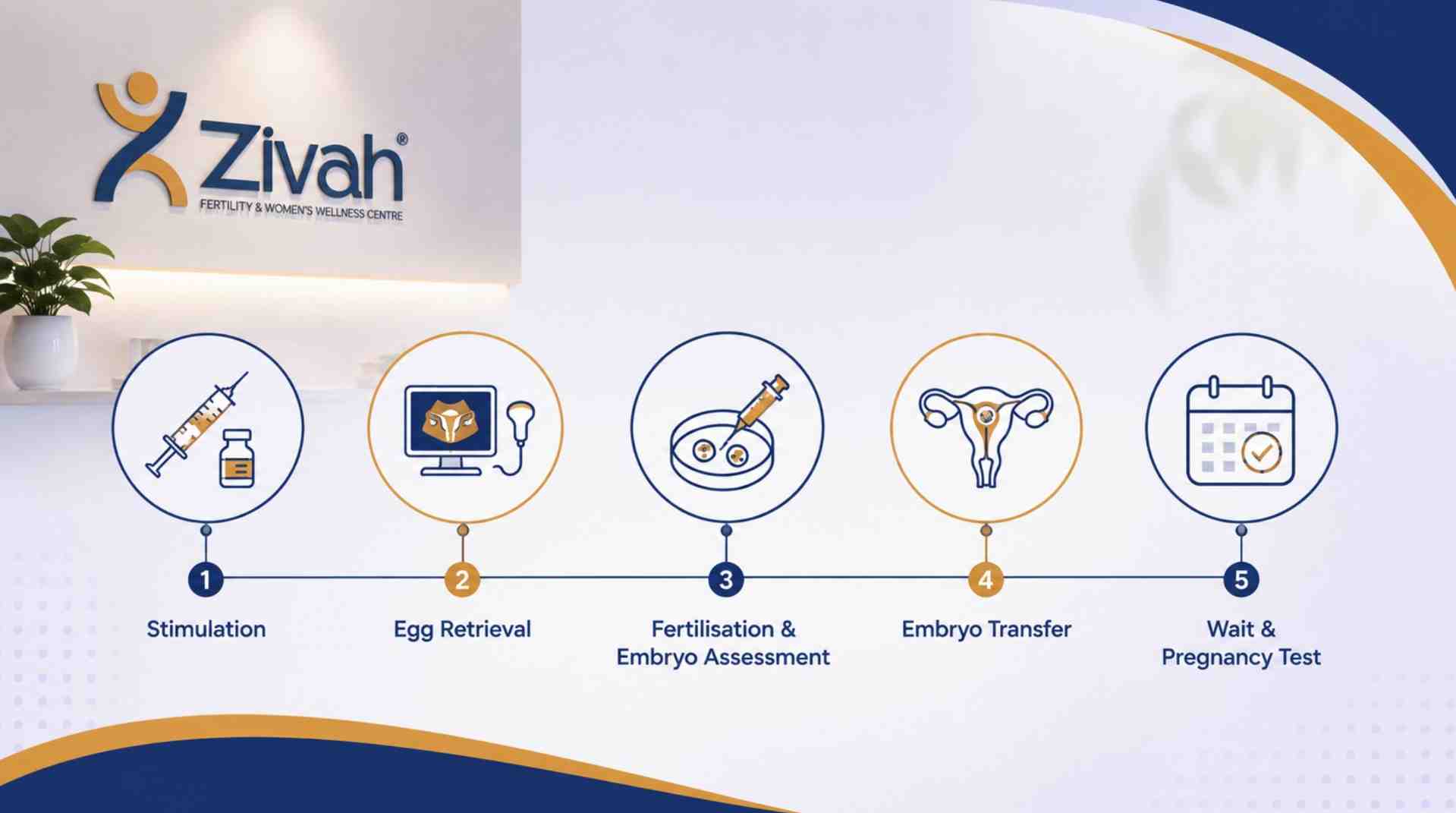
- Ovarian stimulation with monitored hormone support.
- Ultrasound-guided egg retrieval as a day-care procedure.
- Fertilisation and graded embryo assessment in the laboratory.
- Embryo transfer, either fresh or after vitrification.
- A waiting period before the pregnancy test.
How each stage is handled depends on your age, your history and the reason behind the difficulty, which is why the plan is decided with your specialist.
| Element |
1978 |
Today |
|---|---|---|
| Monitoring |
Minimal, manual |
Ultrasound and hormone tracking throughout the cycle |
| Egg Retrieval |
Surgical colpotomy |
Ultrasound-guided day-care procedure |
| Embryo Selection |
Visual only |
Graded assessment and time-lapse imaging |
| Freezing |
Slow freeze, improvised |
Vitrification |
| Regulation |
None |
ART Regulation Act, 2021 |
| Access |
One flat in Kolkata |
Clinics nationwide, including Zivah |
The last row is the one that matters most to anyone reading this. What took place once, in secret, in a rented flat, is now available in clinics across the country.
Why Durga's Story Still Matters
IVF did not arrive in India from somewhere else. It was worked out here, in 1978, by a doctor with no funding, no laboratory and no one to ask.
That is worth knowing if you are thinking about IVF treatment in India today. The care available now, the monitoring, the safety, the law behind it, all of it rests on work that began in a rented flat in Kolkata and was set aside for twenty-four years.
Durga is in her forties now. India's first IVF baby grew up without knowing what her birth meant, and the man who made it possible died without hearing anyone say it. If you are at the start of that road yourself, a conversation with a Zivah specialist is a reasonable place to begin.